
Tuang Sampeu against Gastro-colonialism: Reshaping Food Resilience through Tradition among the Cireundeu Indigenous People of Java Island, Indonesia
 10.21463/jmic.2026.15.2.07
Abstract
Amid the systemic pressures of global capitalism and the historical legacy of gastro-colonialism, the Cireundeu indigenous people of West Java, Indonesia, have demonstrated a profound form of food sovereignty spanning over a century. This study employs a decolonial framework and Foucaultian genealogy to analyze the Cireundeu community’s resistance to the homogenization of rice-based diets imposed during the Dutch colonial era. By prioritizing cassava (tuang sampeu) as a primary staple, the community has effectively enacted epistemic de-linking, transforming a biological necessity into an embodied praxis of cultural and economic independence. The findings reveal that while modern pressures, such as formal education and market commodification, threaten to dilute indigenous knowledge, the Cireundeu people maintain their heritage through internal organizational structures and a philosophy of adaptability (Ngindung ka Waktu, Mibapa ka Jaman). This paper argues that the Cireundeu model offers a vital alternative to the resource curse and provides a resilient framework for sustainable food systems in peripheral regions. Ultimately, their struggle underscores the importance of diversifying food systems as a prerequisite for true national and regional sovereignty in the Global South.
Keywords
Cireundeu indigenous people, decoloniality, food resilience, gastro-colonialism, indigenous island cultures, Tuang Sampeu
1. Introduction
“Orang bilang tanah kita tanah Surga, tongkat kayu dan batu jadi tanaman” — Koes Plus
This legendary lyric by Koes Plus has long served as a romanticized mantra for Indonesia’s natural fertility. However, beneath this glorification lies a bitter irony: a paradise nation ensnared in a chronic food crisis and a deepening reliance on imports, amid systemic failures often characterized as the resource curse. The Cireundeu indigenous people present a radical counter-narrative. Through the tradition of tuang sampeu, they are not merely surviving; they are launching a silent resistance against gastro-colonialism.
As an agrarian nation endowed with abundant natural resources, Indonesia views its agricultural sector not only as a primary economic pillar but also as a vital cornerstone of national development. While land and food production are inseparable sources of life, this abundance has not granted Indonesia true independence from food-related insecurities. In reality, food issues remain a complex threat. Experts suggest that Indonesia will face severe food challenges alongside a population surge by 2050, while current issues, such as the failure of food estate projects and import crises, continue to jeopardize national food sovereignty, particularly for rice. John (2010) asserts that countries rich in natural resources often experience slower economic growth, weaker state institutions, and greater potential for conflict than resource-scarce nations. The sheer wealth of a region’s natural resources does not automatically translate into improved social welfare or socio-economic development (Fadillah, 2025; Lotfalipour et al., 2022). Rather, strong, resilient institutions are required to manage these resources effectively and foster positive economic growth (Narh, 2025). Poor institutional or state management, marked by corruption, mismanagement, and socio-economic inequality, ultimately results in diminished public welfare (Francisco et al., 2024; Narh, 2025). This precipitates the resource curse, leading to stagnant economic growth, high socio-economic disparity, and the potential for abuse of power stemming from overreliance on abundant natural assets (Cai and Newth, 2013; Francisco et al., 2024; Lotfalipour et al., 2022; Narh, 2025). Manzano and Guttierez (2019) further note that this phenomenon is even more pronounced at the subnational or local level, particularly in peripheral regions. Conversely, Yang and Li (2024) emphasize the need to reduce resource dependency to enhance socio-economic well-being. The dominance of extractive sectors often concentrates economic valuation among the elite, thereby hindering the development of other sectors. To escape the cycle of the resource curse, it is imperative to seek alternatives to single-sector and specific-resource dependency (Lu et al., 2025; Yang and Li, 2024).
This paradox is equally evident in Indonesia’s agricultural sector, particularly in rice. Indonesia’s inherent soil fertility and favorable climate provide significant potential for rice cultivation, positioning rice as a strategic national commodity for achieving food self-sufficiency and security (Ansari et al., 2021; Susanti et al., 2024). However, the convergence of rapid population growth, the conversion of paddy fields to non-agricultural use, and exposure to climate change has rendered production conditions increasingly unstable (Susanti et al., 2024). Setiawati et al. (2024) explain that the determinants of Indonesian rice imports, in both the short and long term, reveal that macroeconomic factors beyond total production capacity shape the complexity of the export-import structure. Variables such as harvest area prices, foreign exchange reserves, exchange rates, and total consumption levels are deemed significant. Shobur et al. (2025) further argue that these factors complicate the rice supply chain, particularly when intermediaries prevent rice surpluses from being optimally absorbed. Consequently, the reliance on rice imports persists to meet continuous demand (Setiawati et al., 2024; Shobur et al., 2025). While imports are viewed as a necessary measure for food security, they ironically trigger conflicts with local farmers and adversely impact their socio-economic conditions (Paganini et al., 2020; Shobur et al., 2025).
The government’s decision to implement rice imports is also driven by the mandate to meet national food needs, as outlined in Law No. 7 of 1996 of the Republic of Indonesia. This legislation stipulates that food security, defined as the fulfillment of staple food needs through local rice, will ensure that food security at the community, regional, and national levels is achieved as collectively envisioned (Ketaren and Rangkuty, 2021). Furthermore, the consumption of wheat, which is notably not indigenous to Indonesia, continues to show a steady increase in import volume. Indonesia’s continued reliance on rice imports clearly indicates that the state has yet to achieve food sovereignty. This failure not only undermines the economy and farmers’ welfare but also threatens the country’s rich and diverse local food systems (Pudjiastuti et al., 2021; Putra et al., 2025; Setiawan et al., 2016). Today, Indonesia finds itself trapped as a consumer that enriches global elites rather than evolving into a producer of high-quality food. Borrowing the framework established by Perez, this condition is aptly described as gastro-colonialism, a term that explains how food systems function as a structural continuation of colonial capitalism.
Research on the Cireundeu community has been extensive, particularly in examining the practice of tuang sampeu (eating cassava) as a symbol of local identity passed down through generations(Irawan et al., 2024; Miranto et al., 2025). As a distinctive food choice that stands in contrast to the dominance of rice in Indonesia, previous research has addressed strategies for adaptation and the preservation of tradition amidst various forms of external pressure on the community, such as the consistency of local wisdom in responding to social change, modernity, food security challenges, and even food colonialism or gastro-colonialism (Dalih et al., 2024; Fadhilah et al., 2025; Kunkurat et al., 2025; Razak and Supriatna, 2026; Sukma and Yuliar, 2025). However, the overall research still tends to position cassava-based food as a traditional practice that manifests as a social, cultural, and economic asset supporting the collective sustainability of the Cireundeu community. On the other hand, the cassava-based food consumption practices that have become a tradition of the Cireundeu community can also be understood as a local gastronomic heritage (Dalih et al., 2024; Fadhilah et al., 2025; Kunkurat et al., 2025; Razak and Supriatna, 2026; Sukma and Yuliar, 2025).
Based on previous studies, gastronomy has become a topic receiving special attention across various academic disciplines globally. Studies on gastronomy, for instance, have explored how the identity and image of local food can influence tourists’ perceptions, making the findings potentially valuable for stakeholders in the culinary and tourism industries (Eren, 2018). Therefore, food is not merely a basic necessity closely tied to human survival. However, food is a complex cultural artifact that serves as a symbol of identity and cultural heritage, and as a tourist attraction that can empower a community (Cheng et al., 2025; Fernandes et al., 2024; Fitria et al., 2021). Furthermore, gastronomy studies also offer solutions to critical global challenges such as food security, environmental sustainability, and public health (Balderas-Cejudo et al., 2025; Cheng et al., 2025; Eren, 2018; Fernandes et al., 2024; Fitria et al., 2021). In this context, although gastronomy addresses substantive issues, a broader perspective is still needed to examine local food through a gastrocolonial approach. It could be stated that cassava-based foods among the Cireundeu indigenous people play significant roles as staple foods and cultural heritage across spatial and temporal dimensions: fulfilling basic needs, preserving tradition, strengthening food security, and shaping social transformation from colonialism to modernity.
Simpson (2007) critiques that indigenous communities are often positioned as remnants of the past, objects of tourist spectacle, or rigid cultural artifacts solely for public consumption. Meanwhile, the state and the tourism industry incorporate traditions into their economic structures. In this study, the author does not limit the view of the tuang sampeu tradition or cassava consumption to a rigid cultural identity and the sole foundation of the Cireundeu community’s resilience; rather, the author seeks to analyze how power configurations construct these gastronomic products through political-economic contestations that serve as the arena for colonial penetration, cultural subordination, and the hegemony of global capitalism. Thus, there is an effort to move beyond interpreting tuang sampeu as a static cultural identity (tradition) toward understanding it as a medium of indigenous sovereignty within a complex contemporary reality.
2. Methods
This study addresses a highly localized form of indigenous food knowledge while simultaneously situating it within broader global debates on capitalism, gastrocolonialism, and regional identity. Many locally grounded studies, particularly those published in Indonesian, are not adequately represented within standardized metadata systems commonly employed in systematic review protocols. Consequently, this research adopted a comprehensive narrative review strategy. Relevant scholarly works in both English and Indonesian were identified, traced, and critically interpreted to construct a coherent understanding of the subject across local and global contexts. This approach enabled the integration of diverse forms of knowledge that would otherwise remain disconnected within conventional review frameworks.
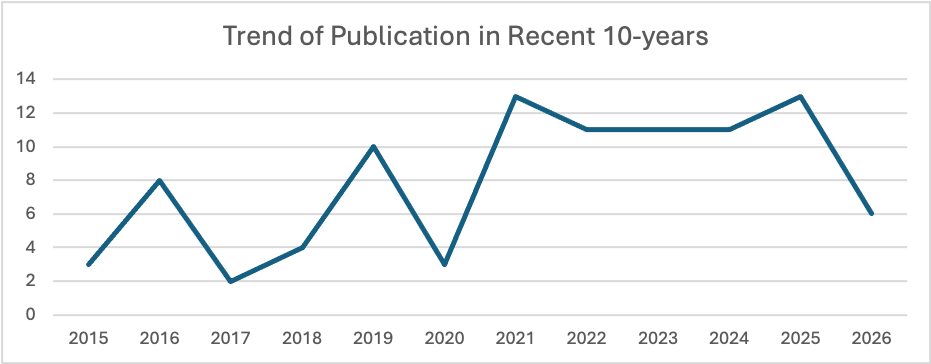
This research employs a qualitative approach, combining bibliometric analysis and a narrative literature review. A netnographic approach was used to examine the phenomena of gastrocolonialism and food resilience. Bibliometric analysis was used to depict the trends in recent publications on this topic. Cireundeu indigenous people and their local food preservation practices are commonly studied at the national level in Indonesia. However, its global publication, particularly in the Scopus database, is rare. To address this gap, recent publications were tracked using the Google Scholar database. Due to the lack of systematic metadata in Google Scholar, other tools were used, including Publish or Perish and Vosviewer. The Publish or Perish tool was used to record recent publications from 2015 to 2026 by using the following keywords: "Cireundeu AND (rasi OR cassava OR singkong OR food OR makanan OR pangan OR wisata OR tourism)". It resulted in about 95 papers, as portrayed in Figure 1.
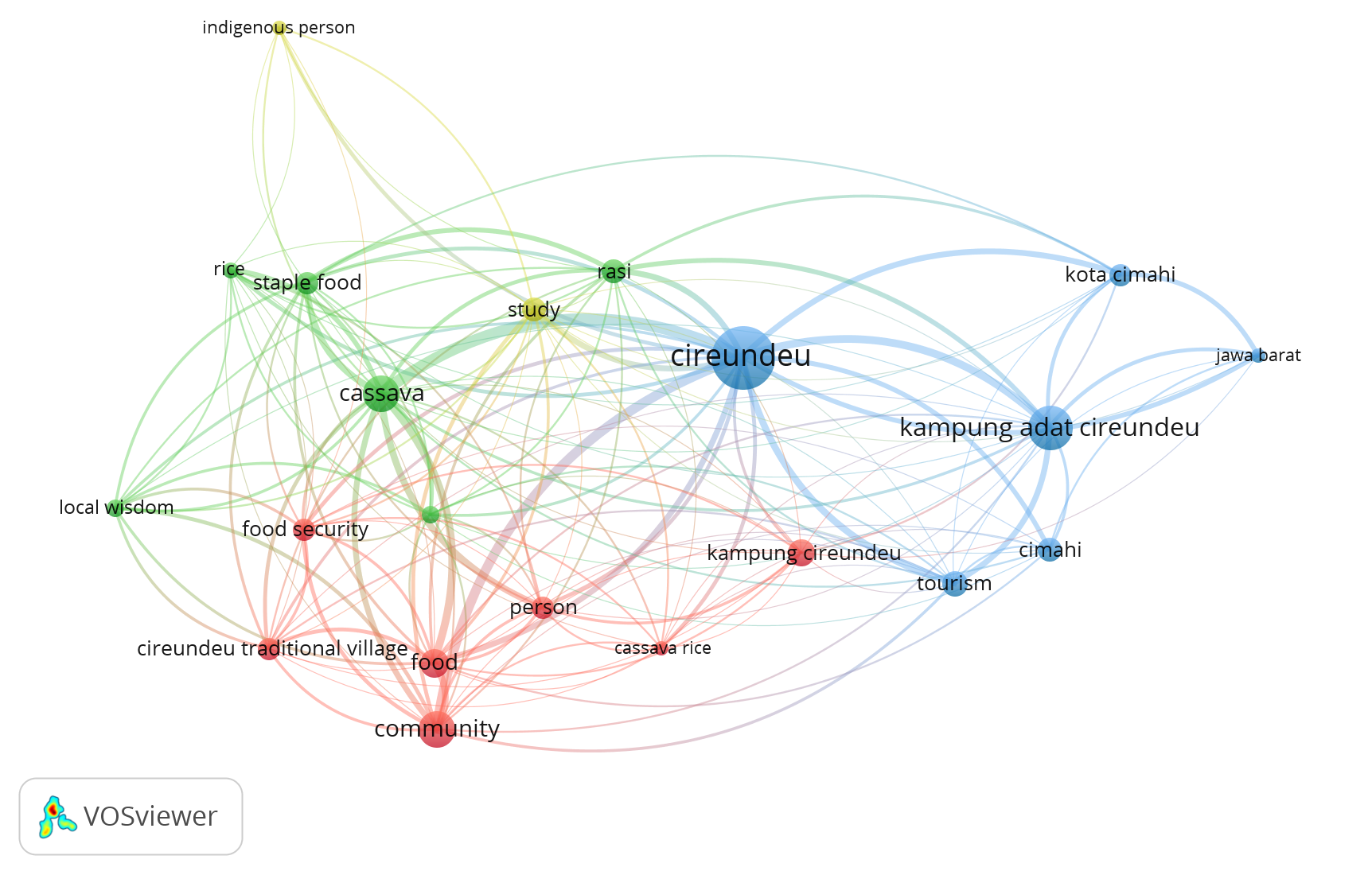
Based on tracked publications, Vosviewer was used to map the term co-occurrence within the selected period. As shown in Figure 2, there are about 4 research clusters based on term co-occurrence, ranked from largest to smallest. They are (1) cluster about Cireundeu as traditional village and communiy, discussing cassava rice as their traditional food and the matters of food security (red-colored), (2) cluster about Cireundeu as a village with cassava rice named rasi as their staple foods (green-colored), (3) cluster about Cireundeu as geographical site in West Java, commonly known as kampung adat with tourism attraction on cultural aspect (blue-colored), and (4) cluster about Cireundeu on anthroplogical context as indigeneous people to be studied (yellow-colored). Based on this mapping, the terms “cireundeu,” “kampung adat,” and “cassava” are commonly found, indicating that the discourse about cassava as a local food in Cireundeu is associated with local identity as a traditional village, since “kampung adat” shares a similar abbreviation with “kampung” and “village.” Moreover, most terms are linked to one another, indicating that research on Cireundeu centers on the following major topics: local wisdom and tradition, local and staple foods, food security, tourism, and indigenous people and communities. These topics would be discussed within this research.
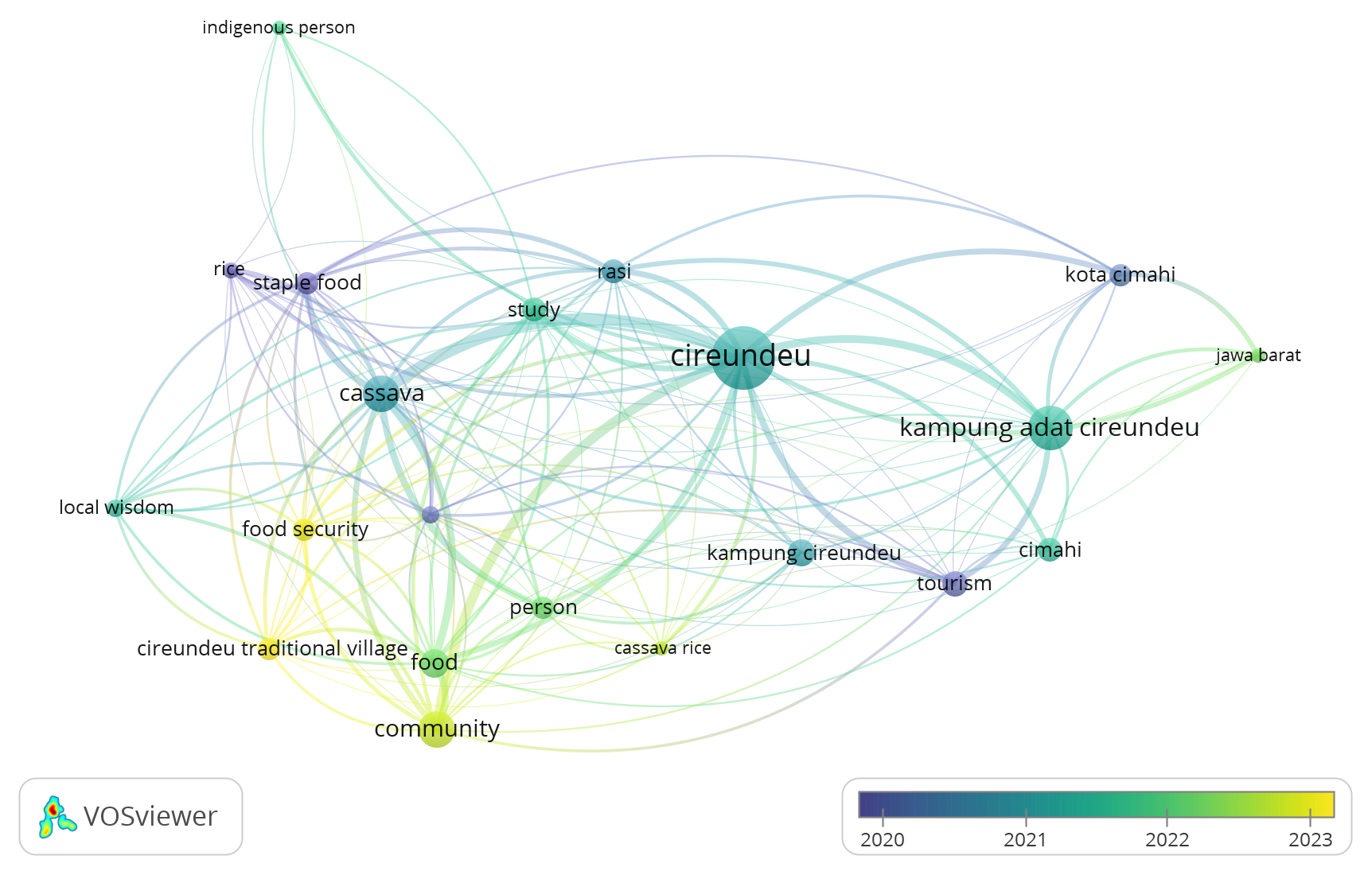
Research on these topics has increased significantly since 2021, possibly due to their close association with the post-COVID-19 era and the emerging challenges and opportunities it has brought. This is possible because rasi, as a local food for Cireundeu people, might have played an essential role in strengthening food security during that pandemic era, prompting researchers to conduct further studies. Figure 3 also shows that the research topics shifted from staple foods to indigenous people and communities, indicating a deeper exploration of the socio-anthropological context of the Cireundeu people and their local traditions. Moreover, the research broadened to discuss community and food security, showing that the study of rasi, a local food, was scaled up to address food security issues within the context of food diversification.
A single case study method is used to analyze the Cireundeu indigenous people in depth through their digital presence and representations. The selection of this method is predicated on the necessity to dissect a specific unit of analysis: the digital articulation of cassava consumption as a form of food autonomy that has endured for decades amidst the national hegemony of rice. By referring to the trends explained above, this paper is relevant for providing literature that connects the historical aspect of the Cireundeu indigenous people and their local food-preservation wisdom to local and regional identity in the modern era of capitalism and tourism development. The study emphasizes how this dietary practice serves as a robust regional identity marker, distinguishing the Cireundeu indigenous people from the homogenized national agrarian narrative. By analyzing these digital artifacts, this study seeks to unearth the underlying meanings of the tuang sampeu tradition, which functions as a radical counter-narrative to the state’s technocratic food policies.
Data were gathered through triangulation of digital sources, primarily a curated corpus of YouTube audiovisual content, along with relevant literature and previous studies on the Cireundeu indigenous people. To enhance transparency and analytical validity, the study followed a clearly defined data collection and analysis procedure informed by previous research on indigenous food systems, digital ethnography, and cultural heritage studies. These data were used to enrich a narrative literature review, involving a critical review of food policy documents and theoretical discourses on the resource curse to establish the macro-context. Subsequently, digital observation was conducted on various video documentations, including interviews with indigenous elders (sepuh), culinary demonstrations of rasi (cassava rice), and community vlogs, to document the technical and philosophical dimensions of their food practices. This approach allows for the analysis of naturally occurring data and public discourse without direct researcher interference, capturing authentic cultural expressions as they are presented in the digital sphere.
Data analysis was performed using Norman Fairclough’s model of Critical Discourse Analysis (CDA). This technique was employed to bridge three crucial dimensions: the textual level, dissecting the narratives within the YouTube content; the institutional practice level, critiquing state policies that suppress local food diversification; and the socio-cultural practice level, analyzing the manifestation of decolonizing taste as a form of digital resistance. Furthermore, the analysis extends to how these digital representations foster a model of sustainable tourism that prioritizes cultural sustainability and the preservation of traditional foodways over commercial commodification. Through this netnographic lens, the research reveals the interconnectedness between micro-level local traditions and broader socio-economic structures in the discourse of contemporary food sovereignty.
In accordance with the above bibliometric analysis, this paper would be enriched by multiperspective studies to ensure conceptual coherence with existing scholarly discussions while addressing the specificities of the Cireundeu indigenous community. The collected materials were subsequently subjected to thematic analysis, focusing on recurring discourses concerning gastro-colonialism, food security, capitalism, and regional identity. The use of multiple data sources enabled cross-validation of findings and reduced the risk of relying on a single perspective.
3. Results and Discussion
3.1. Gastro-colonialism and the Intertwining of Capitalism
In contrast to the complex food insecurity and deep-seated dependence on rice that Indonesia still faces, the Cireundeu indigenous people in Cimahi, West Java, have consistently practiced food sovereignty for over a century. By upholding ancestral philosophies and environmental stewardship, they have preserved indigenous knowledge as the foundation for food resource management; as a result, this community possesses a remarkably resilient food security system. This resilience did not emerge in a vacuum; its roots were established in 1918, when their ancestors urged the community to renounce rice and transition to cassava as its primary food source. This shift was a conscious strategic move, born of the realization that colonial powers exerted control by dominating food sources, specifically rice (Durmelat, 2015; Guy, 2012).
A deeper examination reveals that Indonesia’s food challenges have persisted since the Dutch colonial era, albeit in evolving forms. To map these historical ruptures, this study employs a Foucauldian genealogical approach to uncover the power relations that gave rise to the practices, knowledge, and preferences underpinning gastro-colonialism, a series of discontinuities and contingencies that shape contemporary consumption structures. Historically, the dominance of rice as Indonesia’s primary food commodity is inseparable from the agrarian character of Java, which existed since the era of ancient kingdoms, before the Dutch colonial administration transformed rice into a tool of subjugating control. The influence of European colonialism and imperialism on staple food consumption spans multiple dimensions, from determining staple types and production processes to the forced integration of local populations into these systems.
The Cireundeu indigenous people were among the groups significantly impacted by Dutch colonial policies. In 1918, they suffered a severe food crisis caused by the desiccation of paddy fields and the systematic seizure of their rice harvests by the colonial occupiers (Arif and Miranto, 2022). This was a catastrophic event, as they had become accustomed to rice as their primary daily staple. In response, an ethno-agricultural approach, rooted in traditional indigenous regulations, was implemented as a sustainable farming technique that remains active and vital to this day (Primasongko and Raihandhany, 2022).
Historically, the rice shortages occurring during the Dutch colonial era triggered a massive ecological rupture across Java. This stemmed from colonial policies that coerced landowners to surrender a significant portion of their paddy fields to cultivate sugarcane and indigo, export crops that were highly profitable for the Dutch administration (Gordon, 1999; Hasibuan et al., 2025; Masyrullahushomad and Sudrajat, 2020). Consequently, the production capacity of rice, the community’s primary food staple, was severely diminished. This reduction, coupled with the population’s heavy reliance on rice, led to skyrocketing market prices. As a result, common laborers were unable to afford basic sustenance, leading not only to widespread famine but also to a decline in the productivity of export commodities, thereby indirectly disadvantaging the Dutch (Christine, 2014).
Recognizing that rice scarcity could destabilize their political authority, the Dutch colonial government proposed the Van Deventer Trilogy (Ethical Policy) to intervene in the welfare of the Indonesian population. One of these three policies was irrigation, which served as the cornerstone of rice agriculture. By repairing and expanding irrigation networks, the colonial government sought to maximize rice yields, allowing for more frequent planting cycles and reducing the risk of harvest failure. While these measures appeared beneficial to the Indonesian people on the surface, irrigation was fundamentally a tool to maintain colonial stability. Because rice had been the central lifeline of society since the era of ancient kingdoms, irrigation policies indirectly reinforced and solidified total dependency on rice. This staple remained firmly within the colonial grip.
The success of this established rice tradition in Java facilitated the spread of rice consumption culture across the archipelago, accelerated by the Dutch as a form of dietary homogenization and dominance. This posed a significant risk by marginalizing the potential of other local food varieties. A prime example is the Dutch effort to enforce rice uniformity on Mentawai Island; at the time, the Dutch deemed indigenous cultivation methods there inefficient and primitive, arguing they should be eradicated (Arif et al., 2023).
During this era of colonial control over rice, the populace suffered from hunger, and the ancestors of the Cireundeu indigenous people realized that under such conditions, even survival alone was a struggle. From this historical context, we can observe how the conscious motive, or consciousness, of their ancestors served as the foundation for the development of a decolonial spirit. This critical awareness rejected the notion that their plight was natural, enabling them to liberate themselves from the oppressive structures of the time. Once this consciousness took root, it manifested as action, resistance, and a restructuring of their communal life. This awareness functions as a form of epistemic de-linking, which is a separation from the logic of colonial modernity that creates opportunities to rebuild and center indigenous knowledge (Mignolo, 2009).
One significant action stemming from this critical consciousness was the resistance initiated by their ancestors, who mandated the forced cultivation of cassava, already a staple commodity in Cireundeu Village. This strategic cultivation functioned as a small-scale guerrilla rebellion to reclaim communal plantations from colonial hands (Yasyi, 2020). This spirit continued to evolve and flourish collectively, manifesting as an action that indirectly challenges the structural food dependency established by global capitalism and the Indonesian government itself (Damayanti, 2025; Fadhilah et al., 2025; Utaridah et al., 2025). By rejecting rice in favor of indigenous foods preserved for centuries, the community transformed this decolonial perspective into an embodied praxis. Resistance, in this context, is not always defined by grand revolutions; it can be enacted through small, collective, and repetitive embodied practices (Scott, 1985), much like the Cireundeu indigenous people, who have integrated resistance into their daily habitus.
When the Cireundeu indigenous people shifted their staple from nasi (rice) to rasi (cassava rice), they effectively dismantled the dominant knowledge that perpetuates gastro-colonialism (Damayanti, 2025; Fadhilah et al., 2025). The habitus of centering cassava as a staple food inverts the colonial logic that positions rice as a superior food source. This is encapsulated in their ancestral mandate: “Teu boga sawah asal boga paré, teu boga paré asal boga béas, teu boga béas asal bisa nyangu, teu nyangu asal dahar, teu dahar asal kuat.” This translates to: “It matters not if one lacks a rice field as long as one has paddy; it matters not if one lacks paddy as long as one has rice; it matters not if one lacks rice as long as one can cook; it matters not if one cannot cook as long as one eats; it matters not if one does not eat as long as one remains strong” (Maryani, 2022).
Through this inherited philosophy, they recognize that nature provides humanity with strength through diverse choices; therefore, humans must not be tethered to a single type of food. Conversely, the colonial logic, acting as an instrument of capitalism, aggressively engineers dependency. This regime seeks to create conditions in which a nation no longer possesses local reserves, thereby forcing the populace to conform to standardized food norms. In the context of Indonesia, a nation facing vulnerability within the global food capitalism crisis, the culture of tuang sampeu (eating cassava) practiced by the Cireundeu indigenous people indirectly resists a dominant knowledge system that disadvantageously exports high-value foods at the expense of its own local food supplies, in turn addressed through imports of cheap staple foods, which destabilize local food producers of the South (McMichael, 2009). Their robust resistance to gastro-colonialism is inseparable from their consistent preservation of ancestral heritage and the passing down of embodied resistance to the traumas of the Dutch colonial era (Damayanti, 2025; Fadhilah et al., 2025; Utaridah et al., 2025).
Post-independence, the agenda of food homogenization intensified, reaching its zenith during the New Order era, when rice became the definitive symbol of national food security. Under the Soeharto administration, rice self-sufficiency programs were aggressively pursued, even to the extent of incorporating rice into civil servant salaries. This policy further solidified the societal perception of rice as the prestigious staple of the elite and the military. As noted by Wasino and Hartatik (2018), the elevation of rice as a primary staple was closely tied to government policy, as successive rulers in Indonesia, particularly in Java, consistently prioritized rice availability as a tool of governance. Consequently, this established a hierarchy that marginalized local food diversity, leading to a pervasive sense of cultural shame regarding non-rice staples, a legacy of homogenization that persists today. This hierarchy is not a taken-for-granted or natural phenomenon; rather, it is a production of colonial knowledge that Quijano (2000) identifies as the coloniality of power, wherein authority operates through racial classification, colonial dominance, and Eurocentrism as a global rationality.
3.2. Staying Vigilant Against the Lulling Effects of Gastro-colonialism
The spirit of the Cireundeu indigenous people, characterized by their resistance through sustainable food independence, reached a pivotal turning point in 1924. A female indigenous figure, Ibu Omah Asnamah, successfully developed a technology to process cassava into a rice-like staple known today as sangueun. This innovation followed her release from colonial imprisonment. In 1923, she had been arrested by the colonial authorities, who deemed her presence dangerous; during her incarceration, she was held in isolation and deprived of food and water by the Dutch. Upon her release, Ibu Omah returned to Cireundeu with a renewed vigor to ensure the community possessed alternative food sources beyond rice. She cautioned them to protect their ancestral lands, predicting they would one day become crowded with tangtung (buildings/congestion). Today, the community fully recognizes that Ibu Omah’s prophetic warnings have gradually come to pass.
This is evident in the contemporary Bandung region, which has seen widespread conversion of land from agricultural to non-agricultural uses, even as the human population continues to surge, thereby increasing food demand. The habit of tuang sampeu has evolved into a cultural cornerstone for the Cireundeu indigenous people, preserved and passed down as an act of devotion honoring Ibu Omah Asnamah's struggle. Consequently, the people of Cireundeu have completely renounced rice-based foods. This prohibition has become an internalized life philosophy for each member of the community (Vaulina, 2022)
From a decolonial perspective, this aligns with the practice of cimarronaje, which seeks to sustain the world by reinforcing collective memory. These practices are rearticulated as a form of resistance against the gastro-colonialism operating through the global food system. Although the practice of tuang sampeu originated as a direct response to Dutch colonial dominance, it has persisted as a cultural tradition. This indirectly shifts the paradigm of veiled modernity within the gastro-colonial agenda by constructing an independent food epistemology.
The culture of tuang sampeu, or eating cassava, among the Cireundeu indigenous people is not merely a fundamental biological activity to sustain the body; it is deeply intertwined with spiritual values (Komarudin et al., 2024; Mu’min, 2020). This stands in stark contrast to the colonial paradigm, which views eating primarily as consumption, the purchase of commodities, a lifestyle choice, or an aesthetic pursuit. Instead, the Cireundeu community interprets the act of eating as an ancestral tribute, a connection between humanity and nature, and a blessing derived from the earth's abundance.
The indigenous knowledge held by the Cireundeu indigenous people frequently intersects with, and often clashes with, Western perspectives that equate rationality strictly with the measurable, material, objective, and scientific. Such frameworks often marginalize indigenous knowledge as irrational or mystical; however, this knowledge possesses its own profound rationality within an epistemology born of lived experience and ecological relationships (Smith, 2012). For instance, the decision to adopt cassava as a staple food was not solely a spiritual mandate; it was a pragmatic solution to harvest failures, capitalizing on cassava’s resilience and its potential for year-round cultivation in the arid lands of Cireundeu.
The Cireundeu indigenous people also practice the tuang sampeu culture through sophisticated technical knowledge, ranging from specific cultivation methods to processing techniques, all governed by principles of collectivism, strong kinship ties, and the tradition of gotong royong (cooperation). A prime example is their land management system, where cassava fields are divided into three or four plots, each planted at three-to four-month intervals. This staggered cultivation allows for consistent harvesting based on need; as one plot is harvested, other community members immediately replant it. Through this systematic approach, the community ensures a perpetual food supply while safeguarding the daily nutritional needs of all members. This practice serves as a potent critique of Western knowledge systems, which tend to be hyper-individualistic, to detach knowledge from the community and the environment, and to reduce food production to market-driven competition.
The decolonial efforts of the Cireundeu indigenous people have reached the stage of embodied resistance, practiced in the minutiae of daily life, ensuring the preservation of cimarronaje to this day. Ultimately, the Cireundeu indigenous people have successfully maintained an alternative way of life rooted in local wisdom and values despite the pervasive challenges of gastro-colonial hegemony (Damayanti, 2025; Fadhilah et al., 2025; Utaridah et al., 2025). In practice, adults typically consume rasi twice daily, as it is considered more satiating than rice, while children and adolescents may consume it more frequently to support their developmental needs (Arif and Miranto, 2022). Regarding consumption habits, they remain bound by customary rules that dictate the wise use of rasi; portions are taken in moderation as a sign of respect for everyone involved in the processing chain and to avoid any act that might trivialize the sacred blessing of their sustenance.
3.3. The Complexity of Inheritance: Navigating the Confluence of Tradition and Modernity
Complexities, biases, and shifts perpetually confront efforts to deconstruct dominant knowledge. The collision with modernity and the penetration of Western knowledge create a tension that is difficult to circumvent. Despite living alongside contemporary advancements, the community does not entirely reject modernity; consequently, the challenge of internal modernization poses a significant prospect. Their openness to coexistence with modernity aligns with the core local wisdom of “Ngindung ka Waktu, Mibapa ka Jaman,” which implies that while the Cireundeu indigenous people maintain a way of life rooted in traditional systems, they remain adaptive and progressive in response to dynamic global changes, particularly in the utilization of today’s digital technologies (Dalih et al., 2024). In the realm of education, Cireundeu children pursue formal schooling like their peers, attending institutions from kindergarten through to higher education (Arif and Miranto, 2022). However, this concurrently increases the likelihood of friction with the outside world, as the school institution indirectly serves as an ideal conduit for the penetration of modernity.
Although formal schooling in Indonesia attempts to uphold local wisdom, it is inevitable that these institutions still inherit colonial paradigms. Formal schools carry a modern habitus that is far from neutral; they are spaces that reproduce dominant values. The knowledge structures within schools still position Western epistemology as superordinate. As Trina Fizzanty, Head of the BRIN Center for Education Research, emphasized, the educational approach thus far has relied too heavily on Western narratives, despite Indonesia's distinct social, cultural, and political structures, a condition she described as being trapped in the shadow of Eurocentrism (BRIN, 2024). This highlights that schools, as primary educational institutions, still lack a paradigm for inclusive education that is truly relevant to local cultures.
In West Java, Sundanese language and culture have long been established as subjects; however, this has not been sufficient to displace the dominant ideology. These local contents often serve merely as supplementary material rather than an epistemological framework capable of dismantling Western universalism. Consequently, schools indirectly detach students from their community’s history and culture. In the context of the Cireundeu indigenous people, for instance, schools do not holistically integrate knowledge of indigenous agriculture or provide a scientific-pedagogical space for local cultural spirituality. Nonetheless, Sundanese philosophy remains a resilient guiding principle among the Cireundeu community itself (Putro and Kustini, 2022).
Through an empirical comparison, this study illustrates the phenomenon described by Smith (2012), who argues that early educational institutions served to redefine the world and the specific positioning of Indigenous peoples within it. Schools operating under a Western paradigm actively sought to reconfigure the status of indigenous communities. Within this framework, colonialism dictates the very definitions of the world, establishing benchmarks for progress, enforcing rigid hierarchies of knowledge, and determining the boundaries between what is deemed scientific and what is dismissed as unscientific. Consequently, indigenous knowledge is systematically relegated back to the inferior status assigned to it by Western rationalism.
Caught between the dual pressures of tradition and modernity, the Cireundeu indigenous people recognize the vital importance of strictly transmitting traditional systems to their children. Even though formal schools provide no facility for indigenous knowledge, the community undertakes specific efforts as part of their resistance. On one hand, they accept the necessity of formal education; on the other, to bequeath their heritage, they create dedicated spaces through the family unit and customary institutions. For example, the habit of tuang sampeu in the form of rasi begins within the family, where children are introduced to the rasi menu as early as ages three to five. They understand that the family serves as the foundational pillar for instilling and practicing traditional values.
Through customary institutions, the transmission of heritage is further reinforced by encouraging children to safeguard ancestral traditions through several key pillars, which are instilling tata krama (etiquette) and social decorum toward all community members, both elders and peers; studying the Sundanese script as a vital ancestral legacy, along with the profound philosophical meanings embedded within it; engaging with Sundanese arts and culture; and fostering a deep recognition of indigenous leaders and elders (sesepuh), including their respective roles within the community (Arif and Miranto, 2022).
The collaborative effort to preserve the culture of the Cireundeu indigenous people, particularly the tuang sampeu tradition, is inextricably linked to their established organizational system. The Ketua Adat (customary leader), the ais pangampih (deputy leader), the paniten (communal liaison and ritual executor), and the sesepuh (elders) maintain active roles, working in synergy to uphold the community’s traditional life systems. The endurance of this ancestral heritage to the present day implies that the transmission of tuang sampeu has been executed with optimal efficacy. This is further substantiated by the research of Arif and Miranto (2022), which concludes that the succeeding generations of the Cireundeu community possess a high level of consciousness regarding the inheritance and preservation of their ancestral traditional systems.
3.4. Contestation of Cultural Preservation Amidst the Current of Capitalism
A close reading of the Cireundeu indigenous people demonstrates that the tuang sampeu culture remains resilient despite the pressures of modernization, with various transmission efforts ensuring its continuity among the younger generation. However, it would be premature to conclude this analysis without addressing a critical nuance: whether the preservation of the tuang sampeu tradition remains pure, or whether a capitalist logic has subtly permeated its practice. This inquiry arises from a paradigmatic necessity to identify the subtle fissures through which modern capitalism operates.
The concept of purity is inherently complex. Traditions frequently transform in dialogue with their temporal context, echoing the ancestral proverb of the Cireundeu people to remain adaptive. Thus, tradition must be viewed as a dynamic space; the practice of tuang sampeu cannot remain entirely insulated from the political, economic, and logical influences of the modern era. While its existence persists, its form has undergone a significant transformation.
Originally, cassava served as a primary cultural identity and a daily dietary staple; however, its role has now expanded to include a tradable commodity. Cassava-based products are now processed into souvenirs for tourists and marketed beyond Cireundeu's borders. Production is carried out routinely by residents and can now be categorized as Small and Medium Enterprises (SMEs) (Sanusi and Sidik, 2022). Furthermore, alongside the massive cultural promotion spearheaded by the government and social media, Cireundeu’s appeal has evolved into a Tourism Attraction Object (ODTW), focusing on both cultural and agro-tourism due to the unique nature of its cassava management (Putranto and Taofik, 2014).
Consequently, the tuang sampeu culture exists within a paradoxical space; while commodification provides economic benefits, it simultaneously creates vulnerabilities. Tuang sampeu is no longer positioned solely as a symbol of spirituality, ecology, and resistance. Instead, it has concurrently become a tourist attraction, social media content, and a branding tool for the indigenous village, serving as what Greenwood calls a commodity sui generis. Greenwood argues that economists and planners involved in tourism often obscure this complexity by treating local culture as a mere natural resource (Greenwood, 1989). This perspective is highly relevant to the mechanisms of colonialism, which reframe cultural products as raw resources to be utilized and exploited for their market value. Moreover, because tuang sampeu is rooted in historical and philosophical values, it risks being reduced to mere exoticism or viewed through a primitive lens. Even their customary prohibition against eating rice is susceptible to Othering, as it is often perceived as a deviation from normative gastronomic orders.
Preserving tradition is neither simple nor brief; thus, the ongoing preservation efforts of the Cireundeu indigenous people serve as a testament to their struggle to safeguard their heritage amidst myriad complexities. Drawing on Smith (2012), institutions such as the state or formal schools frequently package local culture as local wisdom or heritage, yet often fail to provide a genuine space for indigenous epistemology itself.
The emergence of a conscious effort among the Cireundeu indigenous people to establish educational initiatives within their internal sphere is a concrete step toward safeguarding traditional inheritance. While the culture of tuang sampeu, as an embodiment of the decolonial spirit, is inextricably linked to contemporary complexities in practice, this does not necessarily result in the erosion of core values.
Furthermore, the transition of sampeu (cassava) into a tradable commodity can still align with their foundational spirit, provided these efforts are dedicated to community empowerment. Rasi, as the staple food of the Cireundeu indigenous people, continues to be maintained as a form of embodied resistance. Beyond its role as a staple, they process cassava into various confectionery and crackers intended for both communal consumption and commercial distribution. These products are marketed under the label sagala sampeu (All Things Cassava). By establishing and independently managing their own cooperatives, the Cireundeu indigenous people have transformed their territory into a hub for local economic development. By building their own systems, the community ensures it remains an active participant in the management and stewardship of its culture.
3.5. Strengthening Local and Regional Identity and Sustainable Tourism in Global Development
In the modern era, gastronomy has evolved into a vital component of spatial and regional identity (Fernandes et al., 2024; Lin et al., 2021; Rinaldi, 2017; Urkiaga et al., 2026). Regional identity—viewed through a gastronomic lens fosters a potent culinary image that becomes inextricably linked to specific places or territories through symbolic association (Fernandes et al., 2024; Urkiaga et al., 2026). This phenomenon serves as essential territorial branding capital for tourism development, even extending into the global sphere (Eren, 2018; Lin et al., 2021; Rinaldi, 2017; Seyitoğlu and Ivanov, 2020). Tourists increasingly associate robust images of specific foods with the regions they visit (Eren, 2018; Rinaldi, 2017). This demonstrates that gastronomy is no longer merely a historical account of food evolution; it has permeated socio-economic dimensions, forging resilient regional identities within a modern, global territorial scope (Balderas-Cejudo et al., 2025; Bellini et al., 2018; Navarro-Dols and González-Pernía, 2020).
In Indonesia, gastronomy has played a significant role in shaping the cultures and traditions of its heterogeneous regions, ranging from customary and religious festivities and wedding ceremonies to daily life, all of which are characterized by distinct culinary identities and traditions (Pratama et al., 2024). The collective strengthening of regional identity through gastronomy in Indonesia reflects an assimilation of historical heritage from the ancient, colonial, and postcolonial eras to form a cohesive national identity and powerful branding (Fitria et al., 2021; Nadra et al., 2025; Pratama et al., 2024; Syawaludin, 2025; Untari and Satria, 2025). Among the Cireundeu indigenous people, gastronomy, manifested through ethno-agriculture and a unique form of food security, has become a hallmark of Cireundeu’s sustainable regional identity (Primasongko and Raihandhany, 2022; Sukma and Yuliar, 2025). The intergenerational inheritance of these traditions has endowed Cireundeu with a formidable regional identity as a guardian of local wisdom and local heritage (Permana et al., 2025; Shalihah et al., 2021).
The resistance of the Cireundeu indigenous people against gastro-colonialism has fostered a distinctive adaptation in food security, serving as a manifestation of the dynamics of social change (Dalih et al., 2024; Razak and Supriatna, 2026). Their agricultural adaptation patterns, rooted in the philosophies of “teu nyawah asal boga paré, teu boga paré asal boga béas, teu boga béas asal bisa nyangu, teu nyangu asal dahar, teu dahar asal kuat” and “Ngindung ka waktu, mibapa ka jaman”, essentially embody a concept of food sufficiency that integrates spatio-temporal aspects. This involves a sustainable balance between land use and planting schedules adjusted to environmental carrying capacity, dietary needs, and supply availability (Dalih et al., 2024; Kunkurat et al., 2025; Maryani, 2022; Primasongko and Raihandhany, 2022). Such a framework illustrates a manifestation of anti-gastro-colonial resistance that not only builds a robust historical and regional identity but also demonstrates profound environmental sensitivity through a spatio-temporal approach grounded in local wisdom.
The regional identity of the Cireundeu indigenous people, which projects their food security efforts, serves as powerful capital for branding environmental and ecosystem preservation under the banner of sustainable development. Supported by advancements in information and communication technology, this branding has achieved widespread publication, attracting visitors and subsequently invigorating the tourism sector. This image is anchored in culinary tourism attractions centered on Cireundeu’s unique cassava-based staples, bolstered by a compelling narrative of food resilience (Kunkurat et al., 2025; Maryani, 2022; Priyanto and Desmafianti, 2023; Shalihah et al., 2021). Furthermore, the preservation of local wisdom and traditions fosters interest in cultural and environmental tourism, aligning with ecotourism concepts and broader sustainable tourism trends (Putro and Kustini, 2022; Simanjuntak and Sunarja, 2023). Consequently, the direct and active participation of the Cireundeu indigenous people is essential to support the tourism image and regional identity that constitute their primary assets (Mulia and Kusumah, 2022). The growth of a modern tourism sector based on traditional imagery and environmental sustainability reflects a burgeoning trend in global tourism (Alawi and Noer, 2025; Berry and Yadav, 2026; Cheng et al., 2025; Dordai et al., 2026). Thus, the Cireundeu indigenous people, through their inherent local wisdom, possess significant capital to optimize their gastronomic potential, food security, and sustainable tourism, enabling them to compete within local, national, and global socio-economic development frameworks.
4. Conclusion
The author acknowledges that the perspectives presented herein are not entirely free of subjectivity, primarily because this study was based on a literature review and analysis of digital media to gain a deeper understanding of the Cireundeu indigenous people. It is observed that, while the tuang sampeu culture is undergoing continuous transformation, these shifts consistently gravitate toward reinforcing food sovereignty. This is evidenced by the community’s success in managing cassava through a comprehensive upstream-to-downstream model that encompasses cultivation, processing, and consumption.
This research was limited to the geospatial context of the Cireundeu indigenous people in Cimahi, West Java. Although a qualitative approach was used, this study still requires deeper exploration through primary observations and interviews to enrich the narrative findings. However, this research framework would apply to similar discourse on local wisdom, gastro-colonialism, and regional identity across different archipelagic contexts in Indonesia, such as Kalimantan (Borneo) and Papua. In the national context, food deficits, such as those occurring in Papua, could be effectively mitigated by strengthening local food systems. Papua may differ from Java; while rice may be unsuitable for cultivation there, the region is blessed with an abundance of sago, tubers, and horticultural crops. In truth, food has long served as a savory meal for capitalism, and the aspiration for food sovereignty represents a vital form of resistance against Western capitalist structures. Such an ideal can only be realized when the state provides ample space for genuine efforts to diversify food. Furthermore, recognizing the diverse food potential inherent in each region is an absolute necessity for achieving true and meaningful food diversification.
Acknowledgment
This research was conducted with support from the Indonesian Endowment Fund for Education/Lembaga Pengelola Dana Pendidikan (LPDP) through its scholarship program. The authors would also like to express their gratitude to Universitas Gadjah Mada for providing an interdisciplinary research ecosystem that supports reputable and credible research.
References
- Alawi, T.R., Noer, L.R., 2025. Global Research Trend in Sustainable Tourism Marketing: A Bibliometric Approach. Journal Research of Social Science, Economics, and Management 5:9634–9650. https://doi.org/10.59141/JRSSEM.V5I5.1217
- Ansari, A., Lin, Y.-P., Lur, H.-S., 2021. Evaluating and Adapting Climate Change Impacts on Rice Production in Indonesia: A Case Study of the Keduang Subwatershed, Central Java. Environments 8:117. https://doi.org/10.3390/environments8110117
- Arif, A., Sastra, Y., Herin, F.P., Yunus, S.R., 2023. Warisan Kolonial di Balik Peminggiran Budaya Pangan Lokal [WWW Document]. KOMPAS.id. URL https://www.kompas.id/artikel/warisan-kolonial-di-balik-peminggiran-budaya-pangan-lokal (accessed 11.2.25).
- Arif, M., Miranto, S., 2022. Daya Dukung Kearifan Lokal, 1st ed. Publica Indonesia Utama, DKI Jakarta.
- Balderas-Cejudo, A., Iruretagoyena, M., Alonso, L., Church, M., Izquierdo, L., Hill, I., Larson, K., 2025. Gastronomy and beyond: A collaborative initiative for rethinking food’s role in society, sustainability, and territory. Int. J. Gastron. Food Sci. 39:1–8. https://doi.org/10.1016/J.IJGFS.2025.101118
- Bellini, N., Clergeau, C., Etcheverria, O., 2018. Introduction, in: Bellini, N., Clergeau, C., Etcheverria, O. (Eds.), Gastronomy and Local Development. Routledge, London, pp. 1–8. https://doi.org/10.4324/9781315188713-1
- Berry, K., Yadav, N., 2026. Trends and trajectories of sustainability in gastronomy tourism: a bibliometric analysis. Cogent Business & Management 13:1–20. https://doi.org/10.1080/23311975.2026.2633460
- BRIN, H., 2024. BRIN Giatkan Upaya Dekolonisasi Pendidikan untuk Masa Depan yang Lebih Inklusif [WWW Document]. BRIN: Badan Riset dan Inovasi Nasional. URL https://brin.go.id/news/121886/brin-giatkan-upaya-dekolonisasi-pendidikan-untuk-masa-depan-yang-lebih-inklusif (accessed 10.26.25).
- Cai, Y., Newth, D., 2013. Oil, Gas and Conflict: A Mathematical Model for the Resource Curse. PLoS One 8:1–10. https://doi.org/10.1371/journal.pone.0066706
- Cheng, D., Wu, Y., Zhou, J., Zhou, Y., 2025. Rethinking the socio-cultural sustainability of gastronomy tourism: A Critical Tourism Studies lens. Int. J. Gastron. Food Sci. 42:101370. https://doi.org/10.1016/J.IJGFS.2025.101370
- Christine, N.A., 2014. Latar Belakang Penerapan Ordonansi Pajak Penghasilan Di Hindia Belanda Tahun 1908-1942. Avatara: Jurnal Pendidikan Sejarah 2:140–148.
- Dalih, R., Lubis, G.I., Hendrawan, J.H., 2024. Ngindung Ka Waktu Mibapa Ka Zaman: Food Resilience Based on Local Wisdom in Kampung Adat Cireundeu. International Conference on Aplied Social Sciences in Education 1:463–469. https://doi.org/10.31316/ICASSE.V1I1.6849
- Damayanti, A.A., 2025. Rasi singkong as a creation of painting artworks, in: IICACS : International and Interdisciplinary Conference on Arts Creation and Studies. pp. 1–12. https://doi.org/10.33153/IICACS.V10I1.302
- Dordai, L., Becze, A., Roman, M., 2026. Gastronomic Tourism: Global Trends, Sustainability Challenges, and Research Directions (2010–2025)—A Comprehensive Review. Gastronomy 4:1–24. https://doi.org/10.3390/GASTRONOMY4010004
- Durmelat, S., 2015. Introduction: Colonial culinary encounters and imperial leftovers. French Cultural Studies 26:115–129. https://doi.org/10.1177/0957155815572572
- Eren, S., 2018. Gastronomic Identity and Gastronomic Image in Tourism Destinations: A Local Food Perspective, in: Marin Rusev, Eric Strauss, Cevdet Avcikurt, Abdullah Soykan, Bekir Parlak (Eds.), Social Sciences Researches in the Globalizing World. St. Kliment Ohridski University Press, Sofia.
- Fadhilah, A., Hunowu, M.A., Mastanah, 2025. Local wisdom and food culture in Cireundeu village for community resilience, in: Towards Resilient Societies: The Synergy of Religion, Education, Health, Science, and Technology. CRC Press, pp. 268–273. https://doi.org/10.1201/9781003654940-42
- Fadillah, M.I., 2025. Resource Wealth and Happiness: Evaluating The “Resource Curse” VS. “Resource-Based Development” Theories. Return : Study of Management, Economic and Bussines 4:58–64. https://doi.org/10.57096/RETURN.V4I1.318
- Fernandes, G.P., Costa, A., Cerveira, R., 2024. Gastronomic Identity and the Role of the Confraternities in the Valorisation of Local Products. The Confraternity of Bucho Raiano in the Promotion of Culture and Inland Tourism. European Countryside 16:151–167. https://doi.org/10.2478/euco-2024-0009
- Fitria, R., Supriatna, A., Hakam, K.A., Nurbayani, S., Warlim, 2021. Gastronomy tourism as a media to strengthen national identity, in: Promoting Creative Tourism: Current Issues in Tourism Research. Routledge, pp. 457–463. https://doi.org/10.1201/9781003095484-66
- Francisco, F.J., González-Padilla, P., Matos, N., B. Correia, M., 2024. Bibliometric measurement of the resource curse and its implication for sustainable development. Resources Policy 89:104560. https://doi.org/10.1016/J.RESOURPOL.2023.104560
- Gordon, A., 1999. The agrarian question in colonial Java: Coercion and colonial capitalist sugar plantations, 1870-1941. Journal of Peasant Studies 27:1–34. https://doi.org/10.1080/03066159908438723
- Greenwood, D.J., 1989. An Anthropological Perspective on Tourism as Cultural Commoditization, in: SMITH, V.L. (Ed.), Hosts and Guests, The Anthropology of Tourism. University of Pennsylvania Press, pp. 171–186.
- Guy, K.M., 2012. Food Representations, in: Martin Bruegel (Ed.), A Cultural History of Food. Bloomsbury Academic, London.
- Hasibuan, Y.S., Affandi, K.M., Nasution, J., 2025. The Socio-Economic Impacts of Agrarian Exploitation through Irrigation Systems during the Dutch East Indies Period. Warisan: Journal of History and Cultural Heritage 6:140–149. https://doi.org/10.34007/WARISAN.V6I2.2966
- Irawan, B., Safira, K.M., Annisa, Rohmatullayaly, E.N., Ihsan, M., Suryana, Iskandar, J., Iskandar, B.S., 2024. Ethnobotany of cassava (Manihot esculenta Crantz) in the traditional peri-urban Sundanese community of Cireundeu Hamlet, Cimahi City, West Java, Indonesia. Biodiversitas 25. https://doi.org/10.13057/biodiv/d250113
- John, J. Di, 2010. The “Resource Curse”: Theory and Evidence (ARI). Real Instituto Elcano.
- Ketaren, A., Rangkuty, R.P., 2021. Kajian Pembangunan Ketahanan Pangan Keluarga Petani. Jurnal Ilmu Sosial dan Ilmu Politik Malikussaleh (JSPM) 2:218–237. https://doi.org/10.29103/JSPM.V2I2.5646
- Komarudin, D., Safa’at, F.A., Latifa, A.Z., Hidayanti, E., Rosmayni, R.D., Supriyono, 2024. Peranan Singkong sebagai Makanan Pokok di Kampung Adat Cirendeu. Jurnal Pendidikan Tambusai 8:45799–45806.
- Kunkurat, Sebayang, T.R., Irza, A.L., Rajab, M., 2025. Community Services: Optimilization Indigenous Community of Cireundeu in Adapting Food Resilience to Supporting SDGs Desa Agenda. Pasundan International of Community Services Journal (PICS-J) 7:32–41. https://doi.org/10.23969/PICS-J.V7I01.35069
- Lin, M.P., Marine-Roig, E., Llonch-Molina, N., 2021. Gastronomy as a Sign of the Identity and Cultural Heritage of Tourist Destinations: A Bibliometric Analysis 2001–2020. Sustainability 13:12531. https://doi.org/10.3390/SU132212531
- Lotfalipour, M.R., sargolzaie, A., Salehnia, N., 2022. Natural resources: A curse on welfare? Resources Policy 79:103056. https://doi.org/10.1016/J.RESOURPOL.2022.103056
- Lu, S., Li, J., Zhang, W., Xiao, F., 2025. How can the “resource curse” be broken? Transition factor flows, the urban life cycle and value chain upgrades in resource-based cities. Humanit. Soc. Sci. Commun. 12:1–15. https://doi.org/10.1057/s41599-025-04518-3
- Manzano, O., Gutiérrez, J.D., 2019. The subnational resource curse: Theory and evidence. Extr. Ind. Soc. 6:261–266. https://doi.org/10.1016/J.EXIS.2019.03.010
- Maryani, E., 2022. Food security for drought disaster adaptation in Cireundeu Traditional Village. IOP Conf. Ser. Earth Environ. Sci. 986:1–6. https://doi.org/10.1088/1755-1315/986/1/012058
- Masyrullahushomad, M., Sudrajat, S., 2020. Penerapan Agrarische Wet (Undang-Undang Agraia) 1870: Periode Awal Swastanisasi Perkebunan di Pulau Jawa. Historia. HISTORIA: Jurnal Program Studi Pendidikan Sejarah 7:159–174. https://doi.org/10.24127/HJ.V7I2.2045
- McMichael, P., 2009. A food regime analysis of the ‘world food crisis.’ Agriculture and Human Values 2009 26:4 26:281–295. https://doi.org/10.1007/S10460-009-9218-5
- Miranto, S., Arif, M., Zulfiani, Z., Anwar, C., 2025. Ethnoagriculture and Food Sovereignty in Kampung Cireundeu: An Environmental Education Perspective. Tadris: Jurnal Keguruan dan Ilmu Tarbiyah 10:63–77. https://doi.org/10.24042/tadris.v10i1.21011
- Mulia, S.N., Kusumah, A.H.G., 2022. The Role of Cireundeu Traditional Village in Tourism Management. JHSS (Journal of Humanities and Social Studies) 6:198–202. https://doi.org/10.33751/JHSS.V6I2.5441
- Mu’min, U.A., 2020. Spiritualitas Karakter Tuang dalam Budaya Masyarakat Kampung Adat Cireundeu. Islamadina : Jurnal Pemikiran Islam 21:53–67. https://doi.org/10.30595/islamadina.v0i0.6325
- Nadra, N.M., Ayu, I., Sumawidari, K., Kade, I.A., Damayanti, W., Arjana, W.B., Bali, P.N., 2025. Traditional cuisine as a social symbol: A socio-cultural analysis of the collective identity of Indonesian society. Journal of Commerce, Management, and Tourism Studies 4:460–473. https://doi.org/10.58881/JCMTS.V4I3.379
- Narh, J., 2025. The resource curse and the role of institutions revisited. Environ. Dev. Sustain. 27:8187–8207. https://doi.org/10.1007/S10668-023-04279-6
- Navarro-Dols, J., González-Pernía, J.L., 2020. Gastronomy as a real agent of social change. Int. J. Gastron. Food Sci. 21:100240. https://doi.org/10.1016/J.IJGFS.2020.100240
- Paganini, N., Adinata, K., Buthelezi, N., Harris, D., Lemke, S., Luis, A., Koppelin, J., Karriem, A., Ncube, F., Nervi Aguirre, E., Ramba, T., Raimundo, I., Sulejmanović, N., Swanby, H., Tevera, D., Stöber, S., 2020. Growing and Eating Food during the COVID-19 Pandemic: Farmers’ Perspectives on Local Food System Resilience to Shocks in Southern Africa and Indonesia. Sustainability 12:8556. https://doi.org/10.3390/su12208556
- Permana, F.A., Maulana, F., Ibrahim AM, F.M., 2025. Kampung Adat Cireundeu: Local Heritage as a Pillar of the Climate Justice. Socio Religia 6:1–12. https://doi.org/10.24042/7J9DZJ16
- Pratama, A.Y., Alfaqi, M.Z., Mawarti, R.A., Shofa, A.M.A., Hikam, I., 2024. Cultural identity in Indonesian gastronomy, in: Andajani, K., Karmina, S., Rahmania, L.A. (Eds.), Inclusive, Sustainable, and Transformational Education in Arts and Literature. Routledge, pp. 183–188. https://doi.org/10.1201/9781003484318-27
- Primasongko, A., Raihandhany, R., 2022. Ethnoagriculture of Cirendeu traditional village, Cimahi, West Java: Local knowledge implementation on agricultural practices. Genbinesia Journal of Biology 2:22–34. https://doi.org/10.55655/GENBINESIA.V2I1.24
- Priyanto, R., Desmafianti, G., 2023. Cultural Value of Cassava Food as a Tourism Attraction in Cireundeu Traditional Village. Jurnal Kepariwisataan: Destinasi, Hospitalitas dan Perjalanan 7:51–66. https://doi.org/10.34013/JK.V7I1.908
- Pudjiastuti, A.Q., Arisena, G.M.K., Krisnandika, A.A.K., 2021. Rice Import Development in Indonesia. SOCA: Jurnal Sosial, Ekonomi Pertanian 15:390–405. https://doi.org/10.24843/SOCA.2021.V15.I02.P14
- Putra, F.A. Al, Satyawan, I.A., Prakoso, S.G., 2025. Konflik Kepentingan Kebijakan Impor Beras Indonesia Diantara Menjaga Ketahanan Pangan Dan Perlindungan Petani Lokal. Inovasi 22. https://doi.org/10.33626/B6394510
- Putranto, K., Taofik, A., 2014. Pola Diversifikasi Konsumsi Pangan Masyarakat Adat Kampung Cireundeu Kota Cimahi Jawa Barat. Jurnal Istek 8:159–181.
- Putro, M.Z.A.E., Kustini, 2022. Ecotourism of Cireundeu and Basic Sundanese’ Way of Life. Jurnal Manajemen Hutan Tropika 28:141–149. https://doi.org/10.7226/JTFM.28.2.141
- Quijano, A., 2000. Coloniality of power and Eurocentrism in Latin America. International Sociology 15:215–232. https://doi.org/10.1177/0268580900015002005
- Razak, O.W., Supriatna, E., 2026. Dynamics of Social Change in Sundane Society: Between Tradition and Modernity in Cireundeu Traditional Village, Cimahi. Jurnal Dialektika: Jurnal Ilmu Sosial 24:68–75. https://doi.org/10.63309/dialektika.v24i1.946
- Rinaldi, C., 2017. Food and Gastronomy for Sustainable Place Development: A Multidisciplinary Analysis of Different Theoretical Approaches. Sustainability 9:1748. https://doi.org/10.3390/su9101748
- Sanusi, N., Sidik, A.P., 2022. Komodifikasi Keunikan Kampung Adat Cireundeu Sebagai Objek Wisata Budaya. Linimasa: Jurnal Ilmu Komunikasi 5:76–82. https://doi.org/10.23969/LINIMASA.V5I1.4721
- Scott, J.C., 1985. Weapons of the Weak: Everyday Forms of Peasant Resistance. Yale University Press.
- Setiawan, E., Hartoyo, S., Sinaga, B.M., Hutagaol, M.P., 2016. Impact of Rice Import Tariff and Quota on Food Security in Indonesia. International Journal of Sciences: Basic and Applied Research (IJSBAR) 28:220–232.
- Setiawati, R.I.S., Jaenudin, M., Amini, A.F., Puspita, N.P.R., 2024. Short- and long-term determinants of Indonesia’s rice import: An error correction model approach. Jurnal Ekonomi & Studi Pembangunan 26:61–79. https://doi.org/10.18196/JESP.V26I1.24963
- Seyitoğlu, F., Ivanov, S.H., 2020. A Conceptual Study of the Strategic Role of Gastronomy in Tourism Destinations. Int. J. Gastron. Food Sci. 21:100230. https://doi.org/10.1016/j.ijgfs.2020.100230
- Shalihah, S., Sugandi, D., Somantri, L., 2021. Adaptation of indigenous communities in kampung cireundeu to the environment in maintaining local wisdom. IOP Conf. Ser. Earth Environ. Sci. 683:12128. https://doi.org/10.1088/1755-1315/683/1/012128
- Shobur, M., Nyoman Marayasa, I., Bastuti, S., Muslim, A.C., Pratama, G.A., Alfatiyah, R., 2025. Enhancing food security through import volume optimization and supply chain communication models: A case study of East Java’s rice sector. Journal of Open Innovation: Technology, Market, and Complexity 11:100462. https://doi.org/10.1016/j.joitmc.2024.100462
- Simanjuntak, D., Sunarja, D., 2023. Organizational Communication Based on Local Wisdom by the Tourism Awareness Group in the Management of Cireundeu Traditional Village. Society 11:814–834. https://doi.org/10.33019/SOCIETY.V11I2.575
- Simpson, A., 2007. On Ethnographic Refusal: Indigeneity, ‘Voice’ and Colonial Citizenship. Junctures: The Journal for Thematic Dialogue, 67–80.
- Smith, L.T., 2012. Decolonizing Methodologies Research and Indigenous Peoples (2nd ed.). Zed Books Ltd, London.
- Sukma, F.N.M., Yuliar, S., 2025. Mobility, Local Identity And Sustainability of The Cirendeu Indigenous Community in West Java. Kritis Special Edition, 40–57.
- Susanti, W.I., Cholidah, S.N., Agus, F., 2024. Agroecological Nutrient Management Strategy for Attaining Sustainable Rice Self-Sufficiency in Indonesia. Sustainability 16:845. https://doi.org/10.3390/SU16020845
- Syawaludin, D.F., 2025. Gastronomy as a Cultural Agency: Identity Negotiation and Postcolonial Hybridity in Urban Cuisine. Return: Study of Management, Economic and Bussines 4:322–329. https://doi.org/10.57096/RETURN.V4I4.417
- Untari, D.T., Satria, B., 2025. Reimagining Indonesia’s Culinary Tourism: The Power of Gastronomy and Branding. Greenation International Journal of Tourism and Management 3:150–155. https://doi.org/10.38035/GIJTM.V3I2.329
- Urkiaga, O., Romeo-Arroyo, E., Mora, M., Vázquez-Araújo, L., 2026. What is gastronomic identity? Exploring its definition and perception through sensory stimuli and projective mapping. Food Research International 230:118589. https://doi.org/10.1016/J.FOODRES.2026.118589
- Utaridah, N., Pratama, P., Noviera, F.R., Setiadi, H., Nurlimah, N., 2025. Digital Storytelling on Instagram Content as a Brand for Food Security of the Indigenous Community of Kampung Cireundeu. Journal of Communication, Religious, and Social Sciences (JoCRSS) 3:71–81. https://doi.org/10.60046/JOCRSS.V3I2.268
- Vaulina, A., 2022. Kampung Ini Tak Makan Nasi Hampir Satu Abad. Angelick Vaulina, Indonesia.
- Wasino, W., Sri Hartatik, E., 2018. Rice Policy in Java from Traditional Kingdoms to Dutch Colonial Time, in: UNNES International Conference on Research Innovation and Commercialization 2018. pp. 730–735. https://doi.org/10.18502/kss.v3i18.4763
- Yang, Z., Li, M., 2024. Escaping the resource curse: does resource dependence reduction mitigate income inequality? Humanities and Social Sciences Communication 11:1697. https://doi.org/10.1057/s41599-024-04228-2
- Yasyi, D.N., 2020. Rasi Desa Cireunde, Bentuk Pemberontakan untuk Merdeka [WWW Document]. Good News From Indonesia. URL https://www.goodnewsfromindonesia.id/2020/04/26/rasi-desa-cireunde-bentuk-pemberontakan-untuk-merdeka (accessed 10.28.25).