
The Hierarchical Reciprocal Order in the Premodern East Asian Maritime Realm: Focused on the Repatriation System of Jeju Castaways
 10.21463/jmic.2026.15.2.06
Abstract
The premodern East Asian maritime region was a space in which various political entities and seafaring populations interacted to forge a distinct international order. By analyzing historical incidents of Jeju islanders’ drift to foreign lands and their return, this study demonstrates that the regional framework extended far beyond a mere vertical system of domination. Rather, it functioned as a ‘hierarchical reciprocal order’ in which mutual protection and responsibility operated even within a symbolic hierarchy. During this period, the Hua-Yi order (a Sinocentric center-periphery framework) and the Confucian ideology of yechi (禮治, ritual governance) in East Asia viewed castaways as subjects to be protected within the civilized world. This perception was institutionally embodied through the political principles of sadae-jaso (事大字小, serving the great and cherishing the small) and yuwon-mui (柔遠撫邇, placating those from afar and soothing those near). Driven by these principles, a series of repatriation procedures for foreign castaways became established as an official interstate administrative framework within the investiture-tribute system. In particular, from the eighteenth century onward, bolstered by the expansion of the Qing dynasty’s maritime dominion and the stabilization of diplomatic and trade networks among East Asian states, the castaway repatriation system became increasingly systematic. In sum, this paper comparatively analyzes the historical cases of Jeju islanders who drifted to China, Japan, Ryukyu, Taiwan, and Annam (Vietnam), examining the repatriation mechanisms enacted by each country of landfall. The findings confirm that the premodern East Asian repatriation system for castaways was not limited to benevolent rescue activities. Rather, it functioned as a ‘peacekeeping mechanism’ inherent to the maritime order, effectively combining a civilized hierarchical structure with practical cooperation.
Keywords
Premodern East Asian maritime region, Jeju castaways, Repatriation of castaways, Hierarchical reciprocal order, Confucian ritual order, Investiture-tribute system
1. Introduction
The core frameworks that defined premodern East Asian international relations were the ‘Hua-Yi order’ (a Sinocentric center-periphery framework) and the ‘investiture-tribute system,’ both grounded in Sinocentrism. Traditionally, this structure has been understood as a China-centered, vertical, and unequal order of domination. However, recent scholarship reevaluates it as a ‘communitarian normative system’ where the mutual autonomy of each country and a shared civilized universality coexisted, even within a formal hierarchy.
In particular, international relations scholars emphasize that the tribute system differed from the Western Westphalian balance of power, operating as an independent framework of international rules that maintained long-term peace within a hierarchical structure (Kang, 2010; 2020). Furthermore, they have demonstrated that this order was not a result of unilateral Chinese coercion, but rather a bidirectional compromise in which peripheral states engaged to secure their own political legitimacy and practical autonomy (Lee, 2016). In other words, there is a growing recognition that the traditional East Asian international order was a dynamic system in which diplomatic, trade, and cultural exchanges unfolded in a complex, multi-layered manner, amid the coexistence of formal hierarchy and practical autonomy. From this perspective, the study conceptualizes the operational principles of the tributary-investiture system—characterized by the coexistence of asymmetric status and mutual obligations—as a ‘hierarchical reciprocal order.’ In this framework, hierarchy implies an asymmetry in status and roles between the center and the periphery, yet it did not dictate a relationship of unilateral domination and subordination. As the superior state provided protection and political legitimacy, and the subordinate state fulfilled its corresponding ritual obligations, both parties mutually carried out duties and responsibilities appropriate to their statuses, thereby continuously sustaining and reproducing the hierarchical relationship. Consequently, the ‘hierarchical reciprocal order’ serves as an analytical concept that explains the dual nature of the premodern East Asian international order, where structural asymmetry of power and relational reciprocity operated simultaneously.
The most illustrative example of the actual operational principles of this hierarchical reciprocal order is the ‘castaway repatriation system.’ Drifting incidents in premodern maritime spaces were not mere distresses at sea but political matters involving interstate diplomatic orders and international norms. At the time, East Asian states considered castaways not merely as foreign nationals but also as subjects in need of rescue, protection, and repatriation to their home countries. In this process, the Confucian governing ethics of sadae-jaso (事大字小, serving the great and cherishing the small) and yuwon-mui (柔遠撫邇, placating those from afar and soothing those near) served as the core logic justifying the protection and repatriation of castaways: a structured sequence of ‘rescue, interrogation, relief, and return’ was thus institutionalized as a fundamental state obligation and a shared diplomatic code of conduct. This diverged significantly from the concepts of legal and geographical jurisdiction characteristic of Western imperialism, which sought to dominate maritime spaces through the establishment of territorial and exclusive sovereign lines (Benton, 2010). Instead, it served as a historical indicator unique to East Asia, proving that a transborder maritime protection network operated effectively through Confucian norms of yechi (禮治, rule by ritual).
Jeju Island, in particular, was a hub of the East Asian maritime network and a frequent locus of maritime drift incidents. Jeju islanders continuously navigated the seas to pursue their livelihoods and fulfill official duties, often drifting to destinations such as China, Taiwan, Japan, Ryukyu, and Annam (Vietnam) in the process. Far from being a mere chronicle of individual disasters, their experiences serve as pivotal case studies demonstrating how civilizational hierarchy and practical reciprocity were embodied through the protection and repatriation of castaways within the premodern East Asian international order.
Previous studies have mainly focused on micro-level, isolated events, analyzing patterns of drift into foreign lands, individual narrative records, repatriation journeys, and country-specific repatriation processes. Conversely, research remains insufficient regarding the structural operational principles of the East Asian international order, as well as the ideological and institutional foundations that underpinned the repatriation system of castaways.
Therefore, focusing on the cases of Jeju castaways stranded in foreign lands and their subsequent return, this study analyzes the formation and operational aspects of the repatriation system of castaways in premodern East Asia. In particular, it examines how Sinocentrism and the political doctrines of Sadae-jaso and Yuwon-mui were implemented in the actual processes of protecting and repatriating castaways. By doing so, this paper demonstrates that the traditional East Asian order was not a unilateral relation of subordination, but rather a complex international network where mutual protection and reciprocity operated even within a hierarchy.
2. Ideological and Institutional Foundations of the Premodern East Asian Maritime Order
2.1. Ideological Worldview for the Reception of Castaways: Sinocentrism and the Hua-Yi Order
Sinocentrism and the Hua-Yi order formed the foundational ideological bedrock of the premodern East Asian international system. As a worldview, Sinocentrism positioned China as the absolute center of Confucian civilization and ritual teachings, and it held a civilizational character that distinguished the civilized center from the periphery. This perception crystallized into the Hua-Yi order—a framework that arranged neighboring countries and regions around China—thereby shaping the foundational structure of East Asian international relations. Far from a system of domination enforced by military coercion, the Hua-Yi order operated as an international framework that established a hierarchy between the center and the periphery based on Confucian rituals and civilizational consciousness.
Under this worldview, states within the East Asian Confucian cultural sphere—such as Joseon, Ryukyu, and Vietnam—perceived castaways not as mere foreigners or hostile others, but as entities to be managed within the same civilizational realm. Furthermore, the rescue and repatriation of these individuals were understood as an extension of ritual governance.
Instead of treating the procedures of investigating, sheltering, and repatriating foreign castaways as routine maritime accident management or mere diplomatic business, civilized states viewed them as a political and moral obligation. At its core, Sinocentrism and the Hua-Yi order served as the ideological ground that shaped the regional perception of castaways, transforming them from targets of exclusion and hostility into subjects entitled to protection and repatriation in premodern East Asia.
2.2. Confucian Norms for the Protection and Repatriation of Castaways: Sadae-jaso and Yuwon-mui
A Confucian code of conduct regulating interstate relations within the Hua-Yi order, ‘sadae-jaso’ operated as a relational ethic predicated on mutual responsibility and moral obligation. While ‘sadae’ dictated that a smaller state serves a larger power through proper rituals, ‘jaso’ mandated the larger state’s responsibility to protect and provide relief to the smaller one. As explained in the Chunchu Jwajeon (春秋左傳, The Zuo Commentary), “Sadae lies in supplying what the great state demands, and jaso lies in providing relief for what the small state lacks.” Thus, rather than a system of unilateral domination and subordination, the relationship between the two states hinged on mutual protection and reciprocity (Kwon, 2014: 151).
This logic expanded into a norm for foreign relations through the concept of ‘yuwon-mui,’ a doctrine rooted in the principle of yuwonin (柔遠人, treating people from afar with leniency) in the Jungyong (中庸, Doctrine of the Mean).
At this juncture, the ritual act of ‘cherishing men from afar’ did not remain a matter of mere moral goodwill. Instead, it operated as a political mechanism to solidify the legitimacy of imperial power and to include the outside world within the Sinocentric order. In other words, the relief and repatriation of foreigners were not merely the fulfillment of a moral obligation but also a form of statecraft that incorporated the ‘other’ as a member of the civilized order through the medium of ye (禮, Confucian ritual propriety) and asserted the state’s own moral and civilizational superiority. As such, the ideology of ‘yuwon-mui’ did not stop at abstract political discourse but became the basis for a practical norm justifying the reception and treatment of foreigners (Hevia, 1995: 212-220).
This Confucian political ethic applied directly to the management of castaways within the premodern East Asian maritime region. Castaways who made landfall on foreign coasts were viewed not as outsiders beyond the border, but as subjects of Sinocentric inclusion deserving of state protection and relief. Through official interrogation, each state verified the identity of the castaways, provided them with food and clothing, and safely repatriated them to their home countries.
The principles of sadae-jaso and yuwon-mui ultimately served as the core norms that defined the protection and repatriation of castaways as a state’s diplomatic and moral obligation in premodern East Asia.
2.3. The Investiture-Tribute System and Institutionalization of the Repatriation Framework
The institutional mechanism through which the principles of Sinocentrism and sadae-jaso were put into practice in real-world diplomacy was the investiture-tribute system. Investiture was a diplomatic act in which the Chinese emperor officially recognized the ruling legitimacy of a neighboring state’s monarch; in response, tribute was the procedure by which neighboring countries periodically offered local products to maintain friendly diplomatic relations (Kang and Lee, 2015: 189). Rather than a unilateral relation of subordination, this framework operated as a multifaceted international network encompassing trade, diplomacy, intelligence, and cultural exchange. It functioned as an order of ‘hierarchical reciprocity’ that guaranteed substantive autonomy and security within a symbolic hierarchy. Within this regional architecture, returning castaways was likewise recognized as a core diplomatic act practicing interstate rituals. China, Joseon, Ryukyu, and Japan, among other regional states, officially repatriated castaways to their home countries through central government approval procedures after rescuing them and conducting interrogations at local administrative offices.
During the Ming and Qing dynasties, the repatriation procedures for castaways became gradually institutionalized, resulting in a more stable and systematic operational framework by the eighteenth century. In particular, around 1737 (the second year of the Qianlong reign), the Qing dynasty systematically reorganized the regulations governing the rescue and repatriation of foreign castaways. This repatriation system achieved institutional completeness by becoming tightly linked with authorized maritime networks and regular trading routes. This structural integration demonstrates that the rescue and protection of castaways had evolved beyond benevolent relief into an effective system operated in accordance with official interstate diplomatic protocols and administrative procedures (Li, 2025: 131).
In premodern East Asia, the repatriation system for castaways functioned as an institutional mechanism operating on the basis of maritime trade networks and diplomatic orders, illustrating that the East Asian maritime region was a deeply interconnected space of exchange.
3. Aspects of Jeju Islanders’ Drifting into Foreign Lands within the East Asian Maritime Region
3.1. Structural Background of Drifting and the Maritime Environment
Due to its geographical characteristics as a volcanic island encircled by the sea and its barren natural environment composed of volcanic ash soil, Jeju Island necessitated outward maritime travel. With agricultural productivity heavily limited, local populations relied on fishing and maritime trade as vital means of livelihood. Driven by these economic realities, residents continuously navigated open waters to transport grain, travel to take civil service examinations, perform official duties, and deliver local tribute products—including horses, seafood, and tangerines—to the court. This maritime mobility broadly encompassed not only ordinary coastal residents, but also central government officials dispatched or rotated by the court, alongside administrators and scholars traveling on public or private business.
However, the waters surrounding Jeju were notoriously hazardous, heavily influenced by monsoons, ocean currents, and typhoons that frequently caused local vessels to drift into foreign territories such as China, Japan, Ryukyu, and Annam (Vietnam). Notably, this maritime region served as a confluence for the Kuroshio, Tsushima Warm, and the Yellow Sea circulation currents, meaning that vessel movements and drift trajectories varied significantly by season. During the winter (November to February), strong northwestern monsoons pushed Jeju vessels toward southwestern Japan and Ryukyu. Conversely, summer and early autumn (August to September) brought southeastern monsoons and typhoons that induced long-distance drift toward the coasts of East China (Jiangsu and Zhejiang) and South China (Guangdong and Fujian).
3.2. The Scope of Jeju Islanders’ Drifting to Foreign Countries
A total of 366 maritime drifting cases involving Jeju islanders during the Joseon period have been identified. This figure was calculated by compiling and cross-referencing domestic and international sources; chronological records such as the Joseon wangjo sillok (Veritable records of the Joseon dynasty), Bibyeonsa deungnok (Records of the Border Defense Council), Seungjeongwon ilgi (Daily records of the Royal Secretariat), and Ilseongnok (Daily record of the royal court and state affairs); administrative registries including the Pyoin yeongrae deungnok (Registry of the reception and arrival of castaways) and Jeju gyerok (Jeju official reports); diplomatic compendia such as the Tongmungwanji (Treaties on the Bureau of Interpreters), Dongmun hwigo (Compendium of diplomatic documents), and Byeollye jibyo (Essentials of diplomatic precedents); as well as personal anthologies and castaway narratives by individuals associated with Jeju, alongside international records such as Japan’s Tonghang Illam (Conspectus of maritime communications), Ryukyu’s Yeokdae Boan (Precious documents of successive generations), and China’s Ming-Qing sillok (Veritable records of the Ming and Qing dynasties). Of these, 288 cases resulted in landfalls in foreign territories, including China, Japan, Ryukyu, Taiwan, and Annam. On the other hand, 78 cases (21.4%) consisted of internal drifting within Joseon—such as to the coasts of Jeju or Jeolla Province—or instances where the final landfall site could not be confirmed due to disappearance or death. Furthermore, excluding 41 cases where the exact number of individuals was unrecorded, a total of 4,442 Jeju people experienced maritime accidents. Among them, 3,681 individuals (82.9%) survived and returned home through the rescue and repatriation systems of foreign nations (Kim, 2017: 42). These statistics demonstrate that the rescue and repatriation of castaways in the premodern East Asian maritime region possessed a considerable level of institutional and conventional stability.
Figure 1 illustrates the analysis of the 288 cases of Jeju islanders’ drifting to foreign countries during the Joseon period, categorized by country of landfall.
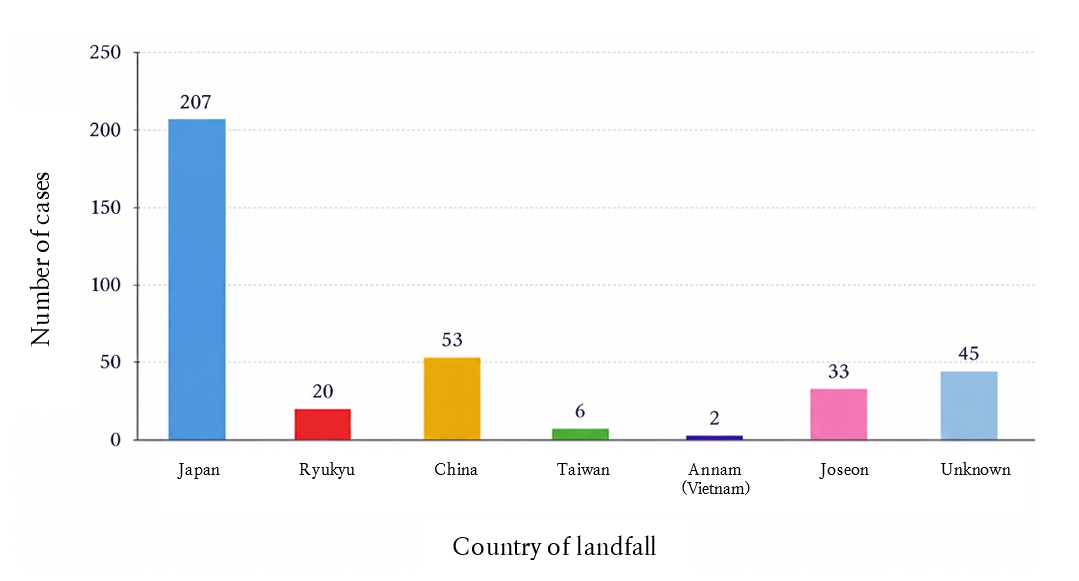
In terms of distribution by country of landfall, Japan accounted for the highest number of cases at 207 (71.9%), followed by China with 53 cases (18.4%), Ryukyu with 20 cases (6.9%), Taiwan with 6 cases (2.1%), and Annam with 2 cases (0.7%). This distribution indicates that the southwestern waters of Japan and the East China Sea, which are adjacent to Jeju waters, formed the main drift zone for these vessels (Kim, 2017: 47).
3.3. Distribution of Country-Specific Landfall Sites for Jeju Castaways
Figure 2 illustrates the primary landfall sites by country for Jeju castaways during the Joseon period. Overall, the trajectories of these castaways spanned the entire East Asian maritime region—including Japan, Ryukyu, China, Taiwan, and Annam—demonstrating that their maritime activities extended into both the East China and South China Seas. Notably, these drift routes were not merely accidental movements; rather, they exhibited a consistent spatial pattern repeatedly shaped by the convergence of monsoons and ocean currents.
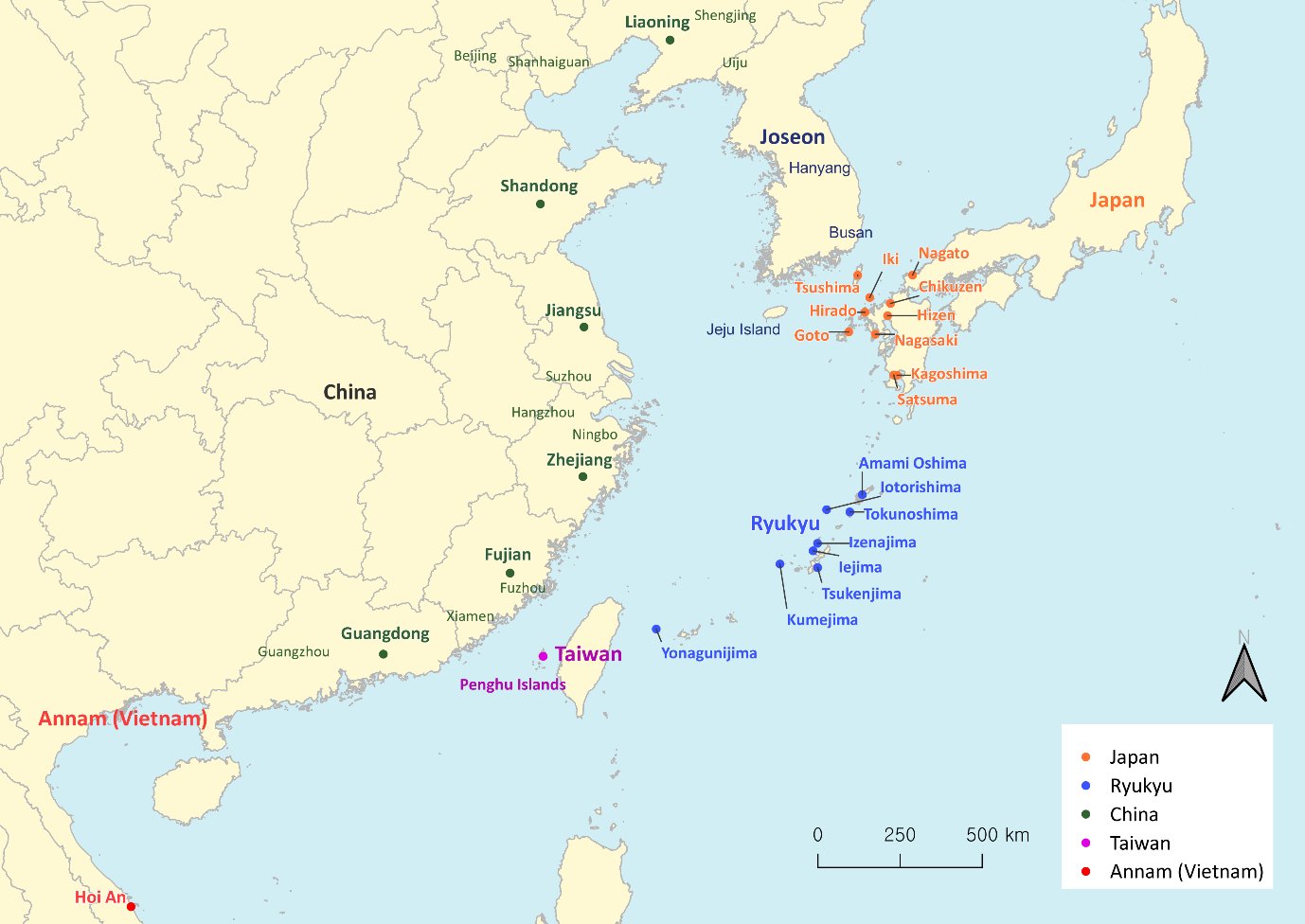
The primary landfall sites in Japan, which accounted for over 70% of all drift cases involving Jeju castaways, were concentrated in the country’s southwestern maritime region. These locations included Goto, Tsushima, Iki, Hizen, Satsuma, Nagasaki, Kagoshima, Hiradoshima, Chikuzenshu, and Nagato. In particular, the Goto region was the most prominent landfall site, accounting for 92 cases—approximately 44.4% of the total landfall cases in Japan (Kim, 2017:48-49). This spatial pattern was a direct consequence of the Kuroshio Current, the Tsushima Warm Current, and the winter northwestern monsoons, which repeatedly drove Jeju vessels into southwestern Japanese waters.
The principal landfall sites in Ryukyu were distributed across various parts of the archipelago. These included 5 cases in Oshima, alongside landfalls on Kumejima, Izenajima, Tokunoshima, Fukajima, Tsukenjima, Iejima, Tsurushima, and Torishima. As island regions situated within the East China Sea, Jeju and Ryukyu shared a common maritime environment; consequently, there was a high probability of vessels drifting into each other’s waters under the influence of the Kuroshio system and winter northwestern monsoons. Indeed, drift cases to Ryukyu tended to concentrate during the winter season, mirroring the pattern observed in landfalls to Japan (Kim, 2017: 50).
Regarding the landfall sites of Jeju islanders in China, Zhejiang Province accounted for the highest proportion with 11 cases, followed by Fujian and Jiangsu Provinces with 8 cases each. Additionally, landfalls were confirmed along various other parts of the Chinese coast, including Guangdong, Liaoning, and Shandong Provinces. Overall, the landfalls of Jeju castaways were concentrated along the East China coast, including Jiangsu and Zhejiang, and the South China coast, including Fujian and Guangdong. This spatial pattern is understood to be a result of Jeju vessels making long-distance drifts to the Chinese coast under the influence of southeastern monsoons, typhoons, and the Yellow Sea circulation. In particular, around August and September, drift cases to the coasts of Jiangsu, Zhejiang, and Fujian occurred frequently due to the impact of typhoons and tropical depressions (Kim, 2017: 51-52).
The 6 cases of Jeju islanders’ drifting to Taiwan occurred exclusively after the eighteenth century. This period followed the Qing dynasty’s tightening of maritime surveillance to suppress anti-Qing factions and pirate networks after defeating the forces of Zheng Chenggong (Koxinga). During this era, Jeju castaways made landfall in areas such as Changhua County and the Penghu Islands.
Meanwhile, Jeju islanders drifted beyond the East China Sea to Annam, with a total of 2 cases confirmed to date. Of these two cases, the one where the landfall site is clearly verified is the 1687 incident involving Kim Dae-hwang and his crew at Hoi An. This specific case demonstrates that the maritime drift range of Jeju islanders expanded deep into the South China Sea, illustrating the wide-area connectivity of the premodern East Asian maritime region.
Consequently, the drifting of Jeju islanders during the Joseon period was neither a random nor an isolated phenomenon. Instead, it represented a spatial flow repeatedly shaped by the structural environment of the East Asian maritime zone, including monsoons, ocean currents, and shipping networks. This evidence demonstrates that the premodern East Asian maritime region was not a fragmented borderland, but rather a dynamic network through which people, vessels, goods, and information continuously circulated.
4. The Repatriation System of Jeju Castaways by Landfall Country and the Operation of the Hierarchical Reciprocal Order
The overseas drifting of Jeju islanders within the premodern East Asian maritime region was far more than a series of isolated maritime accidents; it constituted a dynamic arena where the East Asian international order practically operated. Although drift events themselves occurred accidentally and discontinuously, the subsequent rescue and repatriation processes were systematically managed, grounded in interstate diplomatic norms and Confucian notions of ritual propriety. In particular, these cases provide critical insights into the repatriation policies and diplomatic protocols enforced by various East Asian states, including China, Taiwan, Japan, Ryukyu, and Annam.
Therefore, by comparing and analyzing the repatriation practices applied to Jeju castaways across different landfall countries, this section demonstrates that the premodern East Asian maritime order was an international system predicated on ‘hierarchical reciprocity,’ wherein participants mutually shared a humanitarian obligation to ‘protect and repatriate castaways.’
4.1. China (Ming and Qing): The Regularization of the Castaway Repatriation Practices under the Sinocentric Order
Rooted in the Sinocentric worldview and the Confucian ideology of sadae-jaso, the Ming and Qing dynasties perceived foreign castaways as subjects deserving of protection and relief. Consequently, following strict institutional procedures, these empires rescued and repatriated them entirely at state expense.
The repatriation procedures established during the Ming period followed a strict four-stage process before the castaways were escorted to Beijing, where the imperial palace was located. In the first stage, frontline coastal defense soldiers stationed at military garrisons conducted the initial interrogation. This was followed by a secondary interrogation administered by the garrison’s commanding officer. The third stage involved a reexamination by provincial-level military commanders. In the final stage, the highest-ranking provincial officials—including the regional commander, grand coordinator, and surveillance commissioner—cross-checked the prior investigative records, inquired about domestic affairs in Joseon, and issued official documentation to authorize the escort to Beijing (Wang, 2012: 183).
During the Qing dynasty, maritime activities expanded substantially following the enactment of the Jeonhaeryeong (展海令, Edict to Open the Seas) in 1684. Furthermore, the regulations governing the rescue and repatriation of castaways became increasingly systematic through imperial edicts issued in 1729 and 1737. This institutional development under the Qing can be understood as a manifestation of a dynamic ‘maritime vision’ through which the empire, moving beyond the conventional perception of it as a purely land-based power, asserted strict judicial and administrative control over coastal spaces and expanded its hegemonic jurisdiction from the eighteenth century onward (Po, 2018). In other words, the establishment of a stable, state-level, fully funded repatriation system—wherein the authorities provided food, clothing, and travel expenses using official funds—signifies that the Qing Empire, in the process of controlling and organizing its coasts, completely incorporated castaway management into the official domain of maritime defense and maritime administration. This enhanced repatriation apparatus not only provided reliable relief for foreign castaways but also exerted a profound institutional influence across the broader maritime repatriation networks of the premodern East Asian maritime region.
Jeju castaways were generally repatriated via an overland route: from their landfall site to Beijing, and then through Shanhaiguan, Shengjing, and Uiju, before finally entering Joseon territory. They either returned alongside official Joseon diplomatic missions or were escorted by Qing officials under the supervision of the Ministry of Rites to be formally handed over to Joseon authorities. Once repatriation was complete, the King of Joseon concluded the diplomatic protocol by dispatching an official communication of gratitude to the Qing Ministry of Rites and submitting a memorial of thanks to the emperor (Liu, 2010: 149). This process extended beyond mere humanitarian rescue, serving as a diplomatic act that practically embodied the empire's moral authority and the investiture-tribute order, while simultaneously demonstrating the institutional capacity of the Qing Empire to govern its own maritime frontiers (Po, 2018).
4.2. Taiwan: A Peripheral Repatriation System under Qing Maritime Control
The 6 cases of Jeju islanders drifting to Taiwan occurred exclusively during the eighteenth and nineteenth centuries, following the Qing dynasty’s expansion of its maritime dominion to encompass the island. After the subjugation of Taiwan by the Qing in 1683, the island was incorporated as the Taiwan Prefecture (Taiwan-fu) under the jurisdiction of Fujian Province. Consequently, foreign castaways from Jeju were processed directly through the Qing dynasty’s maritime relief and repatriation system, undergoing administrative protocols virtually identical to those enforced on the Chinese mainland.
Upon being rescued by the local county authorities, Jeju castaways underwent an initial investigation by local officials to verify their nationality, identities, social status, and the circumstances surrounding their drift accident. They were then transferred to Taiwan Prefecture for a secondary interrogation of a similar nature. Subsequently, the castaways crossed the Taiwan Strait via Xiamen, traveled through Fuzhou (the provincial capital of Fujian), and were escorted to the imperial capital of Beijing before being repatriated to Joseon via Uiju. Their standard repatriation route thus proceeded from the Taiwan landfall site to Taiwan Prefecture, across the sea to Xiamen, overland to Fuzhou, and onward to Beijing, before finally entering Joseon through Uiju.
This institutional repatriation system, however, revealed clear limitations in peripheral regions beyond the effective reach of Qing administrative authority. A prime example is the 1758 case of Kim Yeon-song and his twelve companions, who made landfall in Miaoman Village—an indigenous territory in eastern Taiwan. Upon arrival, the castaways were detained, plundered, subjected to forced labor, and coerced into permanent settlement. They were only able to reenter the official repatriation network after a Qing merchant privately intervened and facilitated their transfer to the Taiwan Prefecture (Kim, 2017: 163). This incident underscores that the reciprocal repatriation order in premodern East Asia operated with structural stability only within spaces directly governed by the central state.
4.3. Japan: A Pluralistic Repatriation System under the Neighborly Relations Order
Unlike the centralized Chinese system, Japan’s repatriation system for Jeju castaways was characterized by a pluralistic and decentralized structure involving both the shogunate and local domains.
During the Muromachi period, spanning the fifteenth and sixteenth centuries, repatriations were conducted either directly by the feudal lords of the landfall sites or through the mediation of Tsushima. Against this background, Joseon established gyorin (交隣, neighborly relations) system to curb Japanese piracy and stabilize diplomatic ties, designating Tsushima as the official diplomatic channel and granting it exclusive trade privileges. The repatriation of castaways thus became deeply intertwined with these trade rights. To safeguard its exclusive diplomatic and commercial monopoly, the lord of Tsushima occasionally interfered with repatriation attempts made by other feudal lords or went so far as to deploy fabricated envoys. As a result, Japan’s repatriation system during the early Joseon period functioned more as a commercially reciprocal arrangement than as a humanitarian, state-funded return.
Subsequently, from the seventeenth to the nineteenth centuries, the Edo shogunate centralized diplomatic authority and regularized the repatriation system. By managing relations with Joseon, Ryukyu, China, and the Netherlands hierarchically and differentially, the shogunate established its own independent foreign order without being integrated into the Sinocentric investiture system. In this process, incorporating the protection, investigation, and repatriation of foreign castaways into official diplomatic procedures was a core practice aimed at demonstrating coastal control and seizing the diplomatic initiative (Toby, 1984). In other words, the refinement of the castaway management system functioned as a practical mechanism to strengthen the shogunate's own foreign control and diplomatic legitimacy, alongside the stable maintenance of neighborly relations between Joseon and Japan. Accordingly, the return of Joseon castaways was carried out as gayeok (家役, hereditary official duty) imposed on the Tsushima domain (Hong, 2013: 171-173). Castaways who made landfall on the Japanese mainland were sheltered and investigated in Nagasaki—a territory under the shogunate’s direct control—before being transferred to Tsushima and ultimately returned to Busan. Crucially, the shogunate bore the financial costs of this repatriation, indicating that the relief of castaways had become firmly established as an institutional diplomatic practice to maintain neighborly relations between Joseon and Japan (Lee, 2003: 280). This attests to the fact that despite not being integrated into the Sinocentric investiture system, Japan actively participated in the castaway rescue and repatriation regimes of the East Asian maritime region, leveraging the shogunate's own independent capacity to manage foreign relations (Toby, 1984).
4.4. Ryukyu: Shifting Geopolitics and the Realignment of Repatriation Routes
Ryukyu’s repatriation routes for Jeju castaways evolved through three distinct modes driven by shifts in the East Asian geopolitical landscape: direct transport to Joseon by Ryukyu envoys, transit through Japan, and a detour via China.
During the fifteenth century, the primary repatriation mode involved the Ryukyuan king dispatching official envoys to escort castaways directly back to Joseon. In this process, Hakata merchants from Japan, commissioned by the Ryukyuan court, frequently engaged in these repatriations under the guise of fabricated envoys to expand their own trading opportunities with Joseon. Following Ryukyu’s subordination by Japan’s Satsuma domain in 1609, however, the repatriation system was realigned under the Japanese shogunate-domain system. Yet, despite this subordination, Ryukyu occupied a dual status, being partially integrated into the Japanese shogunate-domain system while maintaining its investiture relations with China intact (Smits, 1999). Consequently, the repatriation of Jeju castaways who made landfall in Ryukyu shifted to a transit route through Japan, proceeding from Satsuma to Nagasaki, Tsushima, and ultimately Busan. Following the Qing dynasty’s lifting of the maritime ban in 1684, Ryukyu deliberately avoided the Japan transit route to safeguard its investiture relations with the Qing. From the eighteenth century onward, a detour route via Fujian and Beijing to Joseon was maintained over a prolonged period (Lee, 1999: 226-228).
These strategic shifts demonstrate that Ryukyu successfully navigated its survival within the East Asian international order by carefully calibrating its diplomatic balance between China and Japan. Furthermore, the historical reality that each transit state bore the associated costs, regardless of the route chosen, empirically demonstrates that the principle of state-funded repatriation for castaways had been firmly established and practiced as a universal norm across the premodern East Asian maritime region.
4.5. Annam (Vietnam): Unofficial Commercial Repatriation and Maritime Humanitarianism
Only 2 cases of Jeju islanders making landfall in Annam are documented during the Joseon period. Of these, the 1687 repatriation of Kim Dae-hwang and his crew, totaling twenty-four individuals, stands out as a unique instance where ‘repatriation for a fee’ was executed through the maritime network of private merchants from a third country, in the absence of formal diplomatic relations between the two states.
At the time, despite lacking diplomatic ties with Joseon, Annam fulfilled its relief obligations grounded in the Confucian principle of in (仁, benevolence), providing lodging, meals, and supplies to the castaways over an extended period. However, since no official diplomatic or repatriation framework existed between the two nations, Annam opted for an alternative: entrusting the castaways to private vessels operated by local Chinese merchants—specifically, Chen Jian from Fujian and Zhu Hanyuan from Zhejiang. In this process, a so-called ‘paid repatriation contract’ was forged between the Annam authorities and the Chinese merchants, stipulating that the Joseon government would later compensate them with 600 bags of rice for the castaways’ passage and shipping fees. Boarding the Chinese merchant vessel, Kim Dae-hwang’s group departed Annam and returned toward Jeju via the Chinese coast, traveling through Guangdong, Fujian, and Zhejiang. Upon arrival, the Chinese merchants were escorted to Hanyang (Seoul) in accordance with state protocol. The Joseon court then officially settled this private contract using state funds, paying 2,556 taels of silver on behalf of the castaways, who could not afford the transit costs. Subsequently, the court escorted the Chinese merchants by land to Beijing, where they were handed over to Qing authorities. Fearing diplomatic friction with the Qing, Joseon chose not to dispatch a direct official reply to the king of Annam. This unique mechanism is diagrammed as Pattern 2 in Figure 3.
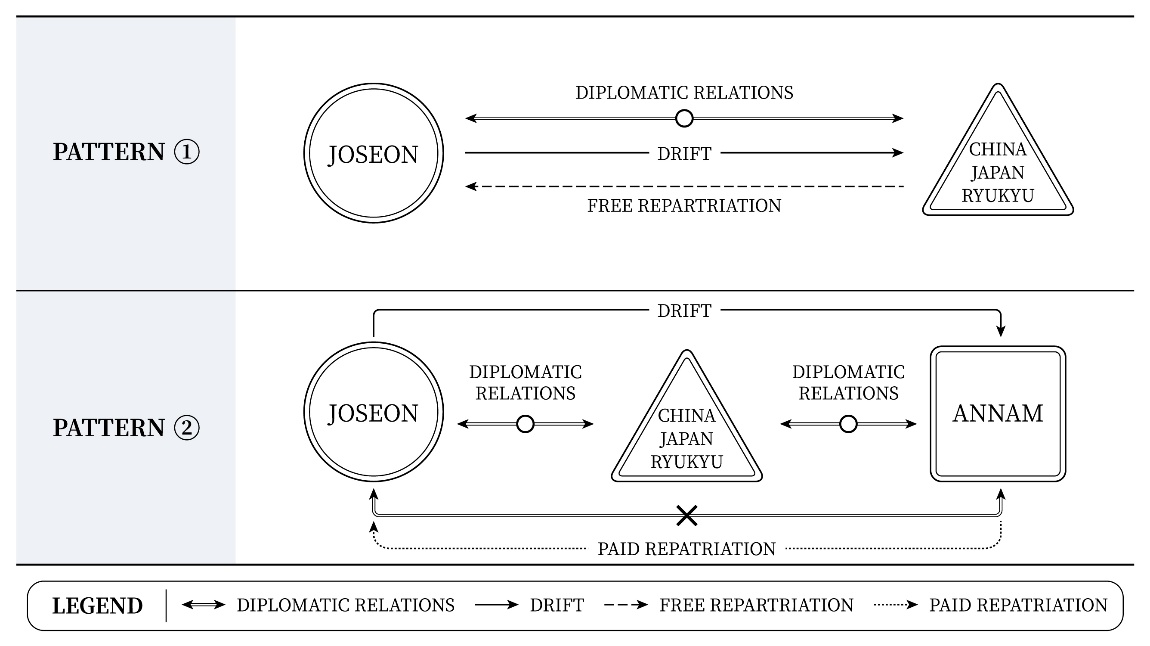
Ultimately, the repatriation of Kim Dae-hwang’s group demonstrates that drift incidents between non-signatory states could be organically resolved through the commercial networks of third-country merchants. This cross-border interaction suggests that the repatriation system for castaways in the premodern East Asian maritime region operated within a complex order where state diplomacy and private commercial networks intertwined.
5. Conclusion: Reexamining the Premodern East Asian Maritime Order and Its Contemporary Significance
By analyzing cross-border drift and repatriation cases involving Jeju islanders, this study has demonstrated that the premodern East Asian maritime order was not a system of unilateral, vertical dominance. Instead, it functioned as a ‘hierarchical reciprocal order’ wherein mutual protection and responsibility operated within a symbolic hierarchy. This research holds significance by defining castaway repatriation not merely as the administrative management of maritime accidents, but as a crucial case study that reflects the operational principles of the international order in East Asia. Furthermore, it shifts the historical perspective of Jeju from an isolated, peripheral island to a bridgehead of the East Asian maritime network, highlighting Jeju castaways as historical agents who demonstrated the practical mechanisms of this maritime order.
The findings indicate that the repatriation system in premodern East Asia was grounded in the principles of mutual protection and responsibility within the symbolic hierarchy of the Sinocentric order. East Asian states institutionalized standardized procedures spanning rescue, interrogation, relief, and repatriation based on the investiture-tribute system under the Confucian ideology of rule by ritual. They regarded this process as a practical apparatus for maintaining interstate diplomatic stability.
In practice, 82.9% of Jeju islanders who drifted to foreign lands—totaling 3,681 individuals—survived and returned home during the Joseon period, with specific procedures taking diverse forms depending on the political and diplomatic circumstances of the landfall countries.
In the case of China and Taiwan, a systematic, state-funded repatriation was implemented by deploying a structured four-stage interrogation process refined during the Ming and Qing eras, alongside a relief system codified during the Qianlong reign. Japan likewise regularized the repatriation of castaways as an official duty for the Tsushima domain following the establishment of the Edo shogunate, bearing all relief and escort costs from its state budget to utilize repatriation as a peaceful diplomatic instrument for sustaining good neighborly relations. Meanwhile, navigating the volatile geopolitics of the Ming-Qing transition and its 1609 subordination by Japan’s Satsuma domain, Ryukyu flexibly alternated between direct repatriation to Joseon and detours via Japan or China. It thereby calibrated diplomatic equilibrium and reciprocal relations within a multilateral maritime order (Haneda, 2018: 256-257). Notably, in the case of Annam (Vietnam), which lacked official diplomatic ties with Joseon, the institutionalized principle of state-funded return established with China, Japan, and Ryukyu could not be applied. Nevertheless, driven by the Confucian concept of benevolence, Annam preemptively provided relief to Jeju castaways. In the absence of a direct repatriation route, it opted to forge a ‘paid repatriation contract’ mediated by the maritime network of Chinese merchants. Following the castaways’ return, the Joseon court concluded the matter by settling the associated expenses through official procedures. This case demonstrates that, even between states lacking diplomatic ties, flexible and reciprocal repatriation functioned based on practical consultations and mutual needs. Admittedly, negative cases involving detentions and forced labor existed due to political suspicion or regional constraints. However, the fact that castaways were regarded as individuals to be safely returned, rather than as human resources to be exploited or exchanged, suggests that a humanitarian consensus and reciprocal norms substantially operated at the core of the East Asian maritime order at the time.
Meanwhile, the institutionalized system of state-funded repatriation and relief in premodern East Asia did more than serve diplomatic and humanitarian functions; it also influenced the maritime perceptions and mobility patterns within Jeju society itself. As information regarding the generous relief and reliable repatriation experienced by returned castaways in their countries of landfall spread throughout local communities, drifting came to be perceived as an alternative survival strategy by Jeju islanders suffering from frequent natural disasters and oppressive tribute tax burdens. Consequently, the stabilized East Asian repatriation system paradoxically triggered an unintended side effect: an increase in ‘intentional, voluntary drift,’ known historically as gopyo (故漂).
Ultimately, the castaway repatriation system in premodern East Asia constituted a maritime-level peacekeeping mechanism that institutionalized interstate cooperation based on Confucian civilizational consciousness and ritual governance norms. The reciprocal norms and historical experiences embodied in this maritime world offer critical implications for reconsidering contemporary maritime cooperation and transnational order in East Asia. More broadly, they provide a valuable historical point of reference for the construction of sustainable systems of peace and cooperation founded upon mutual trust in today’s pluralistic international environment.
References
- Arano, Y., 2003. The repatriation system for castaways and international relations in early modern East Asia, in: Jeju National Museum (Ed.), The History of Navigation and Drifting. Sol, Seoul, pp. 292–304.
- Benton, L.A., 2010. A Search for Sovereignty: Law and Geography in European Empires, 1400–1900. Cambridge University Press, Cambridge.
- Haneda, M., 2018. History Seen from the Sea: Openness, Competition, and Coexistence—A 700-Year History of Cultural Exchange in East Asia. Minumsa, Seoul.
- Hevia, J.L., 1995. Cherishing Men from Afar: Qing Guest Ritual and the Macartney Embassy of 1793. Duke University Press, Durham, NC.
- Hong, S., 2013. The role of Tsushima Domain in Joseon-Japan relations in the late Joseon period. Journal of Northeast Asian History 41: 171–173.
- Ikeuchi, S., 1998. Early Modern Japan and Joseon Castaways. Rinsen Shoten, Kyoto.
- Kang, D.C., 2010. Hierarchy and legitimacy in international systems: the tribute system in early modern East Asia. Security Studies 19(4): 591–622.
- Kang, D.C., 2020. International order in historical East Asia: tribute and hierarchy beyond Sinocentrism and Eurocentrism. International Organization 74(1): 65–93.
- Kang, J., Lee, S., 2015. Confucian international order: its ideal and contemporary implication. Journal of Korean Philosophical History 47: 184–194.
- Kim, G., 2010. The systems for assistance for accidents and rescue of drifters in pre-modern Korea. Journal of Northeast Asian History 28: 7–10.
- Kim, N., 2016. A study on the aspects of drifter’s concealment of Jeju origins in the 15th–19th century. Journal of Local History and Culture 19(1): 58–101.
- Kim, N., 2017. A study on Jeju islanders drifted to other countries and foreign castaways to Jeju Island in Joseon dynasty (Doctoral dissertation). Jeju National University, Jeju.
- Kwon, S., 2014. East Asian interstate relations in the Confucian li thought. Journal of Korean Political and Diplomatic History 35(2): 151–160.
- Lee, H., 1999. Joseon–Ryukyu relations viewed through human exchange, in: Joseon and Ryukyu. Arche, Seoul, pp. 226–228.
- Lee, H., 2003. Modern Korea–Japan relations from the perspective of ‘drifting’: focusing on repatriation procedures. Journal of Korean History 123: 279–280.
- Lee, J., 2016. China's Hegemony: Four Hundred Years of East Asian Domination. Columbia University Press, New York.
- Liu, X., 2010. The rescue and repatriation of foreign drifters by Qing China: focusing on cases involving Koreans and Japanese. Journal of Northeast Asian History 28: 131–136.
- Li, X., 2025. A study on the repatriation of Joseon castaways drifting to China during the 17th to 19th centuries (Doctoral dissertation). Kyungpook National University, Daegu.
- Po, R.C., 2018. The Blue Frontier: Maritime Vision and Power in the Qing Empire. Cambridge University Press, Cambridge.
- Smits, G., 1999. Visions of Ryukyu: Identity and Ideology in Early Modern Thought and Politics. University of Hawaii Press, Honolulu, HI.
- Tang, X., 2002. Methods of China in rescuing Joseon shipwrecked vessels and castaways during the Shunzhi and Qianlong periods. Collected Papers on the History of Chinese Maritime Development 8: 98–99.
- Wang, T., 2012. The salvage system of Ming dynasty on Korean castaways: focusing on Jeju castaways who arrived in China. Journal of Korean Historical-Folklife 40: 169–183.