
Youths in Search of Place: Lessons from Spain’s Generation of ’98 for Busan and Jeju
 10.21463/jmic.2026.15.2.03
Abstract
This study examines the public sphere formation associated with Spain’s Generation of ’98 and employs it as a comparative framework for understanding contemporary youth crises in Busan and Jeju, South Korea. We analyze three aspects of public sphere vitality—openness, rational-critical discourse, and institutional impact—using Habermas’s theory of the public sphere. As the analysis demonstrates, the youth crisis in Busan is not only an outcome of economic contraction, demographic decline, and out-migration in a post-industrial society but also the result of the loss of independent cultural spaces and inadequate structural conditions for youth discourse to affect policy. In contrast, Jeju is experiencing a youth crisis stemming from tourism-centric development, increases in living pressures, and the disappearance of local and traditional cultural spaces. In both contexts, the difficulties faced by young people are both socioeconomic in nature and a consequence of the contraction of communicative spaces where young people can interpret regional change, voice shared concerns, and forge collective futures. The Generation of ’98 is a case in point of how intellectual/cultural agents can create a movement that turns crisis into public reflection, albeit within a bounded and socially limited arena. Drawing on this comparison, we propose a youth-led regional cultural commons as a tool for enhancing the agency, deliberative participation, and regionally-based democratic renewal of young people.
Keywords
Busan City–Jeju Island, Generation of ’98, Public Sphere, Youth Crisis, Regional Decline
1. Introduction
Contemporary Busan and Jeju are confronted with shared challenges, including youth out-migration, precarious employment, housing insecurity, and the erosion of autonomous cultural spaces. While these problems are typically presented as socioeconomic problems, they also signify the loss of sites where the young can collectively make sense of what is happening to them, voice criticism, and envision other futures for their cities. This phenomenon can be interpreted through Habermas’s (1989) concept of the public sphere as a social space in which citizens critically and rationally discuss matters of common interest. Habermas called for a communicative arena free of both domination and the market and asked that public opinion be formed in a discursive manner (Calhoun, 1992). Thus, the reduction of independent cultural spaces for the youth of Busan and Jejudo represents not only a loss of recreational facilities but also a loss of civic and cultural spaces that are important for democratic participation, collective identity formation, and urban imagination (Fraser, 1992). Korea’s current urban situation is therefore similar to that of the cultural crisis faced by the so-called Generation of ’98 in Spain, and both are dealing with this phenomenon by endeavoring to come up with some kind of answer, by reflecting on it, and by attempting to reconstruct public cultural life in terms of a regional youth agenda.
Many studies have been conducted on youth out-migration from Busan and Jejudo as well as on industrial restructuring, demographic decline, and regional inequality on the basis of a socioeconomic perspective. However, relatively little analysis has been devoted to such phenomena from the standpoint of cultural-political theory and public sphere transformation. Prior research has mostly examined both employment precarity and housing instability, viewing youth discontent as a consequence of material deprivation or labor market imbalance (Sassen, 2001; Harvey, 2012). This literature pays less attention to how structural decline reshapes the communicative contexts in which young people interpret social change, form collective identities, and develop civic agency. (Dahlgren, 2009). Specifically, there is a considerable lack of studies on the role of the erosion of independent cultural spaces, the fragmentation of discourse in digital media, and the weakening of deliberative institutions in the contraction of a youth public sphere in Busan and Jejudo (Habermas, 1989; Fraser, 1990; Papacharissi, 2002). The current work accordingly takes a participatory turn by drawing upon Habermas’s theory of the public sphere, which focuses on shifting attention from merely economic measures to the crisis of collective sense-making itself, looking into urban decline both materially and communicatively and culturally (Habermas, 1996).
The contextual and comparative structures of Spain’s Generation of ’98 and present-day Busan are based not on a superficial historical similarity but on a shared structural condition of destabilization of identity within crisis. Despite differences in time, space, and political context, both cases refer to societies that are forced to deal with the symbolic disintegration of previously prevailing dominant developmental narratives: the former, with the symbolic loss of imperial modernity after El Desastre (Balfour, 1997; Carr, 1982), and the latter, with the erosion of the identity of an industrial-port city in the process of post-industrial transition, shifting demographics, and overarching centralization toward Seoul (Sassen, 2001). In both settings, the younger intellectual/cultural ones are compelled to redefine a collective downfall and create some meaning in an environment where the old institutions are no longer perceived as credible (Labanyi, 2010). Correspondingly, this study views the Generation of ’98 not only as a literary movement but also as a historical instance of crisis-responsive public sphere formation (Habermas, 1989). The comparison is analytically valuable because it draws attention to how struggle over interpretation, identity, and future imagining arise from the conditions of structural crisis, as well as how the discursive formation among young individuals can either be individualized and despairing or transform into a more coherent arena for civic reflection. We therefore suggest that the current youth crisis in Busan City and Jeju Island (Jejudo) should be understood not only as a socioeconomic issue but also as a crisis of public communication and democratic imagination (Fraser, 1992; Dahlgren, 2009).
2. Theoretical and Research Framework: Habermas’s Public Sphere
The key analytical framework used in this study is the concept of the public sphere put forth by Jürgen Habermas (1989), who defined the public sphere as a site of discussion and a historically specific communicative structure. This sphere came into being in eighteenth-century Europe when the bourgeoisie emerged between the private sphere of the household and the public sphere of the state (Calhoun, 1992). In this arena, people were supposed to put aside class, wealth, and personal interests to deal with each other as equals in logical-critical discussion. For Habermas, this phenomenon was not only cultural in nature but also the very substance of democratic legitimacy: Legitimacy of political authority can be acquired only if it is responsive to public opinion developed through open, rational, and logical deliberation (Habermas, 1989).
Habermas asserted that for a public sphere to be fully effective, it requires three interdependent conditions, of which the first is openness or accessibility. In principle, participation should be offered to everyone in society, irrespective of class, gender, education, or other markers of social hierarchy (Fraser, 1990). Accessibility is more than physical availability; it is about eliminating economic, cultural, and technological obstacles to participation in meaningful public conversation. In today’s contexts, this requirement also includes digital accessibility, the neutrality of algorithms, and the minimization of gaps in involvement in online digital environments (Papacharissi, 2002).
The second condition is rational-critical discourse. Habermas (1984) claimed that the exchange of opinions is not the most important part of the public sphere but argumentation supported by evidence, logicality, and a willingness to be challenged. Participants should be prepared to defend their stances, respond to arguments, and modify their views when confronted with better arguments. There must be some self-reflexivity in the process, in that people should be aware of their own assumptions and biases and reflect on them. Emotional expression is not excluded, but it must be translated into publicly justifiable contentions that can be public and not private sentiment or the tactical art of persuasion (Benhabib, 1992). In this context, the public sphere becomes a place that allows the transformation of individual experiences into common problems that people would solve together.
The third condition is institutional impact. A public sphere that generates discourse but not the mechanisms by which the conclusions of the public sphere can impact political or administrative decisions is incomplete. Habermas believed that structural connections with formal institutions need to be established for the public sphere, enabling public opinion to influence legislation, policies, and cultural norms (Habermas, 1996). This does not necessarily involve having a direct decision-making authority, but it does entail having credible mechanisms for considering and evaluating deliberative outcomes and bringing them into institutional processes. Without these connections, public discourses run the risk of generating merely symbolic consequences (Dryzek, 2000).
Habermas further pointed out that since its onset, the public sphere has undergone substantial structuring. The public sphere has, in modern times, been increasingly “refeudalized” (Habermas 1989) through the advent of industrial capitalism and mass media, as well as by the development of bureaucracies in the so-called welfare state. Cultural products are commercialized, and citizens are turned into consumers, with the focus of media shifting from critical debate to entertainment and advertisement (Thompson, 1995). Meanwhile, political decision-making is increasingly technocratic, and the process of policy formulation is more expert/administrative than popular deliberative. As public relations and political marketing become increasingly central to political communication, public discourse is redirected toward the manufacture of consent rather than the formation of critical public opinion (Habermas, 1989; McNair, 2011). This shift undermines the rational-critical character of the public sphere and weakens its capacity to subject power to public scrutiny.
Habermas (1984) believed that social coordination should be idealized as communicative rationality (interaction for reaching mutual understanding) and not as strategic action for reaching a predetermined goal. Deliberative democratic theory extends this principle into the political realm, arguing that democratic legitimacy rests on participatory, reasoned, and informed public deliberation (Habermas, 1996).This change reflects the normatively significant requirement to establish institutional designs that foster excellent, sustained public discourse (Cohen, 1989).
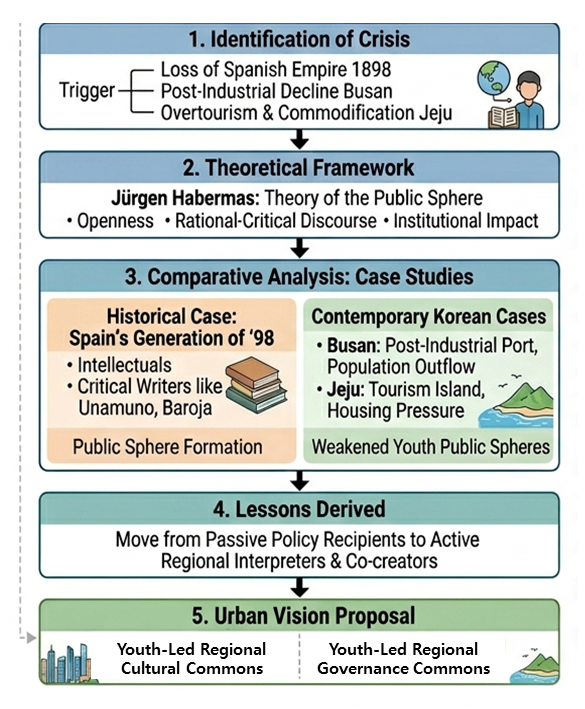
Our study uses Habermas’s framework not as a rigid model but as a diagnostic tool (Figure 1), thereby enabling a structured comparison of the Generation of ’98 in Spain and contemporary youth culture in Busan. We evaluate each case according to the three core dimensions of openness, rational-critical discourse, and institutional impact. This approach allows us to identify the strengths and limitations of each public sphere and derive normative implications for how Busan’s youth might cultivate a more robust and influential role in shaping the city’s future. By situating both historical and contemporary cases within this theoretical lens, the analysis demonstrates how public sphere vitality is essential for collective self-understanding and the democratic regeneration of societies facing crisis (Carr, 1982; Labanyi, 2010).
3. The Generation of ’98 as a Historical Public Sphere
3.1. Crisis Context and Emergence
The Generation of ’98 can be seen not only as a literary movement but also as a historically located intellectual reaction to structural crisis. In 1898, Spain lost the Spanish–American War, or El Desastre, which substantially affected Spain’s sense of national identity and legitimacy (Balfour, 1997; Carr, 1982). The Generation of ’98 comprised critical intellectuals who sought to reassess Spain’s condition through sustained reflection on the foundations of its culture, history, and national identity (Ramsden, 1974).They were not directly involved in political mobilization but concentrated on “the reconstruction” of a modern national consciousness through intellectual and cultural intervention (Fox, 1978). The orientation demonstrates their turn from being merely a passive observer of the crisis to being an active agent of the nation’s decline, which can be defined as a modern public sphere (Habermas 1989; Labanyi 2010).
3.2. Public Sphere Characteristics
One of the most significant contributions of the Generation of ’98 in the social sphere is that they constructed a rational-critical discourse that is very similar to Habermas’s (1989) idea of the public sphere. Through their novels, essays, and journalistic writing, they systematically diagnosed the structural problems of Spain, from the corruption of the political system to the stagnation of education and existential disorientation (Carr, 1982; Labanyi, 2010). Their intellectual work can be analytically described as “crisis recognition - self-reflection - public problematization,” in which private concerns over national decline were converted into public issues for discussion and deliberation (Calhoun, 1992).
Miguel de Unamuno and Pío Baroja illustrated this process. Unamuno’s novels, such as Mist (Niebla) and San Manuel Bueno, mártir, are characterized by existential and spiritual questioning that rely on the disruption of subjectivity and metafictional devices (Unamuno, 1914/2007). Similarly, The Tree of Science (El árbol de la ciencia) by Baroja (1911/2001) is a radical criticism of Spain’s institutional and intellectual shortcomings in terms of the disillusionment of Andrés Hurtado. These works did not merely reflect social reality; they also provided an interpretive framework through which readers could recognize national decline as a shared crisis (Ribbans, 1964)
Azorín and Ramiro de Maeztu helped rebuild Spanish identity by engaging with history and by criticizing Spanish culture and history. Their works, together, raised the question “What is Spain for us?” and brought the concept of a nation to the public sphere (Azorín, 1902/1998; Maeztu, 1934). If Habermas is right in his description of this phenomenon as the successful establishment of a rational-critical public sphere, then intellectuals served as mediators, as designers of public discourse that mediated the individual and the social.
3.3. Key Literary Examples as Public Sphere Contributions
The literary works of the Generation of ’98 were not simply aesthetic works but also critical contributions to the creation of a modern public sphere. In these works, the authors carried out experiments in narration and inquired into the philosophical to convert their intimate fears into issues that could be understood by the public and thus collectively reflect on.
In this transformation, perhaps one of the most striking examples is Miguel de Unamuno’s Mist (Niebla, 1914). The protagonist Augustus Perez of the masterpiece of the novel faces his own author and asks about the nature of his life and his autonomy (Unamuno, 1914/2007). Through this metafictional strategy, Unamuno challenges established authority and invites reflection on free will, identity, and existential authenticity (Longhurst, 1969).The novel is not merely a philosophical work, but it drives the reader to question their own attitude to current systems of authority: religious, political, and intellectual. Unamuno is a Habermasian kind of figure, as he turns existential anxiety into a problem in the sense that it can be made public and subject to rational-critical reflection in the cultural sphere (Habermas, 1989).
The Tree of Science (El árbol de la ciencia, 1911) by Pío Baroja (1911/2001) looks at Spain’s institutional shortcomings from the point of view of Andrés Hurtado, a disappointed medical student. Throughout the novel, Andrés sees education, science, religion, and politics as empty, unable to solve social ills (Ribbans, 1964). With Andrés’s psychological fragmentation, Baroja reveals systemic corruption, intellectual paralysis, and moral stagnation. Significantly, it is not only an individual’s despair that is portrayed in the novel but also an invitation to the reader to understand these failures as structural social conditions (Fox, 1978). In this way, Baroja not only lends a voice to a collective and issues a national criticism of the moment of national decline, as a central function of the public sphere, but he also serves as a representative of his generation.
Meanwhile, the Will (La voluntad, 1902) by Azorín is a reflective historical consciousness of the crisis in Spain. As Azorín (1902/1998) uses a disjointed narrative and introspective style, he illustrates the paralysis of contemporary Spain and the lack of collective will in the country. He carries out not nostalgic revivalism but critical historiography, challenging mythologized conceptions of Spain and calling readers to a new interpretation of their historical legacy (Labanyi, 2010). Azorín thus contributed to the formation of a public consciousness that was reflective and critical, rather than one shaped by inherited or unexamined traditions.
As a whole, these texts illustrate the nature of the shift in literature from an instrument of public debate to a medium for public deliberation that occurred during the Generation of ’98. They recognize common issues—existential uncertainty, institutional decay, and historical disorientation—and they offer interpretive models that can help people recognize issues together (Carr, 1982). Their significance lies not in offering immediate political solutions, but in opening new interpretive possibilities for understanding Spanish society in crisis. In this respect, they performed a central function of the Habermasian public sphere by transforming private anxieties into matters of common concern and making them available for rational-critical discussion (Habermas, 1989).
3.4. Limitations and Lessons
The Generation of ’98 marked a significant moment in Spain’s intellectual history by translating a structural national crisis into a subject of public reflection and debate.Their intellectual activity shows how crisis narratives can be transformed in a deliberative discussion, which can allow society to reflect and possibly reform itself (Labanyi, 2010). However, the public sphere they helped create remained socially constrained, as participation was largely confined to educated, middle-class intellectuals. Its inclusiveness and accessibility were therefore limited (Fraser, 1990).Consequently, the discursive impact that they produced did not directly engender institutional change. This restriction was referred to by Habermas (1996) as a weakness in institutional linkage and the inability of discourse to influence political decision-making processes. Still, the effects of the Generation of ’98 must not be overlooked. They helped reshape Spain’s cultural and intellectual landscape by creating a space for public reflection that could have long-lasting, if indirect, effects on social change (Ramsden, 1974).
4. Diagnosing Regional Youth Culture Crises in Busan Through a Habermasian Lens
As South Korea’s second-largest city and a major port, Busan is experiencing interrelated demographic, economic, and cultural challenges that together constitute a youth crisis.Coupled with the lack of stable jobs in traditional industries such as shipbuilding and manufacturing, the high cost of living that far exceeds the wages of young people, and fading distinctive youth cultural spaces, a persistent out-migration of young adults, particularly to the capital Seoul, has occurred. While policy responses have largely focused on job creation, housing subsidies, and entrepreneurship programs, these measures do not fully address a more fundamental problem: the erosion of the youth public sphere. At stake is not merely economic opportunity but also physical and discursive spaces for young individuals to collectively make sense of their situations, raise objections, and envision other civic possibilities (Dahlgren, 2009).
This demographic trend also highlights the extent of the youth problem in Busan on the basis of recent data. Data from Statistics Korea (KOSIS, 2024), for instance, show that Busan has consistently experienced net out-migration among the 20s and 30s age groups for the last 10 years, especially to the Seoul metropolitan area. The youth population has steadily declined at the same time as Busan’s traditional manufacturing and port-based businesses have shrunk, raising concerns about the city’s longer-term sustainability. As a result, Busan has an aging index and birth rate that are among the worst in the major cities of South Korea (KOSIS, 2024). Such developments indicate that Busan’s difficulties go beyond mere short-term economic stagnation, as they also indicate a structural reduction in the city’s ability to keep younger generations as active social and cultural actors.
Qualitative evidence from the literature also suggests that youth discourse in Busan remains fragmented and often lacks institutional influence. Studies on Busan’s demographic crisis and youth governance indicate that, although various participatory mechanisms have been introduced, many young people perceive limited opportunities to translate their concerns into meaningful policy outcomes (Park & Hong, 2025; Busan Metropolitan City, 2026). Furthermore, discussions surrounding youth out-migration, precarious employment, and quality of life are frequently expressed through online communities and informal networks, yet these conversations rarely develop into sustained collective action or formal policy agendas (Busan Youth Forum, 2026; Breeze in Flow, 2024). This occurrence reflects a broader sense of communicative fatigue and institutional disconnection among young residents in Busan.
An examination of local governance structures further reveals the limitations of youth participation mechanisms. While there are youth councils, advisory committees, and participatory forums in Busan, they normally have consultative, not binding, powers. A review of the process of youth policy committees and the planning documents of the municipalities points to a pattern of youth participation being stimulated after key decisions have been made on policy, reducing the substantive effect of deliberation. Youth engagement, therefore, has the potential to be a form of procedural legitimacy and not real co-governance (Fung & Wright, 2003). This institutional restriction is part of a larger process of disempowerment of the youth public sphere—one that involves formal communicative participation but is non-transformative.
Evaluated against Habermas’s three criteria, the present situation of the youth in Busan is far from a well‑functioning one. In relation to openness and access, autonomous meeting spaces for young people that enable them to assemble, self‑organize, and engage in debate have been reduced significantly. Commercialization has changed the traditional youth district as exemplified by Seomyeon, Gwangalli, and Nampo‑dong, where independent bookstores, live music houses, and artist studios have been replaced by franchises and businesses catering to tourists because of high rents. This trend has been driven by projects of top–down redevelopment, speculating on commercial investments and the construction of tourism infrastructure instead of organically grown youth cultural spaces. In digital spaces, which are seemingly characterized by extensive participation, fragmentation is evident. In online avenues, such as café blogs (e.g., Naver and Daum, Discord servers, or Instagram groups), communities are often homophilic, or serve to strengthen lifestyle curation or the release of emotions. This means there is a growing restriction in meaningful participation, which is now confined to those who possess enough economic capital to access the café‑based space for involvement in the culture or making it happen or to be part of a niche subculture that can sustain an underground culture. This situation negatively and directly impacts the openness that Habermas (1989) regarded as essential for a healthy public sphere.
The rational‑critical discourse of the young in Busan is also deteriorating. A considerable proportion of communication from the youth today is affective in nature, as reflected in expressions of despair (“I can’t live here”), resentment (“Older generations are taking all the resources”), or escapism (“I’m getting out of here as soon as I can”). Although such responses are understandable reactions to structural pressures, they often lack the analytical framing needed to develop into collective problem-solving. Often, critique fails to advance to the point of formulating alternative, concrete, and viable measures, with discussions about urban policy often stopping at general demands such as “something has to happen” or “the government must do something.” Echoes are also enhanced by algorithmic filtering and self‑selection, which limit the extent of dissenting views that are encountered and make it difficult to engage in the kind of systemic analysis that Habermas linked to rational‑critical debate.
Institutional impact appears to be the weakest dimension. While Busan has formal structures for youth involvement, these are often symbolic rather than substantive means to include young individuals. Both city and district councils and/or committees of youth are present but typically assume only advisory status and have no power to vote on budgets or ordinances. A wide range of public hearings on youth policy are held late in the planning process, after most decisions have been made, and youth participation is more of a rubber stamp than a significant factor. Funding structures for youth projects can also serve as instruments of control because grants may demand to be linked to local priorities, as is the case with tourism or event attendance, which restrains critical and experimental project ideas. Furthermore, youth-led initiatives often remain temporary and project-based, making even successful efforts difficult to sustain or scale without stronger institutional support.In this role, the youth are treated as stakeholders to be consulted rather than civic agents whose voice should have a meaningful impact on policy—a necessary and fundamental shift in democratic commitment to the public sphere.
In sum, the phenomena described above have engendered a de- and fragmentated youth public sphere—an evaluation consistent with Habermas’s perspectives. Spatial commodification and digital siloing are breeding unequal access. Youth discourse frequently takes the form of emotional expression rather than sustained rational-critical engagement, limiting its capacity to convert personal frustration into collective and actionable insight. Institutional impact remains similarly weak, as young people may be heard within formal participatory settings but are rarely able to exert meaningful influence over policy decisions or processes of urban transformation.. In contrast, the Generation of ’98, whose own self‑perception was flawed, managed to establish a significant platform for critical self‑questioning in a time of crisis, which had national repercussions. While there is considerable diagnostic energy among the youth in Busan, as expressed in sentiments of dissatisfaction, the structures and discursive practices needed to transform such energy into a public discourse of regeneration are lacking. The challenge is, thus, not only to confront economic precarity but also to create a communicative infrastructure that will allow youth to collectively interpret, critique, and reshape their city’s future (see, e.g., Carr, 1982; Labanyi, 2010).
5. Diagnosing Jeju Island’s Youth Crisis Through a Habermasian Lens
Jeju occupies a distinctive position in South Korea’s regional landscape. It is a provincial city met with different challenges emerging from other provincial cities, with the major issue being industrial decline. The island is often described as one of the most beautiful places in Korea, with its natural beauty, rich cultural legacy, and growing tourism sector. Despite these indicators of economic success, concerns regarding youth employment, housing, and long-term settlement have intensified. The issues point to the fact that the problem of the youth in Jeju should not be analyzed merely on the grounds of economic aspects. Instead, it is emblematic of a larger erosion in the public sphere where young individuals collectively interpret regional change, express common issues, and contribute to the future of the island (Habermas, 1989; Dahlgren, 2009).
Despite Jeju’s sustained tourism-led economic growth, recent demographic trends suggest that the island remains vulnerable to youth out-migration. While tourism has created employment opportunities, many jobs available to the youth remain concentrated in the service and hospitality sectors, which are often characterized by workforce instability, high turnover, and limited long-term career prospects (Dos Santos, 2022). Consequently, many young adults continue to leave Jeju for employment and educational opportunities in metropolitan regions such as Seoul and other large cities. Recent population statistics indicate that young people in their 20s and 30s account for a substantial share of Jeju’s net out-migration, largely driven by employment and education-related mobility (Chosun Ilbo, 2026). This trend implies that economic development alone is insufficient to retain the population of interest in local communities when opportunities for professional advancement and social mobility remain limited (The Straits Times, 2023).
In Jeju City of Jeju Island, once flourishing commercial and community areas such as Chilseong-ro and Tap-dong have changed much in the past, as they have accommodated tourism-related developments. Although these spaces have traditionally been the daily places of locals, small business owners, and young people, their social function has been altered by the growing focus on consumption by visitors. Despite the evolution of urban investment, several independent bookstores, cultural workshops, and locally run cafes have been left to struggle to survive due to the commercial rise in rent. This means that areas where residents could informally engage with their neighbors have turned into commercial tourist areas instead of local public places.
Tourism has expanded rapidly in the eastern region of Jeju, especially in Seongsan and Gujwa, giving birth to new economic opportunities but also exerting pressure on land use and the housing market (Li et al., 2021). The numerous guesthouses, cafés, and businesses related to tourism have helped increase property values, making it increasingly difficult for younger people to secure long-term occupancy. These are frequently marketed as lifestyle migration and creative entrepreneurship spaces, but young people in these avenues are not always able to access all the benefits of development because of a lack of affordable housing and capital.
These problems are aggravated by the housing situation. The high appreciation and prices of tourism development and external investments have raised the cost of living in many parts of the island. Young people living in the city face challenges when it comes to finding and keeping affordable housing, starting their own families, and achieving long-term settlement. This breeds a general feeling of alienation and marginalization from the advantages of regional development, among many other problems. This fragmentation between the image of Jeju as a successful tourist destination and the daily lives of youth on the island also gives rise to social disconnection (Harvey, 2012).
Youth discourse in Jeju likewise exhibits a number of features linked to a diminished public sphere. Young individuals are actively engaging in conversations on social media, local online communities, and civic networks about housing, overtourism, environmental and cultural preservation, and employment insecurity. However, these exchanges tend to be disjointed and episodic. Often, such expressions of frustration about tourism dependence or loss of local identity fail to evolve into the longer-term rational-critical deliberation that can create collective solutions. Although digital platforms offer opportunities to communicate, they are inclined to promote the expression of emotional responses over the formation of coherent and thoughtfully developed public agendas (Papacharissi, 2002; Sunstein, 2001).
Another key issue is the link between the voice of young people and institutional decision-making. Jeju is home to several forms of participatory avenues: youth councils, advisory committees, and public consultation processes. Typically, however, these avenues function within a consultative framework that exerts minimal influence on significant development decisions. Administrative and political processes are normally far removed from youth participation in decisions on large-scale tourism projects, urban development initiatives, and investments in infrastructure. This means that many young people perceive their participation as a token gesture and that it does not really matter, thus exacerbating the sense of political inefficacy and alienation from conversations that they feel (Dryzek, 2000; Fung & Wright, 2003).
A case in point of the constrained public deliberation on Jeju is the controversy over the proposed Jeju Second Airport. Public hearings, surveys, and consultations took place, but many citizens and civic organizations complained that they were superficially engaged and that many significant decisions had already been made. There was a perceived lack of opportunities to influence the policy process for the young generation, who were interested in environmental sustainability, affordable housing, and the future direction of regional development. The case exemplifies the tension between formal participation and communicative power, from a Habermasian view.
A critical analysis based on the three criteria suggests that many weaknesses plague the current public sphere for the youth of Jeju. First, the commercialization of cultural and social spaces where people interact and engage civically brought forth insularity. Second, communication is often fragmented, and public discourse is reactive instead of deliberative, thereby undermining rational-critical discourse. Third, institutional influence remains weak, as existing participatory arrangements offer young people few meaningful opportunities to shape regional policymaking.
Jeju has relatively small facilities for youth culture compared with major metropolitan cities. Public youth centers and city-sponsored programs are available, but facilities that focus on critical thinking, artistic experimentation, and civic engagement are rare. Many cultural activities are anchored in short-term funding from the public and are project-based, which renders the sustained maintenance of youth networks difficult. Accordingly, prospects for ongoing rational-critical discussion continue to be disjointed and organizationally weak.
Jeju’s situation is reminiscent of the circumstances that the Generation of ’98 in Spain grappled with. While the contexts are vastly different, both point to a disconnect between the dominant narratives of progress and experiences of uncertainty, exclusion, and cultural disorientation. Similar to the Generation of ’98, who wanted to rethink the country’s predicament by critically discussing it in the public sphere, today’s young people in Jeju need to integrate small-scale experiences of change into a more coherent public discourse that can serve a more influential function in determining the future development path of the island.
6. Comparative Analysis: Lessons from Spain’s Generation of ’98 for Busan City and Jeju Island Youth
We established an integrated analytical framework for comparative analysis (Figure 2), which also connects historical contexts, Habermasian public sphere diagnostics, and regenerative urban outcomes. The left and center-top segments in Figure 2 make up contextual triggers, wherein historical imperial defeat and contemporary post-industrial or tourism-induced urban transitions are depicted as macro-structural disruptions to and destabilizations of preexisting master narratives. Problem diagnosis is approached through the lens of problem diagnosis via the public sphere, which identifies common systemic symptoms in cases, including the fragmentation of communicative discourse, the erosion of autonomous cultural spaces, diminished institutional connections, and systematic youth exclusion from democratic planning. At the heart of this analytical system lies the relational dialectic between historical case (Spain’s Generation of ’98) and contemporary youth agency. Instead of portraying the contemporary generation as passive, the structure accords a dual agentic loop to the historical intellectual activity of the ’98 writers and the contemporary bottom–up culture that has been built through independent publishing and the activity of local arts activists in Busan and Jeju. Finally, this discursive and cultural energy is translated rightward into regenerative regional outcomes to show how revitalizing the public sphere can transcend materialist economic management to move toward a long-term cultural regeneration, institutional co-governance, and resilient, democratic regional renewal in a shared cultural commons.
One of the important lessons derived from the comparison is that youth crisis conditions are not necessarily the same across regions. Busan and Jeju employ two different approaches to regional change. Busan’s problems stem from its industrial decay, population shrinkage, and out-migration of young people—all products of economic shrinkage and regional decline. By contrast, Jeju exemplifies a growth-driven crisis, in which rapid tourism development, rising property values, overtourism, and the commodification of local culture generate new forms of social and cultural pressure. Busan represents a case of post-industrial decay, whereas Jeju exemplifies tourism-driven overdevelopment.
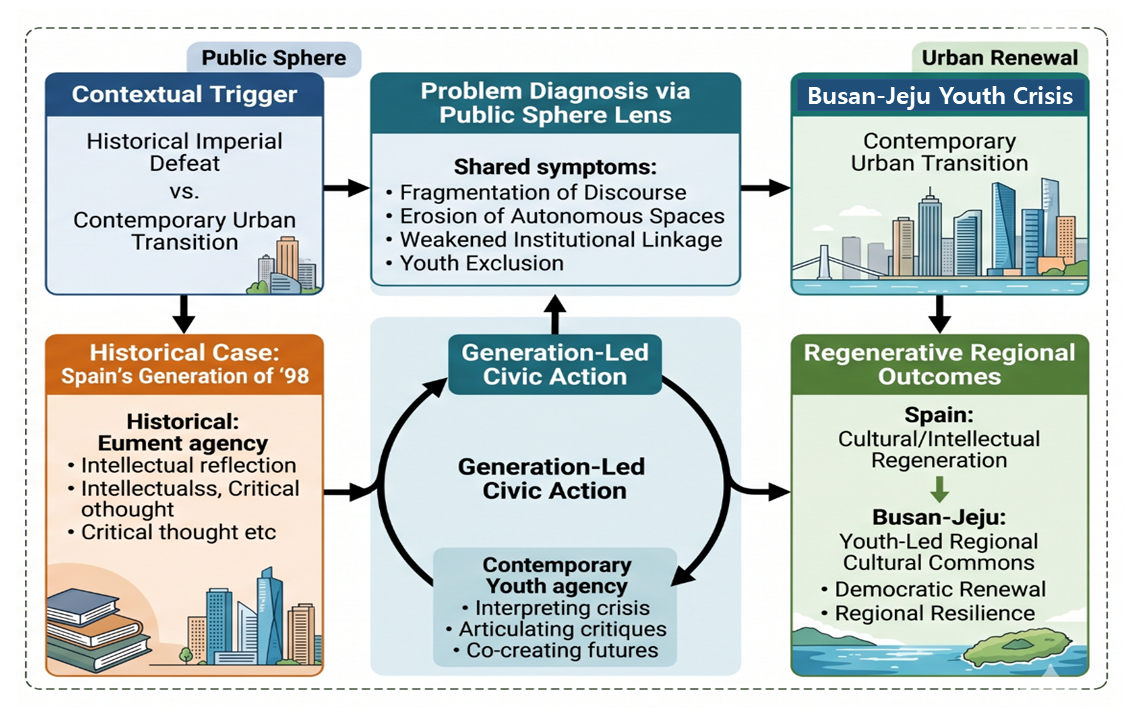
Nevertheless, these cases share influence on the formation of the public sphere for youth. Independent cultural spaces have been weakened in both regions, though through different processes: in Busan, through economic contraction and commercial redevelopment; and in Jeju, through tourism-oriented commercialization and development. In both regions, opportunities for youth-led deliberation have narrowed, while formal participatory mechanisms remain weakly connected to policy and development decision-making. Thus, rather than the question of growth or decline, the key issue is whether young people have significant opportunities to affect the way growth or decline is managed and interpreted in a region. Comparing the Generation of ’98 and contemporary Busan–Jejudo youth through the public sphere yields actionable insights:
| Dimension | Generation of ’98 (Spain, 1898–1930s) | Contemporary Busan Youth | Contemporary Jeju Youth | Key Implications for Busan and Jeju |
|---|---|---|---|---|
| Crisis Trigger | Imperial defeat and loss of colonial possessions, decline of national prestige (Balfour, 1997) | Post-industrial decline, youth out-migration, demographic contraction, regional inequality (KOSIS, 2024; Kang, 2021) | Tourism dependence, rising housing costs, overtourism, environmental pressures, cultural commodification (Jeju Research Institute, 2023) | Regional crises may emerge from either decline or growth, yet both can weaken youth public spheres when development processes exclude youth participation. |
| Primary Response | Cultural criticism, philosophical reflection, national self-examination (Carr, 1982) | Individual adaptation, migration to Seoul, and fragmented civic engagement | Lifestyle adaptation, tourism-sector employment, and localized activism on environmental and development issues | Youth must move from passive adaptation to collective interpretation and public engagement. |
| Dominant Youth Concerns | National decline, modernization, cultural identity | Employment insecurity, housing affordability, regional decline, population loss | Housing affordability, overtourism, environmental sustainability, local identity, tourism dependence | Youth concerns should be translated into shared public agendas rather than remaining individualized grievances. |
| Discourse Quality | High levels of intellectual reflection and systematic critique (Labanyi, 2010) | Emotional venting, fragmented online discussions, and limited long-term deliberation | Active civic dialogue, but often episodic and issue-specific, with weak continuity across movements | Strengthening evidence-based and solution-oriented discourse is essential. |
| Spatial Infrastructure for Public Sphere | Literary salons, newspapers, cafés, universities | Declining independent cultural venues in Seomyeon, Gwangalli, and Nampo-dong; fragmented online communities | Limited youth-centered cultural infrastructure; commercialization of Tap-dong, Chilseong-ro, Seongsan, and Gujwa; tourism-oriented redevelopment | Autonomous cultural spaces must be preserved as foundations for youth public spheres. |
| Relationship to Development Model | Critique of Spain’s declining imperial-modernization project | Questioning the sustainability of industrial-port city development | Questioning tourism-led growth and market-driven regional development | Youth should participate in evaluating and redefining regional development paradigms. |
| Representative Public Issues | “What is Spain?”, national regeneration and identity reconstruction | Urban decline, youth migration, redevelopment, and economic transition | Jeju Second Airport, overtourism, environmental preservation, housing affordability, cultural sustainability | Public issues should be linked to broader visions of regional futures. |
| Institutional Linkage | Influenced the intellectual climate, but weak direct policy effect | Formal youth councils and advisory bodies with limited decision-making authority | Consultative participation mechanisms with limited influence over major tourism and infrastructure decisions | Deliberative outcomes must be institutionally connected to policy processes. |
| Inclusiveness and Accessibility | Predominantly educated male intellectuals, limited participation (Fraser, 1990) | Participation uneven due to educational, cultural, and economic inequalities | Participation uneven due to geographic concentration, tourism-oriented economy, and limited civic infrastructure | Broader and more inclusive participation mechanisms are needed. |
| Temporal Orientation | Long-term national regeneration and cultural renewal | Often focused on immediate survival and employment concerns | Balancing short-term economic growth with long-term sustainability and community preservation | Youth should be encouraged to act as long-term stewards of regional futures. |
| Public Sphere Weakness | Elite exclusivity and limited institutional penetration | Fragmented discourse and weak policy influence | Commercialization of public space and weak deliberative influence over development decisions | Strengthening openness, discourse quality, and institutional impact remains essential. |
| Normative Vision | National cultural regeneration | Youth-led cultural port city | Youth-led cultural island | Youth-led regional cultural commons |
What is most important, in a Habermasian sense, in the work of the Generation of ’98 is not the eventual solution to Spain’s political or economic issues but the establishment of a public sphere that allows for the critical interpretation of and public debate regarding the issue of national decline. Unamuno, Baroja, Azorín, and Maeztu were among the intellectuals who framed vague anxieties in a unified discourse about the future of Spain (Labanyi, 2010). Through their writing, they helped society break out of its passive resignation by creating a common language with which to comprehend the crisis and talk about it. In this sense, the Generation of ’98 proves to be a model of how cultural and intellectual activity can serve as a tool for constructing a public sphere in uncertain times (Habermas, 1989).
The main insight from the Generation of ’98 in Spain is thus not a matter of reproducing literary movements or intellectual elites but of developing institutions that can foster a collective reflection on crisis. The success of Spain’s intellectuals lay in their ability to develop interpretive structures that related the personal to the social. The two cities, Busan and Jeju, need similar processes to collectively identify the problems that they encounter, envision another way of doing things, and then share their vision with institutions that have actual power to make decisions (Habermas, 1996; Dryzek, 2000).
7. Implications: Youth Agency and a New Regional Vision for Busan and Jeju
The comparative study of Spain’s Generation of ’98, Busan, and Jeju shows that youth crisis is not only an economic problem but also a crisis of interpretation, communication, and civic imagination. Busan and Jeju are very different in terms of development history, but both show a fragile youth public sphere, as autonomous cultural spaces have been eroded, discourse has been fractured, and institutional influence has been curtailed. Therefore, a policy exclusively oriented toward jobs, housing, or entrepreneurship alone is insufficient. The more fundamental problem is how to reshape the communicative and institutional settings in which young people can actively shape the future of their spaces (Habermas, 1996; Dahlgren, 2009).
7.1. From Policy Recipients to Regional Interpreters and Co-Creators
As the experience of Spain’s Generation of ’98 shows, the social function of young people is not only to be productive—it is to be able to “read” a collective crisis and present possible futures (Carr, 1982; Labanyi, 2010). In the same vein, one should break away from seeing the youth of both Busan and Jeju as objects of policy and regard them instead as regional interpreters and co-creators.
This perspective involves critically assessing the impact of industrial restructuring, population loss, and waterfront redevelopment on Busan. Youth should be encouraged to research the future direction of the city in light of global economic changes, regional inequality, and urban planning. (Sassen, 2001; Harvey, 2012). They should not merely be consulted on predetermined policies but should be involved in the discussion of the future identity of Busan as a post-industrial port city, industrial transition, and cultural regeneration.
In the case of Jeju, the youth agency needs to go beyond adapting to tourism-led development. Jeju’s younger generation has a situated understanding of the island’s challenges, including overtourism, environmental degradation, housing insecurity, and cultural transformation.They feel the effects of decisions made on the future of Jeju in debates such as those on the commercialization of Tap-dong and Chilseong-ro or the construction of Jeju Second Airport, as well as the changes to Seongsan and Gujwa. They should therefore take part in assessing development models, offering sustainable alternatives, and communicating visions that incorporate economic growth and ecological and cultural resilience (Harvey, 2012; Dryzek, 2000).
7.2. Forecasting Vision: A Youth-Led Regional Cultural Commons
Although Busan and Jeju have unique regional identities, both cities need a new model of development that puts youth agency at the heart of cultural and civic life. This research explores the idea of a youth-led regional cultural commons as a normative approach to enhancing regional public spheres.
In Busan, this vision can materialize through the notion of a youth-led cultural port city, which is connected to a city-wide cultural commons that integrates independent cultural spaces, community media portals, artistic networks, and deliberative forums. A model of this type would not only maintain but also broaden opportunities for critical dialogue and incorporate youth-produced ideas into urban planning and economic growth (Ostrom, 1990; Zukin, 2010).
In the long run, the idea can be implemented this time via the conception of a youth-led cultural island in Jeju. This model would treat young people on the island as the core players in the stewardship of local culture, environment, and community life rather than as tourists. Independent cultural spaces, ecological projects, community-based tourism endeavors, and youth-driven research networks can serve as vehicles for young individuals to collectively influence the future of the island. This would reinforce local identity and offer alternatives to market-led approaches to development (Lefebvre, 1996; Fainstein, 2010). Despite such differences between the regions, they can espouse visions underlain by the same goal: to change the way youths consume regional policy and the manner by which they produce regional meaning and local identity.
7.3. Policy Levers for Strengthening Youth Public Spheres
A reconstruction of regional youth public spheres necessitates coordinated interventions on spatial, discursive, institutional, and symbolic levels. To begin with, governments in the region should focus on conserving and developing independent youth cultural facilities. In Busan, this can mean resisting the commercialization and displacement of independent cultural spaces such as those in Seomyeon, Gwangalli, and Nampo-dong (Zukin, 2010). Specifically, focus should be directed to preserving local cultural spaces in areas such as Tap-dong, Chilseong-ro, Seongsan, and Gujwa, where such sites have recently been converted into consumption areas for tourists.
Second, capacities in the fields of education and communication should be enhanced, commencing with youth-driven research projects, public sociology initiatives, and deliberative forums supported by universities, youth centers, and local governments (Burawoy, 2005). Through these endeavors, young individuals can explore regional issues and develop policy solutions on the basis of their research (Burawoy, 2005). Annual regional future forums in Busan and Jeju could serve as platforms through which young people present locally grounded knowledge, policy ideas, and civic visions to policymakers and civic leaders.Third, institutional connections between discourse and decision-making must be enhanced. More youth councils and advisory committees should be formed, conferring them increased influence in planning and budgeting instead of aiming for tokenistic consultation (Fung & Wright, 2003). Youth impact assessments and formal response mechanisms with decision-making bodies on how to respond to youth-raised concerns should be integrated into expansive projects, such as the waterfront redevelopment in Busan and large-scale tourism or infrastructure projects in Jeju.
Finally, symbolic recognition is likewise critical. Political elites, developers, or tourism agencies are frequently involved in creating regional narratives. The perspectives formulated by young people should be included in formal planning documents, regional branding initiatives, and public educational campaigns to bolster democratic legitimacy (Anderson, 1983). This would validate youth as co-authors of regional futures and not only beneficiaries of development.
7.4. Toward Democratic Regional Renewal
The basic lesson from the Generation of ’98 is that regeneration starts not only with infrastructure projects or economic incentives but also with the ability of citizens to think critically about their situations and collectively imagine alternatives (Habermas, 1989; Carr, 1982). Busan and Jeju confront distinct forms of structural crisis: Busan faces post-industrial decline and demographic contraction, while Jeju faces tourism dependence and the commodification of local culture. Both, however, face a shared problem: that of the erosion of youthful public spheres that can turn private grievances into civic action. Thus, the future vitality of Busan and Jeju lies in the retention of young people physically as well as their empowerment communicatively and institutionally. As youth craft regional interpretations, cultural spaces, and development agendas, regional renewal can transition from economic governance toward a more democratic and sustainable form of transformation (Habermas, 1996; Dahlgren, 2009).
Through the case study of Busan and Jeju, it is possible to deduce that regional youth policy should not be based solely on economic indicators, such as growth rates, employment rates, or population change. While regions of decline and rapid growth can breed different types of inequality, both can undermine the ability of youth to exercise agency if there is a disconnect between public discourse and development decision-making. Therefore, reinforcing youth public spheres must be seen as a prerequisite for democratic regional governance, whether a region is experiencing contraction or expansion.
8. Conclusion
By interpreting Spain’s Generation of ’98 as a historical case of crisis-responsive public-sphere formation, this study has applied Habermas’s theory of the public sphere to analyze contemporary youth crises in Busan and Jeju. Despite differences in time—over a hundred years—geography, and political, economic, and cultural climate, all three cases point to a common process: material insecurity and conflict over identity, interpretation, and collective imagination are engendered in times of structural crisis. The significance of the Generation of ’98 lies not only in its literary achievements but also in its capacity to transform national crisis into sustained public reflection, cultural self-examination, and collective debate.This work has an important normative lesson to draw from the comparison with the Spanish Generation of ’98. Although the intellectuals of the Generation of ’98 did not directly resolve Spain’s structural problems or hold significant formal political power, they helped create a shared interpretive framework through which Spanish society could critically reflect on its crisis.What endured was the development of a common interpretive structure, against which society could critically reflect on itself and conjure up alternative futures. Likewise, the challenge for the young today in Busan and Jeju is not only to call for policy action but also to foster the conditions and processes essential for public reflection and deliberation that can help turn the uncertain experiences of individual youth into collective public discussion.
Taken together, the experiences of Spain’s Generation of ’98, Busan, and Jeju show that crisis can either deepen social fragmentation or become a catalyst for civic reflection and democratic regeneration. Essentially, the long-term vitality of both regions depends not only on retaining young residents but also on empowering them as active civic agents and co-creators of regional futures. In this respect, the most lasting legacy of the Generation of ’98 is the communicative power that they amassed to render a crisis into collective imagination and democratic action, as guided by Habermas. The reconstruction of strong public spheres for youth can therefore be a cultural goal as well as a prerequisite for the long-term sustainability and democratic stability of the regions in South Korea.
Acknowledgments
This work was supported by the Global Joint Research Program funded by Pukyong National University (202412450001).
This work was supported by the Ministry of Education of the Republic of Korea and the National Research Foundation of Korea (NRF-2025S1A6B5A02004116)
References
- Anderson, B. 1983. Imagined communities: Reflections on the origin and spread of nationalism. Verso.
- Azorín. 1998. La voluntad [The Will]. Cátedra. (Original work published 1902).
- Balfour, S. 1997a. The end of the Spanish empire, 1898–1923. Oxford University Press.
- Balfour, S. 1997b. Riot, regeneration and reaction: Spain in the aftermath of the 1898 disaster. The Historical Journal, 38(2): 405–423.
- Baroja, P. 2001. The tree of science (M. Alpert, Trans.). NYRB Classics. (Original work published 1911).
- Benhabib, S. 1992. Models of public space: Hannah Arendt, the liberal tradition, and Jürgen Habermas. In C. Calhoun (Ed.), Habermas and the public sphere: 73–98. MIT Press.
- Britannica. 2025. Generation of 1898. Encyclopaedia Britannica. https://www.britannica.com/topic/Generation-of-1898
- Burawoy, M. 2005. For public sociology. American Sociological Review, 70(1): 4–28.
- Busan Metropolitan City. 2026. Busan Youth Policy Network.
- Busan Youth Forum. 2026. Busan Youth Forum: Youth Activity Hub.
- Calhoun, C. (Ed.). 1992. Habermas and the public sphere. MIT Press.
- Carr, R. 1966. Spain, 1808–1939. Oxford University Press.
- Carr, R. 1982. Modern Spain, 1875–1980. Oxford University Press.
- Cohen, J. 1989. Deliberation and democratic legitimacy. In A. Hamlin & P. Pettit (Eds.), The good polity : 17–34). Blackwell.
- Dahlgren, P. 2009. Media and political engagement: Citizens, communication, and democracy. Cambridge University Press.
- Dos Santos, L. M. 2022. Human resources and workforce shortages in Jeju Island due to islandness: The challenges faced by former hospitality and tourism professionals. Island Studies Journal, 17(2): 130–152. https://doi.org/10.24043/isj.390
- Dryzek, J. S. 2000. Deliberative democracy and beyond: Liberals, critics, contestations. Oxford University Press.
- Fainstein, S. 2010. The just city. Cornell University Press.
- Fox, E. I. 1978. Crisis and continuity: The Generation of 1898 in Spain. Tamesis Books.
- Fox, L. C. 1978. The vision of Cain and Abel in Spain’s “Generation of 1898.” CLA Journal, 21(4): 499–512.
- Fraser, N. 1990. Rethinking the public sphere: A contribution to the critique of actually existing democracy. Social Text, 25/26, 56–80.
- Fraser, N. 1992. Rethinking the public sphere: A contribution to the critique of actually existing democracy. In C. Calhoun (Ed.), Habermas and the public sphere: 109–142). MIT Press.
- Fung, A., Wright, E. O. 2003. Deepening democracy: Institutional innovations in empowered participatory governance. Verso.
- Habermas, J. 1984. The theory of communicative action, Vol. 1: Reason and the rationalization of society (T. McCarthy, Trans.). Beacon Press.
- Habermas, J. 1989. The structural transformation of the public sphere: An inquiry into a category of bourgeois society (T. Burger & F. Lawrence, Trans.). MIT Press. (Original work published 1962).
- Habermas, J. 1996. Between facts and norms: Contributions to a discourse theory of law and democracy (W. Rehg, Trans.). MIT Press.
- Harvey, D. 2012. Rebel cities: From the right to the city to the urban revolution. Verso.
- Jeju Research Institute. 2023. Tourism Development and Youth Perceptions in Jeju. Jeju Research Institute.
- Kang, M. H. 2021. Youth outmigration and regional inequality in South Korea: The case of Busan. Korean Journal of Regional Studies, 29(3): 45–67.
- KOSIS. 2024. Internal migration statistics by age and region. Statistics Korea. https://kosis.kr
- Labanyi, J. 2010a. Memory and modernization in democratic Spain. Poetics Today, 28(1): 89–116.
- Labanyi, J. 2010b. Spanish culture from Romanticism to the present. Polity Press.
- Lee, J. Y., Park, S. H. 2022. Cultural gentrification and the transformation of youth spaces in Busan. Journal of Urban Cultural Studies, 9(2): 117–136.
- Lefebvre, H. 1996. Writings on cities (E. Kofman & E. Lebas, Trans.). Blackwell.
- Li, X., Kim, J. S., Lee, T. J. 2021. Collaboration for community-based cultural sustainability in island tourism development: A case in Korea. Sustainability, 13(13), 7306.
- Longhurst, C. A. 1969. Unamuno’s theory of the novel. Oxford University Press.
- Maeztu, R. de. 1934. Defensa de la Hispanidad. Fax.
- McNair, B. 2011. An introduction to political communication (5th ed.). Routledge.
- Molero Perea, C. M. 2012. El desastre del 98 en la literatura. Centro Virtual Cervantes.
- Moulaert, F., MacCallum, D., Mehmood, A., Hamdouch, A. 2013. The international handbook on social innovation. Edward Elgar.
- Ostrom, E. 1990. Governing the commons: The evolution of institutions for collective action. Cambridge University Press.
- Papacharissi, Z. 2002. The virtual sphere: The internet as a public sphere. New Media & Society, 4(1): 9–27.
- Park, B. & Hong, C. 2025. Fostering a “young city” in Busan: A strategic approach to countering population decline and promoting youth settlement. The Journal of Asian Studies: 28(4), 225-250.
- Ramsden, H. 1974a. The Spanish “Generation of 1898”: The history of a concept. Bulletin of the John Rylands Library, 56(2): 463–491.
- Ramsden, H. 1974b. The Spanish Generation of 1898: The history of a concept. Bulletin of Hispanic Studies, 51(1): 50–67.
- Ribbans, G. 1964. Niebla y soledad: Aspectos de Unamuno y Baroja. Gredos.
- Sassen, S. 2001. The global city: New York, London, Tokyo (2nd ed.). Princeton University Press.
- Sunstein, C. R. 2001. Republic.com. Princeton University Press.
- Thompson, J. B. 1995. The media and modernity: A social theory of the media. Stanford University Press.
- Unamuno, M. de. 2007. Mist (Niebla) (J. E. Crawford Flitch, Trans.). University of Illinois Press. (Original work published 1914).
- Zukin, S. 2010. Naked city: The death and life of authentic urban places. Oxford University Press.
Newspapers and other communications
- Breeze in Flow. 2024. Why Busan’s youth are leaving despite global hub plans. https://breezeinflow.com/opinion/why-busans-youth-are-leaving-despite-global-hub-plans
- Chosun Ilbo. 2026, May 28. Jeju’s youth exodus drives population decline. https://www.chosun.com/english/national-en/2026/05/28/JMPB27T5VJD35LVIVCOXLE5VWI/
- The Straits Times. 2023, June 7. Jeju Island population declining as young Koreans leave to seek jobs. https://www.straitstimes.com/asia/east-asia/jeju-island-population-declining-as-young-koreans-leave