
The Boat That Rocked the Ocean: Maritime Heritage and Indigenous Perspectives at the Evergreen Maritime Museum, Taipei
 10.21463/jmic.2026.15.2.02
Abstract
This article offers critical reflections on the Evergreen Maritime Museum in Taipei, Taiwan. It examines six key artifacts from the permanent collection as windows into the museum's curatorial priorities and the tensions between its corporate identity and its Taiwan-specific maritime heritage. The six objects are the bamboo sailing raft of Kaohsiung, the Wang Ye ceremonial boat and koi pennant, the stellar board (qianxingban) replica, the painting ‘HMB Endeavour Breached for Repairs’ by J. Steven Dews, the Evergreen container ship models, and the Tao boat of Orchid Island. These are situated within the relevant scholarly literatures in maritime anthropology, museum studies, and folklore studies. The article argues that while the museum presents a rich and accessible collection, its dominant narrative of global commercial maritime modernity and technological progress overshadows a more distinctive yet less-known story rooted in Indigenous seafaring cultures, folk religion, and the Austronesian connections that link Taiwan to Pacific Island cultures. A comparative analysis with other small-scale maritime museums in Southeast Asia, through the lens of Indigenous inclusion and living maritime heritage technologies, is proposed for future work.
Keywords
maritime museum, Taiwan, Indigenous seafaring, Tao people, Austronesian, museum studies, corporate heritage
1. Introduction
The lobby of the Evergreen Maritime Museum in Taipei announces its ambitions immediately. The double-height, light-filled space is festooned with international maritime signal flags and hosts full-sized vessels displayed in the round. At the center stands an Arabian dhow, a seaworthy craft commissioned by the museum’s founder, Chang Yung-fa (Chang, 1997), through a Dubai-based business associate. This handsome dhow with its curved hull and twin lateen-rigged masts embody centuries of Indian Ocean trade, and its provenance in Chang’s personal commercial network signals the kind of maritime world this museum seeks to showcase. Flanking the dhow, adjacent to the gift shop and set against a floor-to-ceiling glass wall through which the Taipei cityscape extends beyond, stands the museum's most impressive object: a full-sized contemporary traditional boat built by the Tao people of Orchid Island (Lanyu, 蘭嶼) (discussed in Section 7). With its sharply upswept bow and stern, hull accented in deep red, and elaborate surface geometrics in red, black and white, the Tao craft demands prolonged attention. The boat’s iconography features precisely executed diamond checkerboards, radiating sun-eye motifs, and nested triangles along every edge. The background is populated by stylized human ancestors, their arms outstretched and terminating in large spiral discs, their heads crowned with cascading spirals and feathers, presiding over both bow and stern. The ancestors, feathers, spirals, and concentric sun-eye all carry specific meaning within Tao culture, encoding cosmological relationships between humans, the sea, and the sun that sustains life on Orchid Island. The boat’s striking incongruity as an object dense with ritual significance, framed against an urban Taipei skyline through plate glass, makes it impossible to pass without stopping. Encountered upon entry and once again on exit, the Tao boat more than any other single object inspired the question this article sets out to examine: How can Indigenous perspectives and technologies inform the curation and interpretation of maritime culture?
The museum occupies five floors of the Chang Yung-Fa Foundation building in central Taipei, a short walk from the Chiang Kai-shek Memorial Hall and easily reached by MRT. At the time of the author’s visit in May 2026, admission was free, underwritten by the Chang Yung-Fa Foundation Art Festival (April–June 2026); the usual adult admission fee is NT$200, modest by the standards of comparable institutions in the region. The centrally located museum, staffed by welcoming volunteers and populated on weekday mornings by school groups receiving enthusiastic Mandarin-language guided tours, offers substantial educational benefit. The Evergreen Maritime Museum presents itself, and functions, as a gift to its home city and a beacon to visitors.
Bilingual signage in English and Mandarin Chinese guides visitors throughout all five floors. The labeling is clear, competent and consistently maintained. What the signage lacks is any Indigenous language, though Taiwan is home to 16 officially recognized Indigenous peoples speaking mutually unintelligible Formosan languages, languages that, as Li and Zeitoun (2023) document, constitute nine of the ten primary branches of the Austronesian family, making the island the likely homeland of diverse languages spoken today by some 300 million people across the Pacific and Indian Oceans. The Taiwanese language (Tâi-gí, 臺語) is similarly lacking, the result of a long process of colonization and Mandarin-promoting language policy (Huang, 1997). No Tao words appear on the panel accompanying the Tao boat (Section 7); no Hakka or Tâi-gí appears on the objects drawn from Taiwan’s Han coastal communities. The museum speaks fluently in the two languages of Taiwan’s official and global-commercial present. The languages of its deeper and older maritime past are absent.
From the lobby, visitors take the elevator to the fifth floor, then descend helically through millennia of maritime lore. The tour opens with the deep history of seafaring: dugout canoes, bamboo raft vessels (discussed in Section 2), European ships of the Age of Discovery, early steam vessels, represented through an extraordinary collection of scale models whose craft and detail impress. The fourth floor brings the visitor into the modern era: ocean liners, warships, submarines, and the container ships of Evergreen Marine Corporation (discussed in Section 6), here given pride of place in both quantity and scale. The third floor hosts a gallery of marine oil paintings of high artistic value, organized thematically under headings such as ‘Surging Momentum’ and ‘Violent Waves on the Raging Sea.’ Particularly noteworthy is a painting by contemporary British artist John Steven Dews (b. 1949), ‘HMB Endeavour Breached for Repairs’ (discussed in Section 5), depicting the setting in which stranded European sailors first met Australian Aboriginals and observed kangaroos. Tellingly, the painting features only European sailors against a lush landscape; both Aboriginal people and local fauna are absent, although mentioned in the painting’s curatorial note. The second floor brings the visitor closest to Taiwan itself, with exhibits on the island’s maritime history, folk traditions, and relationship with the sea — containing, among other objects, the Wang Ye ceremonial boat and koi pennant complex associated with the Hsigang Chingan Temple (discussed in Section 3), a model of the bamboo sailing raft of Kaohsiung, and a replica stellar board (qianxingban) linked to the Ming dynasty voyages of Zheng He (discussed in Section 4). From the second floor, visitors descend once more to the lobby and, on their way out, once again pass by the remarkable Tao boat.
The museum’s stated mission is “to preserve and present the history, art and science of boats and ships, in the hope of generating public interest in maritime culture and in turn inspiring the pursuit of knowledge and the spirit of exploration” (Evergreen Maritime Museum, n.d.). This broad thematic scope including “history, art and science” and “the spirit of exploration” invoke a global maritime heritage that understandably reflects the global commercial aspirations of its founding patron. Local heritage comes into focus in “Maritime Taiwan” (gallery 3F) which showcases artifacts that “connect the relationships between Taiwan, the Taiwanese, and the sea.” The analysis that follows is an inquiry into what the mission’s global framing foregrounds, and what it tends, perhaps inevitably, to leave in shadow.
This journey from world maritime prehistory through European commercial and military expansion, through Evergreen’s corporate history, through Taiwan’s folk maritime culture, and back to the Indigenous vessel that first drew attention at the entrance enacts a particular viewpoint about what maritime heritage means. The museum effectively showcases its Taiwan-specific content. The Tao boat presides in the lobby, the bamboo raft is present, the Wang Ye complex is included, and the visitor who knows to look for them will find them rewarding. But the collection’s dominant theme is established by the sheer number and prominence of its commercial ship models, by the curatorial sequence, and by the dhow at the lobby’s center. All these steer us towards a vision of Taiwan as a node in the global network of commercial maritime modernity, heir to the seafaring traditions of China and the wider world, and home to a shipping industry of international standing. What that vision tends to overshadow, and partly occlude, is a different and arguably more distinctive maritime story rooted in Indigenous seafaring cultures, boat-building lifeways (Barnes, 2002; Trần et al., 2025), folk religion, and in the Austronesian connections that tie Taiwan not so much to container ports of the world as to proximate Pacific Island cultures.
This article examines that tension through close reading of six objects drawn from the museum's permanent collection, situating each within the relevant scholarly literatures in maritime anthropology, museum studies, and folklore studies. Five objects are considered in roughly chronological sequence: the bamboo sailing raft of Kaohsiung; the Wang Ye ceremonial boat and koi pennant from Chingan Temple; the stellar board (qianxingban) replica; the painting ‘HMB Endeavour Breached for Repairs’ by J. Steven Dews; and the Evergreen container ship models. The sixth object — the Tao boat of Orchid Island (Pongso no Tao in the Tao language; Lanyu, 蘭嶼 in Mandarin) — is reserved for last: not because it is the least significant, but because the visitor may pass it once without fully grasping it until the whole collection has been seen.
The six objects examined in this article were selected during a single visit to the museum in May 2026. They are not a systematic sample of the collection but the objects that most arrested the attention of this author, a practicing anthropologist whose fieldwork has been conducted with Indigenous and traditional communities in Siberia, Melanesia, Micronesia, and Vietnam— communities whose maritime and riverine cultural traditions provide a comparative lens for experiencing a museum devoted to seafaring heritage. The selection criterion was, in this sense, phenomenological. These six objects stood out as significant exemplars of Indigenous cultural representation within the collection, and illuminated the tensions between the museum’s global commercial narrative and the local and Indigenous heritages it includes. The author was also mindful of the recently updated ICOM Code of Ethics for Museums (ICOM, 2026), which encourages Indigenous consultation and the inclusion of Indigenous perspectives in museum interpretation. While not a binding standard, the Code reflects an emerging international consensus about best practices in museum curation, and provided a useful analytical frame for assessing what the Evergreen Museum displays, and what it does not. The interpretive approach applied throughout draws on Varutti's (2014) concept of the “polysemic object,” developed specifically in relation to Tao canoes in Taiwanese museum contexts, as a framework for reading the cultural significance of objects against the explanatory narratives offered by the museum.
2. The Bamboo Sailing Raft of Kaohsiung
Among the objects in the Evergreen Maritime Museum, the bamboo sailing raft of Kaohsiung (高雄雙排潿笹筏) is the most modest in appearance but perhaps the most historically resonant. The museum displays a scale model (65 × 11 × 12 cm) of a double-outrigger sailing raft constructed from eleven bamboo culms approximately seven meters long, lashed together with rattan strips. The accompanying label, in slightly awkward but serviceable translation, describes it as “the cheap, helpful tool to catch fish or collect seashores.” This phrase identifies the raft as an object of everyday working life, not ceremonial value, with its plainness a virtue rather than a deficiency. The raft represents the persistence of maritime lifeways.
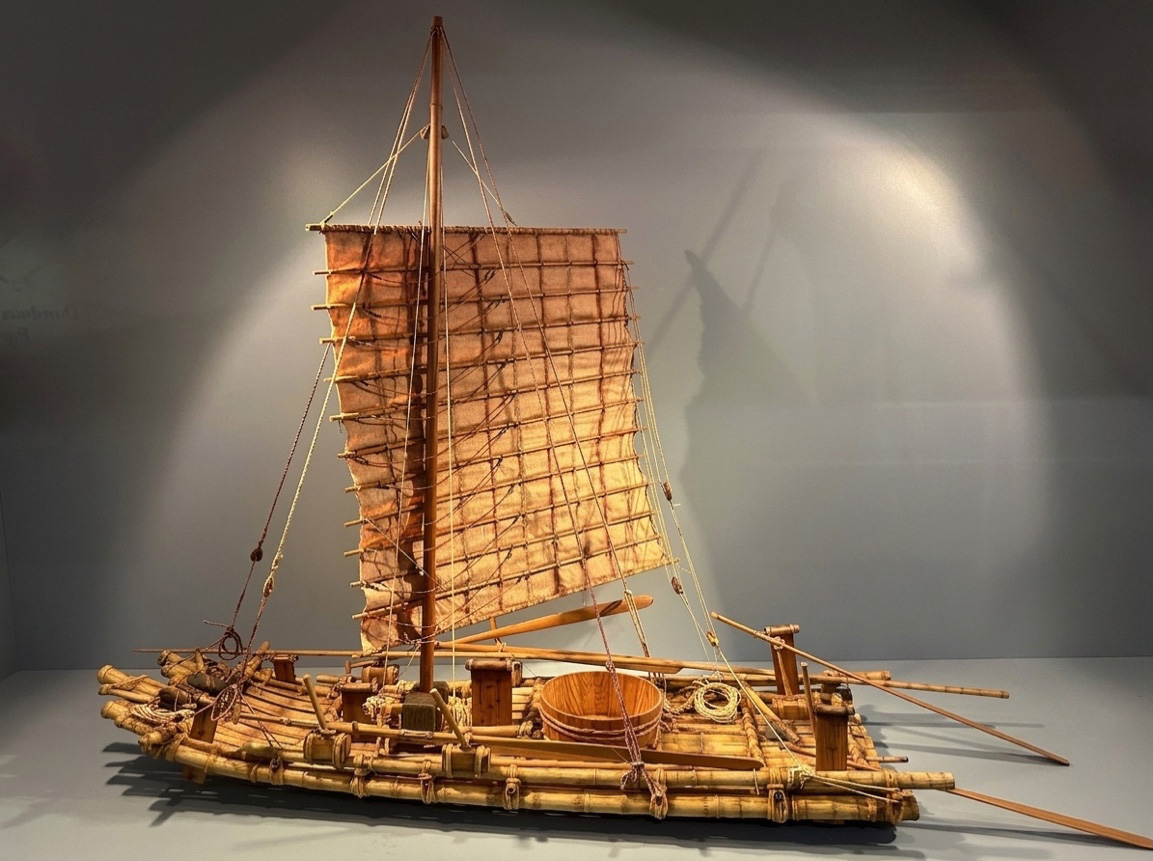
That persistence is itself remarkable. The bamboo sailing raft is among the oldest and most widely distributed watercraft types in the world. Bamboo rafts, with or without a sail, represent the most used seagoing vessel type in the coastal waters of Taiwan in the recent past, and bamboo rafts with oars or paddles had been used by fishermen around the South China Sea and Taiwan in rivers and shallow coastal waters for millennia (McGrail, 2001). Their distribution extends far beyond Taiwan: sailing rafts were used across the Pacific and Southeast Asia, documented ethnographically in Vietnam, southern China, the Philippines, and island Melanesia (Doran, 1971). Ethnographic observations of sailing rafts indicate that they were in widespread use in the Pacific, though archaeological evidence is limited due to poor preservation of organic materials. On the Chinese mainland, bamboo rafts of diverse scales were developed for riverine commerce. Small and agile bamboo rafts plied the rapids of the upper Yangtze and its tributaries. Larger bamboo rafts used in calmer currents could carry up to 7 tons of cargo; some even had dwellings built on them (Worcester, 1971). The raft is thus not a primitive stage on the way towards more sophisticated technology, but a solution so well-adapted to its environment that it has persisted across millennia.
In Taiwan, two distinct bamboo raft traditions are worth distinguishing. The Amis Indigenous people of the eastern coast maintained a tradition of raft-building that has been handed down through oral tradition (Liu et al, 2005; Tsai, 2020). Amis rafts have been recreated in recent years to demonstrate the feasibility of ocean migration using bamboo and rattan rafts (Ministry of Culture, 2017). The traditional Amis method of raft-making consists of harvesting bamboo in autumn or winter, scraping off the outer skins, bending and straightening by fire, drying, and finally assembly using rattan fibres (Calamus formosanus Becc.) with wooden battens. The bamboo species preferred by the Amis people for making rafts was Ma bamboo (Dendrocalamus latiflorus Munro), which grows a thick culm of up to 0.20m in diameter. The knowledge required to build a seaworthy raft from these materials is substantial: the builder must know which bamboo species from among many to select, the correct season for harvest (dry season culms are denser and less prone to cracking), the fire-bending techniques that allow the bow to be shaped into an upswept profile. He must master the curing processes of slow drying in beach sand and infiltration of ash mixed with water that extend the raft’s working life. According to Amis elders, well treated bamboos can be used for up to five fishing seasons, approximately four months per year, if properly maintained by untying and drying (Kaifu et al., 2019). This sophisticated ecological and engineering competence is transmitted orally and by observation across generations.
The Kaohsiung raft in the museum belongs to a different but related tradition. Han settlers crossing the Taiwan Strait from Fujian brought bamboo watercraft technology with them, the crossing itself being sufficient proof of their seafaring competence, and established it as the dominant vessel type along Taiwan’s west coast. Here, as McGrail (2001) documents, it remained the most used seagoing craft into the modern era. But the mainlanders arrived to find an Indigenous maritime tradition already operating across those same waters and extending considerably further. Davidson (1903: 563), writing at the close of the Japanese colonial period under the chapter heading “Savage Head-Hunters of Formosa,” records that the Pepo (Pepohoan) people of the western plain had constructed what he dismisses as “boats and feeble rafts of timber.” Yet the voyaging range he then proceeds to document for these same vessels belies his own description, as well as his chapter heading. The Pepo (also known as Pingpu 平埔) had not only crossed the Formosa Channel, he reports, but invaded the southern coast of China, crossed the Bashi Channel to the south, and maintained sustained communication with Luzon island. A craft capable of ocean crossings from Taiwan to China and to the Philippines is not a feeble craft, and its builders are not aptly described by the word savage. The condescension of Davidson’s language is a familiar colonial trope, the dismissal of Indigenous technological achievement by an observer whose own description refutes the dismissal. Han settlers crossing from Fujian brought bamboo raft technology with them and established it along a coastline where an Indigenous ocean-going raft tradition had long preceded them, a historical perspective the museum’s label does not acknowledge.
This is the deeper significance of the Kaohsiung raft as the opening object in this survey. The bamboo raft stands at the beginning of a long technological and cultural arc. Whether in the hands of Taiwan's Indigenous peoples navigating the fishing grounds of the Pacific coast, or in the hands of Han settlers sailing the waters off Kaohsiung, it represents the foundational maritime competence from which everything else in this museum ultimately descends. It is the craft type that, in sail-equipped and ocean-going form, enabled the first great human movement out of Taiwan and into the Pacific, forming the Austronesian diaspora that would eventually carry human communities to Hawai’i, New Zealand, Madagascar, and the islands of Polynesia and Micronesia. The museum does not make this connection explicit. But the raft’s presence at the chronological beginning of the collection’s historical arc, however inadvertent, places Taiwan where the scholarly evidence insists it belongs: at the start of the maritime story, not merely as a participant in the global networks of others.
3. The Wang Ye Ceremonial Boat and Koi Pennant
If the bamboo raft represents Taiwan's most ancient and practical maritime heritage, the Wang Ye ceremonial boat and its accompanying koi pennant (koi being the Japanese term for carp) represent the sea as a sacred space, a medium for communal spiritual protection, and a vehicle for one of the most distinctively Taiwanese ritual traditions still actively practiced today. Displayed together, the two objects form a ritual complex whose meaning neither can fully convey alone. The boat is an elaborately crafted model of a ceremonial junk, its hull decorated with dragon motifs in red and gold, with miniature temple structures rising from its deck, and three masts carrying battened sails. It is shown against a backdrop of four photographs depicting the procession, the offerings, and the moment of ignition. The pennant, loaned by Hsigang Chingan Temple (also known as Xigang Qingan Temple, 西港慶安宮, with geocoordinates 23.121546, 120.202595), is a paper construction in the form of a gilded carp bearing paper sails inscribed with Chinese characters, adorned with orange pompom ornaments at the mouth. The toy-like pennant is simultaneously festive and sacred in its visual language.
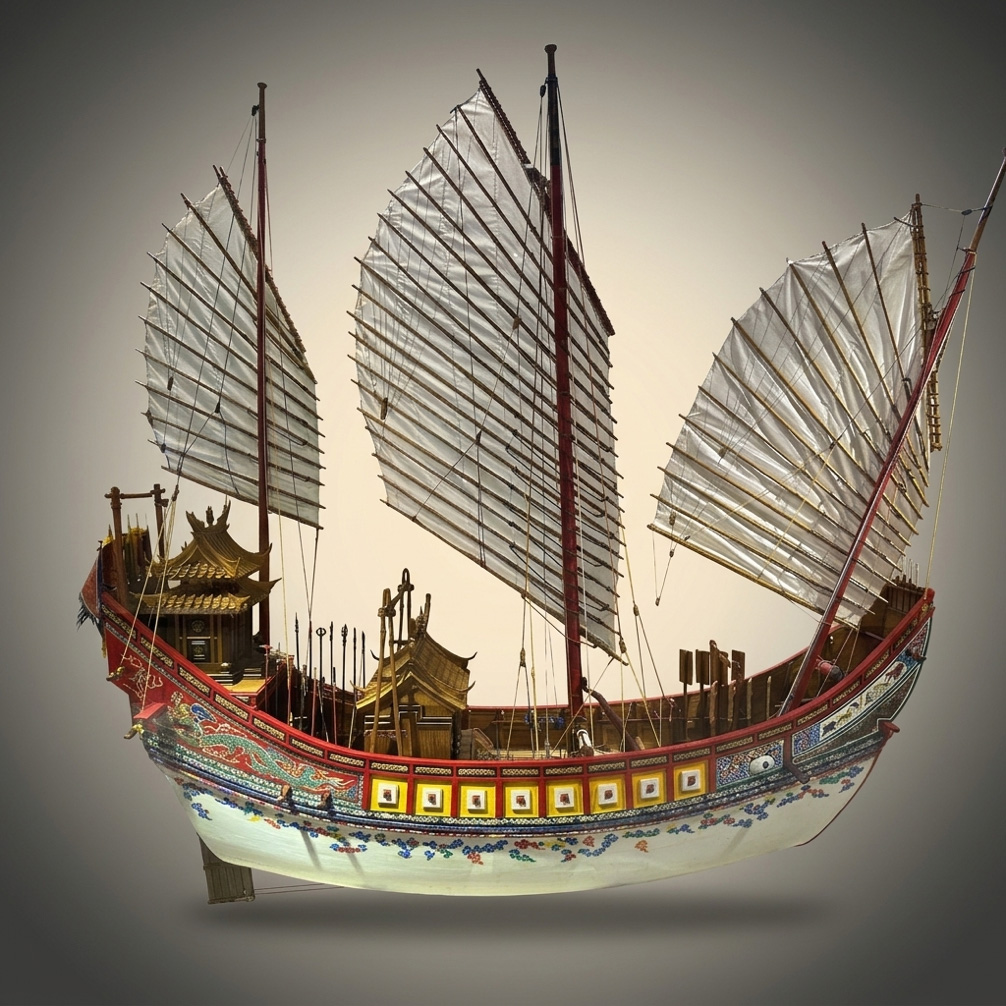
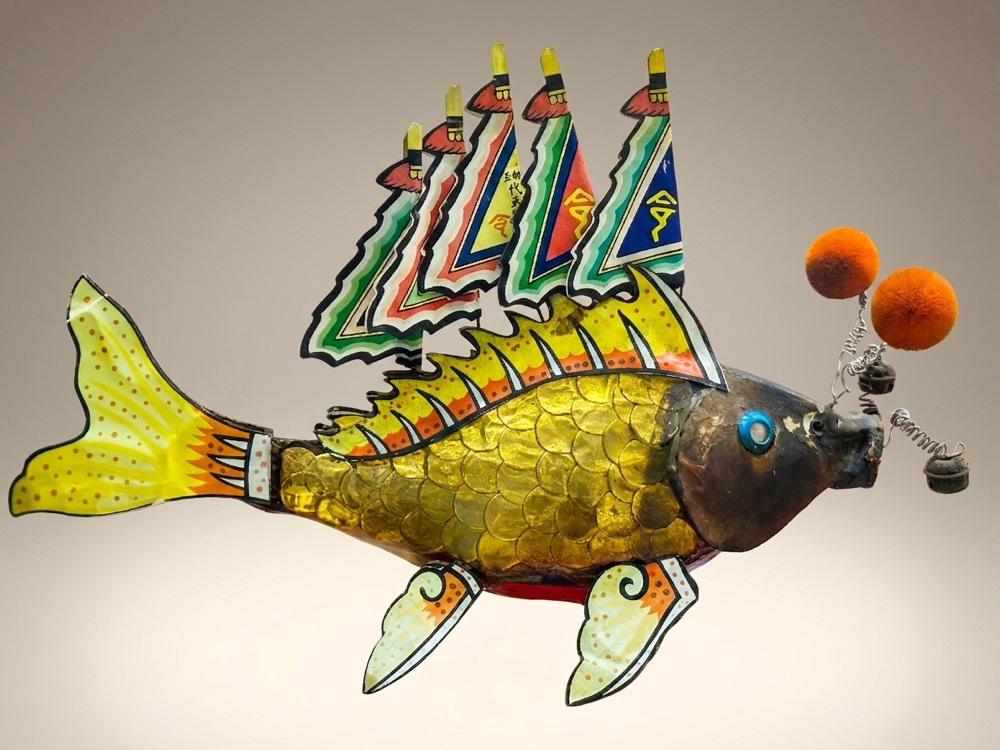
The koi pennant's label explains that King-Boats at Hsigang fly such pennants on their masts, symbolizing good fortune, and that the temple organizes a divination ceremony in which the deity selects the recipient. This is accurate as far as it goes, but it tells only a fraction of the story. The Wang Ye (wangye, 王爷) tradition, also known in English as the King-Boat or Royal Lords cult, is one of the most elaborated and significant folk religious traditions in Taiwan. It is rooted in the experience of Hokkien-speaking settlers who crossed the treacherous Taiwan Strait and established communities along Taiwan’s southern and western coasts during the late Ming and Qing dynasties. These communities faced epidemic disease, typhoon, and the ever-present dangers of coastal life with limited access to government aid. The Wang Ye deities they revered were associated with plague expulsion and community protection, and understood as Imperial Inspectors dispatched by the Jade Emperor to patrol the human world. Offerings to the deities secured a communal spiritual insurance against such hazards (Katz, 1987).
The ritual at the heart of the tradition is the wangchuan ceremony (王船祭), also called in English the “Grand King Boat Ceremony.” A purpose-built wooden boat, loaded with offerings, ritual currency, and the accumulated misfortunes of the community, is ceremonially burned and sent out to sea in flames, carrying plague and ill-fortune away with it. The boat model in the museum, and the backdrop photographs showing processions through temple-lined streets and the moment the vessel is set ablaze, give the visitor a vivid if compressed impression of this drama. What the display does not convey is the scale, the intensity, or the community mobilization involved. The Donggang Welcoming the Royal Lords Festival in Pingtung, held every three years, is the most celebrated of Taiwan's Wangchuan ceremonies. It involves eight days of ritual, hundreds of spirit mediums, the construction of a boat more than fourteen meters long at a cost of millions of New Taiwan dollars, and the participation of virtually the entire local population (Katz, 1995). In Hsigang, whose temple donated the koi pennant now on display in the Evergreen Museum, the ceremony has roots stretching back three centuries and has been designated as national folk heritage by Taiwan’s Ministry of Culture.
In 2020, the Wangchuan ceremony was inscribed on the UNESCO Representative List of Intangible Cultural Heritage of Humanity, jointly nominated by the Ministry of Culture and Tourism of the People’s Republic of China and the Ministry of Tourism, Arts and Culture of Malaysia, and inscribed on 17 December 2020 (UNESCO, 2020). This inscription is not mentioned anywhere in the museum’s display. For a tradition that has received the highest possible international recognition for intangible cultural heritage, its absence is notable. Equally notable is the absence of Taiwan itself from the nomination. Because Taiwan is not a member state of UNESCO, it could not participate in the joint nomination, despite being one of the primary living homes of the Wangchuan tradition and having designated the Hsigang ceremony a national folk heritage through its own Ministry of Culture.[1] The koi pennant in the Evergreen Museum thus carries a double invisibility. It remains unacknowledged by the museum’s own labeling, and unrepresented in the international recognition that the tradition has deservedly received.
The koi pennant itself deserves attention as a remarkable object. It is a paper sculpture in the form of a carp, a creature whose symbolic associations in Chinese culture encompass abundance, perseverance, and transformation. Equipped with sails and masts that make it a boat in miniature, the koi is a fish that is simultaneously a vessel. The gilded metal body, hammered into overlapping scales, contrasts with the brightly painted paper sails bearing the names of deities. Orange pompoms at the mouth suggest whiskers. The object occupies a liminal space between the sacred and the playful, between a votive offering and a folk-art object. It is characteristic of the Wang Ye tradition's broader aesthetic; elaborate, syncretic, and rooted in coastal folk religion rather than elite or state-sponsored culture.
The Wang Ye complex is the most distinctively and irreducibly Taiwanese object-group in the entire museum. The bamboo raft has analogues across Southeast Asia; the stellar board was adopted from Arab navigators; the container ships belong to global commerce. But the Wangchuan ceremony, as a synthesis of Hokkien settler religion, maritime cosmology, plague-expulsion ritual, and community theater, performed on the beaches of southern Taiwan in a tradition three centuries old, expresses Taiwan in a way that nothing else in the collection quite does. That it is present in the museum at all is to the institution's credit. That it is present without the context of the UNESCO inscription, without the Wangchuan terminology, and without any sense of the living community that continues to practice it, reveals the museum’s characteristic limitation.
4. The Stellar Board (Qianxingban) Replica
Among many navigational instruments in the museum, the stellar board replica (qianxingban, 牽星板) stands out as a unique cultural borrowing that found many homes. The museum displays a reproduction, clearly labeled as such, of a set of eleven graduated ebony boards arranged in a stepped pyramid, with a small lighter-colored wooden piece beside them. (The accompanying label states twelve boards; the author counted eleven on the object as displayed, which may reflect attested variation in the device’s construction.) The label explains that mariners used the stellar board to calculate a ship's position at night according to the stars, normally in conjunction with a compass, and that the Chinese admiral Zheng He (Dreyer, 2007) commanded seven expeditionary voyages during China’s early Ming dynasty between 1405 and 1433 using this instrument. The association with Zheng He is accurate, and the object is genuinely significant. But in the context of a museum on the island that is the homeland of the Austronesian language family, the choice to represent ocean navigation exclusively through an imperial Chinese maritime instrument raises questions worth pondering.
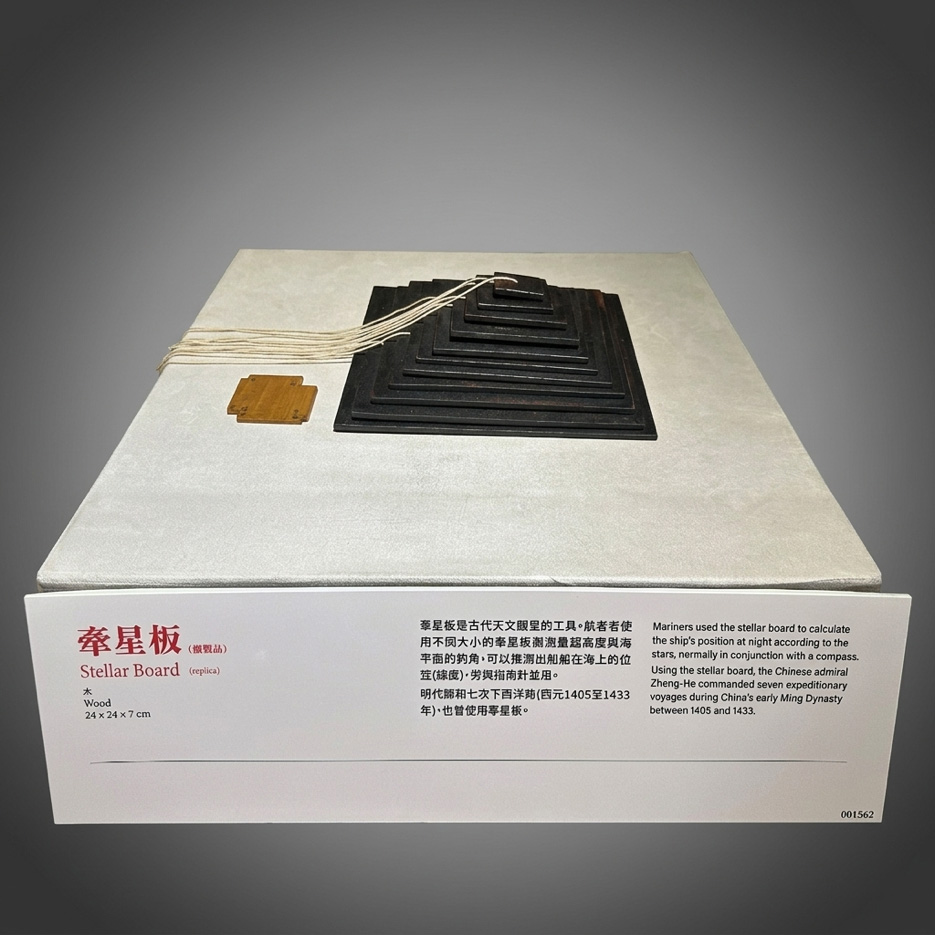
The stellar board is the Chinese adaptation of the Arab navigational device known as the kamal, a fact the museum’s label does not mention. The kamal originated with Arab navigators of the late ninth century and was employed across the Indian Ocean from the tenth century onward, adopted by Indian, Ottoman, and Chinese navigators before the sixteenth century (McGrail, 2001; Needham, 1971). Its operating principle is straightforward but ingenious. The navigator holds one end of a knotted string in the teeth while extending the appropriate board at arm’s length; the lower edge of the board is aligned with the horizon and the upper edge with a target star — typically Polaris in the northern hemisphere — and the angular elevation of the star above the horizon, which approximates the observer’s latitude, can be read from the string's knot position. The eleven (or twelve) boards of different sizes correspond to different angular measurements, allowing the navigator to select a board sized for the latitude being observed. Before departing a known port, the navigator would tie a knot in the cord corresponding to that port's stellar reading; maintaining that reading on the outward journey meant holding a constant latitude. This latitude sailing technique made long-distance ocean voyaging reliably repeatable (Tibbetts, 1971). It is useful and elegant, requiring no mathematical calculations, just the ability to align the shape with the reference points and count knots by touch in darkness.
What makes the stellar board exhibit analytically interesting is not what it shows but what it implicitly excludes. The qianxingban represents one solution — a Chinese adaptation of an Arab instrument — to the problem of ocean navigation. It is a technological object: portable, quantitative, dependent on a standardized instrument held at a fixed distance from the eye. But the peoples who first sailed from Taiwan into the Pacific and Indian Oceans developed navigational knowledge systems of equal sophistication and greater antiquity that were of an entirely different character; embodied, environmental, and mnemonic rather than instrumental.
Polynesian and Micronesian navigators, whose ancestors departed from Taiwan millennia before Zheng He’s first voyage, developed a comprehensive system of open ocean navigation that required no physical instruments whatsoever. As David Lewis documented in his foundational study We, the Navigators (1972), traditional navigators across Oceania memorized the rising and setting positions of hundreds of stars, organized into named star paths that linked specific islands to specific celestial markers. They read ocean swells, distinguishing by feel alone the long, slow undulations of deep-ocean swells from shorter wind-driven waves, using the body as an instrument to detect the directional information encoded in wave patterns that persist even through storms. They observed the flight paths of birds, the color and temperature of water, the quality of cloud formations over unseen islands, and the behavior of bioluminescence at night (Hutchins, 1983). The Marshall Islands navigators of Micronesia encoded their knowledge of swell patterns and island positions in stick charts — physical mnemonic devices constructed from palm ribs, coconut fiber, and shells, representing not distances but the directional relationships between ocean conditions and land (Lewis, 1972; Dodd, 1972). Diverse traditions across the Pacific used wind compasses, not a physical object but a mental construct, a memorized map of directional winds, to maintain orientation across thousands of miles of open ocean (Harrison et al, 2024).
These traditions represent navigational expertise on a scale at least equal to anything in the Chinese or European maritime repertoire. David Lewis sailed from Tahiti to Aotearoa New Zealand using no modern instruments (compass, chronometer, sextant, or radio), covering 3,603 kilometers and making landfall with an error of only 41 kilometers (Lewis, 1972). The Polynesian voyaging canoe Hōkūleʻa, navigated by Micronesian master navigator Mau Piailug using traditional wayfinding methods, sailed from Hawaiʻi to Tahiti in 1976 and in 2017 completed a circumnavigation of the planet. These are not romantic reconstructions of primitive seamanship but demonstrations of a knowledge system of extraordinary precision and depth.
The stellar board exhibit, by representing ocean navigation through the qianxingban and its association with Zheng He, positions Chinese imperial maritime technology as a benchmark for navigational achievement in the region. This is a coherent curatorial choice, and the object is a fascinating one. What it leaves unrepresented, in a museum on the island that is the Austronesian homeland, is the parallel tradition of wayfinding developed by the peoples whose ancestors departed from Taiwan to populate the Pacific — a tradition that solved the same problem of open-ocean navigation through entirely different means, including star paths, stick charts, and wind compasses, and whose sophistication is no less remarkable for being embodied, oral, and mnemonic rather than textual, graphic, and instrumental. The two traditions are not in opposition; they are simply different answers to the same vast question.
5. HMB Endeavour Breached for Repairs by John Steven Dews (b. 1949)
On the third floor, among the marine oil paintings organized under thematic headings such as ‘Surging Momentum’ and ‘Violent Waves on the Raging Sea,’ hangs a sumptuous painting by John Steven Dews, a renowned painter in the tradition of British maritime art[2]. The canvas depicts Captain James Cook’s ship HMB Endeavour careened on her side at the mouth of the Endeavour River, in what is now Cooktown in north Queensland, Australia, in June 1770. The composition is dramatic: the stranded ship heels dramatically to starboard against a backdrop of lush tropical hills, her copper-sheathed hull exposed for repair, a ship’s boat pulling across the calm estuary in the foreground, tents of the shore camp visible at right. The work is technically impressive, evoking romance and danger in the age of exploration. The accompanying label reads, in part: “While cruising Eastern Australia in 1770, HMB Endeavour struck a reef and breached for repairs. It was the first time European scientists from the ship saw the strange animal jumping out of the woods, and later named it kangaroo.”
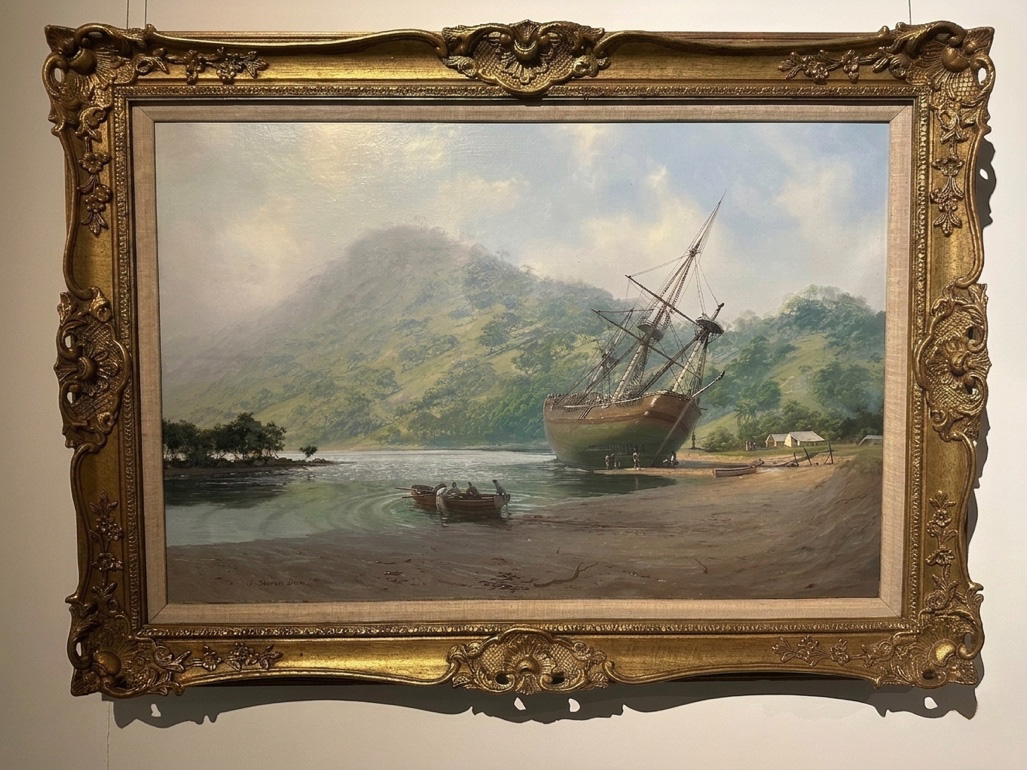
Two observations about this label warrant attention before turning to the painting itself. The first is a matter of translation: the English text uses “breached for repairs” where “beached for repairs” would be the standard nautical and historical term for careening a vessel on shore to expose the hull. “Breached” means broken through or violated; “beached” means intentionally run aground. The error is minor but reveals the limits of the otherwise competent bilingual translation work that characterizes this museum, most likely arising from the Chinese title’s reference to 裂縫 (crack or fissure), the damage that necessitated the repairs, rather than the repair operation itself.
The second observation is more consequential. The label states that European sailors “later named it kangaroo.” This is incorrect, and the misattribution matters. Cook’s Endeavour anchored at the mouth of the river on 11 June 1770 and remained for seven weeks while the hull was repaired. After approximately a month, five Guugu Yimithirr men — the Indigenous people on whose traditional land the ship had grounded — approached the vessel and established what the historical record describes as an amicable relationship (Haviland, 1979). During this period, the naturalist Joseph Banks recorded approximately fifty words of the Guugu Yimithirr language, among them the word gangurru — the Guugu Yimithirr name for the large grey kangaroo, which Banks transcribed as “Kangaru” in his journal on 12 July 1770. The word was not coined by European scientists; it was given to them by the people on whose land they had, by accident, arrived. The Europeans recorded an Indigenous word. The label’s phrasing, “named it kangaroo”, quietly appropriates that act of naming, erasing the Guugu Yimithirr contribution to one of the most famous moments in the history of European exploration.
This brings us to the painting itself, and to its most significant feature: what it does not show. Dews created this work, as an artist working in the 20th and 21st centuries, not as a nineteenth-century recorder of imperial conquest. He painted it with full access to the historical scholarship that has, over the past several decades, substantially revised the story of Cook’s encounter with Australia's Indigenous peoples. That scholarship has documented the Guugu Yimithirr’s active presence during the Endeavour’s seven-week stay, their engagement with the crew, their role as the source of the word that entered the English language, and the catastrophic dispossession that followed European settlement of their lands in subsequent centuries. Yet the painting shows none of this. Its canvas is populated entirely by European sailors going about the business of maritime repair: figures haul on ropes, examine the exposed hull, row the ship’s boat. The landscape is lush and beautiful and empty. The Guugu Yimithirr, on whose land this scene unfolds, are as absent from Dews’ twenty-first-century canvas as they are from the museum label that describes the painting.
The collection consistently displays objects and images that point toward the richness of maritime encounter while concealing from view the Indigenous peoples who were present at, and often central to, those encounters. The Tao boat’s panel omits the flying fish ritual culture of Orchid Island. The stellar board’s label omits the Austronesian navigational traditions that predate and surround it. And here, a painting by a living British artist reproduces a familiar trope of European maritime iconography: the heroic ship, the industrious sailors, the empty landscape waiting to be named. That this painting hangs in a Taiwanese museum dedicated to maritime heritage, on an island whose own Indigenous peoples have experienced analogous processes of erasure, gives it a resonance that neither the artist nor the curators may have intended, yet one that an attentive visitor cannot easily ignore.
6. The Evergreen Container Ship Models
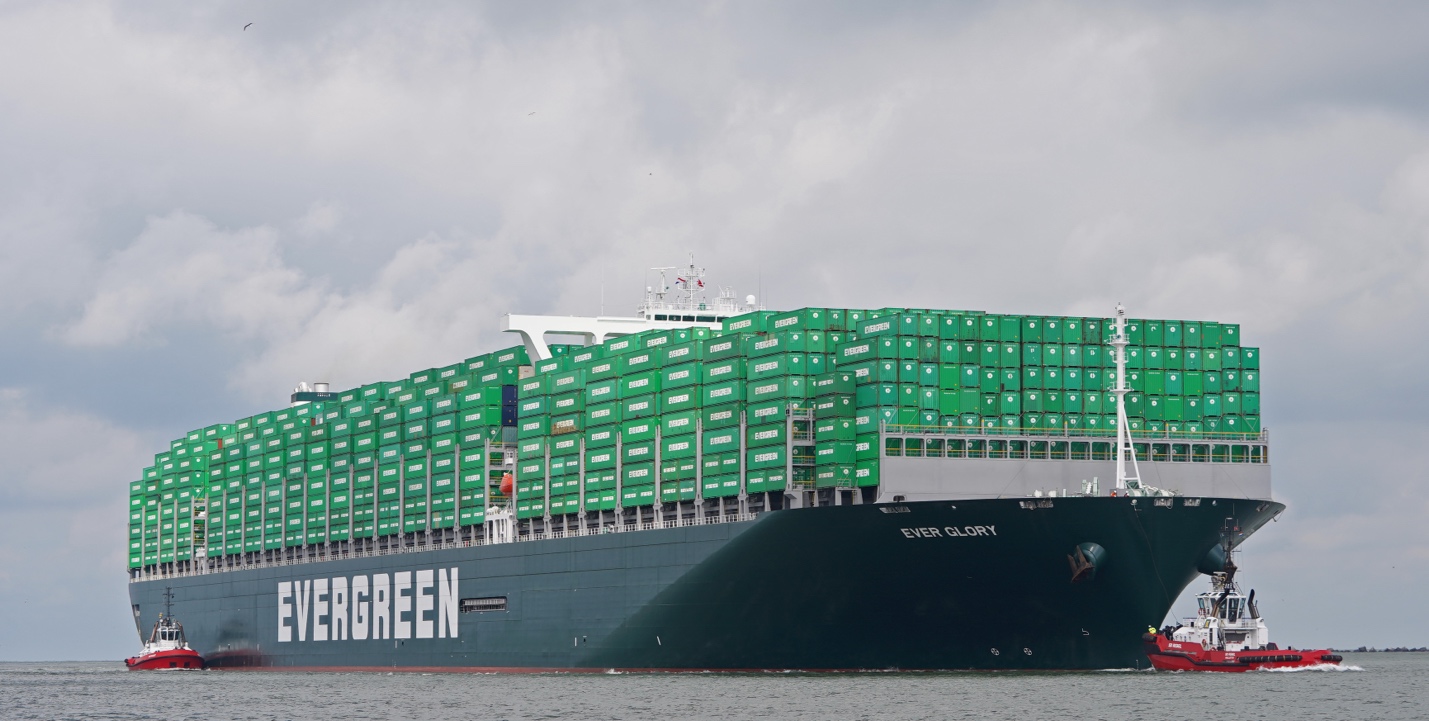
The fourth floor of the Evergreen Maritime Museum is, in one sense, the destination toward which the entire collection has been building. Here, amongst scale models of ocean liners, warships, and submarines that trace the development of maritime technology through the twentieth century, stands a fleet of container ship models that constitutes the museum’s largest single collection of like objects. The models are fully loaded, their decks stacked with rows of identical containers in Evergreen’s distinctive green livery, their hulls bearing the company’s name logo. This fleet in miniature is clearly the main assemblage that the museum is intended to celebrate.
It would be easy to read this display as mere corporate self-promotion, a shipping magnate’s vanity project. The phenomenon of corporations and founding families establishing museums as vehicles for heritage-making and brand patrimonialization is well documented (Cerquetti et al., 2023; Pulh et al., 2023). And maritime museums have been shown to organize their narratives around the priorities of dominant commercial and institutional actors at the expense of local seafaring communities (Bunz, 2022; Sutherland, 2024). But the container ship models deserve a more historically grounded reading, made possible by the museum’s own curatorial choices. The visitor who has descended through the full arc of maritime history arrives at these vessels having already encountered the lashed bamboo raft, the ceremonial Wang Ye junk laden with ritual offerings, the stellar board used to navigate the Indian Ocean, and the careened hull of the Endeavour being repaired after striking a reef. Each of these objects represents a different solution to the same problems: how to navigate across water, how to carry people and goods, how to survive the ocean’s indifference to human effort.
The problem of cargo, of carrying maximum loads on watercraft, is among the oldest and most consequential in the history of human migration. Cargo drove the development of the Chinese junk’s multiple watertight compartments (Needham, 1971; Van Tilburg, 2013), the Mediterranean nave tonda (round ship, designed for cargo) (Casson, 1971), the Dutch fluyt’s capacious hold (Unger, 2008), and the nineteenth-century clipper’s trade-off between speed and capacity (MacGregor, 1988). Excess cargo caused some of maritime history’s most catastrophic failures. When chronic overloading of vessels sent countless ships and their crews to the depths, British politician Samuel Plimsoll campaigned for and eventually achieved in 1876 the mandatory load line. The ‘Plimsoll line’, still marked on every commercial vessel today, set a legal limit on how much a ship could be laden. The history of cargo shipping is inseparable from the history of lost goods, ships, and lives, all in the service of the human drive to move cargo across water in ever larger quantities.
The modern container ship represents the most capacious solution yet for this ancient problem and has become an icon of global commerce (Leivestad & Schober, 2021). The innovation that made this ship possible was not primarily nautical but organizational. The standardized intermodal container, developed by American trucking entrepreneur Malcolm McLean in the 1950s, allowed cargo to be transferred without unpacking between ship, truck, and train (Levinson, 2006). The container transformed shipping economics so completely that the cost of moving goods across an ocean declined sharply, enabling the trade networks that now sustain the world economy. A modern large container ship carries upwards of twenty thousand twenty-foot equivalent units, each a steel box 6.1 meters long, 2.4 meters wide, and 2.6 meters high, stacked in columns that rise far above the bridge, extending in orderly rows from bow to stern in a display of modular organization that is, in its own way, as visually striking as anything in the museum. The contents of those containers (electronics, clothing, furniture, food, pharmaceuticals, machinery) are invisible, sealed inside identical steel boxes whose contents are known only to manifests and databases. The ship is simultaneously the most transparent and the opaquest of vessels: its capacity is immediately visible, its cargo entirely hidden. Beyond merely transporting cargo, the container ship also carries “noneconomic forms of social worth”, and leverages multiple nodes of existence, from construction, to launch, to scrapyard (Schober et al., 2022).
Evergreen Marine Corporation was founded by Chang Yung-fa in 1968 with a single secondhand vessel. By the time of his death in 2016 it had grown into one of the world’s largest container shipping lines, operating a fleet of more than 190 vessels and serving ports in over eighty countries. The museum he founded celebrates this trajectory, and the rows of green models make the argument visually. This is what Taiwan achieved, an enormous contribution of one man and his company to the global movement of goods. The pride is not without justification. Taiwan’s emergence as a major maritime trading nation in the postwar period is a significant chapter in the island's economic history. Chang’s story as a sailor who rose to captain and then from a single used cargo vessel built a shipping empire, presents the kind of founding myth museums are well positioned to tell (Chang, 1997).
The green fleet also communicates this museum’s maritime imagination, juxtaposed with the bamboo raft, the Wang Ye boat, the stellar board, and the Tao canoe. Each object represents in turn a maritime relationship between people and sea grounded in specific place, specific community, and specific ecological and spiritual knowledge. The container ship represents a relationship between capital and ocean, in which the sea is a medium for the global movement of generic goods, with the ship’s cultural and ecological qualities seemingly irrelevant to the operation. The containers are identical because what matters is capacity, standardization, interoperability, and scale. These are virtues in a shipping line. As the organizing principle of a museum dedicated to maritime heritage, they produce a collection that is in some tension with itself, one in which the objects that bear the most cultural weight are outnumbered and outscaled by the objects that carry the most cargo.
7. The Tao Boat of Orchid Island
The visitor who has descended through five floors of the Evergreen Maritime Museum and paused before the bamboo raft, the Wang Ye ceremonial complex, the stellar board, the Dews painting, and the rows of green container ships, arrives back at the lobby bearing a different understanding than the one they entered with. The Tao boat is still there, against its glass wall, the Taipei skyline still visible beyond it. But it looks different now.
On first encounter, the Tao boat arrests attention through sheer visual virtuosity. On second encounter, having seen what the museum considers worth celebrating and explaining at length, it arrests attention through a different quality, a kind of gravitational pull it exerts on its surroundings. It stands adjacent to a gift shop, where visitors purchase souvenirs of their maritime experience. It occupies a humble place in the side of the lobby while the Arabian dhow commissioned through Chang Yung-fa’s Dubai business network occupies the place of honor at the room’s heart. It backs against a glass wall that frames modern Taipei, the capital of a state that has administered Orchid Island since 1945 and whose relationship with the Tao people has not always been benign. These are not incidental juxtapositions. They are the condition in which this extraordinary object exists and exerts its pull.
The boat itself demands careful description, because the accompanying panel does not provide an adequate one. It is a full-sized contemporary traditional vessel, carvel-built from 27 pieces of wood in four tiers of edged planks, with the sharply upswept bow and stern that are the defining feature of Tao watercraft. Six oars, painted in stripes of red, white and black, rest within it, and an elaborate oarlock — presumably designed to hold a long-handled rudder, though the rudder itself is absent from the display — confirms that this is not a ceremonial model but a functional boat, capable of being launched and sailed. That the rudder is missing is a small detail, but a telling one: the boat is presented as a visual and cultural artifact rather than as a working vessel, its seagoing capacity implied but not demonstrated.
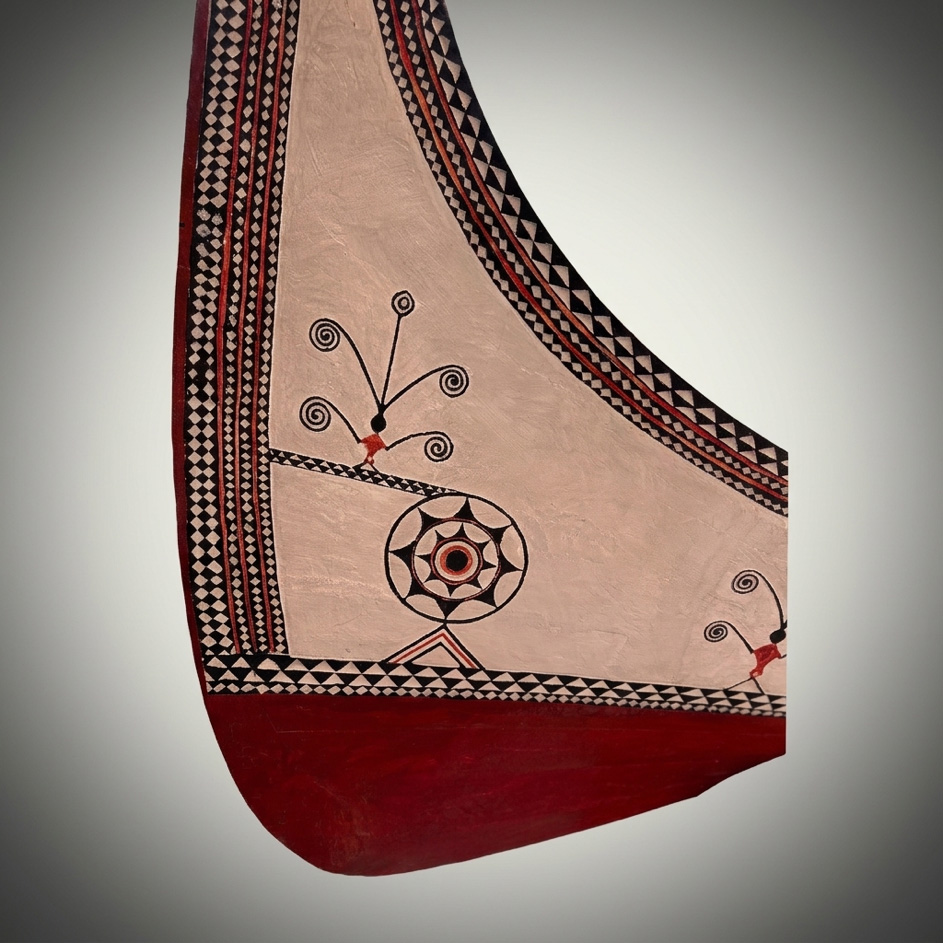
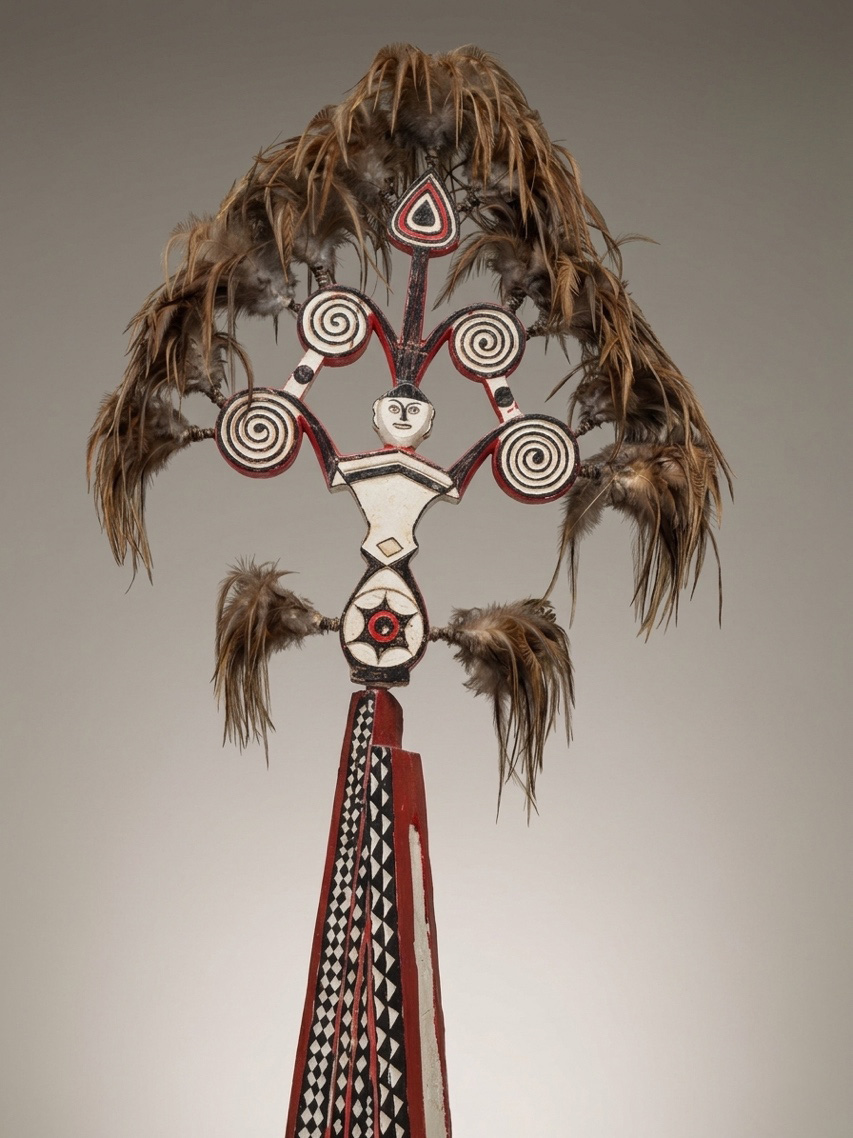
The surface decoration rewards prolonged attention. The hull is painted deep red. Rising from it, the upper strakes and bow and stern pieces carry elaborate ornamentation executed in a palette of red, black and white with extraordinary precision. Diamond checkerboard borders run along every edge. Within these borders, radiating sun-eye motifs — concentric circles with pointed rays, in red, black and white — inhabit a mostly empty white field. Branching spiral figures, their tendrils terminating in tight coils, occupy the upper surfaces. And presiding over bow and stern, a sculptural wooden figure: a stylized human ancestor, arms outstretched and terminating in large spiral discs, the head crowned with cascading bundles of feathers, the torso decorated with the same diamond and spiral motif as the hull. The figure smiles. It is alert, symmetrical, heraldic — a guardian presence on a vessel whose every painted surface encodes a relationship between human beings, the sea, and the cosmos.
The interpretive panel describes the boat’s construction: carvel planking, the raised bow and stern, the 27-piece timber assembly. It notes that feathers decorate bow and stern and that the diamond border represents waves while the double circles represent the boat’s eyes, seeking bountiful fish. Four photographs show the Tao Tribal Launching Ceremony for a new boat at Langdao Village, Lanyu, in 2001. This is more than many museum labels provide, and it is instructive. But what the panel does not say is as significant as what it says. It does not say that the Tao people of Orchid Island are the only remaining seafaring Indigenous people in Taiwan, the sole community among the nation’s 16 recognized Indigenous groups to have maintained a living tradition of ocean-going boat-building (Barnes, 2002) and fishing into the present (Digital Museum of Taiwan Indigenous Peoples, 2017). It does not say that the boat’s cultural meaning is largely organized around the annual migration of flying fish, libangbang, “a gift from heaven” in the Tao language, whose seasonal arrival determines the ritual calendar, the fishing practice, and the social life of the community (RTI, 2025). It does not say that the Tao are an Austronesian people whose language and material culture connect them most directly not to the Taiwanese mainland but to the Ivatan people of the Batanes Islands of the Philippines, a hundred miles to the south across the Luzon Strait (Yang, 2012). It does not use the word Tao, preferring the older exonym “aboriginal.” And it contains, as noted, not a single word in the Tao language, which has a richly elaborated maritime lexicon (Appendix A).
What the panel does, in other words, is precisely what Varutti (2014) identified in her study of Tao canoes in Taiwanese museums: it treats the boat as a polysemic object whose cultural density is acknowledged but not unpacked, presenting it as a beautiful artifact to be admired rather than as a window into a complete and sophisticated maritime civilization. The unique cultural density of Tao canoes, as Varutti argues, provides opportunities to critically engage with the propensity of museums to act as sites for the production and transformation of knowledge about indigenous cultures. But such opportunities are as often declined as taken up. The Evergreen Museum's treatment of the Tao boat is a case study in that declination: a gesture of inclusion that stops short of interpretive engagement.
The centrality of seafaring to Tao cultural life is vividly documented in the memoir of Syaman Rapongan (2025), an ethnic Tao author, fisherman, and boatbuilder born in 1957 on Orchid Island. Rapongan recalls a community whose annual calendar was organized around three seasons: a fishing season, a feasting season, and a hungry waiting season, governed by the sea and its resources. Participation in the ancient ancestor offering ritual required all able-bodied village men, defined explicitly as those capable of constructing a canoe, to appear in traditional livery and adornment: boat-building competence was not merely a practical skill but a condition of full ceremonial personhood. Rapongan recalls as a child counting more than fifty men processing in his village, which meant, by this logic, more than fifty canoes. Each canoe, crafted by its owner, was, “a tangible symbol of the ocean civilization of the Tao,” embodying the linkage of sea and land and standing as a material expression of family identity. Tao ocean lifeways remain vital and were dramatically demonstrated in June 2026, when a crew of Tao men completed a two-day open-ocean voyage from Lanyu Island to the Batanes Islands of the Philippines in a traditional Tao boat, revitalizing a sea route that had lain dormant for some three hundred years (Lee & Ko, 2026). As Tao heritage is a living tradition, documented by one of its own members in internationally recognized literature, the interpretive resources exist to transform the Evergreen Museum’s single boat and its modest label into a rich encounter with a seafaring culture.
The interpretive panel accompanying the Tao boat contains no words in the Tao language. This is a significant omission. A brief consultation of Rau and Dong’s (2006) Yami Texts with Reference Grammar and Dictionary[3], the standard reference grammar and lexicon of the language, reveals a maritime vocabulary of remarkable precision and depth. The language distinguishes between at least three types of watercraft: the tatala (small canoe or fishing boat), the cinedkeran (large multi-person ceremonial vessel), and the pikavangan (two-person boat). It possesses a verb, mikavang, meaning specifically “two people sit in a boat together.” It encodes the action of rowing in no fewer than eight distinct verbal forms: kaoden, ngaoda, ngaodan, ngaokaoda, komaod, mangaod, ipamakong, and mamakongan. And it organizes maritime space through a fundamental directional axis: ilaod, meaning toward the sea or seaward, opposed to irala, meaning toward the land or mountain. Tao oral genres describe ghosts that fish, an environmental calendar with months named for flying fish, and the ‘beckoning flying fish ceremony’. Tao is listed by Ethnologue as having approximately 3,800 speakers and classified as endangered (Eberhard et al., 2024); a museum exhibit including even a handful of Tao words alongside the standard bilingual signage would be making a small but meaningful gesture toward a language and a maritime knowledge system that may not survive another generation. The boat stands in the Evergreen Maritime Museum as a visual spectacle; but the language that would speak its meaning is absent.
And yet the Tao boat is here. A museum whose gravitational center is unambiguously the corporate achievement of Evergreen Marine Corporation, whose lobby centerpiece is a dhow from Dubai, whose most numerous objects are green container ships loaded with invisible cargo, nevertheless boasts a full-sized Tao ceremonial fishing boat poised against a glass wall, looking out over Taipei. Its ancestor figures smile, evoking the joyous ritual where Tao men in ceremonial dress toss the new boat into the air thrice, then launch it with shouts and songs into the sea (Arnaud, 2011; Chen, 2017). Its spiral eyes seek bountiful flying fish. Its feathers catch the light of a building designed to celebrate the movement of standardized containers across the world’s shipping lanes.
The visitor who knows what they are looking at will find the Tao boat the most remarkable object in the collection. The visitor who does not — who reads the placard, glances at the photographs, moves on toward the gift shop — will have seen something beautiful but perhaps understood little of what they saw. The gap between those two experiences is not the Tao boat’s failure. It is the museum’s invitation, unanswered, to do better.
8. Conclusion
The Evergreen Maritime Museum is a generous institution. It is free or modestly priced, centrally located, beautifully maintained, and staffed by people who clearly care about the collection in their care. Its ship models are among the finest in the region, its marine paintings gallery is a cultural achievement, and its bilingual labeling brings maritime history within reach of an international public. Enthusiastic docents inspire the next generation of Taiwanese schoolchildren with the wonder of the sea and humanity’s long, arduous, inventive engagement with it. The museum is a gift to its city and, for those who make the journey to Taipei, to the world.
Its limitations are those of circumstance and curatorial choices. A museum founded by a shipping magnate, housed in a corporate foundation building, committed to celebrating the global commercial maritime achievement that Chang Yung-fa’s life represents, might naturally organize its storytelling around that achievement. The European sailing exploits that fill the upper floors, the green container ships, and the Arabian dhow in the lobby all speak the language of commercial maritime modernity. They operationalize the sea as a medium for trade, for exploration, for the movement of goods, and the projection of power. These are important dimensions of maritime history, a story this museum tells skillfully.
What the museum tells less well is the story that begins not with European navigators or Chinese admirals or Taiwanese shipping magnates, but with the people who were already in Taiwan and the surrounding ocean regions. These people were already seafaring in an intimate and ritually regulated relationship with the ocean, millennia before any of those later chapters were written. The Tao boat in the lobby suggests a deeper story to be told. The bamboo raft carries it in its lashed culms. The Wang Ye boat is processed across the beaches of southern Taiwan every three years to tell that story. While these objects preside in the collection, their deeper meaning remains mostly untold.
The present study has focused on a single institution, examining six objects from the Evergreen Maritime Museum’s permanent collection as windows into the tensions between corporate maritime identity and Indigenous seafaring heritage in Taiwan. The analytical framework developed here — attending to what museums display and what they omit, and contrasting curatorial choices with the living maritime cultures they reference — is one that invites systematic extension. A comparative study of small-scale maritime museums across Southeast Asia, undertaken through the same lens of Indigenous inclusion and living maritime heritage technologies, would yield significant insight into how the region’s diverse seafaring cultures are institutionally remembered, partially represented, quietly erased, or finally revitalized. It would help to improve maritime museum exhibit user experience (King et al., 2025; Nuovo, 2020) and strengthen heritage education to “bridge the gap between the past and present” (Garradas & Semedo, 2023, p. 52). Six Asian museums suggest themselves as productive sites for such a study: the Maritime Museum (Museum Bahari) (www.museumbahari.org) in Jakarta, Indonesia, housed in a former Dutch East India Company spice warehouse and confronting the colonial entanglements of its own building; the Maritime Museum (Muzium Samudera) (www.perzim.gov.my/en/portfolio/muzium-samudera-flor-de-la-mar/) in Melaka, Malaysia, whose replica of the sunken Flor de la Mar raises questions about whose maritime losses are commemorated and whose are not; the Museum of Philippine Maritime History (www.facebook.com/nhcpmpmhofficial) in Iloilo City, Philippines, opened in 2023 and still in the early stages of defining its relationship to the archipelago’s living seafaring communities; and two Japanese institutions that approach maritime heritage from the bottom up rather than the top down — the Toba Sea-Folk Museum (www.umihaku.com/english/) in Mie Prefecture, dedicated to the fishing traditions and ama diving culture of the Toba coast, and the Nakagawa Funabansho Museum (www.kcf.or.jp/nakagawa/) in Tokyo’s Koto Ward, which recovers the riverine and coastal lifeways of Edo-period commoners largely invisible in grander national narratives. Finally, a visit to the Lanyu Museum in Hongtou Village, Lanyu Island, would yield a deeper understanding of Tao culture where it still thrives. Together, these six institutions span colonial, postcolonial, corporate, and Indigenous-focused approaches to maritime heritage, and would provide a comparative set from which broader regional conclusions might be drawn.
What can we learn from Asia’s Indigenous maritime cultures, even if filtered through a corporate museum lens? We can certainly learn more than the labels hint at. The Tao boat teaches us how an island people developed, over centuries, a boat-building tradition of extraordinary technical and spiritual sophistication, organized around their relationship with the flying fish, carried by familiar currents, pushed by known winds. The bamboo raft tells us that the ancestors of the Taiwanese people, Indigenous and Han alike, were not bounded by land, but looked to the ocean and saw possibility. The museum echoes these stories, but only partially. To know the fuller story and understand what it meant and means to live as a maritime people in Taiwan, to fish by the rhythms of the Kuroshio Current, to build a boat as an act of devotion and launch it with ceremony, one must go south. Across the water on Pongso no Tao, the Tao boats still adorn the shore, and the Tao people who built them are still, against considerable odds, setting forth on the open sea to explore and connect.
Endnotes
References
- Barnes, R.H., 2002. Yami boats and boat building in a wider perspective. in: Parkin, D., Barnes, R. (Eds.). Ships and the Development of Maritime Technology in the Indian Ocean. Routledge, London, pp. 291–314.
- Bunz, A., 2022. Museum, Place, Architecture and Narrative: Nordic Maritime Museums’ Portrayals of Shipping, Seafarers and Maritime Communities. Berghahn Books, New York/Oxford. https://doi.org/10.1515/9781800733893
- Casson, L., 1971. Ships and Seamanship in the Ancient World. Princeton University Press, Princeton, NJ.
- Cerquetti, M., Montella, M.M., Sardanelli, D., 2023. Corporate museums as heritage vehicles: a comparative analysis between family and non-family businesses. Corp. Gov. Res. Dev. Stud. 2(2022): 65–86.
https://doi.org/10.3280/cgrds2-2022oa13773 - Chang, Y.-F., 1997. Tides of Fortune: Memoirs of Chang Yung-fa. Evergreen International Corp., Taipei.
- Chen, W., 2017. Tao’s new boats ceremony in July. Lanyu.land (blog). https://lanyu.land/new-boat-launching-ceremony/ [Accessed 16 August 2026].
- Davidson, J.W., 1903. The Island of Formosa, Past and Present: History, People, Resources, and Commercial Prospects. Macmillan, London and New York.
- Digital Museum of Taiwan Indigenous Peoples, 2017. Tao. Available at: https://www.dmtip.gov.tw/web/en/page/detail?nid=12 [Accessed 25 May 2026].
- Dodd, E., 1972. The Ring of Fire, Volume II: Polynesian Seafaring. Dodd, Mead & Co., New York.
- Doran, E.J., 1971. Sailing raft as a great tradition. in: Riley, C.L., et al. (Eds.) Man Across the Sea. University of Texas Press, Austin, pp. 115–138.
- Dreyer, E.L., 2007. Zheng He: China and the Oceans in the Early Ming Dynasty, 1405–1433. Pearson Longman, New York.
- Eberhard, D.M., Simons, G.F., Fennig, C.D. (Eds.). 2024. Ethnologue: Languages of the World, 27th ed. SIL International, Dallas. https://www.ethnologue.com/language/tao
- Evergreen Maritime Museum, n.d. Mission statement. Available at: https://www.evergreenmuseum.org.tw/en [Accessed 27 July 2026].
- Garradas, C., Semedo, A., 2023. The potential of maritime museums for heritage education. Didáctica de las Ciencias Experimentales y Sociales. 44: 51–70. https://doi.org/10.7203/DCES.44.26418
- Harrison, K.D., Kelso, N., Ramík, D.M., Ramík, N., Plunkett, G.M., Wahe, M., Balick, M.J., 2024. Wind lore as environmental knowledge in Southern Vanuatu. J. Mar. Island Cult. 13(1). https://doi.org/10.21463/jmic.2024.13.1.01
- Haviland, J.B., 1979. Guugu Yimidhirr. in: Dixon, R.M.W., Blake, B. (Eds.) Handbook of Australian Languages, Vol. 1. Australian National University Press, Canberra, pp. 27–182.
- Huang, S.-F., 1997. Language ideology in Taiwan: the KMT's language policy, the Tai-yu language movement, and ethnic politics. J. Multiling. Multicult. Dev. 18(4): 302–315.
- Hutchins, E., 1983. Understanding Micronesian navigation. in: Gentner, D., Stevens, A.L. (Eds.) Mental Models. Lawrence Erlbaum Associates, Hillsdale, NJ, pp. 191–225.
- International Council of Museums (ICOM), 2026. Code of Ethics for Museums. Adopted at the 41st ICOM Ordinary General Assembly, Paris, 25 June 2026. https://icom.museum/wp-content/uploads/2026/06/Code-of-Ethics_2026_EN-1.pdf [Accessed 27 July 2026].
- Kaifu, Y., Lin, C., Goto, A., et al., 2019. Palaeolithic seafaring in East Asia: testing the bamboo raft hypothesis. Antiquity. 93(372): 1424–1441. https://doi.org/10.15184/aqy.2019.90
- Katz, P.R. 1987. Demons or deities? The Wangye of Taiwan. Asian Folklore Stud. 46(2): 197–215.
- Katz, P.R., 1995. Demon Hordes and Burning Boats: The Cult of Marshal Wen in Late Imperial Chekiang. SUNY Press, Albany.
- King, E., Smith, M.P., Wilson, P.F., Stott, J., Williams, M.A., 2025. Evaluating museum exhibits: quantifying visitor experience and museum impact with user experience methodologies. Curator: Museum J. 68: 163–200. https://doi.org/10.1111/cura.12637
- Lee, H.-F., Ko, L., 2026. Lanyu boat sets sail on historic journey to Philippines’ Batanes. Focus Taiwan. Available at: https://focustaiwan.tw/culture/202606150020 [Accessed 27 July 2026]
- Leivestad, H.H., Schober, E., 2021. Politics of scale: colossal containerships and the crisis in global shipping. Anthropol. Today. 37: 3–7. https://doi.org/10.1111/1467-8322.12650
- Levinson, M., 2006. The Box: How the Shipping Container Made the World Smaller and the World Economy Bigger. Princeton University Press, Princeton, NJ.
- Lewis, D., 1972. We, the Navigators: The Ancient Art of Landfinding in the Pacific. Australian National University Press, Canberra.
- Li, P.J.-K., Zeitoun, E. (Eds.). 2023. Handbook of Formosan Languages Online: The Indigenous Languages of Taiwan. Brill, Leiden.
- Liu, C., Kao, C., Lin, J.-Z., Chao, H.-C., 2005. Bamboo Raft and Fishery Culture of the Amis Indigenous People on the Eastern Coast of Taiwan. Austronesian Community College Association of Taitung County, Taitung.
- MacGregor, D.R., 1988. Fast Sailing Ships: Their Design and Construction, 1775–1875. Naval Institute Press, Annapolis, MD.
- McGrail, S., 2001. Boats of the World: From the Stone Age to Medieval Times. Oxford University Press, Oxford.
- Ministry of Culture, 2017. Prehistoric raft will be replicated using bamboo, rattan. Available at: https://www.moc.gov.tw/en/News_Content2.aspx?n=467&s=14234 [Accessed 25 May 2026].
- Needham, J., 1971. Science and Civilisation in China, Vol. 4, Part 3: Civil Engineering and Nautics. Cambridge University Press, Cambridge.
- Nuovo, M.M.S., 2020. Aims and targets of maritime museums and exhibitions in Europe: six case studies from Germany, Greece and Italy. in: IKUWA6 Shared Heritage: Proceedings of the Sixth International Congress for Underwater Archaeology, pp. 270–285.
- Pulh, M., Chaney, D., Mencarelli, R., 2023. The patrimonialization of brands: an empirical exploration of two branded museums. Culture et Musées. 42(2023): 102–128. https://doi.org/10.4000/culturemusees.10701
- Radio Taiwan International, 2025. Flying fish: a seasonal ritual of the Tao peoples of Orchid Island. Available at: https://en.rti.org.tw/news/view/id/2012926 [Accessed 25 May 2026].
- Rapongan, S., Eyes of the Ocean. 2025. Columbia University Press, New York.
- Rau, D.V., Dong, M.-N., 2006. Yami Texts with Reference Grammar and Dictionary. Language and Linguistics Monograph Series A-10. Institute of Linguistics, Academia Sinica, Taipei.
- Schober, E., Dewan, C., Markkula, J., 2022. Container ships: life cycles, chains of value, and labor in maritime logistics. in: Aldenderfer, M. (Ed.), Oxford Research Encyclopedia of Anthropology. Oxford Academic, New York. https://doi.org/10.1093/acrefore/9780190854584.013.374 [Accessed 2 June 2026].
- Sutherland, C., 2024. From colonial conquest to climate crisis: reframing French maritime museums. Int. J. Herit. Stud. 30(11): 1250–1262. https://doi.org/10.1080/13527258.2024.2386693
- Tibbetts, G.R., 1971. Arab Navigation in the Indian Ocean Before the Coming of the Portuguese. Royal Asiatic Society, London.
- Trần, H., Harrison, K.D., Trần, P.L.H., Bùi, M.C., Phạm, T.K., 2025. The Bahnar canoe and environmental knowledge in the Central Highlands of Vietnam. J. Mater. Cult. 30(4): 524–544. https://doi.org/10.1177/13591835251389565
- Tsai, F.C.L., 2020. Shuttling between land and sea: contemporary practices among Amis spearfishing men as a foundation for local marine-area management. Sustainability. 12(18): 7770. https://doi.org/10.3390/su12187770
- UNESCO, 2020. Ong Chun/Wangchuan/Wangkang ceremony, rituals and related practices for maintaining the sustainable connection between man and the ocean. Inscribed on the Representative List of the Intangible Cultural Heritage of Humanity, 15th session of the Intergovernmental Committee, 17 December 2020. https://ich.unesco.org/en/RL/ong-chun-wangchuan-wangkang-ceremony-01608 [Accessed 25 May 2026].
- Unger, R.W., 2008. Fluyt. in: Hattendorf, J.B. (Ed.), Oxford Encyclopedia of Maritime History, Vol. 2. Oxford University Press, New York, pp. 50–51.
- Van Tilburg, H.K., 2013. Chinese Junks on the Pacific: Views from a Different Deck. University Press of Florida, Gainesville, FL.
- Varutti, M., 2014. Polysemic objects and partial translations: museums and the interpretation of indigenous material culture in Taiwan. Museum Anthropol. 37(2): 102–117. https://doi.org/10.1111/muan.12056
- Worcester, G.R.G., 1971. The Junks and Sampans of the Yangtze. Naval Institute Press, Annapolis, MD.
- Yang, C.-H., 2012. Ethnic group existed betwixt and between islands and states: on oral histories among the Tao from Orchid Island, Taiwan and the Ivatan from Batanes Islands, the Philippines. J. Austronesian Stud. 3: 27–53.
Appendix A.
Tao (Yami) Maritime Vocabulary: A Thematic Lexicon
The following lexicon is extracted from the trilingual index (English/
Tao (also called Yami) is an Austronesian language of the Philippine Batanic branch, spoken by approximately 4,000 people on Orchid Island (Lanyu, 蘭嶼), Taiwan (Eberhard et al., 2024), and classified as endangered. It is the only indigenous language of Taiwan not classified as a Formosan language, reflecting the Tao people's close cultural and linguistic ties to the Ivatan people of the Batanes Islands, Philippines (Yang, 2012). The maritime vocabulary documented here reflects the centrality of ocean life, boat-building, tidal ecology, fish taxonomy, and the flying fish ritual cycle to Tao cultural identity.
The elaboration of the Tao lexicon — with eight distinct verbal forms for rowing, multiple terms for directional orientation relative to the sea (ilaod, seaward; irala, landward), five terms for tidal states, an elaborate ceremonial vocabulary for the flying fish season, and a gendered taxonomy of fish species distinguishing men's fish (rahet) from women's fish (oyod) — reflects a maritime civilization of extraordinary cultural depth.
Note on source: The trilingual index (PDF pages 112–235; book pages 567–690) contains parallel English/
| English Gloss | Tao (Yami) | Chinese | Pinyin |
|---|---|---|---|
| boat | tatala | 船 | chuán |
| big boat (6-, 8-, or 10-person) | cinedkeran | 大船 | dàchuán |
| two-person boat | pikavangan | 雙人船 | shuāngrén chuán |
| boat owner | mapitatala | 船主 | chuánzhǔ |
| make a big boat | micicinedkeran | 建造大船 | jiànzào dàchuán |
| pull a boat ashore | aralaen | 拖船上岸 | tuōchuán shàngan |
| row a boat | miavavang | 遊船 | yóuchuán |
| two people sit in a boat | mikavang | 雙載 | shuāngzài |
| English Gloss | Tao (Yami) | Chinese | Pinyin |
|---|---|---|---|
| oar; canoe paddle | avat | 槳 | jiǎng |
| oar; rudder | savilak | 舵 | duò |
| boat house | kakamaligan | 船屋 | chuánwū |
| moorage; place where boats are moored at seashore | aharang | 海邊停放船處 | hǎibiān tíngfàng chuánchù |
| ride; board (a boat) | omavang | 搭乘 | dāchéng |
| board; plank | tapi | 木板 | mùbǎn |
| English Gloss | Tao (Yami) | Chinese | Pinyin |
|---|---|---|---|
| row | kaoden | 划 | huá |
| row | ngaoda | 划 | huá |
| row | ngaodan | 划 | huá |
| row | ngaokaoda | 划 | huá |
| rowing | komaod | 划著 | huázhe |
| rowing | mangaod | 划著 | huázhe |
| do rowing action | ipamakong | 做划槳之勢 | zuò huájiǎng zhī shì |
| do rowing action | mamakongan | 做划槳之勢 | zuò huájiǎng zhī shì |
| go ashore; pull into shore | pakarala | 上岸; 靠岸 | shàngan; kàoàn |
| ashore | ngiyid | 上岸 | shàngan |
| pull into shore | makarala | 靠岸 | kàoàn |
| English Gloss | Tao (Yami) | Chinese | Pinyin |
|---|---|---|---|
| sea (open ocean surface) | wawa | 海上 | hǎishàng |
| sea water | attaw | 海水 | hǎishuǐ |
| sea (shoreside) | ttaw | 海邊 | hǎibiān |
| island | maattaw | 島嶼 | dǎoyǔ |
| island (on the island) | kapongsoan | 島上 | dǎoshàng |
| deep sea; sea bottom | kalilian | 深海海底 | shēnhǎi hǎidǐ |
| was out to sea (past) | nimakateyteylaod | 靠海上 (過去) | kào hǎishàng |
| away off shore | palaod | 遠離岸邊 | yuǎnlí ànbiān |
| away off shore | palaoda | 遠離岸邊 | yuǎnlí ànbiān |
| far from the shore | maláod | 離岸邊很遠 | lí ànbiān hěn yuǎn |
| near the sea; seaward side | laod / ilaod | 靠海的 | kào hǎi de |
| water (fresh) | ranom | 水 | shuǐ |
| English Gloss | Tao (Yami) | Chinese | Pinyin |
|---|---|---|---|
| tide; tidal water | henep | 潮水 | cháoshuǐ |
| full tide; high water | mipono | 滿 (潮) | mǎn cháo |
| rising tide; high tide | mipehnep | 漲潮 | zhǎngcháo |
| ebb; low tide | mangci | 退潮 | tuìcháo |
| tidal zone; sedgeland at shore | keysakan | 潮水; 潮間帶 | cháoshuǐ; cháojiān dài |
| English Gloss | Tao (Yami) | Chinese | Pinyin |
|---|---|---|---|
| seashore | vanoa | 海邊 | hǎibiān |
| seashore | awa | 海邊 | hǎibiān |
| harbour; seashore | pasalan | 港岸; 海灘 | gǎngàn; hǎitān |
| area where beach morning glories grow | kavalinoan | 馬鞍藤一帶 | mǎānténg yīdài |
| reef | kakawan | 礁石 | jiāoshí |
| place name: Military Ship Island | Jiahaod | 地名; 兵艦島 | dìmíng; bīngjiàn dǎo |
| place name: Nuclear Waste Harbor | Jimaramay | 地名; 核廢港 | dìmíng; héfèi gǎng |
| English Gloss | Tao (Yami) | Chinese | Pinyin |
|---|---|---|---|
| fish (generic) | among | 魚 | yú |
| fish (various; catch of fish) | amoamong | 魚類 | yúlèi |
| fish owner; one who has fish | mapiamong | 擁有魚的人 | yōngyǒu yú de rén |
| caught fish (past) | nimangahahap | 捕魚 (過去) | bǔyú |
| manage to catch fish | makamong | 捕到魚 | bǔdào yú |
| a way to catch fish; fishing method | manazataza | 漁法 | yúfǎ |
| catch fish | manazatazan | 捕魚 | bǔyú |
| with fish scales | miisis | 有鱗片 | yǒu línpiàn |
| fish (men's category) | rahet | 男人的魚 | nán rén de yú |
| fish (women's category) | oyod | 女人的魚 | nǚ rén de yú |
| fish name (parrot fish) | arawa | 魚名 (哥魚) | yúmíng |
| fish name (rudderfish) | ilek / iilek | 魚名 (白鯧魚) | yúmíng |
| fish name (spiny tropical fish; for elderly) | angsa / ngasa | 魚名 | yúmíng |
| fish name (women's fish) | kakaray | 魚名 | yúmíng |
| fish name (ghost mispronunciation of arawa) | rarawa | 魚名 | yúmíng |
| fish name | bebeteng | 魚名 | yúmíng |
| fish name | rararay | 魚名 | yúmíng |
| fish name | mahabteng | 魚名 | yúmíng |
| fish name (vaoyo species) | vaoyo | 魚名 | yúmíng |
| flying fish (black-winged species) | panid | 飛魚 | fēiyú |
| flying fish (black-winged variety) | alibangbang | 飛魚 (黑翅) | fēiyú |
| beckoning flying fish day; flying fish ceremony | kapivanoa | 招飛魚祭之日 | zhāo fēiyú jì zhī rì |
| beckoning flying fish (ceremony, ritual) | mivanoa | 招飛魚儀式 | zhāo fēiyú yíshì |
| this beckoning flying fish ceremony (current year) | ciciapivanoa | 這次招魚祭 | zhècì zhāoyújì |
| net bag for flying fish catch; men's sea bag | aomas | 網袋 | wǎngdài |
| English Gloss | Tao (Yami) | Chinese | Pinyin |
|---|---|---|---|
| go fishing | mamasil | 釣魚 | diàoyú |
| catch fish | manaoy | 捕魚 | bǔyú |
| catch; scoop up fish | manilo | 捕撈 | bǔlāo |
| net; scoop net (hand net) | vanaka | 手撈網 | shǒulāowǎng |
| fish net | tawaz | 魚網 | yúwǎng |
| big mesh bag; large net | panontonan | 大網袋 | dà wǎngdài |
| fish poking rod (to drive fish) | totoyo | 趕魚棒 | gǎnyúbàng |
| spear (noun) | cinalolot | 長矛 | chángmáo |
| spear (verb) | manokzos | 刺殺 | cìshā |
| speared (past) | nimanokzos | 刺殺 (過去) | cìshā |
| gather seafood | maneysavat | 採集海產 | cǎijí hǎichǎn |
| collected seafood (past) | sinavat | 採集的 (過去) | cǎijíde |
| collect seafood | iseysavat | 採集的 | cǎijíde |
| pick snails | pameyret | 撿田螺 | jiǎn tiánluó |
| English Gloss | Tao (Yami) | Chinese | Pinyin |
|---|---|---|---|
| swim | miawawat | 游泳 | yóuyǒng |
| swim | palawawat | 游泳 | yóuyǒng |
| swim | mittattaw | 游泳 | yóuyǒng |
| only swim | kapiawawat | 只游泳 | zhǐ yóuyǒng |
| able to swim that far | mawat | 游得到 | yóudedào |
| swam (past) | nimittattaw | 游泳 (過去) | yóuyǒng |
| swim very well | ji ateymákeykiawat | 很會游泳 | hěn huì yóuyǒng |
| float | attaattaw | 漂浮 | piāofú |
| splash water | saboya | 潑水 | pōshuǐ |
| all wet; soaking wet | mireyrerekétan | 溼答答的 | shī dādā de |
| drown (sink down) | ngneji | 沉下去 | chénxiàqù |
| drown (submerge) | miramosi | 淹沒 | yānmò |
| drowned (past) | nikamotan | 溺水 (過去) | nìshuǐ |
| English Gloss | Tao (Yami) | Chinese | Pinyin |
|---|---|---|---|
| crab name (civet crab) | civet / civecivet | 蟹名 | xièmíng |
| crab name (kotat crab) | kotat / kotakotat | 蟹名 | xièmíng |
| crab name | cinodotodo | 蟹名 | xièmíng |
| sea urchin | asiasi | 海膽 | hǎidǎn |
| English Gloss | Tao (Yami) | Chinese | Pinyin |
|---|---|---|---|
| wind | sazowsaw | 風 | fēng |
| rain | cimoy | 雨 | yǔ |
| rain (verb) | macimoy | 下雨 | xiàyǔ |
| rain cloud | madémdem | 雨雲 | yǔyún |
| raincoat | kapa | 雨衣 | yǔyī |