
Cultural Activism for Sustainable Land and Marine through Two Indonesian Performing Arts
 10.21463/jmic.2026.15.2.12
Abstract
This paper aims to discuss cultural activism for a sustainable land and marine environment through two performing arts in a bamboo garden and on a beach in Jember Regency, East Java Province, Indonesia. To analyze the two performing arts and their discourses conveyed to the public, we applied postcolonial ecocriticism, which emphasizes academic efforts to reveal the interests of advocacy and activism in response to environmental problems through cultural works. This perspective also criticizes environmental policies which continue the similar exploitative practices conducted by the European colonizers. The results of this study show that the two performing arts convey ecological messages that remind the public of the importance of caring for the ecosystems in which they and other living creatures live. The two performances also campaign for public and government environmental awareness, especially regarding the commitment to preserving the land and marine environments. In addition, they become cultural criticisms of government environmental policies, because many green areas are still exploited for profit.
Keywords
performing arts, postcolonial ecocriticism, environmental problems, marine, bamboo
1. Introduction
Environmental problems at local, national, and international levels are not only a cause for concern. Moreover, environmental issues drive various policies, both those initiated by international institutions and those initiated by a country's government. Artists also creatively and thoughtfully contribute to social movements to raise awareness of acute environmental problems that threaten human life through their works. Internationally, works of art that aim to raise awareness of the importance of preserving the natural environment and invite people to be actively involved in environmental conservation are called ecological art (Bullot, 2014; Inwood, 2008; Jacobson et al., 2007; Lipton and Watts, 2004; Song, 2004).
Although ecological art research is not yet popular in Indonesia, several articles indicate that this study has the potential to develop. Setem (2018) examines his work on sand mining and that of other artists, emphasizing the importance of drawing on local culture to produce art that reminds people of the environment's role in sustainability. Witabora and Soedarso (2018) explore the concept of ecological art made from salt, a material of significant importance to human life. Salt was used as a material for digital art, which also campaigns for the importance of humans improving their relations with nature. Setiawan (2022) elaborates on ecological art, drawing on examples from Bali Province and Ngawi Regency (East Java Province). He argues ecological art is urgent to call for public awareness because of Indonesia's increasingly acute environmental problems.
This paper aims to discuss cultural activism for sustainable land and marine environment through two performing arts, Rokat Bambu (2020) and Petik Laut Tanjung Papuma (2022), Jember Regency, East Java Province, Indonesia. Inspired by the popularity of ecological art, the two performing arts invited the public and the government to take their environmental conservation efforts seriously in the midst of some serious environmental problems in Jember, including mining plans in tropical forest areas, forest land for commercial forestry, and the increasing number of shrimp ponds on the south coast. Rokat Bambu, inspired by rokat—a local term for a peasant traditional ritual to dispose of various sengkala (bad things) in human life—and held in a bamboo garden, presented creative dance accompanied by Madurese musical instruments and songs that responded to the bamboo groves. Held by the Jember Art Council in collaboration with folk artists and community, this cultural work responded to the decreasing number of bamboo groves in the Jember land area due to development projects. Meanwhile, Petik Laut Tanjung Papuma is an annual ritual in Tanjung Papuma Beach, held by fishermen and the village government in collaboration with Perhutani, a state-owned company in the forestry sector, and the Jember Art Council, to pray to God so that all those who work in the marine sector will get safety and prosperity. Petik Laut Tanjung Papuma presented a series of rituals with various offerings and performances held on the shores, fostering harmony between humans and the marine ecosystem.
We argue that both performances are forms of cultural activism aimed at promoting ecological awareness amid environmental problems in land and marine environments. Cultural activism is cultural performances that provide a certain society with alternative or critical knowledge related to specific problems that could have a serious impact on people's lives (Karmakar, 2024a; Lähdesmäki, 2013). By watching—and in many cases, being involved in—the performances, the public could participate creatively in a certain movement for responding to essential communal problems (Castillo and Martin, 2015; Lundy, 2024). Through a variety of art works and cultural events, artists/creators and academics can address various discourses to the people about resistance against oppression (Bernard, 2017; Busser, et al., 2013; Macias, 2008; McDonald, 2024; Kornbluh et al., 2021), constructive respond to climate change and global warming (Cassegård and Thörn, 2018; Karmakar, 2024b; Karmakar and Pal, 2024), call for social change (Jia, 2017; Rambaree et al., 2019), and raise awareness of a disease or pandemic (Burk, 2015; Cruz et al., 2021). As an effort to invite the public to be involved in responding to the issues, artists/creators can produce various work of arts, such as theater/drama (Arora, 2019; Bernard, 2014; Da Costa, 2010; Nobuto, 2012; Quah, 2020; Rivers, 2015; Shepard, 2005), documentary films/videos (Graham, 2014; Grewal, 2016; Hurtado, 2021; Sun, 2012), alternative music (Asrawijaya et al., 2024; Bajpaie, 2025; Huang, 2021; Viesca, 2012), new media (Goldman, 2007; Merolla, 2020; Singh, 2019; Soriano, 2016; Titifanue, 2018; Voirol, 2025; Walters, 2011), festivals (Battaglia, 2020; Rapošová, 2019), literary works (Bollas, 2020; Singh et al., 2024), and others.
2. Theory and Method
To analyze cultural activism with an ecological mission in Rokat Bambu and Petik Laut Tanjung Papuma, we applied postcolonial ecocriticism. Efforts to bring together the perspectives of postcolonialism and ecocriticism are closely related to the historical continuation of colonialist ways of dominating social and environmental life in postcolonial countries (Huggan and Tiffin, 2015: 2). The practice of exploiting the natural environment, such as the massification of commercial crops and greedy mining for economic interests in the colonial era, continues to this day when postcolonial countries carry out development which is idealized as being able to improve the welfare of the people. Postcolonial ecocriticism helps see how literary works and other cultural works in the postcolonial era, such as performing arts, do not only belong to the textual world; instead, they have an advocacy function regarding the ecological crisis by looking at the power relation (Asempasah et al., 2022; Sen, 2013), both involving the state and capitalists (Dlodlo, 2024).
Huggan and Tiffin (2015: 11-15) propose some important concepts in postcolonial ecocriticism, such as aesthetics, advocacy, and activism, to critically examine ecological issues in postcolonial imaginative texts that relate contextually to the complexity of power relations in a country. Aesthetic is a series of environmental metaphors in literary works or other cultural works resulting from creators' imagination as a response to environmental problems in postcolonial societies. Advocacy emphasizes the capacity of imaginative work to trigger the birth of social movements, and comprehensive analysis is a form of cultural criticism that prioritizes engagement with environmental problems. Finally, postcolonial ecocriticism reveals the aesthetic function of cultural works and critically examines their social and political roles, especially their capacity for advocacy in producing symbolic guidelines for the material transformation of a troubled world. This understanding presents the role of activism in imaginative work to reconcile exploitative and destructive actions carried out by dominant groups against nature, which are detrimental to ordinary people. This attempt can be made through epistemic decolonization by presenting thoughts or discourse on political actions that aim to transform the conditions of exploitation of the natural environment, which harms marginalized people.
Indeed, in the academic realm, postcolonial ecocriticism is more widely used to examine postcolonial literary works that represent ecological problems through specific critical discourses aimed at resisting environmental domination (Brown, 2023; Chaudhuri, 2021; Egya, 2018, 2021a, 2021b; Majeed et al., 2021). However, that does not mean this perspective cannot examine other cultural works, such as performing arts. Although performing arts, such as dance, do not present the complexity of narratives, characters, and conflicts that indicate an environmental crisis, they are still aesthetic works that present a series of metaphors or symbols that respond creatively to specific environmental problems. Performing arts from the perspective of postcolonial ecocriticism are aesthetic products with political interests that remind the public and the government of ecological problems in regional, national, and global scopes. This perspective also positions performance works as an advocacy function that invites the public to participate in environmental conservation and saving movements. In addition, performing arts that address environmental themes can convey criticism of environmental problems and of unclear state policies that have a destructive effect on nature.
As a field research, we collected primary data through participatory observation during Rokat Bambu and Petik Laut Tanjung Papuma events. We videotaped the entire series of performances and photographed some crucial parts to help categorize the primary data we analyzed. Of course, we analyzed only certain aspects of the two performing arts relevant to the research problems. We made participatory observations to understand communities' lives and their surrounding environments. We also interviewed the director about the show and its objectives to deepen the analysis. Meanwhile, for secondary data that support the primary data analysis, we collected them through searches of digital sources, including journals, online media, and specific websites.
The primary and secondary data selected through our validation process were analyzed using a theoretical framework of postcolonial ecocriticism. Because we had not found any references to the application of postcolonial ecocriticism in the study of performing arts, we adopted the approach commonly used in literary studies while still emphasizing the concepts of aesthetics, agency, and activism. First, we analyzed the aesthetics of each performing art, focusing on essential aspects in detail, such as dance movements and various offerings, to reveal meanings that emphasize the connection between humans and the environment. The next step was to analyze the construction of environmental discourses based on the meanings of the essential parts of both performances shared with the public. These environmental discourses were vital for advocacy because the public needs to be involved in saving and preserving the environment. We connected the discourses on environmental problems in everyday life, primarily through articles and news coverage related to the ecological crisis and its impacts. In the end, based on the discursive findings of the performances, we presented the criticisms conveyed in each performance as forms of activism aimed at transforming public opinion and criticizing the government's policies, emphasizing that the environmental problems occurring today are a continuation of those that occurred in the colonial era. When the postcolonial state government continues to destroy the environment in the name of development, we should criticize it as a colonial continuation.
3. Results and Discussion
3.1 Rokat Bambu: Performing for Bamboo Preservation and Land Sustainability
Bamboo serves multiple functions in human life and the environment. Bamboo is suitable for home materials and household furniture (Gupta and Ranjan, 2016; Irawan et al., 2019; Setiawati et al., 2017), a substitute for wooden furniture (Anokye et al., 2016), and construction design (Goh et al., 2019). Certain substances derived from bamboo are also useful in medicine and chemical composition (Hossain et al., 2015). In Jember, bamboo grows on land, including yards, gardens, fields, forests, and riverbanks. The use of massive amounts of bamboo for household purposes, building houses, and shifting bamboo land for development projects contributes to the decline in bamboo fields and clumps in Jember. The decrease in land and bamboo areas, apart from impacting the scarcity of materials for houses and household furniture, has also exacerbated environmental problems such as landslide hazards and reduced water sources.
For Indonesians, bamboo is not only useful for functional purposes, such as building houses and making kitchen utensils. Furthermore, bamboo has symbolic and cosmological functions, emphasizing the connection between humans and bamboo groves and stems, which represent nature. These symbolic and cosmological meanings are cultural responses of communities that greatly benefit from the presence of bamboo groves in their daily lives, whether in their yards, near rivers, or along fields. Javanese people, for example, assign symbolic meanings to bamboo (pring) based on the local names of various bamboo species. These bamboo names serve as references for expressions with localized symbolic meanings. Pring deling (Gigantochloa atter), for example, is the basis for the expression 'kendel mergo eling timbang grundel nganti suwing,' which means that humans should not be cowardly, but should also always be self-aware and not always grumble in living life. Pring ori (Bambusa blumeana) is the reference for the expression 'sing urip mesti bakale mati,' which means all living creatures will surely die. Pring kuning (Bambusa vulgaris) is a reference to the expression 'urip iku eling wajib padha eling marang sing peparing' which contains the message that life must always remember God the Most Gracious. Pring apus (Gigantochloa apus) is a reference to the expression 'urip iku lampus dadi wong urip ojo apus-apus,' which carries the message that although life is dynamic, life is also fragile, so humans should not lie so that our lives do not become more fragile. Pring petung (Dendrocalamus asper) is the basis of the expression 'urip iku suwung senajan suwung nanging aja padha nganti bingung,' which means that there are many problems in life, and sometimes they make humans more depressed. However, humans should not always be confused.
Not unlike the Javanese, the Jambuan people, a Madurese community living in the suburbs of Jember, also understand the symbolic and cosmological meaning of bamboo. For the Jambuan people, bamboo and bamboo groves symbolize protection and sustainability for future generations. Bamboo is a plant with massive regenerative abilities. This symbolic meaning conveys a message to residents to always prepare for the regeneration process, whether related to education, religion, or economics, so that the next generation is ready to continue life in the area. Its interwoven rhizomes and bamboo stalks, which unite in a grove, teach the Jambuan residents the meaning of unity, mutual support, and mutual nourishment (love) among family or community members. Bamboo also symbolizes resilience, uprightness, and tenacity—traits similar to those of the Madurese people, known for their steadfastness.
Additionally, the bamboo groves in Jambuan, including those where Rokat Bambu performance takes place, are believed to be the dwelling place of supernatural beings tasked with guarding the villages surrounded by the bamboo groves. In other words, the presence of these supernatural beings does not bother the Jambuan residents, although they are often described as frightening figures. On the contrary, this cosmological belief actually leads to the bamboo groves being well-maintained because residents fear that damaging them could anger these supernatural guardians. Thus, the stories passed down through generations about the supernatural guardians in bamboo areas represent traditional ecological knowledge for maintaining and preserving the bamboo groves, which provide numerous benefits to human life.
To raise awareness of the importance of preserving bamboo, the artists and academics who joined Dewan Kesenian Jember (the Jember Art Council) presented a collaborative performance of Rokat Bambu. They held this performance by combining dance, ritual, mamaca (a traditional Madurese song), and glundengan (a set of musical instruments shaped like a jackfruit tree's gamelan) in a bamboo garden in Jambuan, Antirogo Village, Jember Regency, in September 2020. Therefore, as part of a collaborative performance, Rokat Bambu aimed to invite community members to take care of the bamboo to prevent calamities and difficulties. The creator of this performance was Sulistyowati, a senior female choreographer at Jember. The performers were three young women dancers, two mamaca artists, and five glundengan musicians.
Before the performance, two mamaca artists held a ritual with Islamic prayers. They burn incense to focus more on praying to Almighty God. This ritual was a prayer so that Rokat Bambu would run smoothly. It was also an effort to build harmonious relationships with other creatures sent by God to protect the papring (bamboo grove in Madurese terms). The cultural meaning shows that the accusation of shirk for rituals is false. Moreover, the ritual used prayer in accordance with Islamic guidance. This syncretic practice indicates that Madurese Muslims have flexibility in practicing their religion within a cultural framework. From a discursive perspective, the ritual before the performance conveyed the message that establishing harmony among humans, God, nature, and other creatures is important in life. In recent times, this harmony has become a serious problem because human exploitation often disregards the preservation of nature and can negatively impact life. Horton and Horton (2019) argue that many humans believe they have the right to exploit the earth for their own benefit without caring about the environmental damage that results, because they think a more intelligent form of exploitation can sustain the natural environment. The reality is, the damage continues to this day.
After the ritual, the three dancers started the performance by walking on a small path in the bamboo garden. Each of them brought offerings in a container made of banana leaves. Hundreds of residents watched them enthusiastically. Glundengan music, combined with the shrill voice of mamaca artists, accompanied the three dancers' journey. The musical collaboration creates a heroic atmosphere, sending the dancers on a noble mission to entertain residents while conveying an ecological message. The sound of glundengan musical instruments, the shrill voices of mamaca artists, and the bamboo garden as a performance venue created a natural atmosphere that drew the spectators into the show. This atmosphere also helped create a discourse on harmonious relations, constructed through collaborative expressions across various art forms, which could produce peace and tranquility beneficial to humans amid calamities, epidemics, and disasters.
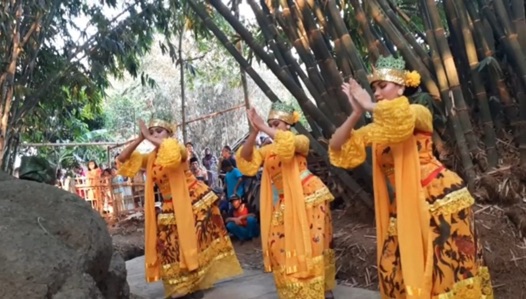
Arriving in front of a large stone, the dancers put offerings on it. Then, they performed an offering dance with hand movements that depicted respect for Almighty God. The dance movement described the offering procession by placing 'kembang pitung warna' (seven-colored flowers) on the large stone in the bamboo area. Aula (2022) argued that in Javanese tradition, offerings in the form of seven-colored flowers consisting of kanthil (Magnolia × alba (D.C) Figlar & Noot.), jasmine, kenanga (Cananga odorata), red rose, white rose, melati gambir (Jasminum officinale), and tuberoses flowers have cultural meanings that are closely related to human life, nature, and God. Kanthil means deep love and affection for fellow human beings and all living creatures in the universe created by God. Jasmine symbolizes purity and the persistence of doing good deeds throughout life. A white rose means the power of the sky or God, who created humans. This flower is reminiscent of the origin of the sacred 'human. The red rose symbolizes 'dumadine jalma manungsa' (the process of human birth and life in the world). In addition, this flower also means a mother who plays an essential role in guiding the human soul and mind. Kenanga signifies the encouragement to honor ancestors and their cultural heritage, and to notify their spirits of ongoing activities. Melati Gambir symbolizes gratitude to God Almighty for all His graces. Tuberose flowers mean peace and harmony between humans, the universe, God, and all His creatures.
Based on the above meanings, the dance scene of offerings near a large rock adorned with seven-colored flowers represents a discourse of human respect for the Almighty God who created humans, all living creatures, and the universe. It is proper for humans to construct a love for fellow humans, the natural environment, and all God's creatures. The dance scene also invites the residents to remember their position in this mortal world and to avoid causing damage, as they do not live alone. To avoid calamity, they must strive for harmonious relations with other creatures and the natural environment. The discourse of harmony at the performance's beginning reminded the residents that humans have been causing damage for a long time, including clearing forests for plantations and mining, destroying bamboo ecosystems for development projects, and other destructive actions. The increasingly marginalized discourse and practice of harmony in human life have led to many ecological disasters. Thus, humans need to think of ways to restore harmonious relations that prioritize the principles of balance and non-greed.
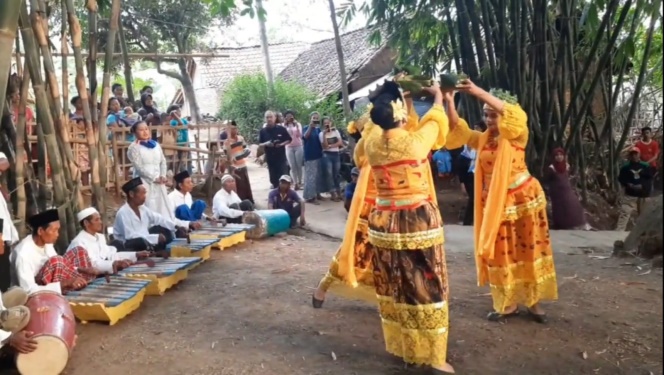
In the next part, the dancers moved under the bamboo grove. They made circular moves toward the center while carrying offerings. After bringing each other offerings in banana leaves, they happily danced while scattering flowers in all directions. For a few minutes, accompanied by glundengan music, they continued to scatter the flowers in a circular motion in and out. Not long after, the dancers brought offerings to a place in one corner. This circular dance symbolizes the fertility that arises from the fondling/harmonious relationship between humans and nature. Fertility benefits all human beings; like the seven-colored flower that the dancers scatter in all directions. This meaning aligns with the Javanese fairy tale about Dewi Sri, the Goddess of Fertility in Javanese mythology, who continues to bestow goodness on humans even after her death. The discourse of beneficial fertility also refers to the vital contribution of bamboo to human life. Bamboo grows and provides significant benefits to people and the environment. When human behavior fosters a harmonious relationship with nature, the fertility and goodness of nature will continue to flow to them.
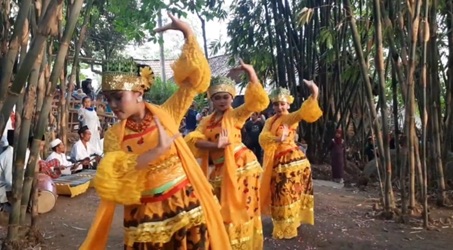
In the final part, the dancers made moves expressing happiness in all directions to convey a sense of responsibility towards the environment and respect for the bamboo grove. They surrounded the bamboo groves as they danced with joy. The two closing gestures signify respect for bamboo and its contribution to people's lives. Humans should make serious and enthusiastic efforts to preserve bamboo clumps and protect bamboo areas from greedy exploitation by investors, including continuing to plant bamboo on productive and critical lands. This commitment will help bamboo grow and thrive, ensuring it continues to provide abundant benefits to humans. In addition, preserving the bamboo area also positively impacts the surrounding environment's sustainability, including water springs useful to the community's daily needs.
The discourse on bamboo sustainability and its positive contribution to human life intertwines with the efforts of many communities worldwide to continue planting and maintaining bamboo using specific methods due to its strategic function (Kumar et al., 1994; Kaur et al., 2016; Putri and Dewi, 2020). Although many people say planting bamboo is not difficult, if it is not properly cared for and replanted on critical lands, its presence will decline. Moreover, the bamboo area is decreasing due to land conversion for settlement and other development. In Jember itself, bamboo is still easy to find, but that does not mean it can be sustainable without proper conservation management. Besides being used for building houses, bamboo has been important in the construction of warehouses for drying cigar tobacco from the colonial era to the present. In addition to housing projects in the city, agricultural work also requires substantial amounts of bamboo. This reality confirms that the decision to prioritize performance in the bamboo area and invite the community to continue caring for and preserving bamboo was right before it was too late, given the massive use of bamboo for community activities.
In addition to discourses related to bamboo conservation, we argue that Rokat Bambu also criticizes the spatial management policies implemented by the Jember Regency Government, which ignored agricultural and ecologically important areas, such as gardens and bamboo forests near residential areas. Antirogo area is a Madurese settlement on the city's outskirts, with very fertile agricultural land. Rice, corn, tobacco, and other crops can grow well in this area. In this area, there are also many bamboo gardens owned by residents and several gumuk, a local term for hill derived from volcanic material from the eruption of Mount Raung in the ancient era. At the developer's seduction, several residents sold hectares of agricultural land in Jambuan for a modern residential area. Likewise, many residents' bamboo gardens near agricultural land were also destroyed. The impact of decreasing bamboo gardens is the reduced debit from water sources in Antirogo. If this continues, it is not impossible; the residents will have water problems. Through this performance, the artists reminded and criticized the Jember district government and developers who often ignore development that is greedy and exploitative to the environment. Unfortunately, a development touted as for the community's welfare turns out to cause serious environmental problems and has a devastating impact on human life.
In this context, environmental discourses to preserve bamboo through performing arts such as Rokat Bambu constitute aesthetic and discursive politics carried out by artists to remind the government of policies and programs that should and should not be pursued. Supposedly, the government will prioritize policies and programs that promote environmental conservation rather than destruction. When the government takes the latter, even though it is in the name of development, it means continuing the exploitative actions carried out by the colonialists. Colonialization has caused massive environmental damage, resulting in impacts such as climate change and prolonged pollution that we feel today (Erickson, 2018; Schneider et al., 2020). When postcolonial governments still issue policies that imitate the colonialists' policies, we may call this condition' colonial sustainability.' The existence of colonial sustainability in the postcolonial period related to environmental policies sets a bad precedent that reveals the government's inability to follow the colonial exploitation model, which causes much natural damage and human suffering. This reality allows environmental colonialism, or ecological imperialism, to persist from the colonial to the postcolonial eras (Qingzhi, 2017; Tomlison, 1998). Suppose the government continues to allow forest clearing for plantation and mining activities. In that case, they contribute to significant ecological destruction that can have terrible impacts on human life, including disease and death, as well as the ecocide-genocide nexus (Crook and Short, 2020; Crook et al., 2018; Lindgren, 2018; Lynch et al., 2020). Massive exploitation of nature for the benefit of mining, plantations, monoculture agriculture, infrastructure, and other developments is evidence that environmental colonialism is still ongoing, involving transnational and national investors (Frame, 2016). Naturally, various ecological disasters that cause loss of life and economic losses often occur in Indonesia, driven by exploitative development and increasing environmental damage (Suharko, 2014).
Furthermore, various environmental discourses in Rokat Bambu also remind Jember residents and Indonesian people to continue preserving bamboo. With performances in the bamboo garden area, where residents can watch live, the ecological call is a joyful invitation. Hopefully, they will continue to care for bamboo in their region, which will contribute to the sustainability of the land area. Indeed, Jambuan residents did not read scientific articles on the positive contributions of bamboo to land areas, such as reducing soil erosion, preventing land degradation, and conserving water (Abadega and Abawaji, 2021; Kasu, 2023; Rani et al., 2024; Wakweya, 2023). They also did not read the article about the important role of bamboo gardens for restoring degraded land (Gairola et al., 2025; Garai et al., 2025; Peprah et al., 2014; Sawarkar et al., 2023), for mitigating climate change (Dwivedi et al., 2019; Mchumo and Wang, 2025; Pan et al., 2023; Zella, 2024), for increasing households' economic improvement (Abebe et al., 2022; Alamerew et al., 2024; Hailu et al., 2025; Nosike et al., 2025) and for global sustainability (Adebowale and Agumba, 2024; Dutta et al., 2025; Manandhar, 2019; Patel et al., 2025; Zhao et al., 2022).
However, residents are aware of how bamboo benefits their lives, such as providing building materials, maintaining water sources, and preventing landslides. To provide a deeper understanding of bamboo's role, function, and contribution to maintaining soil sustainability, preventing erosion, and restoring degraded land, some academics from the Jember Arts Council explained the process to residents after the performance. Of course, they used everyday language that fell far short of scientific standards so that citizens could easily understand their explanations. So, as a form of cultural activism, in addition to presenting Rokat Bambu performance as an aesthetic medium to convey ecological discourse about the importance of bamboo, the Jember Arts Council also campaigned directly among the community in the middle of the bamboo garden, with the hope that residents could continue to raise awareness and involvement in caring for bamboo in gardens, riverbanks, and near rice fields because their sustainability will bring goodness to life together.
3.2 Petik Laut Tanjung Papuma: Ecological Messages for Marine Sustainability
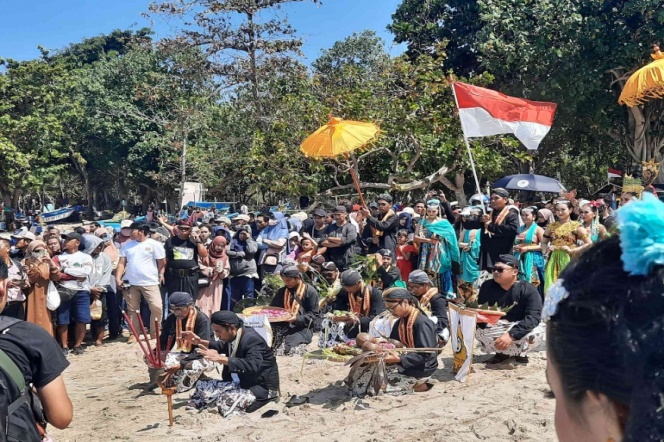
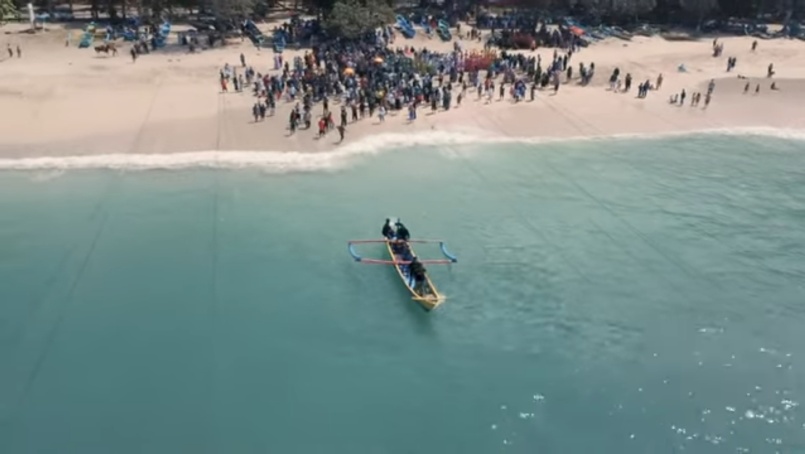
At the beginning of the month of Muharram, the Islamic New Year, on July 30, 2022, the Lojejer Village Government, Wuluhan Subdistrict, Jember Regency, in collaboration with Perhutani East Java and the Jember Art Council, held Petik Laut Tanjung Papuma, a ritual as gratitude to God Almighty for the safety and the abundance of sustenance from activities at sea. This hereditary tradition adopted a new format, featuring a series of creative performances and rituals. The novelty was a ritual procession that used Yogyakarta Javanese customs, with offerings and gunungan (crops shaped like mountains), not the heads of cows or goats, as well as a series of performances related to the rituals. Petik Laut Tanjung Papuma began with a procession of people in traditional Yogyakarta Javanese attire, descending from Siti Hinggil, a hill at the edge of Tanjung Papuma Beach, to take in the vastness of the Indonesian Ocean. Cucuk lampah, a guide in Javanese rituals, directed them towards the road by the beach. This group then joined a group of village officials who wore Javanese clothes, including blangkon (head coverings for men), while carrying gunungan. Women wearing Madurese clothing brought various traditional snacks and offerings. This large group walked along the beach to the center of Tanjung Papuma Beach. In the middle of the journey, hapsari, young women dressed in traditional Javanese clothing, which symbolizes the goddess or the guardian of the sea, welcome them with a sacred dance for a few minutes. Arriving at the location, hapsari took a circular position in front of the rushing visitors who wanted to take a closer look at the ritual procession to be carried out by the sea. After ustadz (an Islamic teacher) led the prayer in an Islamic way, several people started the ritual with Javanese mantras. With offerings, they solemnly chanted a spell while facing the Indonesian Ocean. After this ritual, the fishermen took gunungan with their motorboats to the sea. There, the fishermen threw gunungan into the sea.
Based on our analysis of key aspects of Petik Laut Tanjung Papuma, we see this ritual and performance as an expression of traditional ecological knowledge (hereafter TEK), a body of knowledge that emphasizes human relations with the environment and other living things (Berkes 1993, 2008). TEK functions as (a) a source of agricultural, livestock, natural resource, conservation, and climate change regulatory systems used in the past and transferred to the present (da Cunha and de Almaida, 2000; Shackerrof and Campbell, 2007; Vinyeta and Lynn, 2013); (b) the values and ethics that underlie human actions regarding the environment and all its creatures (Brosius, 1997; Menzies and Butler, 2006; Whyte, 2013); and (c) essential aspects that contribute to shaping cultural identity (Houde, 2007). From Petik Laut Tanjung Papuma, we identify essential TEKs for human life related to nature. TEKs were present throughout the procession and its elements, becoming this activity's eco-cultural wealth.
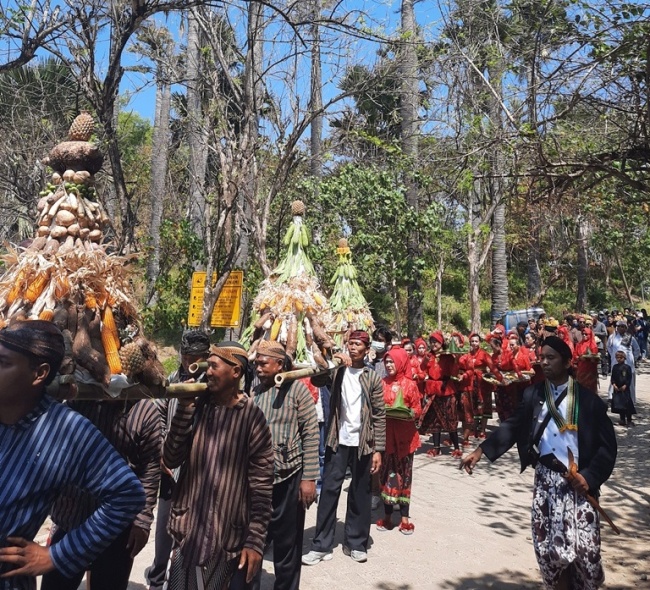
First, consider the existence of gunungan and offerings in rituals. The presence of gunungan and various offerings has a specific cultural meaning. As many people misunderstand, it is not for feeding magical creatures besides Almighty God. Gunungan is an expression of gratitude to God for providing abundant sustenance to humankind. The offerings have particular meanings associated with the purpose of a ritual, mainly to remind us of the nature of humans as beings who relate with nature, other creatures, and God the Creator. Harmony between humans and God, nature, and other creatures must be maintained so that nothing occurs that endangers humans. So, the presence of gunungan and offerings derives ecological knowledge. Humans need to continue to raise awareness not to be arbitrary towards nature and other God's creatures because it can negatively impact their lives.
The presence of a group of women dressed in traditional Javanese clothes, carrying kendi (clay jugs), who followed the procession carries a wise message: an invitation for humans to continue maintaining the source of life, water. Kendi reminds us to continue to love the earth as the origin of life and the place where we live. However, the world faces a water crisis due to ecological damage. Indeed, in Jember, water is relatively easy to obtain; we must not be careless because various environmental problems are occurring in Jember due to development, land use change, and reduced absorption of land. This meaning also counters the opinions of some people who are misguided or do not understand the cultural meaning of the existence of offerings and gunungan. As a result, they often identify offerings and gunungan as a form of fellowship with God. That is not what it means, in any case.
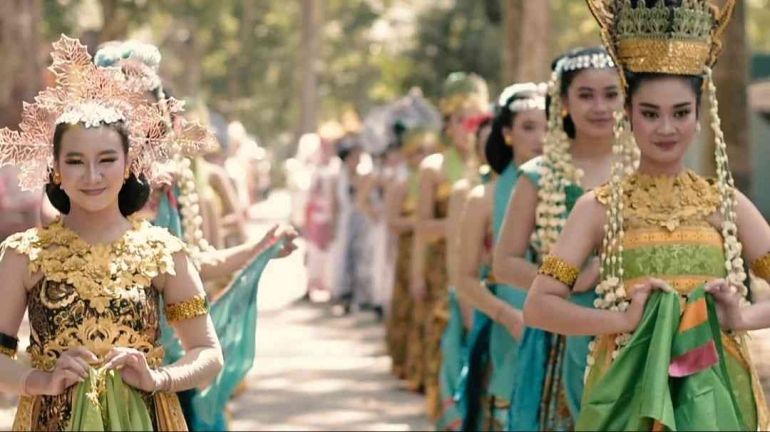
The presence of dozens of hapsari performed by young women made a difference, as other Petik Laut rituals in Jember do not feature this scene. Hapsari symbolizes the tremendous energy of the great ocean, which gives much to humans. As long as humans continue to care for the sea with wise actions, hapsari will continue to pray to God for the welfare and protection of humans. All this time, people thought of Nyi Roro Kidul, or the Queen of the South Seas, as a respected magical figure in the tradition of the southern coast of Java. Neither hapsari nor Nyi Roro Kidul should be interpreted as creatures related to magic or attached to the meaning of shirk. We can understand their story or figures as a force that helps maintain the existence of the great ocean. When the fishing community presents offerings and gunungan, it is a form of gratitude to God and to all His creatures that care for the ocean, including fish and other marine inhabitants that sustain life.
Hopefully, the community will maintain knowledge of Nyi Roro Kidul, the fairy of Segara Kidul, a Javanese term for the Indonesian Ocean, as a framework for thinking and acting that is not exploitative and does not damage the sea. So, their presence in everyday fairy tales or in rituals is a narrative effort to continually remind the public of the harmonious relationship with the forces of the universe. One scene, when a hapsari danced to welcome the Lojejer Village Head's entourage, represents an invitation from the central government to the regional government to permanently align their intentions and actions in utilizing nature, including the sea and everything in it. If the rulers pursue only economic gain, the people will suffer the consequences of unchecked exploitation, leading to an ecological crisis.
A Javanese ritual at the beach during Petik Laut Tanjung Papuma aimed to ask God Almighty to give goodness to fishermen and all those who work in the marine sector. Prayer also asked God to give strength to the representatives and creatures assigned to protect the oceans so that they can continue to guard the preservation of the sea and the abundance of goodness from it. Through these discourses, humans present themselves as creatures who must also respect other creatures, with a particular task from God related to environmental sustainability. This perspective has implications: human efforts to live without emphasizing exploitative reasoning and without placing other living things and all universe inhabitants on equal footing. Humans, by nature, get the most in this life. Time after time, nature faces threats from humans' exploitative reasoning and actions, from the age of simple technology to advanced technology, from the colonial era to the postcolonial era. In the name of modernism, humans have always tried to conquer nature with all available resources. What happened then is an ecological crisis as a global threat.
Amid such conditions, the Indonesian people must always seek wise counsel and action in the teachings of their ancestors. The ancestors put forward a harmonious relationship with nature. However, by modern reasoning, they are all considered ancient and outdated. Time has proven that intelligent behavior in taking from nature will determine the sustainability of human life and civilization. Therefore, the final part of Petik Laut Tanjung Papuma was to throw offerings and crops into the open sea. The residents and the committee pushed the motorboat towards the sea. Cooperation should always prioritize wise actions to create harmony with the universe and all creatures. Towards the sea depicts how humans should not be selfish and want to win alone. They must also be willing to sacrifice, restrain their passions, and take wise actions in managing the environment. Goodness to the sea environment will return the goodness that nature has given humans, like the sea, which always yields fish and other abundant resources.
By representing discourses on the harmony between the human-God-sea and coastal ecosystems, Petik Laut Tanjung Papuma also criticizes marine problems occurring in Jember and Indonesia. The criticism targets exploitative and destructive actions, whether carried out by community members, fishermen, or the government. The government's legalization of offshore oil drilling and mining near the sea poses a real threat of hazardous substances spilling or flowing into the sea. Indeed, all require fuel, but if offshore oil drilling is not carefully managed, it can cause severe problems for marine ecosystems. Likewise, mining in coastal areas can pollute marine ecosystems by releasing hazardous substances, such as mercury, into the sea. Unfortunately, in the name of national income, the Indonesian government allows mining on the seafront, such as the Mount Tumpang Pitu gold mine in Banyuwangi. The legalization of destructive fishing technology will have a direct impact on ecosystems, potentially significantly reducing fishermen's catches. In Jember, the district government also allows shrimp farming between Puger and Kencong sub-districts on the south coast. Shrimp farming can damage coastal ecosystems, pollute the sea, and destroy endemic plants that could help protect coastal areas from tsunamis. In addition, the plan to mine iron sand at Paseban Beach, a coastal area in Kencong Subdistrict, could also negatively impact ecosystems and people's lives. Another problem, no less crucial, is the pollution of the ocean with plastic waste. The bad habit of many residents along the river is littering, which is increasing the volume of plastic waste entering the sea.
By representing discourses on the harmony between the human-God-sea and coastal ecosystems, Petik Laut Tanjung Papuma also criticizes marine problems occurring in Jember and Indonesia. The criticism targets exploitative and destructive actions, whether carried out by community members, fishermen, or the government. The government's legalization of offshore oil drilling and mining near the sea poses a real threat of hazardous substances spilling or flowing into the sea. Indeed, all require fuel, but if offshore oil drilling is not carefully managed, it can cause severe problems for marine ecosystems. Likewise, mining in coastal areas can pollute marine ecosystems by releasing hazardous substances, such as mercury, into the sea. Unfortunately, in the name of national income, the Indonesian government allows mining on the seafront, such as the Mount Tumpang Pitu gold mine in Banyuwangi. The legalization of destructive fishing technology will have a direct impact on ecosystems, potentially significantly reducing fishermen's catches. In Jember, the district government also allows shrimp farming between Puger and Kencong sub-districts on the south coast. Shrimp farming can damage coastal ecosystems, pollute the sea, and destroy endemic plants that could help protect coastal areas from tsunamis. In addition, the plan to mine iron sand at Paseban Beach, a coastal area in Kencong Subdistrict, could also negatively impact ecosystems and people's lives. Another problem, no less crucial, is the pollution of the ocean with plastic waste. The bad habit of many residents along the river is littering, which is increasing the volume of plastic waste entering the sea.
4. Empowering the Ecological Connection of Terrestrial and Marine Environments
Indonesia, as an archipelagic country, possesses a cosmological characteristic that views land and sea as two integral, inseparable entities. Despite their vastly different ecosystems, the ocean and land are complementary entities that provide economic benefits and foster diverse cultural creativity (Izzah et al., 2025). For communities living on land, the ocean is a vast source of life, complementing the limited resources available on land. Although many consider the land to represent Mother Earth, and their livelihoods do not connect to the vast ocean, the ocean remains a vital resource, providing fish to meet their nutritional needs. Meanwhile, communities living on the sea, such as the Bajo Tribe, are economically dependent on the richness of marine resources to meet their daily needs. The Bajo Tribe possesses ecological knowledge in the form of settlement methods, fishing regulations and taboos, and knowledge of the climate and underwater currents, guiding them to avoid damaging the ocean, as doing so would be tantamount to destroying their own mother of life (Mursin et al., 2025). Nevertheless, the Bajo Tribe also respects the land because they get rice and various non-fish food ingredients from agricultural activities in the land area. As for the people who live near the coastal areas and work as fishermen, besides being a place to catch fish, the sea is positioned as a sacred area that must be respected specifically through Petik Laut, a ritual that is held by bringing various offerings to the middle of the sea as a form of gratitude and prayed to God Almighty. In other words, the community, whether living far inland, in coastal areas, or above the sea, is the subject that must maintain the connection between the land and the sea that form the archipelago in Indonesia through various cultural activities who bring ecological messages.
Although not a single event, Rokat Bambu and Petik Laut Tanjung Papuma are conceptually and culturally connected. The dance performance in the bamboo grove on land and the ritual at sea serve as two texts that encourage the community to improve and strengthen awareness of the importance of environmental preservation through cultural activism. When both areas are preserved, people will benefit from their livelihoods.
Rokat Bambu was held in a bamboo grove near a productive agricultural area. In the rice fields, residents grow rice, corn, tobacco, and vegetables. For irrigation, farmers obtain water from small rivers fed by springs and from modern irrigation canals. The springs in Jambuan are still preserved to this day, thanks to numerous bamboo groves, whose roots can store rainwater. Guaranteed water for the rice fields in Jambuan supports successful agricultural activities, resulting in abundant harvests. Traders may distribute harvests of rice, corn, various vegetables, and tobacco to coastal areas, where the majority of residents are fishermen. These fishermen and their families depend on farmers in the surrounding areas, including the Jambuan farmers, for food. The fishermen also bring food supplies prepared by their wives to eat while at sea. As bamboo groves dwindle, the volume of water flowing from springs could decrease, eventually running out. This situation will undoubtedly harm local farming, disrupting food supplies for the Jember residents, including those in coastal areas.
Furthermore, bamboo groves play a crucial role in preventing problems from the sea on land and problems from land to sea. They can block winds from the sea that blow towards agricultural areas. Direct exposure to sea breezes, especially at high speeds, can damage crops, such as tobacco. Even more severe is the occurrence of whirlwinds during the transition from the dry to the rainy season. Without the bamboo groves that function as natural barriers, residential areas in Jambuan and the surrounding areas are vulnerable to these winds. The roots of bamboo help prevent landslides during heavy rain. As the number of bamboo groves dwindles, more soil is washed away by rainwater, eventually leading to rivers that flow into the sea south of Jember. The increasing amount of soil carried by river water into estuaries and the sea can have negative impacts, such as increased sedimentation, the covering of coral reefs and mangroves with sediment, and reduced biodiversity, which can damage maritime ecosystems and reduce fish stocks. Furthermore, sedimentation in estuaries causes shallowing, disrupting fishing routes to the sea and reducing fish catches.
Meanwhile, Petik Laut Tanjung Papuma is a message and a warning to fishermen and communities living in coastal areas always to maintain the sustainability of the marine ecosystem, as this will affect the availability of fish for the community, including those living far from the sea. The cultural and ecological messages in this ritual, at the very least, serve to remind the community and government that marine resources are a key driver of island communities' lives, as the availability of fish is crucial to their nutritional needs. When fishermen and the community develop a shared awareness to prevent acute pollution resulting from the influx of various household and industrial wastes, as well as soil from agricultural and residential areas, the preservation of marine ecosystems positively impacts the sustainability of marine resources for future generations, who will continue the community's life and culture.
Furthermore, Rokat Bambu and Petik Laut Tanjung Papuma, as well as other rituals and performances in Indonesia that aim to strengthen harmony between humans and nature—both on land and at sea—can contribute to island and marine studies, particularly through cultural activism with an environmental dimension. In the context of Indonesia's islands and marine life, various threats to nature preservation, stemming from negative community habits, industrial activities, and less pro-environmental state policies, require communal movements that can mobilize communities and governments to work together for the sustainability of the ecosystem. The study of cultural activism with an environmental dimension is needed to articulate and disseminate the creative cultural works of artists and communities who want to raise public awareness and encourage direct involvement in maintaining the natural wealth in island areas amid increasingly massive threats.
5. Conclusion
Rokat Bambu and Petik Laut Tanjung Papuma disseminate environmental discourses and ecological messages that creatively draw on traditional arts and rituals as a basis for cultural activism, reminding the public of the importance of transforming caring thoughts and actions for the sustainability of the natural environment, particularly land and marine environments. In addition to raising awareness of the need to continue caring for the environment, environmental discourses remind them of the importance of considering the fate of future generations who need living space and cultural sustainability. Dissemination of ecological awareness through performing arts delivers non-dogmatic messages that make it easier to convey environmental advocacy calls to the public. In addition, through these two performances, the creators criticize the government for exploiting nature, which has gained legitimacy through policies that continue to cause environmental damage, while presenting environmental discourses of harmony with nature. Environmental discourses also criticize the government, saying that in environmental policies, they should prioritize the sustainability of nature for future generations, rather than aggravating the damage that leads to ecocide. As forms of activism, the messages and discourse in these two performances aim to strengthen public awareness of the dominant forces run by the state and capitalists, which continue to exploit productive land and sea areas. With this awareness, the public can develop a critical attitude and take practical action when they become aware of systematic efforts to exploit the environment, which can lead to the destruction of ecosystems.
Indonesia needs many performing arts and other arts as cultural activism that carry an ecological call and message, given the many threats to environmental sustainability. The more shows that carry ecological messages, the more people realize the importance of prioritizing perspectives and actions that foster a harmonious relationship with nature. The characteristics of art that are not dogmatic make it easier to give messages to the public without being patronizing. In addition, open performances of the performing arts, reported in many media, also provide criticism and advice to the government, so that they do not continue to support investors in exploiting and destroying nature. The development practice will only continue ecological colonialism as it was in the colonial era if the Indonesian government cannot prioritize ecological sustainability.
Acknowledgement
This paper is the output of research funded by a grant from the Institute for Research and Community Service, Universitas Jember. We want to express our gratitude to the Rectorate of Universitas Jember for its financial and policy support in implementing this research. All contents of the paper are our responsibility.
References
- Abadega, A.F, Abawaji, I.A., 2021. Land restoration and socio-economic contribution of bamboo in Ethiopia. J. Degraded Min. Lands Manag. 8(2): 2617-2621. https://doi.org/10.15243/jdmlm.2021.082.2617.
- Abebe, S., Minale, A.S., Teketay, D., 2022. Socio-economic importance of the bamboo resources in the Lower Beles River Basin, north-western Ethiopia. Environ. Dev. Sustain. 24: 12162–12181. https://doi.org/10.1007/s10668-021-01938-4.
- Adebowale, O.J., Agumba, J.N., 2025. Bamboo in sustainable construction: effects on productivity and safety. Int. J. Product. Perform. Manag. 74(11): 1–20. https://doi.org/10.1108/IJPPM-06-2023-0307.
- Alamerew, A.N., Kozak, R., Shrestha, A.K., Zhu, Z., Wang, G., 2024. A way for livelihood improvement: Systematic review on bamboo forest research. Trees For. People 16: 1-13. https://doi.org/10.1016/j.tfp.2024.100571.
- Anokye, R., Bakar, E.S., Ratnansingam, J., Awan, K.B., 2016. Bamboo Properties and Suitability as a Replacement for Wood. Pertanika J. Sch. Res. Rev. 2(1): 64-80. https://doi.org/10.13140/RG.2.1.1939.3048.
- Arora, S., 2019. Left to ‘Biyaasi Number’: Cultural Activism and Political Street Theatre in Delhi. Contemp. Theatre Rev. 29(1): 71-90. https://doi.org/10.1080/10486801.2018.1558219.
- Asempasah, R., Sam, C.A., Abelumkemah, B.A., 2022. A postcolonial ecocritical reading of Yaa Gyasi’s Homegoing (2016) and Kwakuvi Azasu’s The Slave Raiders (2004). Cogent Arts Humanit. 9(1): 1-13. https://doi.org/10.1080/23311983.2022.2145669.
- Asrawijaya, E., Ningsih, S., Adhuri, D.S., Kusrina, T., 2024. Sedulur Sikep Fights for the Environment & Livelihood through the Javanese Pop Song ‘Ibu Bumi’. J. Urban Cult. Res. 29: 279-294. https://doi.org/10.14456/jucr.2024.32.
- Aula, L.G., 2022. Dianggap Mistis, Ini Makna Kembang Tujuh Rupa. https://www.solopos.com/dianggap-mistis-ini-makna-kembang-tujuh-rupa-1240998. Retrieved at November 8, 2025.
- Bajpaie, S., 2025. The contested legacy of Rabindrasangīt: musical nationalism, political symbolism, and the shaping of Bangladesh’s cultural identity. Ethnomusicol. Forum 34(1): 4–28. https://doi.org/10.1080/17411912.2025.2504252.
- Battaglia, G., 2020. Between cultural performance and cultural activism: contemporary documentary film festivals in India. Transnatl. Screens 11(3): 233-247. https://doi.org/10.1080/25785273.2020.1823076.
- Berkes, F., 2008. Sacred Ecology. Routledge, New York.
- Berkes, F., 1993. Traditional Ecological Knowledge in Perspective, in: Ingglis, J.T. (Ed.), Traditional Ecological Knowledge: Concepts and Case. International Program on Traditional Ecological Knowledge in association with International Development Research Centre, Ottawa, pp. 1-11.
- Bernard, A., 2014. Taking sides: Palestinian advocacy and metropolitan theatre. J. Postcolon. Writ. 50(2): 163-175. https://doi.org/10.1080/17449855.2014.883174.
- Bollas, A., 2020. Literature as Activism - From Entertainment to Challenging Social Norms: Michael Nava’s Goldenboy (1988). Int. J. Appl. Linguist. Engl. Lit. 9 (1): 50-55. http://dx.doi.org/10.7575/aiac.ijalel.v.9n.1p.50.
- Brosius, J.P., 1997. Endangered Forest, Endangered People: Environmentalist Representations of Indigenous Knowledge. Hum. Ecol. 25(1): 47-69. https://doi.org/10.1023/A:1021983819369.
- Brown, J.M., 2023. The Interconnectedness and Spiritual Equality of All Things: Recovering Indigenous Ecological Imagination in Postcolonial Australian Fiction. Crit. - Stud. Contemp. Fict. 64(3): 477-490. https://doi.org/10.1080/00111619.2022.2053044.
- Bullot, N.J., 2014. The Functions of Environmental Art. Leonardo 47(5): 511–512. https://doi.org/10.1162/LEON_a_00828.
- Burk, T., 2015. Radical Distribution: AIDS Cultural Activism in New York City, 1986-1992. Space Cult. 18(4): 436–449. https://doi.org/10.1177/1206331215616095.
- Buser, M., Bonura, C., Fannin, M., Boyer, K., 2013. Cultural activism and the politics of place-making. City 17(5): 606-627. https://doi.org/10.1080/13604813.2013.827840.
- Cassegård, C., Thörn, H., 2018. Toward a postapocalyptic environmentalism? Responses to loss and visions of the future in climate activism. Environ. Plan. E: Nat. Space 1(4): 1-18. https://doi.org/10.1177/2514848618793.
- Castillo, E.G., Martin, P.M., 2015. Cultural activism, hegemony, and the search for urban autonomy in the city of Puebla, Mexico. Environ. Plan. D: Soc. Space 33(1): 52-66. https://doi.org/10.1068/d13001p.
- Chaudhuri, D., 2021. Between Glaciers and Fossils: Landscape, Literature and the Anthropocene in Pakistan. South Asian Rev. 42(4): 324-340. https://doi.org/10.1080/02759527.2021.1889935.
- Crook, M., Short, D., 2020. Developmentalism and the Genocide–Ecocide Nexus. J. Genocide Res. 23(1): 162-188. https://doi.org/10.1080/14623528.2020.1853914.
- Crook, M., Short, D., South, N., 2018. Ecocide, genocide, capitalism and colonialism: Consequences for indigenous peoples and glocal ecosystems environments. Theor. Criminol. 22(3): 298-317. https://doi.org/10.1177/1362480618787176.
- Cruz, G., van Loyen, C., Sánchez, F., 2021. Culture, territory and action: the Providência favela’s response to Covid-19. Int. J. Urban Sustain. Dev. 13(3): 481-495. https://doi.org/10.1080/19463138.2021.2019042.
- Da Costa, D., 2010. Subjects of Struggle: theatre as space of political economy. Third World Q., 31( 4): 617-635. https://doi.org/10.1080/01436591003701133.
- da Cunha, M.C., de Almeida, M.W.B., 2000. Indigenous People, Traditional People, and Conservation in the Amazon. Daedalus 129(2): 315-338.
- Dlodlo, B., 2024. Within the Landscape: A Postcolonial Ecocritical Reading of Yvonne Vera’s Butterfly Burning. Engl. Stud. Afr. 67(1): 34-45. https://doi.org/10.1080/00138398.2024.2347036.
- Dutta, S., Gorain, S., Roy, J., Das, R., Banerjee, S., Gorai, S.K., Choudhury, M.R., Das, S., 2025. Bamboo for global sustainability: a systematic review of its environmental and ecological implications, climate action, and biodiversity contributions. Environ. Rev. 33: 1-26. https://doi.org/10.1139/er-2025-0032.
- Dwivedi, A.K., Kumar, A., Baredar, P., Prakash, O., 2019. Bamboo as a complementary crop to address climate change and livelihoods—Insights from India. For. Policy Econ. 10: 66-74. https://doi.org/10.1016/j.forpol.2019.02.007.
- Egya, S.E., 2021a. ‘Sea-salt rides its currents to the city’: Lagos and the poetics of flooding. Postcol. Stud. 24(3): 384-398. https://doi.org/10.1080/13688790.2021.1878578.
- Egya, S.E., 2021b. ‘Farmer-born peasant-bred’: agriculture, modernity and socio-ecological vision in Niyi Osundare’s Village Voices and The Eye of the Earth. Green Lett. 24(4): 367-380. https://doi.org/10.1080/14688417.2021.1880331.
- Egya, S.E., 2018. The pristine past, the plundered present: Nature as lost home in Tanure Ojaide’s poetry. J. Commonw. Lit. 56(2): 1-15. https://doi.org/10.1177/0021989418777852.
- Erickson, B., 2020. Anthropocene futures: Linking colonialism and environmentalism in an age of crisis. Environ. Plan. D: Soc. Space 38(1): 111-128. https://doi.org/10.1177/0263775818806514.
- Frame, M.L., 2016. The Neoliberalization of (African) Nature as the Current Phase of Ecological Imperialism. Capital. Nat. Social. 26(1): 87-105. https://doi.org/10.1080/10455752.2015.1135973.
- Gairola, S.U., Bhuvaneswari, V., Khanduri, A.K., 2025. Exploring bamboo’s potential in economic returns and degraded land restoration in Uttarakhand, India. Discov. For. 1(13): 1-122. https://doi.org/10.1007/s44415-025-00010-7.
- Garai, S., Malakar, A., Mishra, Y., Kumar, R., Kumar, L., 2025. Where to grow “Green-Gold” to mitigate land degradation? Identifying appropriate habitat for three economically important bamboo species in eastern India. Discov. For. 1(14): 1-10. https://doi.org/10.1007/s44415-025-00016-1.
- Goh, Yingxin, Yap, S.P., Tong, T.Y., 2019. Bamboo: The Emerging Renewable Material for Sustainable Construction. Encyclopedia of Renewable and Sustainable Materials 2: 365-376. https://doi.org/10.1016/B978-0-12-803581-8.10748-9.
- Goldman, P., 2007. ‘Imagining Ourselves’: Cultural Activism for Women through Technology and New Media. Mus. Int. 59(4): 80-87. https://doi.org/10.1111/j.1468-0033.2007.00629.x.
- Graham, Z., 2014. Three Decades of Amazonian Filmmaking. Anthropol. Now 6(1): 86-91. https://doi.org/10.1080/19492901.2013.11728422.
- Grewal, A., 2016. Contested Tibetan landscapes in the films of Pema Tseden. J. Chin. Cine. 10(2): 135-149. https://doi.org/10.1080/17508061.2016.1167336.
- Gupta, D., Ranjan, R., 2016. Role of Bamboo in Sustainable Development. ASJ Int. J. Adv. Sci. Res. Rev. 2(1), 25-32. https://archive.org/details/Dipinte_and_Rajiv.
- Horton, P., Horton, B.P., 2019. Re-defining Sustainability: Living in Harmony with Life on Earth. One Earth 1(1): 86-94. https://doi.org/10.1016/j.oneear.2019.08.019.
- Hossain, M.F., Islam, M.A., Numan, S.M., 2015. Multipurpose Uses of Bamboo Plants: A Review. Int. Res. J. Biological Sci. 4(12): 57-60. https://isca.me/IJBS/Archive/v4/i12/10.ISCA-IRJBS-2015-140.php.
- Houde, N., 2007. The six faces of traditional ecological knowledge: challenges and opportunities for Canadian co-management arrangement. Ecol. Soc. 12(2): 34. http://www.ecologyandsociety.org/vol12/iss2/art34/.
- Huang, V. G., 2021. Musical resistance and musical bodies in the making: A worker-band from southern China. Int. J. Cult. Stud. 24(6): 953-973. https://doi.org/10.1177/13678779211011756.
- Huggan, G., Tiffin, H., 2015. Postcolonial Ecocriticism: Literature, Animals, Environment. Routledge, London.
- Hurtado, A.G., 2021. Resistance and Revival: Indigenous Women Media-Makers in Contemporary Mexico. Lat. Am. Perspect. 48(2): 63-76. https://doi.org/10.1177/0094582X20988695.
- Inwood, H., 2008. Mapping Eco-Art Education. Can. Rev. Art Educ. 35: 57-72.
- Irawan, B., Partasasmita, R., Rahayu, N., Setiawati, T., Iskandar, J., 2019. Indigenous knowledge of bamboos by Naga community, Tasikmalaya District, West Java, Indonesia. Biodiversitas 20(5): 1423-1434. https://doi.org/10.13057/biodiv/d200535.
- Izzah, L., Rochwulaningsih, Y., Sulistiyono, S.T., Robby, K.N.A., Sampurna, I.C., Endrayadi, E.C., 2025. Militarizing Coffee Branding in the Maritime World: Babinsa and Social Change in Java’s Island Culture, Indonesia. J. Mar. Isl. Cult. 14(3): 17-38. https://doi.org/10.21463/jmic.2025.14.3.02.
- Jacobson, S.K., Mcduff, M.D., Monroe, M.C., 2007. Promoting Conservation through the Arts: Outreach for Hearts and Minds. Conserv. Biol. 21(1): 7-10. https://doi.org/10.1111/j.1523-1739.2006.00596.x.
- Jia, K., 2017. Migrant Workers Home and its practices on shaping the culture and community of ‘New Working Class’: a criticism on cultural-political activism in contemporary China. Cult. Stud. 31(6): 941–967. https://doi.org/10.1080/09502386.2017.1374426.
- Karmakar, G., Pal, P., 2024. Examining (in)justice, environmental activism and indigenous knowledge systems in the Indian film Kantara (Mystical Forest). Socio-Ecol. Pract. Res. 6: 117–130. https://doi.org/10.1007/s42532-024-00180-2.
- Karmakar, G., 2024a. Towards a critical ecological ontology: literacy, sustainability, and fostering environmental education through the Indian green informational picturebook. J. Graph. Nov. Comics. 15(6): 939-959. https://doi.org/10.1080/21504857.2024.2371856.
- Karmakar, G., 2024b. Literature, Activism and Transformative Learning. Curr. Writ. Text Recept. South. Afr. 36(2): 101-108. https://doi.org/10.1080/1013929X.2024.2410067.
- Kasu, H.B., 2023. Potentials of bamboo-based agroforestry for sustainable development in Ethiopia. J. Selva Andina Biosph. 11(2): 159-171. https://doi.org/10.36610/j.jsab.2023.110200159.
- Kaur, P.J., Satya, S., Pant, K.K., Naik, S.N., 2016. Eco-Friendly Preservation of Bamboo Species: Traditional to Modern Techniques. BioResources 11(4): 1-21. https://doi.org/ 10.15376/biores.11.4.Kaur.
- Kornbluh, M., Bell, S., Vierra, K., Herrnstadt, Z., 2022. Resistance Capital: Cultural Activism as a Gateway to College Persistence for Minority and First-Generation Students. J. Adolesc. Res. 37(4): 1–40. https://doi.org/10.1177/07435584211006920.
- Kumar, S., Shukla, K.S., Dev, I., Dobriyal, P.B., 1994. Bamboo Preservation Techniques: A Review. International Network for Bamboo and Rattan & Indian Council of Forestry Research Education, India.
- Lähdesmäki, T., 2013. Cultural activism as a counter-discourse to the European Capital of Culture programme: The case of Turku 2011. Eur. J. Cult. Stud. 16(5): 598–619. https://doi.org/10.1177/1367549413491720.
- Lipton, A., Watts, T., 2004. Ecological Aesthetics, Art in Environmental Design: Theory and Practice. Birkhäuser Publishers, Basel.
- Lindgren, T., 2018. Ecocide, genocide and the disregard of alternative life-systems. Int. J. Hum. Rights 22(4): 525-549. https://doi.org/10.1080/13642987.2017.1397631.
- Lundy, P., 2024. Redress, memorials and activism: can heritage be activism? Int. J. Herit. Stud. 30(11): 1277-1290. https://doi.org/10.1080/13527258.2024.2324105.
- Lynch, M.J., Fegadel, A., Long, M.A., 2020. Green Criminology and State-Corporate Crime: The Ecocide-Genocide Nexus with Examples from Nigeria. J. Genocide Res. 23(2): 236-256. https://doi.org/10.1080/14623528.2020.1771998.
- Macias, T., 2008. Conflict over forest resources in Northern New Mexico: Rethinking cultural activism as a strategy for environmental justice. Soc. Sci. J. 45 (1): 61–75. https://doi.org/10.1016/j.soscij.2007.12.006.
- Majeed, M., Imtiaz, U., Imtiaz, A., 2021. Reterritorialization in A Small Place by Jamaica Kincaid: A Postcolonial Eco-Critical Study. Sage Open. https://doi.org/10.1177/2158244021997419.
- Manandhar, R., Kim, J.H., Kim, J.T., 2019. Environmental, social and economic sustainability of bamboo and bamboo-based construction materials in buildings. J. Asian Archit. Build. Eng. 18(2): 49-59. https://doi.org/10.1080/13467581.2019.1595629.
- McDonald, D., 2024. Local Australian memory activism and the fast and slow violence of institutional abuse. Int. J. Herit. Stud. 30(11): 1350-1364. https://doi.org/10.1080/13527258.2024.2378448.
- Mchumo, A., Wang, R., 2025. Bamboo: A Potential Tool for Climate Change Mitigation and Adaptation, in: Wang, H.H., Miao, M.L. (Eds), Global Development and Cooperation with China. China and Globalization. Springer, Singapore, pp. 117-126.
- Menzies, C.R., Butler, C., 2006. Introduction: Understanding Ecological Knowledge, in: Menzies, C.R. (Ed.), Traditional Ecological Knowledge and Natural Resource Management. University of Nebraska Press, Lincoln (USA), pp. 1-17.
- Merolla, D., 2020. Cultural heritage, artistic innovation, and activism on Amazigh Berber websites. J. Afr. Cult. Stud. 32 (14): 2-59. https://doi.org/10.1080/13696815.2019.1624153.
- Mursin, Zulzaman, Hardin., 2025. Kosmologi Laut dan Etika Lingkungan: Analisis Antropologi Ekologi terhadap Praktik Kehidupan Suku Bajo di Desa Mekar Kecamatan Soropia Kabupaten Konawe. Sabana 4(3): 470-484. https://doi.org/10.55123/sabana.v4i3.7260.
- Nobuto, H., 2012. Empowerment of the Socially Vulnerable - Social Inclusion through Theater Workshops and Arts Management: A Case Study in an Urban Slum of Bangkok. J. Urban Cult. Res. 4: 18-38. https://doi.org/10.58837/CHULA.JUCR.4.1.2.
- Nosike, C.J., Nosike, U.C., Ojobor, O.S.N., 2025. Unveiling the Economic Value of Bamboo. FAR J. Financ. Bus. Res, 1(1): 8-16.
- Pan, C., Zhou, G., Shrestha, A.K., Chen, J., Kozak, R.,Li, N., Li, J., He, Y., Sheng, C., Wang, G., 2023. Bamboo as a Nature-Based Solution (NbS) for Climate Change Mitigation: Biomass, Products, and Carbon Credits. Climate 11(175): 1-22. https://doi.org/10.3390/cli11090175.
- Patel, H.R., Mathakia, R., Mangroliya, U.C., 2025. Sustainable bamboo: Technological innovations and patent insights for a greener future. Adv. Bamboo Sci. 10: 1-20. https://doi.org/10.1016/j.bamboo.2025.100127.
- Peprah, T., Essien, C., Owusu-Afriyie, Foli, K.E.G., Govina, J., Oteng-Amoako, A. A., 2014. Exploring the use of bamboo for accelerated reclamation of degraded mined sites in Ghana. J. Bamboo Rattan 13(3&4): 55-66.
- Putri, A.H., Dewi O.C., 2020. Overview of Bamboo Preservation Methods for Construction Use in Hot Humid Climate. Int. J. Built Environ. Sci. Res. 4(1): 1-10. https://doi.org/10.24853/ijbesr.4.1.1-10.
- Qingzhi, H., 2017. Criticism of the Logic of the Ecological Imperialism of “Carbon Politics” and Its Transcendence. Soc. Sci. China 38(2): 76-94. https://doi.org/10.1080/02529203.2017.1302234.
- Quah, S.R., 2020. Intellectual consciousness and the negation of the intellectual class: Kuo Pao Kun’s pre-detention drama and its context. Inter-Asia Cult. Stud. 21(2): 212-224. https://doi.org/10.1080/14649373.2020.1759882.
- Rambaree, K, Powers, M.C.F., Smith, R.J., 2019. Ecosocial work and social change in community practice. J. Community Pract. 27(3-4): 205-212. https://doi.org/10.1080/10705422.2019.1660516.
- Rani, M., Lathwal, M, Vikas, Indira, A, Joshil, B., Kalyan, N., Chongtham, N., 2024. Role of bamboo in environmental conservation and sustainable development. Proceedings of 12th World Bamboo Congress, Taiwan, April 18-22.
- Rapošová, I., 2019. ‘We can’t just put any belly-dancer into the program’: cultural activism as boundary work in the city of Bratislava. J. Ethn. Migr. Stud. 45(11): 2100-2117. https://doi.org/10.1080/1369183X.2018.1440543.
- Rivers, B., 2015. Narrative power: Playback Theatre as cultural resistance in Occupied Palestine. RiDE-J Appl. Theatre 20(2): 155–172. https://doi.org/10.1080/13569783.2015.1022144.
- Sawarkar, A.D., Shrimankar, D.D, Manekar, S.C., Kumar, M., Garlapati, P.K, Singh L., 2025. Bamboo as a sustainable crop for land restoration in India: challenges and opportunities. Environ. Dev. Sustain. (27): 157–189. https://doi.org/10.1007/s10668-023-03911-9.
- Schneider, L., Shulmeister, N., Mariani, M., Beck, K.K., Fletcher, M-S., Zawadzki A., Saunders, K.M., Aquino-López, M.A., Haberle, S.G., 2020. Colonialism and the environment: The pollution legacy of the Southern Hemisphere’s largest copper mine in the 20th century. Anthr. Rev. 9(1): 3-23. https://doi.org/10.1177/2053019620968133.
- Sen, M., 2013. Bones of corals made: ecology and war in Gunesekara's Reef. Textual Pract. 27(3): 479-498. http://dx.doi.org/10.1080/0950236X.2013.784027.
- Setem, I.W., 2018. Seni Ekologis sebagai Media Kreatif Mengkampanyekan Kesinambungan Ekosistem. Proceeding of National Seminar Refleksi dan Retrospeksi Kreativitas Seni untuk Keindonesiaan, ISI Surakarta, July 30.
- Setiawan, I., 2022 . Seni Ekologis: Krisis Lingkungan dalam Tatapan Kreatif Seniman. https://www.kompasiana.com/dekajekita/6210731fbb44866e09620882/seni-ekologis-krisis-lingkungan-dalam-tatapan-kreatif-seniman. Retrieved at October 3, 2025.
- Setiawati, T., Mutaqin, A.Z., Irawan, B., An’amillah, A., Iskandar, J., 2017. Species diversity and utilization of bamboo to support life’s the community of Karangwangi Village, Cidaun Sub-District of Cianjur, Indonesia. Biodiversitas 18(1): 58-64.
- Shackeroff, J.M., Campbell, L.M., 2007. Traditional Ecological Knowledge in Conservation Research: Problems and Prospects for their Constructive Engagement. Conserv. Soc. 5(3): 343-360. https://journals.lww.com/coas/fulltext/2007/05030/traditional_ecological_knowledge_in_conservation.6.aspx.
- Shepard, B., 2005. Play, Creativity, and the New Community Organizing. Progress. Hum. Serv. 16(2): 47-69. https://doi.org/10.1300/J059v16n02_04.
- Singh, B., 2019. Social Media, Cultural Activism and Place-making in Contemporary Lucknow. Soc. Cult. South Asia 5(1): 1–18. https://doi.org/10.1177/2393861718787869.
- Singh, R., Umar, A, Singh, M., 2024. Interwoven Narratives: Exploring Human Values, Activism, and Indigenous Literature through Sea of Poppies, The Lowland, The Far Field, The Ministry of Utmost Happiness, and The Sympathizer. Int. J. Creat. Res. Thoughts 12(4): 548-559. http://www.ijcrt.org/papers/IJCRT24A4325 .
- Song, Y.I.Kang., 2009. Community Participatory Ecological Art and Education. Jade 28(1): 4-13. https://doi.org/10.1111/j.1476-8070.2009.01588.x.
- Soriano, C.R.R., 2016. Transmedia mobilization: Agency and literacy in minority productions in the age of spreadable media. Inf. Soc. 32(5): 354-363. https://doi.org/10.1080/01972243.2016.121262.
- Suharko., 2014. Pencegahan Bencana Lingkungan melalui Pendidikan Lingkungan. JML. 21(2): 254-260.
- Sun, W., 2012. Subalternity with Chinese Characteristics. Javnost-Public 19(2): 83-99. https://doi.org/10.1080/13183222.2012.11009086.
- Titifanue, J., Varea, R.R., Varea, R., Kant, R., Finau, G., 2018. Digital diaspora, reinvigorating Indigenous identity and online activism: social media and the reorientation of Rotuman identity. Media Int. Aust. 169(1): 32-42. https://doi.org/10.1177/1329878X18803377.
- Tomlinson, B.R., 1998. Empire of the Dandelion: Ecological imperialism and economic expansion, 1860–1914. J. Imp. Commonw. Hist. 26(2): 84-99. https://doi.org/10.1080/03086539808583026.
- Viesca, V.H., 2012. Native Guns, and Stray Bullets: Cultural Activism and Filipino American Rap Music in Post-Riot Los Angeles. Amerasia J. 38(1): 113-142. https://doi.org/10.17953/amer.38.1.23321806671n0k0m.
- Vinyeta, K., Lynn, K., 2013. Exploring the Role of Traditional Ecological Knowledge in Climate Change Initiatives. United States Department of Agriculture Forest Service and Pasific Northwest Research Station, Washington, D.C.
- Voirol, J., 2025. Indigenous elegance in the city: producing contemporary indigeneity through YouTube music videos in Otavalo, Ecuador. Lat. Am. Caribb. Ethn. Stud. 20(2): 220–240. https://doi.org/10.1080/17442222.2024.2436256.
- Wakweya, R.B., 2023. The Socioeconomic and Environmental Benefits of Bamboo Forest in Ethiopia: A Review. Indones. J. Soc. Environ. 4(2): 150-159. https://doi.org/10.47540/ijsei.v4i2.934.
- Walters, S., 2011. Everyday Life, Everyday Death. Fem. Media Stud. 11(3): 363-378. https://doi.org/10.1080/14680777.2010.542341.
- Whyte, K.P., 2013. On the role of traditional ecological knowledge as a collaborative concept: a philosophical study. Ecol. Process 2(7): 1-12. https://doi.org/10.1186/2192-1709-2-7.
- Witabora, J., Soedarso, N., 2018. Potensial Aksi 1A - Eksplorasi Seni Ekologi dengan Garam sebagai Materi Seni. J. Dimens. DKV. Seni. Rupa. Desain 3(2): 211-231.
- Zella, A.Y., 2024. Bamboo’s Role in Climate Change Adaptation and Mitigation: An Analysis of Biomass, Carbon Stock, and Economic Potential in Tanzania. J. Geo. Env. Earth Sci. Int. 28 (8): 128-40. https://doi.org/10.9734/jgeesi/2024/v28i8803.
- Zhao, H., Wang, Jian., Meng, Y., Li, Z., Fei, B., Das, M., Jiang, Z., 2022. Bamboo and rattan: Nature-based solutions for sustainable development. Innovation 3(6): 100337. https://doi.org/10.1016/j.xinn.2022.100337.