
Femininizing ‘outer’ islands of Indonesia: gendered aestheticization and exoticization in Wonderful Indonesia’s tourism promotional videos
 10.21463/jmic.2026.15.2.01
Abstract
With their natural beauty, Indonesian islands have been developed into tourist attractions and intensively promoted by the state. This study examines tourism narratives of Indonesian islands in promotional videos produced by the Indonesian Ministry of Tourism and Creative Economy and published on its official YouTube channel, Wonderful Indonesia. Focusing on videos featuring Likupang (2022), Bangka-Belitung (2022), and Sumba (2020), the study analyses how these islands are discursively constituted and rendered as desirable destinations. The findings reveal how state-driven tourism promotion reproduces political and cultural imaginaries of the “Outer” islands as spaces distant from Java, the center of the country’s political and economic life. The videos also reproduce a colonial gaze through the feminine aestheticization and exoticization of the islands, framed through tropes of untouched beauty, mystery, and discovery. Women are positioned ambivalently as both subjects and objects of the tourist gaze, with their bodies mobilized to embody the islands’ beauty and mystique while signifying promises of pleasure and exotic experience. Local women, in particular, are foregrounded to symbolize natural beauty and cultural authenticity, celebrating difference while simultaneously domesticating and commodifying the ‘Outer’ islands for tourism consumption by global audiences, as part of Indonesia’s broader project of nation branding and tourism-driven economic development.
Keywords
outer island, aestheticization, tourist gaze, femininization, exotic
Introduction
For decades, islands have been imagined and promoted as compelling tourist destinations. Valued for their distinctive natural environments and cultural experiences, they are often presented as an escape from the routines and pressures of urban everyday life (Carlsen and Butler, 2011). Visitors are attracted not only by particular attractions but also by the opportunity to immerse themselves in experiences that differ from their daily lives. Consequently, islands rank among the world's most visited tourist destinations, second only to historic cities (Sharpley, 2012). As an archipelagic country, Indonesia has positioned island tourism as a central component of its tourism development agenda through the Ministry of Tourism and Creative Economy. Many islands beyond Java are highlighted for their natural resources, scenic landscapes, and local cultures. Within the tourism industry, these qualities are strategically commodified and promoted as key tourism attractions (Koswara, 2020; Kemenparekraf, 2020).
Island tourism can be understood as tourism activities that take place on islands (McLeod et al., 2021; Hall, 2010). Within this framework, islands are not merely destinations to be visited but also sites where tourism-related services are produced, organized, and consumed. Typically, islands as tourist destinations are associated with ‘remoteness, separateness, socio-cultural insularity, and difference/otherness’ (Sharpley, 2012). These attributes tend to generate a sense of exoticism or exclusivity, grounded in the distinctive local culture and natural environments of the islands (Hall, 2010). In this sense, island tourism tends to position the island as an object of gaze, where the gazer is often imagined as an outsider, typically a foreign tourist who is geographically distant and culturally different from the destination.
Since 2018, Indonesia has intensified the promotion of island tourism through the Ministry of Tourism and Creative Economy under the ‘Wonderful Indonesia’ branding. Introduced in 2011 as a nation-branding strategy, ‘Wonderful Indonesia’ aims to strengthen the tourism and creative economy sectors while projecting Indonesian tourism globally (Fahrizal et al., 2022). To achieve this goal, the government has strategically utilized social media platforms such as YouTube to disseminate tourism promotional content (Ardiya et al., 2025). As of November 2025, the ‘Wonderful Indonesia’ YouTube channel had published 613 videos, gained over 124 million views, and accumulated 178,000 subscribers (Wonderful Indonesia, 2025). Island tourism has become a major focus of this promotional agenda. Through English-language promotional videos, the channel showcases Indonesia’s natural landscapes and local cultures to attract international tourists and elevate islands beyond Java and Bali as globally recognized destinations. This agenda is reflected in initiatives such as the ‘10 New Balis’ program and the designation of several islands and regions as Super Priority Destinations, both aimed at increasing international tourist arrivals (Kemenparekraf, 2020).
This study aims to examine promotional videos of Indonesian island tourism published on the ‘Wonderful Indonesia’ YouTube channel, with a particular focus on islands that the Indonesian government discursively constructs and positions as emerging tourist destinations beyond Java and Bali. Instead of focusing on branding strategies, promotional effectiveness, or destination marketing, this study examines how islands are positioned and imagined through state-led tourism promotion. Specifically, it investigates the meanings, narratives, and subject positions through which islands are constructed as appealing destinations. This study focuses mainly on three promotional videos: Likupang (2022), Bangka-Belitung Islands (2022), and Sumba Island (2020). These islands are purposively selected because they are destinations that the Indonesian government has explicitly identified and promoted as emerging tourism destinations beyond the established centers of Bali and Java within its official tourism development agenda. In this sense, the selection is not intended to be representative of Indonesian islands in general, but rather to examine how state-led tourism promotion discursively constructs and imagines islands that are positioned as alternative destinations outside the country's dominant tourism geography. All three islands lie beyond Bali and Java and are promoted as relatively less known, underexplored, and geographically distant, particularly from Jakarta, the central axis of Indonesia’s political and cultural life.
Since 2019, Likupang and Bangka-Belitung have been designated as part of the 10 New Balis program. Likupang, a coastal area in North Sulawesi, has been promoted as one of the five Super Priority Destinations (Simangunsong and Thasandra, 2022). Through this program, the Indonesian government aims not only to accelerate tourism development in Likupang but also to stimulate the growth of the local creative economy for the benefit of surrounding communities. Similarly, the Bangka-Belitung Islands, located on the eastern coast of Sumatra, have been designated as a Special Economic Zone since 2019 with the objective of transforming the local economy from one that has historically been dependent on mining into one oriented toward tourism (Setyowati, 2019). Meanwhile, Sumba Island in the southern part of East Nusa Tenggara has also been promoted as an emerging tourist destination, alongside its growing global recognition and visibility for its striking natural landscapes and rich cultural heritage. In 2018, Sumba was named the Most Beautiful Island in the World by the German magazine, Focus, in recognition of its environmental and cultural assets (Lewokeda, 2018). The island’s appeal was further reaffirmed in 2022, when the New York–based travel magazine, Condé Nast Traveler, included Sumba among the world’s top must-visit destinations (Sutrisno, 2022). Such recognition is widely seen as having further encouraged the government to intensify tourism development efforts in the region. These three destinations have been officially and strategically identified by the government as emerging tourism sites expected to increase tourist numbers to Indonesia.
Moreover, the three promotional videos are particularly compelling for examination, as they tend to associate the islands' natural beauty with feminine beauty. All three videos feature female travelers as active subjects who explore and experience the islands' natural landscapes, while simultaneously foregrounding local women as prominent figures. The relational dynamic between the travelling subject, as visitor, and local women, as the visited, is thus explicitly staged within these promotional texts. Drawing on O’Barr’s (1994) notion of cultural otherness in travel and tourism advertising, alongside Urry and Larsen’s (2011) concept of the tourist gaze, this study aims to reveal how Likupang, Bangka-Belitung, and Sumba are discursively aestheticized through femininity and how such feminine aestheticization is structured through the positioning of subjects and objects of the tourist gaze. This study also seeks to examine how such feminine aestheticization contributes to the construction of Otherness within the promotional videos.
The existing studies on the promotion of island tourism have predominantly focused on promotional strategies, particularly within the framework of sustainable tourism (Andriani, Sihombing, and Sembiring 2025; Lin, Yoon, and Xiao 2025; Almeida-Santana and Moreno-Gil 2018), as well as on strategic marketing planning and broader promotional efforts (As’at, Mulawarman, and Kamayanti 2015; Yuliani et al., 2020). Some other studies focused on tourism development strategies, especially the identification and optimization of island-based tourism potentials to enhance their attractiveness to visitors (Ilhamsyah et al., 2024; Megawandi, 2020; Lengkong et al., 2018; Mula, 2019), along with the development of collaborative governance models for tourism development (Patadjenu et al., 2023). Meanwhile, studies on island tourism and social media have largely highlighted the role of social media marketing in shaping tourists' perceptions and driving visitor numbers (Nayak and Sit, 2025; Rahjasa et al., 2024; Hafizhah et al., 2022).
A number of studies have examined the ‘Wonderful Indonesia’ program as the Indonesian government’s official initiative for developing the tourism industry and promoting national destinations to a wider and global audience. However, this body of work has primarily foregrounded branding communication strategies and the effectiveness of tourism promotion across ‘Wonderful Indonesia’ social media platforms, such as YouTube, Instagram, TikTok, and X (formerly Twitter) (Febriyanti and Widhiandono, 2025; Yanti et al., 2023). Studies focusing on the representation of tourism in promotional texts have also been conducted. These studies mostly highlighted how natural landscapes and traditional culture are portrayed in promotional texts. These studies scrutinized the use of both verbal and visual language in shaping and articulating identity in tourism promotion. For example, the construction of Indonesian identity in the promotional videos (Ardiya et al., 2025; Alyama et al., 2023; Poyk and Pandjaitan, 2016); stereotypes of gender in the representation of tourism in media (Hoang and Minh 2025; Nguyen, 2025; Jordan, 2007; Desmarais, 2007). However, such studies tended to emphasize national identity construction or stereotypical representations of women in tourism media, while paying limited attention to the genderization of space itself and the way in which peripheral islands are aestheticized within tourism imaginaries.
While existing studies have examined promotional strategies, branding practices, and representational constructions of identity in tourism promotional texts, limited attention has been paid to how state-driven promotional videos articulate gendered and aestheticized imaginaries of islands as tourism destinations. Moreover, the existing studies have tended to place less emphasis on how visual and narrative strategies are embedded within broader relations of power, including the construction of Otherness and the structuring of subject–object positions within the tourist gaze. Addressing this gap, this study provides a critical examination of state-driven tourism promotion, focusing on how islands beyond Java and Bali are discursively constituted and articulated as desirable destinations through gendered aestheticization. In doing so, this study shifts attention from questions of marketing effectiveness to a critical examination of how state-led tourism media construct gendered imaginaries, organize visual regimes of looking, and reproduce forms of Otherness in the representation of island destinations.
Aestheticization of Place and the Construction of Tourist Gaze
In his book Consumer Culture and Postmodernism, Mike Featherstone (2007) highlights the intensification of image and sign production within consumer culture and the media. Images and signs increasingly saturate the fabric of contemporary life, alongside the growing pervasiveness of the aestheticization and stylization of everyday life. Aestheticization emerges as a central process within consumer culture, through which objects, experiences, and environments are polished and rendered appealing in order to capture attention and stimulate desire and pleasure for consumption (Featherstone, 2007).
Similarly, Mark Paterson (2006) conceptualizes aestheticization in relation to ‘how commodities look,’ emphasizing the visual and sensory dimensions through which commodities acquire value. This practice can be understood as an extension of Karl Marx’s notion of commodity fetishism, whereby objects are fetishized through various forms of commercial manipulation. Importantly, Paterson extends the scope of aestheticization beyond commodities per se, arguing that environments and spaces of consumption are likewise subject to similar processes through the proliferation of images and signs. He illustrates this notion with examples of shopping malls and theme parks, which are carefully designed and presented to evoke aesthetic appeal and to promise immersive, spectacular, and often luxurious experiences. With regard to tourism, Paterson underscores that nature has also increasingly been reconfigured as a tourist space, being curated and organized to foreground what he calls ‘staged authenticity (Paterson, 2006). In this sense, natural environments are selectively presented and aestheticized to meet tourist expectations, reinforcing their role as consumable and visually appealing destinations. Within a similar framework, islands in the context of island tourism can be understood not merely as sites encountered in the course of travel; rather, they are spaces imbued with symbolic and affective meanings. Islands are transformed into aesthetic objects that are carefully configured to align with tourist expectations and consumption practices.
Within tourism, place can be understood both as a commodity and as a site of consumption, both of which are shaped by the process of aestheticization. Tourism inherently entails the movement of individuals from their habitual places of residence and work to visit destinations that promise pleasure and experiences different from their everyday routines. Tourist destinations, therefore, tend to enhance their potential and attractions to appeal to visitors. Tourists’ attention tends to be directed toward material and immaterial attributes that generate the desire to visit and to have pleasurable experiences. In this regard, John Urry and Jonas Larsen (2011) assert that tourism constitutes a complex form of consumption which is structured by particular ways of seeing, which they call ‘the tourist gaze.’ The act of gazing, according to Hall Foster, refers to ‘how we are able to see, allowed or made to see, and how we see this seeing or the unseen therein’ (quoted in Urry and Larsen, 2011).
Meanwhile, according to Paterson, the gaze is understood as ‘the way we organize or enforce phenomena through our acts of looking’ (Paterson, 2006). Taken together, these formulations suggest that gazing is a fundamentally visual practice, in which vision operates as the primary modality through which meaning is structured. Within the logic of the tourist gaze, certain places are selectively constituted as objects to be gazed upon, such as landscapes and townscapes, that are expected to provide experiences distinct from those of daily routines (Urry and Larsen, 2011). Tourist destinations, accordingly, are inextricably linked to aestheticization, particularly through the strategic arrangement of visual elements to generate the pleasurable experience of looking. From this perspective, tourism is not merely about physical movement but also about socially organized and culturally mediated practices of looking that structure the way in which places are visually perceived, valued, and ultimately consumed.
Urry and Larsen (2011) assert that the tourist gaze is constituted through signifying practices; it is a vision that is constructed through mobile images and representational technologies. Tourist gaze, in this sense, is shaped and reinforced through the circulation of images and signs across diverse media forms, including tourism advertising, brochures, leaflets, and promotional videos. As a result, tourism consumption begins before the actual travel takes place, as prospective visitors first engage with and consume representations of destinations through promotional materials. Furthermore, the tourist gaze should not be understood as an individual psychological disposition, but rather as a socially organized way of seeing. As Chris Jenks (1995) suggests, there is nothing ‘out there’ that is inherently interesting, good, or beautiful in itself. Instead, what is seen and how it is seen are shaped by a dominant cultural framework. Vision, therefore, serves as ‘a skilled cultural practice.’ In this regard, Urry and Larsen (2011) emphasize that the acts of looking are inevitably mediated by socially constructed ideas, desires, competencies, and expectations, and are structured by social differences such as gender, religion, class, and also age.
Promoting Island and the Representation of Otherness
Tourism promotion plays a crucial role in constructing and disseminating images of destinations to attract prospective visitors (Goodall and Ashworth, 2012; Bonelli and Leotta, 2022). To attract growing numbers of visitors, the tourism industry relies extensively on destination branding and marketing. These practices aim to create a distinctive identity and a positive image for specific places, positioning them as attractive destinations. Through branding and marketing, prospective tourists are offered not merely a destination but also a complete performance of a destination: the journey, the experiences, and the long-lasting memories (Cittone, 2024). Central to these processes is the production and circulation of information. As Don Slater (2002) argues, marketing operates within an arena of information (in Arvidsson, 2006). Tourism promotion, therefore, plays a crucial role in producing, organizing, and disseminating information about destinations. Tourism promotional texts provide communicative links between message producers and audience consumers (Davis, 2013). Yet their role extends beyond simply informing prospective tourists. The promotional texts discursively construct places as tourist destinations by producing ways of seeing, imagining, and valuing places, inviting audiences to see them as desirable objects of travel and consumption.
In the digital era, tourism promotional practices increasingly rely on social media platforms, whose technological affordances enable visually engaging and widely circulated representations of tourism destinations (Riaz et al., 2024; Aisyiyah, 2023; Tran and Rudolf, 2022). Social media marketing has become an increasingly influential marketing and communication technique within the tourism industry (Sharma and Trupp, 2023). Social media platforms play a crucial role in disseminating and circulating various forms of tourism promotion to global audiences. Among these platforms, YouTube has become one of the most influential media for tourism promotion due to its support for long-form video content, high-definition streaming, algorithmic recommendation systems, and global reach. As the second-most-visited website worldwide, YouTube facilitates the transnational circulation of tourism content beyond users’ immediate networks (Motahar et al., 2024; Covington et al., 2016). Its significance is particularly evident in Indonesia, where the platform reaches approximately 139 million users and has fostered a highly participatory digital tourism culture centered on travel vlogs, destination videos, and experiential storytelling (Kemp, 2025).
Through the Ministry of Tourism and Creative Economy, the Indonesian government has also strategically utilized YouTube as a key platform for disseminating state-led tourism promotion. Using its official YouTube channel, ’Wonderful Indonesia,’ the government distributes official promotional content that combines professional production practices with the platform’s technical infrastructures to maximize visibility and audience engagement. Through these practices, Indonesian islands, as tourist attractions, are inserted into global tourism imaginaries while simultaneously appealing to diverse and geographically dispersed audiences. It is thus evident that YouTube's affordances play a significant role in amplifying the visibility and appeal of commercial products (Burgess and Green, 2009), while also disrupting the dominance of mainstream mass media in shaping promotional reach. For these reasons, YouTube has become a crucial social media platform for promoting commercial products, including in the tourism industry (Motahar et al., 2024).
In tourism promotion, islands are often framed as remote, peripheral, exotic, and culturally distinct spaces (Sharpley, 2012; Carlsen and Butler, 2011; Hall, 2010). O’Barr (1994) argues that tourism advertising not only promotes destinations, but also constructs particular subject positions between visitors and the visited. Through what he terms ‘secondary discourse’ (O’Barr 1994), tourism advertisements produce ideas about society and culture that normalize differences between ‘us’ and ‘them’, including assumptions about cultural and economic distinctions between tourists and local communities. In this process, local people and destinations are often represented as culturally Other, positioned in hierarchical relations in which tourists become the gazers while local communities become the gazed upon. Accordingly, tourism promotional texts implicitly shape how audiences are encouraged to view, imagine, and relate to destinations and their inhabitants.
To decipher social ideology and examine how promotional texts, particularly advertisements, articulate Otherness, O’Barr (1994) proposes three interrelated analytical frameworks. The first involves identifying the idealized images of subjects and objects depicted in the text. The second focuses on identifying recurring patterns of interaction among subjects and the social relations they enact. Building on these two frameworks, the third concerns the position of subjects within the social hierarchies discursively produced in the text. These analytical frameworks can be utilized to investigate how islands as tourist objects, alongside the subjects who inhabit and engage with islands, including their activities and the roles they play, are represented in promotional texts. In addition, these frameworks enable examination of how power operates to shape the tourist gaze upon islands within the texts.
Methods
This study is grounded in a qualitative approach, utilizing Multimodal Critical Discourse Analysis (MCDA) as developed by Gunther Kress and Theo van Leeuwen (2001). It is important to note that rather than seeking statistical generalization or representativeness, MCDA aims to reveal discursive mechanisms and ideological operations embedded within the purposively selected texts. Situated within the critical discourse analysis tradition, MCDA prioritizes the critical examination of meaning-making practices and the ways in which discourse reproduces, legitimizes, or contests relations of power. Consequently, its analytical value lies not in the quantity of texts examined but in the depth and contextual richness of the analysis, as well as its capacity to generate theoretically informed insights into the articulation of meaning, ideology, and power within specific texts.
Drawing on Kress and van Leeuwen’s framework, MCDA provides a set of analytical tools to examine how discourse is configured within multimodal texts, while attending to the role of multiple semiotic modes, such as visual, auditory, and textual elements, in the production of meaning. Within this framework, meaning is not produced by a single semiotic mode but emerges through the interaction of multiple semiotic resources or the multimodal ensemble. Following this framework, this study positions island promotional videos as multimodal texts through which discourse and meaning about place, people, and experiences are constructed.
In their collaborative work, Kress and van Leeuwen (2006) emphasize the importance of adopting a critical perspective toward visual communication, arguing that images are never neutral but function as semiotic resources through which ideological meanings are articulated and reproduced. Even seemingly descriptive or informational texts contribute to the circulation of particular discourses and power relations. In line with this perspective, MCDA is employed in this study to examine how discourses of islands are constructed through the orchestration of multimodal resources in tourism promotional videos. Drawing on Kress and van Leeuwen’s (2006) visual grammar framework, the analysis focuses on three metafunctions: representational, interactive, and compositional. The representational dimension examines how social actors, actions, and settings are depicted; the interactive dimension explores how relationships between represented participants and viewers are constructed through strategies such as gaze, social distance, and camera perspective; while the compositional dimension analyses how visual elements are arranged through salience, framing, and information value to produce meaning. Together, these dimensions facilitate a systematic analysis of how multimodal configurations construct particular representations and power relations within island tourism promotional texts.
The main corpus of this study comprises three island promotional videos featuring Likupang (2022), Bangka-Belitung (2022), and Sumba (2020). These videos were produced by the Indonesian Ministry of Tourism and Creative Economy and disseminated through the official ‘Wonderful Indonesia’ YouTube channel. The channel is set to public, enabling unrestricted access to all videos posted on it. These three videos were purposively selected as they feature three islands that have been explicitly identified and envisioned as emerging tourism destinations, comparable to Bali and Java, within the Indonesian government's tourism development agenda. Moreover, these three destinations are geographically distant from the political and administrative center of governance on Java Island. This spatial condition makes them particularly significant for examining how Likupang, Bangka–Belitung, and Sumba are discursively constructed and positioned, given their relative remoteness from centers of power in Jakarta, located on Java Island. As official promotional materials, these selected videos provide a relevant corpus for examining how emerging destinations are articulated, imagined, and positioned within the state's tourism development strategy. Data were collected through documentation of the videos available on the ‘Wonderful Indonesia’ YouTube channel. At the time of writing, each video has garnered more than 6,000 views, with the Sumba Island video reaching approximately 28,000 views. The study was conducted for eight months from April to November 2025.
To analyze how islands in the promotional videos under study are discursively positioned and articulated, this study draws on the analytical framework proposed by William M. O'Barr, particularly focusing on: (1) the identification of idealized images and subject–object relations, (2) the patterns of interaction and social relations among represented participants, and (3) the positioning of subjects within social hierarchies. These analytical frameworks are operationalized through Kress and van Leeuwen’s visual grammar framework, namely, the representational, interactive, and compositional (see Table 1). This framework enables a systematic analysis of how visual elements construct social actors, relationships, and hierarchies within the promotional videos.
| O’Barr’s Framework | Kress & van Leeuwen’s Visual Grammar | Analytical Focus |
|---|---|---|
| Idealized Images and subject-object relations | Representational | How islands and human subjects are depicted (active/passive, subject/object) |
| Interactive | How viewers are positioned in relation to islands and human subjects (gaze, distance, angle) | |
| Compositional | Which elements are foregrounded to construct idealized imagery | |
| Patterns of interaction and social relations | Representational | Types of actions and interactions between subjects |
| Interactive | Power relations constructed through gaze and camera perspective | |
| Compositional | Visual arrangement of interacting participants | |
| Positioning within social hierarchies. | Representational | Who is foregrounded and who is backgrounded |
| Interactive | Viewer alignment with dominant subjects | |
| Compositional | Salience and hierarchy of visual elements |
Subsequently, the data were analyzed to address the research questions using the theoretical frameworks adopted in this study. The three selected videos were analyzed in their entirety and repeatedly viewed to enable close and iterative engagement with the multimodal texts. For analytical purposes, the videos were segmented into scenes based on major shifts in setting, activity, camera perspective, and narrative progression. Guided by Kress and van Leeuwen's (2006) representational, interactive, and compositional dimensions together with the analytical framework adapted from O'Barr (1994) as presented in Table 1, the analysis examined how visual, verbal, narrative, and audiovisual elements contributed to the construction of meaning. The analytical categories were theoretically informed rather than emergent and were employed to identify recurring representational patterns, visual strategies, and discursive formations across the corpus. Interpretations were developed through reflexive and iterative engagement between the multimodal texts and the theoretical framework, situating the findings within broader discussions of tourism representation, Othering, and power relations. These analytical steps enabled the identification of recurring patterns, representational strategies, and underlying discursive formations, thereby providing a robust basis for addressing the research questions posed in this study.
Findings and Discussion
Exoticizing the ‘Outer’ Islands of Indonesia
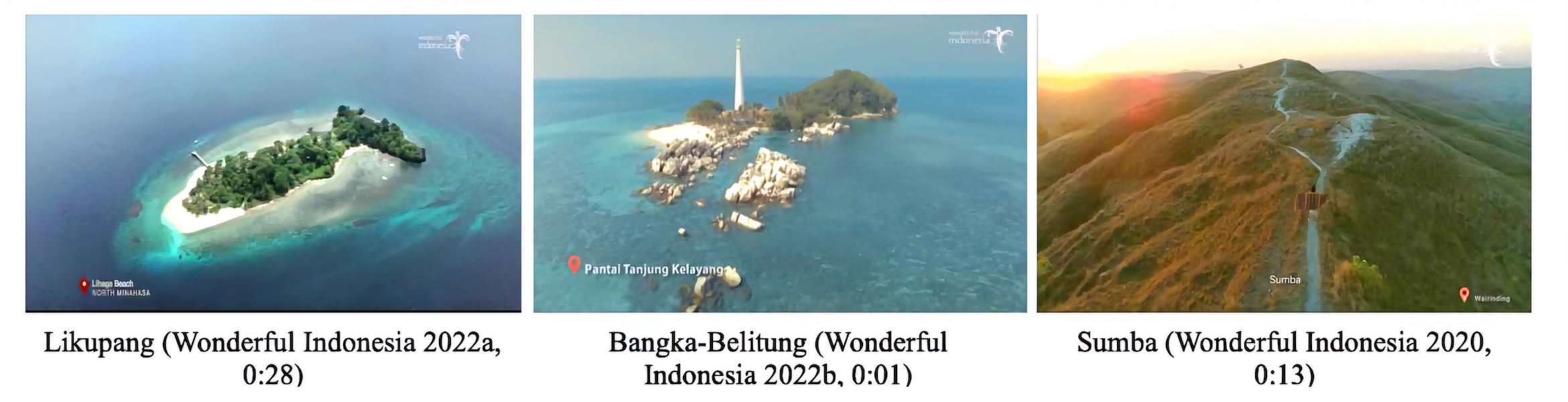
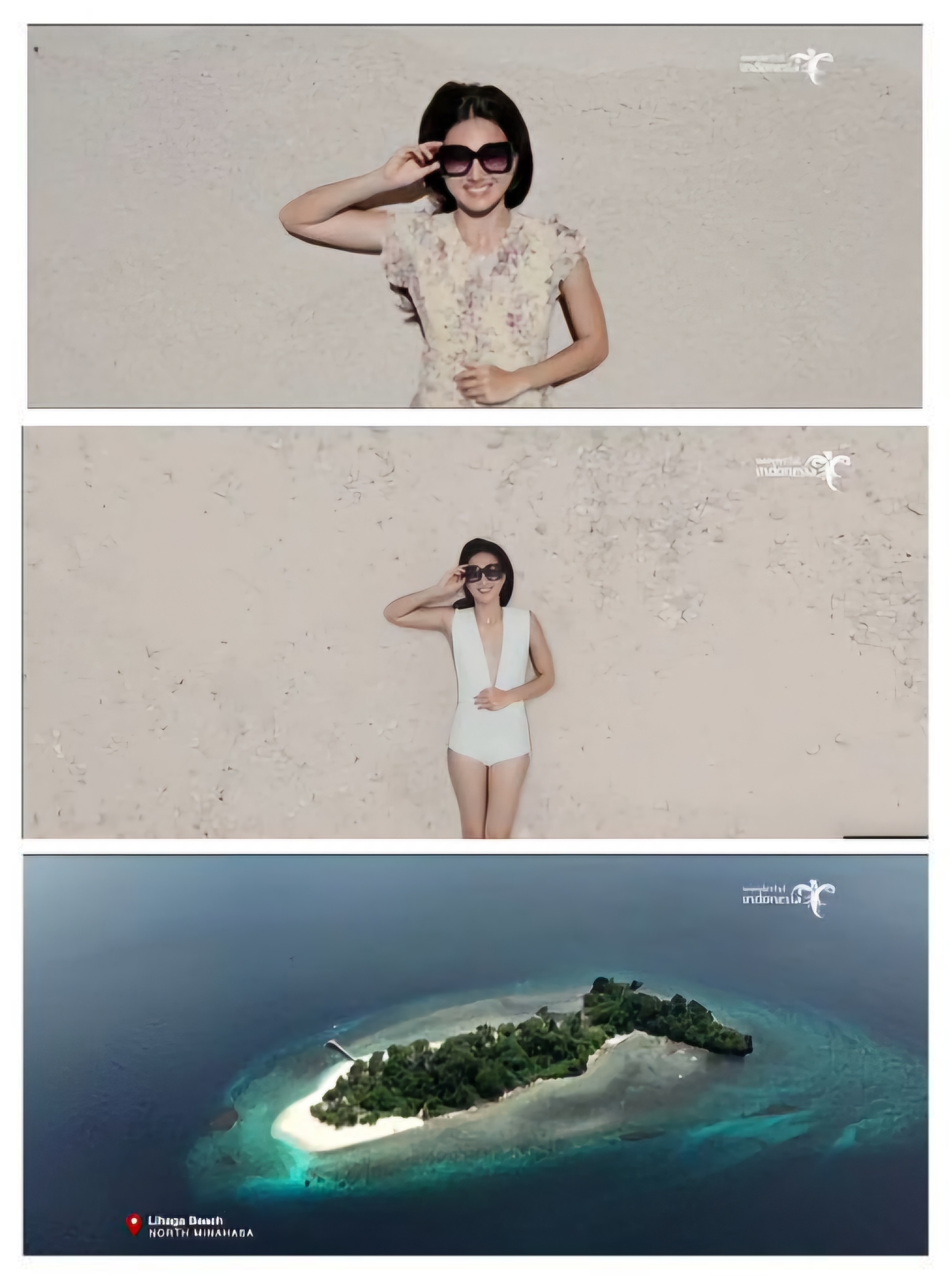
The promotional videos of Likupang, Bangka–Belitung, and Sumba use the same visual approach in representing island space. All three videos rely heavily on aerial, bird’s-eye perspectives, through which the islands are depicted as relatively small landforms encircled by expansive blue seas. This visual strategy positions the islands as spatially isolated and geographically distant, emphasizing their remoteness while simultaneously foregrounding their natural beauty (Figure 1). The islands are depicted through sweeping aerial shots of seascapes, coastlines, architectural forms, and cultural artefacts, such as traditional houses. This representational strategy miniaturizes those elements and reinforces the sense of scale, distance, and relative inaccessibility, but also frames the islands as pristine and insufficiently explored territories.
(Source: Sumba video, Bangka-Belitung video, Likupang video)
In terms of interactive meaning, the videos mobilize specific verbal and visual cues that position viewers as potential explorers, aligning them with the traveler-subjects depicted. Verbal expressions such as ‘explore new places’ (Likupang), ‘how exotic this island’ (Bangka–Belitung), and ’hidden beauty’ and ‘cross the distance’ (Sumba) , conveyed through both voice-over narration and on-screen text, function as discursive invitations that construct a relationship between the viewers and the islands as destinations. These expressions not only highlight the perceived distance and novelty of the islands but also actively invite viewers, who are implicitly positioned as mobile, curious, and external observers, to assume the role of discoverers. The use of English further reinforces this positioning, suggesting that the intended viewers include international viewers, particularly those positioned outside Indonesia. From a compositional dimension, the salience of wide aerial shots, combined with expansive framing and the visual dominance of natural landscapes, directs viewers’ attention toward the islands’ perceived purity and isolation. The arrangement of these visual elements, alongside evocative verbal cues, produces a coherent narrative of remoteness and desirability. Together, these multimodal strategies construct the islands as sites of hidden beauty that are simultaneously distant, mysterious, alluring, and waiting to be discovered.
The multimodal positioning of Likupang in North Sulawesi, the Bangka–Belitung off the eastern coast of Sumatra, and Sumba in the southern part of East Nusa Tenggara as distant and remote appears to be articulated through a Jakarta-centric spatial imaginary. Although these islands are geographically dispersed across the Indonesian archipelago, their representation as ‘distant’ or ‘remote’ is framed in relation to Jakarta, the nation’s political center, located on Java Island. From a political and historical standpoint, regions located at a distance from centers of power have often been constructed as peripheral or situated on the nation's outer margins. This spatial and symbolic positioning can be traced back to colonial knowledge formations. Clifford Geertz (1963), for instance, highlights how the Dutch colonial administration, centered in Batavia (now Jakarta), categorized territories beyond Java as ‘Outer’ islands. These included regions such as Sumatra, Borneo, Sulawesi, and Papua. The designation of these regions as ‘outer’ was inherently relational, produced from the vantage point of the colonial centre in Java. As a result, such regions were represented as distant, marginal, and peripheral, terms that continue to carry ideological weight.
Although postcolonial Indonesia has pursued a more equitable national development, the binary distinction between ‘Inner’ (Java) and ‘Outer’ islands has not been entirely dismantled (Noviani, 2012). Java continues to function as the principal axis of Indonesia’s political, economic, and cultural life. This is further reinforced by demographic patterns, with a significant proportion of the population concentrated on Java, consolidating its status as the core of national activity. Within this framework, the destinations examined in this study—Likupang, Bangka–Belitung, and Sumba—can be situated within what Geertz conceptualizes as the ‘Outer’ islands. Their framing in promotional videos as remote, distant, and awaiting exploration thus reflects more than spatial description; it echoes a historically entrenched hierarchy of place. The multimodal representation of remoteness in these videos can, therefore, be read as a perpetuation of a Jakarta-biased perspective, in which distance from the center is symbolically translated into notions of peripherality, otherness, and difference.
The multimodal configurations evident in these videos contribute to the reproduction of a colonial gaze, ironically through state-led tourism promotion, which rearticulates internal hierarchies and center–periphery imaginaries within the nation itself. This colonial mode of seeing is particularly reinforced by the recurrent use of aerial imagery across the three promotional videos that position the ‘Outer’ islands as objects of visual surveillance, desire, and consumption. By adopting a bird's-eye perspective, aerial imagery offers a synoptic view that enables the observer to survey space from above, positioning the viewer at a privileged, seemingly omniscient vantage point. As Marina Warner (2013) notes, ‘the bird’s-eye view gives a vantage point of great power.’ This perspective is not merely descriptive but also deeply pleasurable and empowering, as it promises a comprehensive view of the landscape and creates the illusion that everything can be seen, known, and controlled. As Kaplan (2018) argues, the view from above is ‘seductively pleasurable and all-empowering,’ offering visibility to states and other actors capable of mobilizing the technological resources which are necessary to produce such images. Although aerial views are widely used to promote tourist destinations and have become increasingly familiar in contemporary everyday life through technologies such as Google Maps, Google Earth, drones, and digital video, aerial vision is far from a natural or neutral way of seeing. Rather, it constitutes a historically and culturally situated visual regime that shapes how places are perceived, represented, and consumed. The development of aerial viewing technologies accelerated between the late eighteenth and early nineteenth centuries through military mapping practices and warfare infrastructures (Kaplan 2018). From this historical trajectory, the desire to achieve a perspective capable of seeing everything became closely intertwined with colonialism, state governance, military strategy, and systems of planning and management (Scott and Haffner, as cited in Kaplan 2018). Consequently, aerial views do more than simply present islands from above. They mobilize a historically specific mode of looking that is embedded in relations of power, surveillance, and territorial control. In this sense, the recurrent use of aerial imagery in the three promotional videos can be understood as reproducing a colonial gaze, positioning the islands as objects to be observed, known, and consumed from a distance by a privileged observer.
The ’Outer’ islands in the three videos are also aestheticized as exotic, distant, and culturally distinct spaces. The persistent foregrounding of remoteness, mystery, and exotic appeal not only enhances their attractiveness as tourist destinations but also situates these islands within asymmetrical relations of power, where they are rendered as objects of visual consumption for an external gaze. The use of English across all three videos further suggests that the imagined audience is primarily international prospective tourists. In this regard, international tourists are positioned as the gazing subjects, while the islands, along with their landscapes, places, cultural traditions, architectures, and local inhabitants, are constituted as objects of the tourist gaze. As objects of this gaze, elements associated with the islands are subjected to processes of aestheticization, whereby they are selectively framed and stylized to evoke impressions of beauty, untouched environments, and pleasurable experiences. As noted by Featherstone (2007), such aestheticization is a defining feature of consumer culture, in which objects and experiences are rendered visually appealing in order to attract attention and stimulate desire for consumption. As the tourist gaze becomes central to the production of the touristic experience (Urry and Larsen, 2011), the aestheticization of the ‘Outer’ islands in these videos entails mobilizing this gaze to promise exoticized experiences for international tourists.
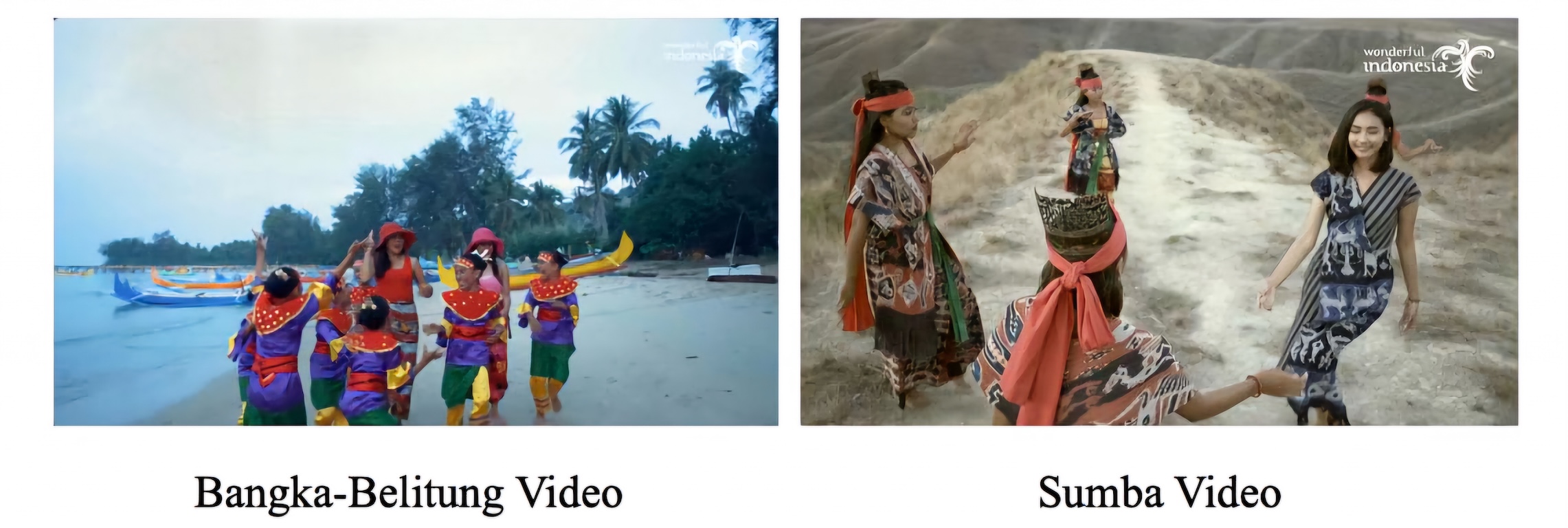
The exoticization of the ‘Outer’ islands is further amplified through compositional arrangements that juxtapose visual markers of traditionality and modernity, thereby heightening their contrast. This juxtaposition does more than simply display differences; it actively articulates them. Traditionality is framed as something visually distinctive, culturally bounded, and temporally static, in relation to modern tourists who embody mobility and leisure. The contrast between the two renders local culture as something both distinctive and consumable, thereby intensifying its exotic appeal. In the Bangka-Belitung video, for instance, local girls in traditional dance costumes walk along the beach, encircling two female tourists wearing hats and beachwear. A similar visual approach is evident in the Sumba video, where Sumbanese women perform traditional dances in open grasslands, surrounding a female tourist, as seen in Figure 2. From a compositional perspective, the spatial arrangement places the tourists at the center of the frame, while the traditionally dressed girls surround them, directing visual attention toward the encounter. This arrangement symbolically positions local culture as a performative backdrop that enhances the tourists’ experience. The co-presence of these figures creates a visual contrast between ‘local tradition’ and ‘modern visitor.’
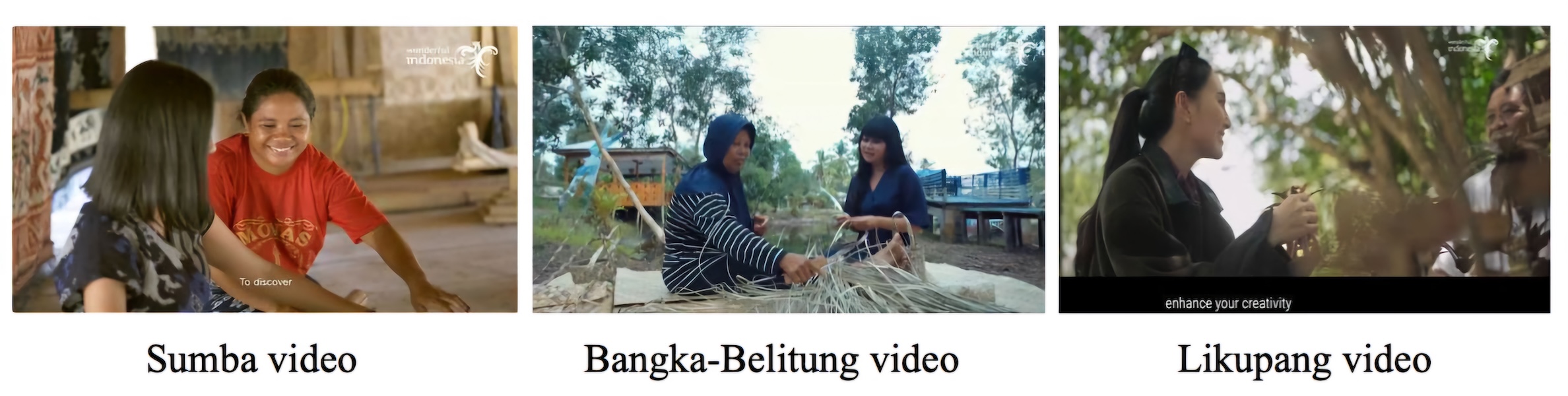
In another scene, a female tourist is depicted visiting a village in Sumba, observing, and learning from a local woman how to weave traditional textiles. This scene is displayed alongside on-screen text ‘to earn, to create, to discover’. (Wonderful Indonesia 2020, 2:17-2:22). In the Bangka-Belitung video, a female tourist is pictured learning traditional weaving from a local woman (Wonderful Indonesia 2022b, 2:00-2:02). A similar scene is depicted in the Likupang video (Wonderful Indonesia 2022a, 0:36-0:41), in which a female tourist interacts with a local male artisan while holding an island’s local craft. This scene is accompanied by the on-screen text ‘Enhance Your Creativity,’ suggesting that tourists are invited not only to observe local culture but also to learn from local creativity and craftsmanship (Figure 3).
(Source: Sumba video, Bangka-Belitung video, Likupang video)
As seen in Figure 3, interactions between tourists and local inhabitants in the three promotional videos are repeatedly framed around moments of cultural observation and learning. In these scenes, the act of looking is foregrounded, with the tourist becoming an active observer and documenter, while the local inhabitant is positioned as the observed, engaged in a culturally coded practice. From representational and interactive dimensions, these scenes position local inhabitants as custodians of tradition, while tourists are framed as mobile subjects who encounter, witness, and consume these traditional practices. The contrast between traditionality and modernity thus functions as a key mechanism of exoticization. Local culture is aestheticized as timeless, different, and, according to Paterson (2006), performed as ‘staged authenticity,’ while the presence of the modern tourist underscores this difference. In this way, the juxtaposition not only highlights cultural differences but also structures them into a hierarchy, in which tradition is rendered visible, legible, and ultimately consumable through the gaze of modern visitors.
In addition, the videos consistently depict visitors or tourists as subjects of leisure, while the local inhabitants are portrayed as engaged in various forms of labor. This labor appears both in the form of daily activities, such as weaving, craft making, and other domestic practices that are rendered visible as spectacles for tourists. It also takes the form of staged performances designed to entertain and accompany visiting tourists. This contrast between leisure and labor is not merely descriptive; rather, it functions discursively to differentiate social roles and positions. Tourists are associated with enjoyment, mobility, and consumption, whereas local inhabitants are aligned with work, service, and cultural display. Such repetition of difference is central to the construction of Otherness.
As O’Barr (1994) suggests, the repeated difference plays a key role in stabilizing and naturalizing social boundaries between ‘us’ and ‘them.’ In the videos, both the local inhabitants and the islands’ natural environments are constructed as objects of the gaze. They are presented as aesthetically pleasing and even enchanting, yet simultaneously marked as fundamentally different from the tourists. Importantly, this difference is framed as desirable, even pleasurable. The considered ‘Other’ is precisely what is promised to deliver enjoyment and entertainment. It is the perceived strangeness, beauty, and mystery of the islands that are mobilized as sources of pleasure for the tourists. In this regard, the tourist gaze, as conceptualized by Urry and Larsen (2011), structures the process of exoticizing and othering the remote islands. Local inhabitants, cultural practices, and natural landscapes are positioned as ‘Others’ whose value lies in their differences from the visiting tourists. This gaze structures a relationship in which the visiting tourist observes, experiences, and consumes, while the local is observed, displayed, and served. Following O’Barr (1994), such representations can be read as articulating social relations that imply a hierarchical social order and differentiate those who possess the capacity for leisure and consumption from those whose roles are tied to labour and service.
The construction of the ‘Outer’ island as Other also underscores the centrality of Java Island as the implicit point of reference through which these regions are framed. Given that these promotional videos are part of a state-led tourism campaign, the wording such as ‘distant’ or ‘hidden,’ along with aerial shots used to depict Likupang, Bangka-Belitung, and Sumba, is a relational category that derives its meaning from distance to the political and economic center, namely Java, and more specifically Jakarta. Java has historically been positioned as the core of modernity and development in Indonesia, a status that continues to shape contemporary spatial imaginaries (Noviani, 2012; Geertz, 1963). Given that these videos are produced by the Indonesian Ministry of Tourism and Creative Economy, they can be understood as representing a state-mediated perspective on regions beyond Java Island. At the same time, the use of English and the orientation toward international audiences indicate that this perspective intersects with a broader global tourist gaze. In this configuration, the viewpoint of the national center converges with that of foreign visitors, jointly constructing the ‘Outer’ islands as peripheral, exotic, and available for consumption within both national and global tourism imaginaries.
Feminine Aestheticization of ‘Outer’ Islands
The three promotional videos similarly construct the islands as tourist destinations through gendered associations with femininity. Across the videos, the islands’ beauty and attractiveness are consistently articulated through feminine imagery. Female tourists enjoying the islands’ scenery function as visual markers of the islands’ desirability, while local women are consistently foregrounded to symbolize both the natural beauty and the traditional character of the destinations. The beauty of the island landscapes, such as mountains, hills, beaches, and oceans, is visually aligned with women’s beauty, creating a symbolic association between the female body and the island landscape. Both women and islands are constituted as objects of visual attention for the tourists within the videos' diegetic worlds and for the viewers who watch them on YouTube. Likupang, Bangka-Belitung, and Sumba have therefore become aestheticized by being symbolically aligned with women, while their natural beauty is articulated through the strategic display of feminine beauty to attract potential visitors.
Based on Kress and van Leeuwen’s (2006) framework, this representational dimension underscores the symbolic naturalization of femininity as a defining attribute of the destinations. Women are represented not merely as tourists or local inhabitants but as embodiments of the islands’ beauty and desirability. Through recurring juxtapositions of female bodies and scenic landscapes, the videos establish an associative logic whereby the islands become legible through the aesthetic codes of femininity. In her discussion of femininizing Africa, Jeanne van Eeden (2007) argues that space is often objectified through visual representations and narratives that render it available for a particular viewing subject, for instance, for the colonial subject in colonial discourses or the tourist subject in tourism narratives. Moreover, van Eeden contends that femininizing the space functions as an ideological strategy to frame space as passive, decorative, and primarily available for visual consumption. Within such representations, space tends to be valued more for its beauty and exotic appeal than for its social and cultural complexity. Seen from this perspective, the three promotional videos in this study exhibit comparable representational tendencies. Likupang, Bangka-Belitung, and Sumba are constructed as femininized spaces that are aestheticized and exoticized within a gendered tourist gaze. The feminine aestheticization is produced through the repeated association of the destinations with female figures. Women, in this regard, are represented as embodiments of the islands’ beauty and become integral to the promotional branding of the destinations. The attractiveness of landscapes, traditional rituals, and local products is symbolically attached to women’s bodies and appearances.
At the level of interactive meaning, the videos seem to invite viewers to engage with both the islands and the female figures through visual intimacy and aesthetic pleasure. In the Sumba video, for example, a series of shots showcasing Sumba’s landscapes—its rolling hills, beaches, and vast savannas—is interwoven with the voice-over narration of a female tourist reflecting on freedom, self-discovery, and the desire to live as a free spirit. These landscape shots are repeatedly intercut with images of the female tourist, visually linking the island and the female body through a pattern of symbolic association (Wonderful Indonesia 2020, 0:27-2:09), as seen in Figure 4.
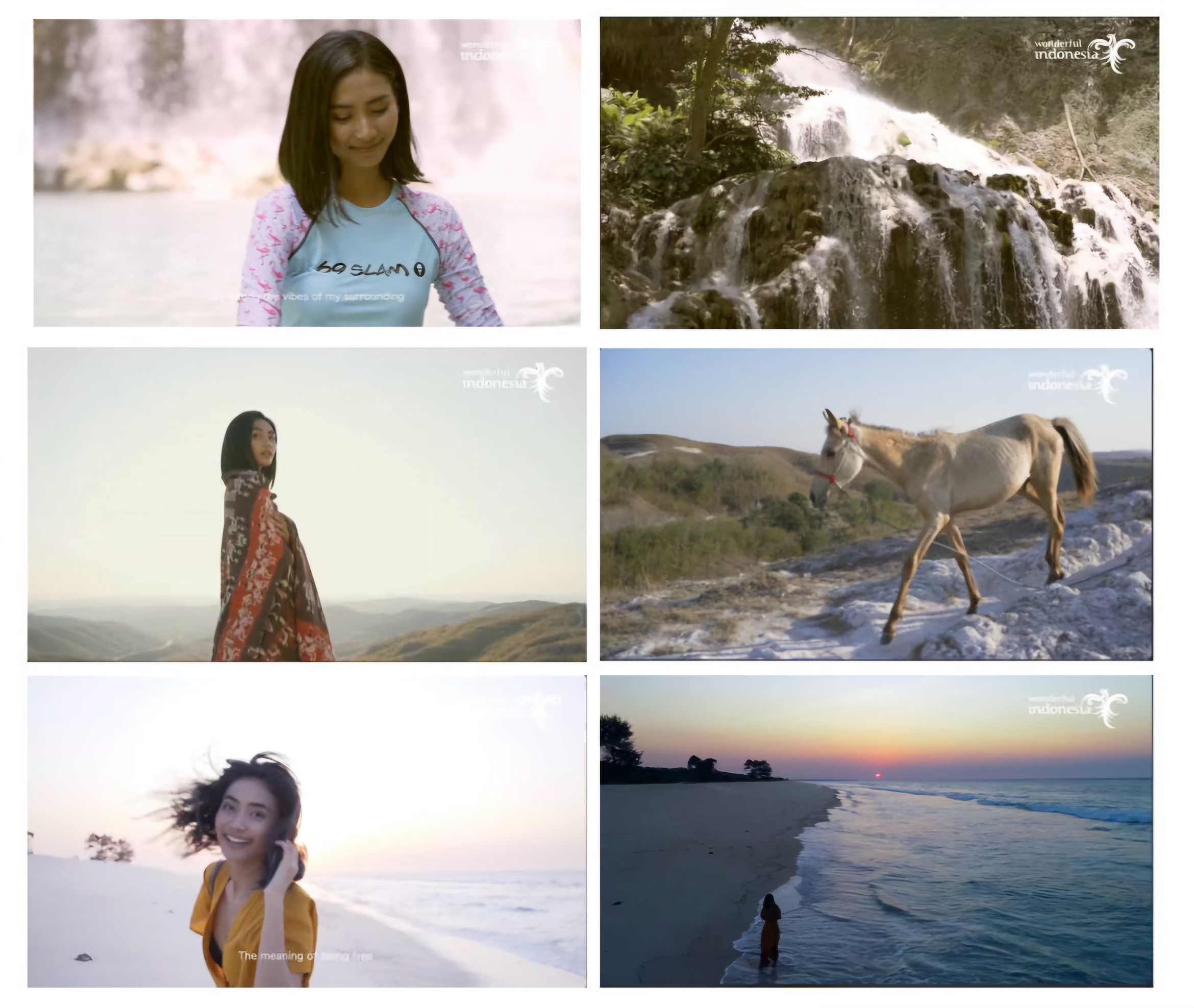
The juxtaposition of panoramic views of the island and the intimate narration of feminine selfhood also creates a symbolic alignment between the landscape's openness and the idea of personal liberation. Through these visual and verbal compositions, Sumba is framed not simply as a tourist destination, but as a femininized space of emotional escape, self-discovery, and aesthetic experience. Likewise, in the Likupang video, a female tourist is shown walking along the beach while the camera simultaneously accentuates her bodily appearance (Wonderful Indonesia 2022a, 0:20-0:27). The framing not only aestheticizes the beaches but also lingers on the curves and movements of the female tourist’s body. At the level of compositional meaning, these visual arrangements position women and landscapes in mutually reinforcing ways, constructing both as aesthetic spectacles to be admired, consumed, and desired.
As Urry and Larsen (2011) argue, tourism encompasses multiple forms of gazing, some of which are structured by gendered and male-centered assumptions. Within this framework, female tourists are positioned as objects of the male gaze, particularly for male viewers of the videos. The female tourists are symbolically intertwined with the islands and are rendered visible for visual consumption. In the Likupang video, for example, the camera adopts a distinctly masculine viewing position by emphasizing particular parts of a female tourist’s body, such as her legs, hands, and sunbathing beach body. Several shots are taken from elevated angles or framed in ways that foreground bodily contours while intercutting these images with scenic landscapes (Figure 5). This visual composition simultaneously aestheticizes the female body and the island scenery, constructing both as spectacles to be visually consumed.
(Wonderful Indonesia 2022a, 0:26-0:29)
Similarly, in the Bangka-Belitung video (Wonderful Indonesia 2022b, 2:30-2:34), women as objects of the male gaze are also reinforced through the camera apparatus. The camera repeatedly follows the movement and framing while tracking the female tourists as they walk along the beach and enjoy the scenery. The camera lingers on and accentuates particular parts of the woman’s body, including shots focusing on her buttocks while tracking her movements across the coastline. Through these gendered visual arrangements, the islands are marketed not only as exotic landscapes but also as spaces mediated by masculine modes of looking and desire.
Interestingly, the three videos in this study portray women ambivalently. On the one hand, female tourists are portrayed as independent travelers, lone adventurers who explore the islands on their own. In this configuration, they are positioned as mobile subjects of gaze—autonomous, liberated, and actively pursuing pleasure within the island spaces. They are represented as women who temporarily escape from their daily routines to enjoy leisure and experience personal fulfilment through travel. Within this representational logic, the female tourist appears as an active consumer who chooses, experiences, and enjoys the island as a tourist destination. At the level of interactive meaning, this mobility grants her the visual authority of the gazing subject. She is shown observing island landscapes, walking along beaches and through savannah and forests, and engaging directly with the island as a space of discovery.
In several scenes, the female tourist is also depicted carrying a camera and photographing tourist attractions across the island. In this sense, she is represented as the bearer of the tourist gaze, actively selecting and framing what is worthy of attention. As noted by O'Barr (1994), ‘the camera is so much a part of that experience of travelling,’ it functions as an instrument that freezes the tourist gaze and transforms looking into a source of pleasure. Through the act of photographing, the female tourist is positioned as an active visual consumer who derives pleasure not only from seeing but also from possessing the destination symbolically through images. Yet this apparent empowerment is accompanied by a contradictory representational logic. Although the female tourist is portrayed as an active subject who looks, explores, and consumes, the videos repeatedly aestheticize her body through carefully composed framings, positioning her simultaneously as an object of spectators’ gaze and visual pleasure. Thus, even as she is granted mobility and the capacity to gaze, she remains contained within a visual regime, which is structured by gendered expectations of femininity and attractiveness. Her autonomy is carefully stylized, packaged, and made visually consumable.
Moreover, as O’Barr further suggests, the camera mediates the relationship between visitors and the visited by documenting distinctions between those who possess leisure and those whose labor sustains visitor or tourist experiences. It marks differences between ‘our’ lives and ‘theirs,’ producing a visual hierarchy between the travelling subject and the local ‘Other.’ This dynamic is visible in the three videos, where women tourists are frequently represented as free-moving, self-actualizing consumers, while local women are more often positioned as static cultural signifiers, embodying tradition, authenticity, and local beauty. Such compositional contrasts reinforce unequal spatial relations, whereby the woman tourist is mobile and agentic, while the local woman is rooted, decorative, and available for visual consumption. In this sense, the woman tourist occupies a contradictory position. She appears empowered as a modern, mobile consumer-subject who actively gazes upon and experiences the islands, yet she is also mobilized as part of the promotional instrument. She functions as a symbolic seller of the destination; her pleasure serves to authenticate and intensify the island’s desirability for prospective visitors. Her enjoyment becomes evidence of the islands’ appeal, while her body becomes part of the visual packaging through which the islands are aestheticized and marketed. This ambivalence reveals how the videos negotiate femininity through a dual logic, namely, women are simultaneously framed as liberated subjects of consumption and as aestheticized objects through which the islands themselves are sold.
Conclusion
The three promotional videos published through ‘Wonderful Indonesia’, the official YouTube channel of the Indonesian Ministry of Tourism and Creative Economy, position Likupang, Bangka-Belitung, and Sumba as ‘Outer’ islands, defined primarily by their distance from Jakarta, located on Java Island, as the center of political and cultural life of the country. The islands are framed as remote, distant, and peripheral spaces whose meanings are constructed from a Java-centric point of view. In this representational logic, Java implicitly functions as the normative axis of Indonesian modernity and national life, while islands as tourist destinations, such as Likupang, Bangka-Belitung, and Sumba, are constructed as culturally different ‘Others’ and subsequently exoticized as spaces of escape, authenticity, and natural beauty. This suggests that state-led promotional videos, rather than merely promoting island tourism, reproduce a colonial gaze that reinforces internal hierarchies and center–periphery imaginaries within the nation itself.
At the same time, the ‘Outer’ islands undergo feminine aestheticization through their symbolic association with women in order to foreground their aesthetic appeal and touristic desirability. The tourist destinations are represented through ideas of feminine beauty, sensuality, and mystery, being imagined as spaces waiting to be discovered and enjoyed by tourists. In this sense, women in the Likupang, Bangka-Belitung, and Sumba videos are represented ambivalently. On the one hand, they are positioned as subjects of gaze, depicted as independent travelers who spend their leisure time exploring and enjoying the beauty of the islands. They are portrayed as mobile, liberated consumers of island tourism, embodying freedom, pleasure, and self-discovery. At the same time, they also function as symbolic sellers who guide prospective visitors toward the destinations, encouraging them to desire and eventually visit the islands themselves.
On the other hand, women are also positioned as objects of gaze, who are aesthetically aligned with the islands they inhabit and explore. Much like the island landscapes, their bodies and appearances are framed as visual attractions to be admired and consumed, not only by tourists within the videos’ diegetic worlds but also by audiences who watch on YouTube. In this sense, women become part of the tourism product itself, serving as marketing instruments that are mobilized to aestheticize, femininize, and commodify the islands in ways that enhance their attractiveness within the visual economy of island tourism.
These findings suggest that the state-led island tourism promotion analyzed in this study continues to rely on gendered imaginaries and the nation’s center-periphery imaginaries that shape how destinations, identities, and regional differences are visually communicated. The islands are not merely promoted as geographical destinations but are symbolically constructed through exoticized and gendered narratives that make them visually consumable within the contemporary tourism economy. Future research could further examine how audiences negotiate or respond to such representations, particularly in digital platforms where tourism promotional videos circulate interactively through comments, sharing practices, and algorithmic visibility. Further comparative research may also examine whether similar dynamics of feminine aestheticization, exoticization, and regional othering operate in tourism campaigns across other postcolonial and archipelagic contexts.
References
- Aisyiyah, S., 2023. Representational and ideational meanings of images and texts of tourism promotion on Instagram. Journal of English in Academic and Professional Communication. 9(1): 37-52.
- Almeida-Santana, A., and Moreno-Gil, S., 2018. Understanding tourism loyalty: Horizontal vs. destination loyalty. Tourism Management. 65: 245-255. https://doi.org/10.1016/j.tourman.2017.10.011
- Alyama, A., Harmoko, D.D., Suwarsito, 2023. Semantic aspect of Indonesian advertisements for overseas promotion: Case study on Wonderful Indonesia YouTube channel. English Journal Antartika. 1(2): 47-5.
- Andriani, N.N., Sihombing, B., Sembiring, C.S.B., 2025. Developing a sustainable tourism promotion strategy for cultural events on Sibandang Island. Journal of Event, Travel and Tour Management. 5(2): 1-27. https://doi.org/10.34013/jett.v5i2.2192
- Ardiya, Sobarna, C., Amalia, R.M., Darmayanti N., 2025. The construction of Indonesian nature and culture in tourism videos produced by Wonderful Indonesia. Studies in English Language and Education. 12(3): 1630-1644. https://doi.org/10.24815/siele.v12i3.38790
- Arvidsson, A., 2006. Brands: Meaning and value in media culture. London and New York: Routledge
- As’at, Soemarno, Mulawarman, A.D., Kamayanti, A., 2015. Tourism marketing strategy to increase tourist visits to Bawean Island, Gresik, East Java. American Journal of Tourism Management. 4(3): 54—60. https://doi.org/10.5923/j.tourism.20150403.02.
- Bonelli, D., Leotta, A., 2022. Introduction, in Bonelli, D., Leotta, A. (Eds.) Audiovisual tourism promotion: A critical overview, Palgrave Macmillan., London, pp. 1-9.
- Burgess, J., Green, J., 2009. YouTube: Online video and participatory culture. Polity, Cambridge.
- Carlsen, J., Butler, R., 2011. Introducing sustainable perspectives of island tourism, in Carlsen, J., Butler, R. (Eds.), Island tourism: Sustainable perspectives. CAB International, Wallingford, pp. 1-8.
- Cittone, M., 2024. Destination branding and marketing. Bibliotex Digital Library
- Covington, P., Adams, J., Sargin, E., 2016. Deep neural networks for YouTube recommendations. In: Proceedings of the 10th ACM Conference on Recommender Systems (RecSys '16). ACM, New York, 191–198.
- Davis, A., 2013. Promotional cultures: The rise and spread of advertising, public relations, marketing, and branding. Polity, Cambridge.
- Kemp, S., 2025. Digital 2025: Indonesia. DataReportal. Available at: https://datareportal.com/reports/digital-2025-indonesia (Accessed: 4 October 2025).
- Desmarais, F., 2007. Advertisements as tourism space: ‘Learning’ masculinity and femininity from New Zealand television. In: Pritchard, A., Morgan, N., Ateljevic, I., Harris, C. (eds.), Tourism and Gender: Embodiment, Sensuality and Experience. CAB International, Wallingford, pp. 207–218.
- Fahrizal, M., Sundari, R., Shiddiqi, M.A.A., Rani, F., 2022. The strategy of the Indonesian government in implementing the Wonderful Indonesia digital diplomacy program. Kemudi: Jurnal Ilmu Pemerintahan. 7(1): 47–65. https://doi.org/10.31629/kemudi.v7i1.4814.
- Featherstone, M., 2007. Consumer culture and postmodernism. Sage Publication, Thousand Oaks.
- Febriyanti, I., Widhiandono, D., 2025. Strategi komunikasi media massa dalam destination branding Indonesia: Analisis kampanye "Wonderful Indonesia". Relasi: Jurnal Penelitian Komunikasi. 5(3): 1–16.
- Geertz, C., 1963. Agricultural involution: The processes of ecological change in Indonesia. University of California Press, California.
- Goodall, B., Ashworth, G., 2012. Marketing in the tourism industry: The promotion of destination regions. Routledge, London.
- Hafizhah, A.M., Budisetyorini, B., Sumaryadi, 2022. The influence of social media marketing on tourist visit intention to Pari Island, Thousand Island. International Journal of Sustainable Competitiveness on Tourism. 1(1): 32–41. https://doi.org/10.34013/ijscot.v1i01.768.
- Hall, C.M., 2010. Island destinations: A natural laboratory for tourism: Introduction. Asia Pacific Journal of Tourism Research. 15(3): 245–249. https://doi.org/10.1080/10941665.2010.503613.
- Henry, 2022. Sumba masuk daftar 30 destinasi wisata terbaik untuk dikunjungi di 2022 versi Conde Nast Traveler. Liputan6. February 15. Available at: https://www.liputan6.com/lifestyle/read/4887489/sumba-masuk-daftar-30-destinasi-wisata-terbaik-untuk-dikunjungi-di-2022-versi-conde-nast-traveler (accessed March 5, 2025).
- Hoang, M., Minh, T.L., 2025. Reframing gender in rural tourism: A cross-national analysis of official websites in the Mekong Subregion. Frontiers in Communication. 10: 1596789. https://doi.org/10.3389/fcomm.2025.1596789.
- Ilhamsyah, S., Dewi, V.N., Siburian, V.R.R., Noviyanti, I., 2024. Strategi jitu blue ocean menciptakan peluang industri pariwisata tanpa persaingan di Provinsi Bangka Belitung. OPTIMAL: Jurnal Ekonomi dan Manajemen. 4(2): 81–94. https://doi.org/10.55606/optimal.v4i2.3334.
- Jenks, C., 1995. The centrality of the eye in western culture: An introduction, in: Jenks, C. (Ed.), Visual Culture. Routledge, London, pp. 1–25.
- Jordan, F., 2007. Life’s a beach, and then we diet: Discourses of tourism and the ‘beach body’ in UK women’s lifestyle magazines, in: Pritchard, A., Morgan, N., Ateljevic, I., Harris, C. (Eds.), Tourism and Gender: Embodiment, Sensuality and Experience. CAB International, Wallingford, pp. 92–106.
- Kaplan, C., 2018. Aerial Aftermaths: Wartime from Above. Duke University Press, Durham.
- Kemenparekraf, 2020. Rencana strategis 2020–2024. Kementerian Pariwisata dan Ekonomi Kreatif, Jakarta. Available at: https://kemenparekraf.go.id/.
- Koswara, I.H., 2020. Pulau-pulau kecil dan pariwisata. Warta Pariwisata. 18(1): 3–4. https://doi.org/10.5614/wpar.2020.18.1.01.
- Kress, G., van Leeuwen, T., 2006. Reading Images: The Grammar of Visual Design, 2nd ed. Routledge, London.
- Kress, G., van Leeuwen, T., 2001. Multimodal Discourse: The Modes and Media of Contemporary Communication. Hodder Education, London.
- Lengkong, J., Mandey, L.C., Ngangi, C.R., 2018. Strategi pengembangan kawasan wisata Likupang, Kabupaten Minahasa Utara. Agri-SosioEkonomi. 14(1): 425–438.
- Lewokeda, A., 2018. Sumba named most beautiful island by Focus: Official. Antaranews (February 26). https://en.antaranews.com/news/114784/sumba-named-most-beautiful-island-by-focus-official (accessed March 5, 2025).
- Lin, Y., Yoon, Xiao, C.R., 2025. Promoting sustainable island tourism through tourists’ environmentally responsible behavior: Integrating VIP, VAB, and TPB. Sustainability. 17(11): 4792. https://doi.org/10.3390/su17114792
- McLeod, M., Dodds, R., Butler, R., 2021. Introduction to special issue on island tourism resilience. Tourism Geographies. 23(3): 361–370. https://doi.org/10.1080/14616688.2021.1898672
- Megawandi, Y., 2020. Pembangunan pariwisata di Provinsi Kepulauan Bangka Belitung dalam pendekatan whole of government. Jurnal Widyaiswara Indonesia. 1(2): 108–119.
- Motahar, P.S., Tavakoli, R., Mura, P., 2024. Social media influencers’ visual framing of Iran on YouTube. Tourism Recreation Research. 49(2): 270–282. https://doi.org/10.1080/02508281.2021.2014252.
- Mula, H., 2019. Potensi desa wisata Rende Kabupaten Sumba Timur. Jurnal Pamator. 12(2): 73–77. https://doi.org/10.21107/pamator.v12i2.6274.
- Nayak, M., Sit, M., 2025. Social media influence on island tourism and its impact on local people, in: Hassan, V.I. (Ed.), Navigating Mass Tourism to Island Destinations: Preservation and Cultural Heritage Challenges. IGI Global Scientific Publishing, Hershey, pp. 255–286.
- Nguyen, T., 2025. Textual and visual analysis of gender stereotypes in English tourism and hospitality advertisements: A pilot study. RA Journal of Applied Research. 11(4): 241–250. https://doi.org/10.47191/rajar/v11i4.01.
- Noviani, R., 2012. Identity Politics in Indonesian Advertising: Gender, Ethnicity/Race, Class, and Nationality in TV Advertisements During the New Order and the Post-New Order Era. Penerbit Kanisius, Yogyakarta.
- O’Barr, W.M., 1994. Culture and the Ad: Exploring Otherness in the World of Advertising. Westview Press, Boulder.
- Patadjenu, S., Silitonga, M.S., Asropi, A., 2023. Tourism development collaborative governance of Likupang, North Minahasa Regency. Jurnal Kepariwisataan Indonesia. 17(1): 23–48.
- Paterson, M., 2006. Consumption and Everyday Life. Routledge, London.
- Poyk, S.D.M., Pandjaitan, Y.A., 2016. Representation of Indonesia in Wonderful Indonesia’s Feeling Is Believing tourism advertisement: A critical discourse analysis. Paradigma: Jurnal Kajian Budaya. 6(1): 102–122. https://doi.org/10.17510/paradigma.v6i1.84.
- Rahjasa, P.S.L., Prasasti, G., Apriliani, K.M., 2024. How travel influencer and social media influence tourist travel decision to Ubud. Tourism Research Journal. 8(1): 127–141. https://doi.org/10.30647/trj.v8i1.243.
- Riaz, S., Sohail, B., Aslam, S., Hussain, B., 2024. Tourism destination branding in the digital age: Evaluating the influence of social media on destination image and visitor perceptions. Contemporary Journal of Social Science Review. 2(4): 70–80.
- Setyowati, H.E., 2019. Siap jadi destinasi wisata kelas dunia, KEK Tanjung Kelayang diresmikan presiden. Kementerian Koordinator Bidang Perekonomian Republik Indonesia (March 14). https://ekon.go.id/publikasi/detail/1288/siap-jadi-destinasi-wisata-kelas-dunia-kek-tanjung-kelayang-diresmikan-presiden (accessed March 4, 2025).
- Sharma, K., Trup, A., 2023. An assessment of the social media marketing performance of Fiji’s hotel industry before and during COVID-19, in: Stephenson, M.L. (Ed.), Routledge Handbook on Tourism and Small Island States in the Pacific. Routledge, New York, pp. 219–231.
- Sharpley, R., 2012. Island tourism or tourism on islands? Tourism Recreation Research. 37(2): 167–172.
- Simangunsong, W.S., Tashandra, N., 2022. 6 Tempat Wisata Likupang, Surga Tersembunyi di Sulawesi Utara. Travel Kompas (March 10). https://travel.kompas.com/read/2022/03/10/130300227/6-tempat-wisata-likupang-surga-tersembunyi-di-sulawesi-utara?page=all (accessed March 3, 2025).
- Tran, N.L., Rudolf, W., 2022. Social media and destination branding in tourism: A systematic review of the literature. Sustainability. 14(20): 13528. https://doi.org/10.3390/su142013528.
- Urry, J., Larsen, J., 2011. The Tourist Gaze 3.0. Sage Publications, Thousand Oaks.
- Van Eeden, J., 2007. Gendered tourism space: A South African perspective, in: Pritchard, A., Morgan, N., Ateljevic, I., Harris, C. (Eds.), Tourism and Gender: Embodiment, Sensuality and Experience. CAB International, New York, pp. 182–206.
- Warner, M., 2013. Intimate communiqués: Melchior Lorck's flying tortoise, in: Dorrian, M., Pousin, F. (Eds.), Seeing from Above: The Aerial View in Visual Culture. I.B. Tauris, London, pp. 11–25.
- Wonderful Indonesia, n.d. Wonderful Indonesia Official [YouTube channel]. https://www.youtube.com/@WonderfulIndonesiaOfficial (accessed November 25, 2025).
- Wonderful Indonesia, 2022a. Likupang, a Piece of Heaven on the Edge of Minahasa [Video]. YouTube (October 7). https://www.youtube.com/watch?v=Cbtt4LsssHo (accessed March 5, 2025).
- Wonderful Indonesia, 2022b. Create an Extraordinary Journey in Bangka Belitung [Video]. YouTube (October 10). https://www.youtube.com/watch?v=i-jJMOmbKKg (accessed March 2, 2025).
- Wonderful Indonesia, 2020. Sumba: Miracles in the Southeast [Video]. YouTube (March 10). https://www.youtube.com/watch?v=K3pVn9awunw (accessed March 3, 2025).
- Yanti, D., Liyushiana, Dalimunthe, F., Prayogi, B., Ismail, W.N.A.T., 2023. The effectiveness of digital media management by local governments in tourist marketing. PLANNING MALAYSIA: Journal of the Malaysian Institute of Planners. 21(6): 1–16.
- Yuliani, N.F., Rachman, S., Indarwati, 2020. Promotional efforts in increasing tourist visits (case study of Sanrobengi island tourism object). Balance: Jurnal Ekonomi. 16(1): 142–150.