
Beyond Transmission: Heritage as Care in the Post-Transmission Condition of Korean Haenyeo
 10.21463/jmic.2026.15.1.09
Abstract
This article proposes heritage as care as a theoretical framework for understanding how cultural heritage persists under conditions of demographic aging, livelihood decline, and post-transmission precarity. While existing heritage studies have emphasized management, safeguarding, and participation, they remain limited in explaining how heritage is sustained when transmission has weakened and institutional support is insufficient. Drawing on long-term ethnographic research on ‘haenyeo’ (female divers) in island communities of South Korea, this study shifts analytical attention from heritage designation to everyday practices of endurance. It argues that haenyeo heritage survives not primarily through formal safeguarding measures, but through continuous acts of care—embodied, relational, and unevenly distributed labor largely borne by aging women. By conceptualizing heritage as care, the article foregrounds the ethical, temporal, and affective dimensions of heritage continuity that are obscured by management-oriented paradigms.
Empirically, the haenyeo case illustrates a post-transmission condition in which heritage persists beyond reproduction through sustained caregiving practices. Theoretically, the article contributes to heritage scholarship by reframing cultural heritage as a process of care rather than an object of management, and by positioning East Asian island contexts as critical sites for theory production rather than peripheral applications of Eurocentric heritage models.
Keywords
Cultural heritage, Heritage as care, Intangible cultural heritage, Haenyeo, Island livelihood sustainability, post-transmission heritage
1. Introduction
Existing heritage frameworks explain how heritage is designated and managed (Smith, 2012) but not how it is endured. Marilena (2011) raises a critical question as to whether the very process of safeguarding intangible heritage may, paradoxically, lead to its erasure. In this regard, she critiques conventional approaches to cultural heritage preservation—particularly those centered on museum practices—for their tendency to distort or fix living heritage, thereby undermining its dynamic and context-dependent nature.
Despite the growing emphasis on participation and community engagement in contemporary heritage studies (Hong and Grydehøj, 2022), the everyday practices through which heritage is sustained remain largely undertheorized. Existing frameworks continue to privilege management, governance, and policy instruments, thereby overlooking the forms of relational, affective, and temporal labor that actually keep heritage alive. This absence is particularly evident in contexts characterized by demographic aging, livelihood collapse, and prolonged socio-economic marginalization, where heritage persists not through institutional intervention but through continuous acts of care.
This article proposes “heritage as care”as an alternative analytical framework to understand how cultural heritage is sustained under conditions of precarity. Rather than treating heritage as an object to be managed or safeguarded, the concept foregrounds care as a relational practice that involves moral responsibility, emotional attachment, and unevenly distributed labor over time. Heritage, in this sense, is not merely preserved but continuously cared for through everyday acts of maintenance, attention, and endurance.
While management-oriented approaches emphasize efficiency, sustainability, and institutional coordination, they fail to account for the burdens and inequalities embedded in heritage practices. By contrast, a care-based perspective reveals how heritage continuity often relies on unpaid, feminized, and aging labor, raising critical ethical questions regarding responsibility and justice. In doing so, the framework shifts the analytical focus from what heritage is to how—and by whom—it is sustained.
The Korean and East Asian contexts offer a particularly compelling ground for theorizing heritage as care, given their histories of rapid modernization, state-mediated heritage regimes, and accelerated demographic aging. In these settings, heritage continuity increasingly depends on the endurance of caregivers rather than the effectiveness of institutions. This suggests that care is not peripheral but constitutive of heritage itself, calling for a rethinking of heritage theory beyond Eurocentric assumptions of stable transmission and institutional support.
By conceptualizing heritage as care, this study contributes to heritage scholarship in three ways. First, it introduces care as a central analytical category for understanding heritage continuity under conditions of precarity. Second, it challenges management-centered paradigms by foregrounding the ethical and relational dimensions of heritage practices. Finally, it demonstrates how East Asian cases can serve not merely as empirical examples but as sites of theoretical production capable of reshaping global heritage debates.
Cultural heritage is commonly understood as something that is safeguarded, managed, or transmitted. Yet across many aging and peripheral communities, heritage persists under conditions where transmission has weakened, institutional support is limited, and formal safeguarding frameworks offer little explanatory power. In such contexts, heritage does not survive because it is effectively managed, but because it is continuously endured. This article argues that the persistence of cultural heritage in these settings can only be understood by shifting analytical attention from management to care. Drawing on ethnographic research on haenyeo (female divers) in South Korea’s island communities, the article proposes heritage as careas a theoretical framework for explaining how heritage continues to exist beyond transmission, through embodied, relational, and ethically charged practices of everyday labor.
Recent interventions in heritage studies have begun to question linear assumptions of continuity and transmission, emphasizing instead the uncertain and processual nature of heritage futures (Harrison, 2013, Harrison et al., 2016). However, the everyday practices through which such futures are sustained remain insufficiently theorized.
This study demonstrates that although haenyeo are recognized as “intangible cultural heritage” requiring safeguarding, their continuity in practice is sustained less through institutional management than through everyday practices of endurance and care. In doing so, it suggests that cultural heritage persists not primarily through management, but through forms of care that sustain it in lived contexts.
2. Literature Review :Where Existing Heritage Theory Falls Short
2.1 Intangible Cultural Heritage and the Limits of Transmission
The transmission-centered model of intangible cultural heritage is insufficient for explaining post-transmission conditions. The core assumptions of intangible cultural heritage (ICH) theory have generally been that communities continue to exist as cultural carriers, that there are bearers responsible for transmitting heritage, and that the possibility of cultural reproduction remains. However, ICH theory faces limitations in accounting for situations that arise after the “last generation” of practitioners, as well as for contexts in which transmission has already weakened.
Existing theoretical approaches to Intangible Cultural Heritage (ICH) have largely developed around three key concepts: safeguarding, transmission, and community participation. The main theoretical frameworks can be summarized as follows. (Laurajane Smith; Barbara Kirshenblatt-Gimblett)
1) The UNESCO-centered institutional paradigm of intangible cultural heritage (Safeguarding Paradigm)
First, the institutional paradigm of safeguarding, largely shaped by UNESCO, constitutes the starting point for contemporary ICH research. The Convention for the Safeguarding of the Intangible Cultural Heritage defines ICH as: (1) practices, representations, expressions, knowledge, and skills that communities, groups, and individuals recognize as part of their cultural heritage; (2) cultural forms that are continuously transmitted across generations; and (3) elements that contribute to the identity and continuity of communities. A central premise of this framework is its emphasis on transmission: intangible heritage is understood to be sustained through intergenerational learning, and it is generally assumed that as long as transmission continues, heritage will also persist.
Second, safeguarding-oriented policies focus on institutional mechanisms such as documentation, education, support programs, and legal or administrative protection.
Third, the paradigm emphasizes community-based heritage, highlighting that the primary subjects of heritage are communities rather than the state (Smith, 2006; Kirshenblatt-Gimblett, 2004). In this regard, Smith (2006) criticized the state- and expert-centered Authorized Heritage Discourse and argued that heritage should be understood as a form of cultural practice enacted by communities. Similarly, Kirshenblatt-Gimblett (2004) conceptualized heritage not as something discovered but as something socially produced. Together, these studies provided a crucial theoretical foundation for shifting heritage research from a state-centered perspective toward a community-centered understanding.
2) Critical Heritage Studies
Since the 2000s, heritage studies have increasingly challenged the idea that heritage represents neutral or inherent values, arguing instead that heritage is a political and social construct. A key concept emerging from this critique is the Authorized Heritage Discourse (AHD), which focuses on how institutions with authority determine what is recognized as heritage (Smith, 2006; Harrison et al., 2016). Smith (2006) argues that heritage policies and management discourses have largely been shaped by an Authorized Heritage Discourse centered on experts and state institutions (Smith and Waterton, 2012). In particular, she explains how dominant heritage discourses, produced by states, experts, and institutional authorities, define the value of heritage. From this perspective, heritage is not an objective value but a discourse that is socially constructed.
Building on Smith’s concept of AHD, Harrison (2016) further analyzed how such discourses are linked to institutional structures of power that legitimize particular definitions and value judgments of heritage. He argues that heritage should be understood as a social practice constituted through power and discourse. According to Harrison, organizations such as UNESCO, national heritage policies, and networks of experts play a central role in institutionalizing definitions of heritage. Consequently, heritage studies need to critically examine the discursive and power structures through which heritage is defined and governed (Askew, 2010). A central implication of these arguments is that heritage can be understood as a product of memory politics; as heritage is often defined through state- and expert-centered frameworks, it may diverge from the lived experiences and voices of communities.
3) Participation and Governance Paradigm
More recent studies have highlighted community participation and governance as key themes in heritage research. Harrison and Holtorf (2019) have drawn attention to participatory heritage, emphasizing community involvement and locally based heritage management. At the same time, the concept of heritage governance highlights the importance of multi-level policy structures and collaboration among national governments, local authorities, and local communities.
4) Processual and Future-oriented Approaches to Heritage
Another significant shift in recent scholarship is the understanding of heritage not as a fixed object but as a process. Concepts such as heritage as process and heritage futures emphasize the uncertain future of heritage, including processes of change, transformation, and even disappearance (Harrison et al., 2016).
Recent heritage scholarship has therefore criticized the conventional view that understands heritage continuity and transmission as linear and stable processes. Instead, scholars emphasize that the future of heritage is uncertain, open-ended, and characterized by multiple possible trajectories. A representative example of this shift is the Heritage Futures research program conducted by Harrison et al (2016). This research proposes a theoretical reorientation in which heritage is understood not merely as something to be preserved from the past but as a future-making practice. Harrison et al (2016) argue that heritage should be understood as a processual practice that actively shapes the future, rather than as an object of preservation rooted in the past. In this perspective, the persistence of heritage is reconceptualized not as linear transmission but as an open-ended process shaped by uncertainty and transformation. Such an approach encourages scholars to reconsider how heritage relates to future societies, particularly in the context of the Anthropocene, climate change, and shifting community structures.
2.2 Limitations of Existing Theories
1) The Limits of ICH Frameworks
Recent scholarship has increasingly pointed out several limitations of existing theories of Intangible Cultural Heritage (ICH). One of the most significant concerns lies in the transmission-centered model, which assumes that the persistence of heritage is ensured through intergenerational transmission. In reality, however, transmission itself has become increasingly difficult due to factors such as population aging, demographic decline, and the collapse of traditional livelihoods.
Similarly, institutional approaches tend to focus on management, policy, and governance as the primary mechanisms through which heritage is sustained. Yet in practice, the continuity of heritage is often maintained not through formal institutions but through the everyday labor and practices of individuals and communities. Existing theoretical frameworks therefore struggle to adequately account for the everyday dimensions of heritage practices, including labor, emotion, and care. In response to these limitations, recent scholarship has begun to introduce the concept of heritage as care, which emphasizes the role of everyday practices of endurance and care in sustaining heritage.
The case of the haenyeo provides a clear example of this limitation. Although haenyeo are officially recognized as “intangible cultural heritage to be safeguarded,” in reality their continuity is sustained not through institutional management but through everyday practices of endurance and care. Heritage is not transmitted simply because it is designated and managed as intangible heritage; rather, it persists because practitioners continue to endure and sustain their livelihoods in everyday life.
In particular, elderly haenyeo maintain the continuity of heritage not primarily as designated bearers of intangible cultural heritage, but as small-scale economic actors who continue their livelihood practices within local fishing economies. By caring for their own bodies and livelihoods, they simultaneously sustain the heritage embedded in these practices.
Importantly, many haenyeo do not prioritize their role as transmitters of intangible heritage. Instead, they place greater emphasis on caring for their own bodies and sustaining their livelihoods. Through these everyday practices of survival and self-care, heritage is maintained almost incidentally. As long-term ethnographic research has shown, haenyeo rely solely on the harvesting skills they have acquired through embodied experience, entering the sea with little more than their own bodies and knowledge. Their lifeworld is shaped by the intersecting conditions of everyday life, gendered labor, subsistence work, domestic responsibilities, marginalization, and aging. Under such conditions, diving is often less an act of cultural preservation than a necessary activity for sustaining daily life.
2) Participation, Governance, and Their Limits
Although recent scholarship has increasingly emphasized participation and governance in heritage management, these frameworks leave important questions unanswered. Who actually goes out to sea every day? Who expends their bodies and labor to sustain these traditions? Participation and governance models rarely provide clear answers to these questions.
As a result, the everyday labor that sustains heritage remains analytically invisible in much of the existing literature.
2.3 Heritage, Labour, and Care as an Absent Concept
Although labour has been discussed in heritage studies, it has largely been treated in terms of economic production, while care has tended to be relegated to the private sphere and associated with feminized and informal domains. As a result, the relational and affective dimensions of care embedded in heritage practices have often remained analytically marginal.
Recent scholarship has begun to draw attention to the politics of labour and care embedded within heritage practices (Waterton & Smith, 2010). Building on this emerging discussion, this article moves beyond treating care merely as a descriptive concern and instead develops it as a key analytical framework for understanding the persistence of heritage under post-transmission conditions.
3. Theoretical Framework: Heritage as Care
3.1 Definition of “Heritage as Care”
This study conceptualizes cultural heritage as a form of care. In this perspective, heritage is understood as a set of relational, embodied, and temporally sustained practices that enable heritage to continue to exist even under conditions of instability and uncertainty.
By proposing an analytical framework of heritage as care, this article makes an original theoretical contribution to heritage studies. Existing heritage research has largely focused on safeguarding, governance, and participation; however, under conditions of population aging and post-transmission precarity, it has paid insufficient attention to the everyday labour through which heritage is actually sustained.
Drawing on ethnographic research on Korean haenyeo, this article reconceptualizes cultural heritage not as an object of management but as a relational and ethical practice of care. In doing so, it extends intangible heritage theory beyond its transmission-centered model and demonstrates that island contexts in East Asia should be understood not merely as peripheral case studies but as important sites of theoretical production. Consequently, this study engages directly with current discussions in island studies (‘nissology’) on heritage, sustainability, and social inequality, and offers meaningful insights for scholars working in heritage theory, community-based heritage studies, and critical cultural geography (McCall, 1994).
More specifically, by introducing the concept of heritage as care, this article proposes a new analytical framework for heritage studies. Moving beyond management- and safeguarding-centered approaches, it conceptualizes cultural heritage as a constellation of embodied, relational, and temporally sustained practices of care. These practices enable heritage to persist even under conditions shaped by demographic aging and post-transmission precarity.
Based on long-term ethnographic research with haenyeo communities in the island regions of Korea, this study shows that heritage does not persist primarily through reproduction or institutional intervention. Rather, it continues through the everyday acts of endurance and persistence performed by elderly practitioners. In doing so, this research positions East Asian island contexts not as marginal examples but as important sites for rethinking Eurocentric assumptions within heritage studies—particularly the assumption that heritage continuity depends on stable transmission and institutional support.
In this article, ‘heritage as care’ is defined as the set of embodied, relational, and temporally sustained practices through which individuals and communities sustain cultural heritage in their everyday lives. Rather than focusing on institutional management or formal transmission, this concept emphasizes the everyday labour, ethical commitments, and acts of endurance that allow heritage to persist under conditions of social, economic, and demographic precarity.
3.2 Analytical Dimensions of Heritage Care
When analyzing heritage as care in the context of Korean haenyeo, the scope of analysis should extend beyond the labour and diving techniques of the divers themselves. It can be defined as a multi-layered framework that encompasses the broader practices of care that sustain haenyeo activities, including relationships, knowledge systems, environmental practices, and institutional arrangements.
In research on haenyeo as a form of cultural heritage, the analytical scope of heritage as care can therefore be conceptualized as a multi-dimensional structure. In the Korean context, this framework includes several interrelated dimensions: embodied labour and diving skills; community cooperation and social relations; marine ecological management and environmental knowledge; processes of knowledge and skill transmission; policy and institutional safeguarding systems; and cultural identity.
Among these dimensions, particular attention is given to haenyeo who have engaged in traditional muljil (breath-hold diving) for decades. The analysis focuses on the repetitive nature of diving labour, the psychological burdens that are disproportionately borne by women and elderly practitioners, the intensity and sustained pressures of this labour, and the strong sense of responsibility toward traditional fishing practices that has become deeply embedded in their bodies and everyday lives.
| Analytical Dimensions | Their Connection to the Haenyeo Case |
|---|---|
| Care labor | Repetitive diving labour among elderly haenyeo |
| Care burden | The concentration of labour burdens on women and elderly practitioners |
| Care temporality | The persistent pressure to continue working—“one must go out to the sea again today” |
| Care ethics | The question of who bears the responsibility for sustaining this tradition to the end |
From this perspective, haenyeo heritage cannot be understood merely as a form of “traditional technique.” Rather, it should be interpreted as a system of care in which body, community, ecology, knowledge, institutions, and ethical responsibility are closely interconnected.
4. Haenyeo as Livelihood-Based Care Practitioners of Heritage
4.1 The History of Haenyeo and Heritage as Care
This study adopts an ethnographic approach to capture haenyeo heritage not as a matter of representation but as a form of lived endurance and persistence. Based on long-term ethnographic fieldwork, the research examines policy documents related to intangible heritage designation and safeguarding plans, while also incorporating life-history interviews with practitioners.
The Republic of Korea has approximately 3,390 islands, of which 480 are inhabited, and 2,910 are uninhabited, reflecting the country’s distinctive geographical condition of being surrounded by the sea on three sides. Among these regions, Jeollanam-do, located along the southwestern coast, contains the largest number of islands among provincial governments, with 2,018 islands.
Historical records indicate that the existence of haenyeo in Korea was first documented in the Samguk Sagi (History of the Three Kingdoms), specifically in the Goguryeo Annals, during the 13th year of King Munja (503 CE). In several official historical texts from the Three Kingdoms period, female divers are described as people who harvested pearls from the sea. In ancient times, pearls were often extracted from abalone.
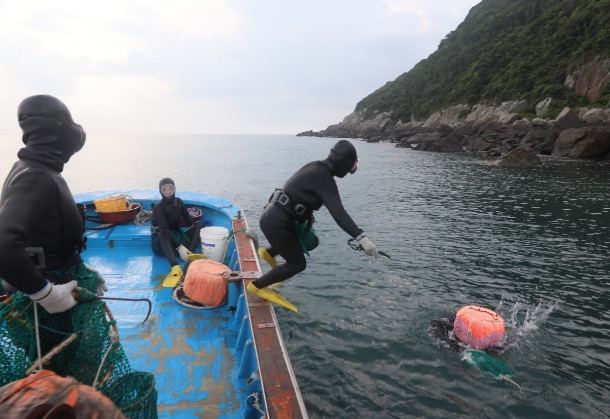
Haenyeo are women who dive into the sea without breathing apparatus, relying solely on breath-hold diving to harvest marine products such as seaweed and shellfish. Beyond the distinctive nature of their labour, haenyeo communities are also valued for their collective culture and women-centered social organization. Haenyeo typically work from spring to autumn, particularly during the summer months, although many continue diving even during the cold winter season. In general, haenyeo dive to depths of around five meters and work underwater for approximately thirty seconds before resurfacing; however, when necessary, they may dive to depths of up to twenty meters and remain underwater for more than two minutes. For this reason, their work is often described as taking place at the boundary between life and death.
Although many haenyeo have historically worked across Korea’s coastal and island regions, their population is rapidly aging, and their numbers are steadily declining, raising increasing concerns about the transmission of this tradition. While haenyeo are widely associated with Jeju Island, female divers have also been active along the southwestern coast of the Korean Peninsula and in many island fishing communities.
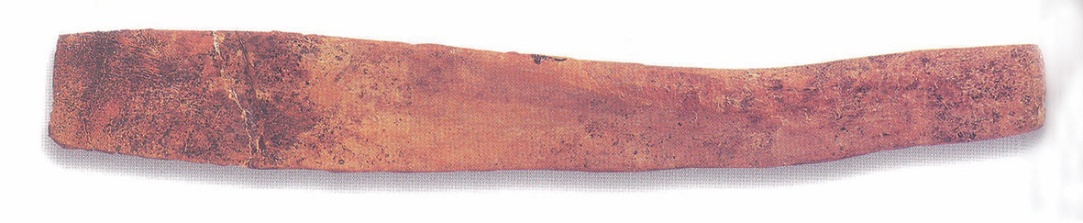
Archaeological evidence suggests that the history of haenyeo practices may extend far back in time. At the Gun-gok-ri shell midden site in Haenam (Jeollanam-do), dating from the Iron Age (ca. 2nd century BC to 3rd century AD), archaeologists discovered a bone tool known as a ‘bitchang’, which was used to harvest abalone. This tool closely resembles the ‘bitchang’ still used by contemporary haenyeo. The excavation also revealed numerous abalone shells, indicating that abalone harvesting had already been practiced in this region from an early period.
During the modern era, Jeju haenyeo expanded their activities beyond Jeju Island to the Korean mainland and other parts of East Asia, and many eventually settled in coastal communities of the peninsula. However, archaeological findings such as those from the Gun-gok-ri shell midden suggest that indigenous female divers may have already existed in the island regions of the West and South Seas prior to the expansion of Jeju haenyeo.

Haenyeo embody the collective sentiments and shared understandings of their communities, and thus possess significant cultural value. The collective transmission structure centered on local haenyeo fishing cooperatives (haenyeo fishing village associations)has been recognized as a key element of this tradition. As a result, in 2017, the practice of “Haenyeo” was designated as a National Intangible Cultural Heritage of Korea, ensuring its preservation and transmission. In addition, “Jeju Haenyeo Culture” was inscribed in 2016 on the UNESCO Representative List of the Intangible Cultural Heritage of Humanity.
The UNESCO inscription encompasses a range of cultural elements associated with haenyeo culture, including the women’s community that harvests marine products by diving without breathing apparatus; muljil (breath-hold diving practices); the sumbisoribreathing sound made when divers resurface; bulteok (communal spaces where haenyeo gather and rest); seasonal rituals and customs; and systems of knowledge transmission. These elements demonstrate that haenyeo culture is not merely a fishing technique but a form of cultural heritage that integrates women’s labour, community organization, and marine ecological knowledge. The inscription thus represents an international recognition of the distinctiveness and continuity of the Korean haenyeo community.
By engaging in livelihood activities that adapt to natural conditions and protect marine resources, haenyeo communities have long maintained environmentally friendly and sustainable labour practices. Through these practices, they have played an important role in marine conservation and the pursuit of sustainable fisheries.
Although the majority of haenyeo are concentrated on Jeju Island, they are also distributed along various coastal areas and islands of the Korean Peninsula. Despite the cultural and historical significance of the labour practices and communal traditions of haenyeo, their population has been steadily declining. At one time, the number of haenyeo exceeded 20,000, but today it has fallen to fewer than 3,000.
This raises an important question: why has the tradition not yet disappeared? Even though haenyeo work is dangerous and physically demanding, the practice continues to be maintained by a small number of practitioners. Who, then, is sustaining this tradition?
The voices of haenyeo themselves provide insight into this question:
- Haenyeo A: “I have no other skills, so I have no choice but to go into the sea.”
- Haenyeo B: “The sea feels more familiar to my body than the land.”
- Haenyeo C: “If I go to the sea, I can at least earn enough for my daily expenses.”
As the haenyeo population continues to age, the number of practitioners within haenyeo communities is declining. In many remote and isolated island regions, the influx of younger generations is particularly limited. If the current divers cease their activities, there is a real possibility that the tradition may disappear. Nevertheless, the practice has not yet vanished.
Importantly, the continuity of haenyeo heritage cannot be explained simply by its designation as cultural heritage. Rather, its persistence is closely linked to the fact that many elderly haenyeo continue diving in order to sustain their livelihoods. In other words, the tradition persists not primarily because it is institutionally recognized as heritage, but because the divers themselves continue to perform acts of self-care and livelihood maintenance despite their advanced age.
It is therefore necessary to recognize that the continuity of haenyeo heritage is not sustained solely through heritage transmission. Instead, it is maintained through the everyday practices of care performed by aging divers who continue to work out of necessity.
Drawing on the traditional knowledge they have accumulated through years of observation and practice, haenyeo enter the cold, deep, and often frightening waters of the sea. Although climate change has reduced marine yields in recent years, the sea still contains various resources that can be harvested. In principle, these resources remain accessible to those who are capable of performing muljil diving practices.
For many elderly haenyeo—often living alone in single-person households—diving remains an essential economic activity. Through this labour, they perform acts of self-sustaining care, supporting their own livelihoods while simultaneously sustaining the heritage embedded in their practices.
1) Embodied Care
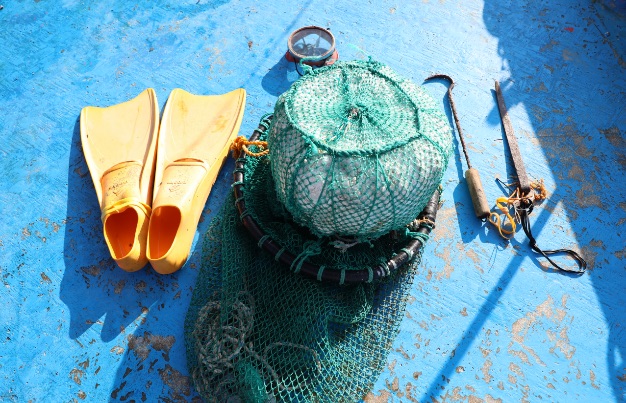
Care among haenyeo is most visibly manifested in embodied labour practices. The techniques and working methods of muljil (breath-hold diving) require a high level of expertise, and divers must regulate their diving time according to differences in skill levels. Because diving involves significant risks, strict safety norms must also be observed. Since the labour itself is performed through the body, haenyeo make efforts to adhere to collective work rules and labour ethics. In addition, resource management practices—such as avoiding the harvesting of immature specimens—demonstrate community-based efforts to regulate marine resources in order to sustain ongoing diving activities. In this sense, haenyeo practices represent not merely the extraction of resources but a form of care that simultaneously involves managing both marine resources and their own bodies.
2) Community Care
Haenyeo culture is sustained not through individual labour alone but through systems of communal cooperation. The bulteok—a communal resting space where haenyeo warm their bodies and rest after emerging from the cold sea—functions as an important cultural institution within the community. It serves as a space for exchanging information before and after diving, sharing rescue practices in cases of danger, and learning collective regulations such as rules governing the use of fishing grounds. These social networks demonstrate that haenyeo heritage persists as a cultural practice embedded within social relationships.
3) Ecological Care
Haenyeo activities incorporate ecological knowledge and resource management practices accumulated over generations. Divers coordinate harvesting periods and observe closed seasons (geumchae-gi) while also protecting certain species through selective harvesting practices. Through these activities, they manage fishing grounds and respond to ecological changes in the marine environment. This reveals that haenyeo are not merely labourers extracting marine resources but actors who actively participate in the stewardship of marine ecosystems.
Chisholm Hatfield and Hong (2019) analyze the traditional ecological knowledge (TEK) accumulated by Korean haenyeo and examine how climate change has affected their ecological environment and livelihoods. They emphasize that haenyeo are not merely divers engaged in manual labor, but knowledgeable actors who have long understood and managed marine ecosystems.
4) Care of Knowledge and Transmission
Haenyeo culture is sustained through knowledge transmission based primarily on field-based experience rather than formal educational institutions. Learning occurs through interactions between senior and junior divers, functioning as a mechanism for transmitting diving techniques and knowledge of the sea. Through working and living together, practitioners naturally acquire work norms and ethical principles. However, in recent years, the aging of practitioners and the decline in new entrants have produced a post-transmission condition, in which the intergenerational transmission of knowledge has weakened. Even under these conditions, the very process through which haenyeo heritage continues to persist can be understood as a practice of care.
5) Institutional Care
In recent years, the haenyeo heritage has increasingly been managed through various policies and institutional frameworks. Local governments have introduced support measures—such as subsidies for medical expenses and the provision of diving suits—through local ordinances aimed at protecting haenyeo and facilitating the transmission of their practices. However, institutional safeguarding alone does not guarantee the continuity of heritage. The relationship between institutional protection and the everyday labour of care performed in the field, therefore becomes an important subject of analysis. Although policy support for Jeju haenyeo has become relatively prominent following their inscription on UNESCO’s Intangible Cultural Heritage list, in many other local governments, practical policies for the protection and support of haenyeo remain insufficient.
6) Ethical and Identity-Based Care
For haenyeo, diving is not merely a livelihood activity but is deeply connected to ways of life and cultural identity. The value of “living with the sea” shapes their worldview, while the dangerous nature of their working environment fosters strong communal responsibility among fellow divers. In addition, the dignity of women’s labour is reflected in their roles as economic providers and family members within island communities. This dimension demonstrates that haenyeo heritage encompasses not only economic practices but also broader ethical and cultural systems of meaning.
4.2 From Transmission to Endurance and Persistence
In conventional narratives of tradition, haenyeo culture is described as being transmitted from “mother” to “daughter.” For generations, traditional knowledge and diving skills (muljil) were passed down from grandmothers to mothers, and then to daughters and granddaughters. In reality, however, the daughters have largely left, leaving only the mothers’ generation behind. During the processes of industrialization and the accompanying urbanization, rural and fishing communities experienced a significant decline in population, resulting in widespread underpopulation. This demographic decline has been particularly pronounced in island regions. Younger generations have tended to avoid settling in these areas due to educational and employment opportunities elsewhere, leading to a weakening of transmission and a sharp decline in the number of haenyeo. As a result, the underwater workspace is now largely occupied by aging divers, while the skills and knowledge of ‘muljil’ are no longer effectively passed on. Transmission did not abruptly cease; rather, it gradually transformed into a condition characterized by endurance and persistence.
Haenyeo continue to engage in daily routines that sustain their diving practices. They regularly maintain and repair their diving suits and equipment without missing a single day. Similarly, they continue to observe communal norms and regulations. Both the maintenance of equipment and adherence to community rules are matters directly connected to survival, as diving is a highly dangerous activity. Because they cannot simply stop working—even as their bodies experience fatigue and injury—they continue to practice everyday forms of care. From this perspective, these activities should be interpreted not as mere cultural representation, but as care practices.
At the same time, contemporary conditions—particularly in remote island regions—such as population aging, declining income, and climate change, suggest that such practices of care may become increasingly unsustainable. Although these conditions ideally require institutional support from the state or policy frameworks, care itself has often remained located outside institutional structures. Heritage may be protected and designated, but there may no longer be practitioners capable of sustaining and transmitting it.
Ultimately, heritage does not persist simply because it is protected; rather, it persists because someone continues to care for it. While traditions and heritage are often assumed to endure because they have been safeguarded, it is important to recognize that behind this continuity lie the ongoing acts of care performed by individuals. Livelihood-based heritage, therefore, has been sustained precisely because haenyeo—its practitioners and caretakers—have continued to carry it forward. For this reason, haenyeo heritage can be understood as a living heritage, sustained through the everyday practices of care performed by those who depend on it for their livelihoods.
5. Discussion: Reconfiguring Heritage Theory through Care
This study makes three theoretical contributions to heritage research.
- Conceptual Contribution.
First, it introduces heritage as care as a core analytical framework for understanding the persistence of heritage under conditions where transmission has weakened. - Empirical-Theoretical Contribution.
Second, it demonstrates that livelihood-based heritage challenges the transmission-centered model that has long dominated intangible heritage theory. - Geographical Contribution.
Third, it positions East Asian island contexts not merely as empirical case studies but as sites capable of generating theoretical insights.
The case of Korean haenyeo should not be understood as an exceptional phenomenon; rather, it reflects structural conditions that are becoming increasingly common in aging and marginalized regional communities. In this sense, East Asia should not be viewed as a peripheral site of theoretical application but as an important locus of theoretical production.
The haenyeo case clearly reveals the analytical limitations of management-centered heritage frameworks. Heritage designation, safeguarding plans, and participation mechanisms continue to be regarded as central elements of institutional heritage practice. However, they provide insufficient explanations for why heritage continues to exist in contexts where transmission has weakened and participation is no longer sustainable. In the case of haenyeo, the persistence of heritage is not produced through effective governance or collective mobilization. Rather, it is sustained through the everyday endurance and persistence of practices repeatedly performed by aging practitioners. This suggests that the continuity of heritage cannot be explained solely through institutional capacity. Instead, when the pathways of transmission are no longer effective, it becomes necessary to focus on the forms of labour, obligation, and attachment that continue to sustain heritage practices. When care rather than management is placed at the center of analysis, the persistence of heritage can be reinterpreted not as a process governed primarily through policy interventions but as one unfolding within unevenly distributed responsibilities.
Conceptualizing heritage as care also enables the theorization of what may be called a post-transmission condition of heritage. Under this condition, heritage does not persist because it is reproduced or learned by the next generation; rather, it persists because those who remain continue to actively maintain it. The case of haenyeo illustrates how care can gradually replace transmission, transforming the persistence of heritage from a matter of cultural reproduction into a question of ethical responsibility. This shift carries important theoretical implications. It challenges the assumption that heritage sustainability primarily depends on successful transmission and instead highlights the moral and temporal dimensions of persistence that emerge under conditions of decline. Understanding post-transmission heritage through the lens of care, therefore, opens new analytical perspectives for examining the future of heritage in contexts increasingly characterized by population aging, demographic decline, and the weakening of livelihood-based practices across many regions of the world.
From this perspective, East Asian island contexts should not be treated as marginal or exceptional cases within global heritage discourse. Rather, these regions reveal structural dynamics that have been insufficiently theorized in heritage studies, particularly the reliance on care-based practices under conditions of demographic aging and limited institutional support. By approaching such contexts not merely as empirical examples but as sites of theoretical production, this study contributes to decentering Eurocentric assumptions in heritage theory—assumptions that often presuppose stable transmission, strong community capacity, and robust institutional support as the basis for heritage continuity.
6. Conclusion
Haenyeo heritage persists not simply because it is protected, but because it is sustained through practices of care—often at considerable personal burden and sacrifice.
This article has argued that existing heritage theories remain insufficient for explaining how cultural heritage persists under conditions where transmission has weakened and institutional support is limited. Drawing on ethnographic research on haenyeo communities in the island regions of South Korea, this study proposes the concept of heritage as care as a theoretical framework. In doing so, it shifts analytical attention away from management- and safeguarding-centered approaches toward the everyday endurance and practices through which heritage continues to exist. Rather than treating heritage persistence as a matter of cultural reproduction or effective governance, this framework foregrounds care as embodied, relational labour imbued with ethical tensions that sustain heritage under conditions of precarity.
The haenyeo case illustrates a post-transmission condition in which heritage is not reproduced through learning and intergenerational succession but is instead maintained through the continued commitment and practices of aging practitioners. By conceptualizing this persistence as care, this article challenges the transmission-centered model of intangible heritage and reveals the uneven structures of responsibility embedded in the continuity of heritage. In this perspective, sustainability is reframed not as the success of institutional policies but as an ethical question concerning who bears the costs and responsibilities of maintaining heritage.
Theoretically, this study contributes to heritage scholarship by positioning care as a key analytical category for understanding the persistence of heritage under conditions characterized by demographic aging, the weakening of livelihood-based practices, and regional marginalization. Empirically, it demonstrates that East Asian island communities should not be understood merely as sites of empirical application but as important spaces of theoretical production capable of reshaping broader debates in heritage studies.
Understanding heritage through the lens of care opens new analytical possibilities for examining the future of heritage in a world where continuity increasingly depends less on transmission than on endurance and persistence. At the same time, it also suggests that the limits and burdens placed upon care itself must become a subject of critical scrutiny.
Acknowledgements
This research was supported by the Humanities Korea Plus (HK+) Project of the National Research Foundation of Korea (Grant No. 2020S1A6A3A01109908).
References
- Askew, M., 2010. The magic list of global status: UNESCO, World Heritage and the agendas of states. Heritage and Globalisation (Edited By Labadi, S,. Long,C). Routledge. https://doi.org/10.4324/9780203850855
- Chisholm Hatfield, S., Hong, S.-K., 2019. Mermaids of South Korea: Haenyeo (Women Divers) Ttraditional ecological knowledge, and climate change impacts. Journal of Marine and Island Cultures 8(1):1-16. DOI:10.21463/jmic.2019.08.1.01
- Marilena, A., 2011. Intangible Heritage and Erasure: Rethinking Cultural Preservation and Contemporary Museum Practice. International Journal of Cultural Property 18(1):37-60. DOI:https://doi.org/10.1017/S094073911100004X
- Harrison, R., 2013. Heritage: Critical Approaches. London: Routledge. https://doi.org/10.4324/9780203108857
- Harrison, R., Bartolini, N., DeSilvey, C., Holtorf, C., Lyons, A., Macdonald, S., May, S., Morgan, J., Penrose, S., 2016. Heritage Futures. Archaeology International 19(1): 68–72. DOI: https://doi.org/10.5334/ai.1912
- Harrison, R., Holtorf, C., 2019. Heritage Futures: Comparative Approaches to Natural and Cultural Heritage Practices. International Journal of Heritage Studies 25(4): 339–346. https://doi.org/10.1080/13527258.2018.1530289
- Hong, S.-K., Grydehøj, A., 2022. Sustainable island communities and fishing villages in South Korea: Challenges, opportunities and limitations. Sustainability 14(24): 1-15(16657). https://doi.org/10.3390/su142416657
- Kirshenblatt-Gimblett, B., 2004. Intangible Heritage as a Metacultural Production. Museum International 56: 52–65. https://doi.org/10.1111/j.1350-0775.2004.00458.x
- McCall, G., 1994. Nissology: The study of islands. Journal of The Pacific Society 17(2-3): 1-14 http://hdl.handle.net/1959.4/38278
- Smith, L., 2006. Uses of Heritage. London: Routledge. https://doi.org/10.4324/9780203602263
- Smith, L., 2012. Discourses of heritage: Implications for archaeological community engagement. Nuevo Mundo Mundos Nuevos: 1-10. https://doi:10.4000/nuevomundo.64148
- Smith, L., Waterton, E., 2012. Constrained by Commonsense: The Authorized Heritage Discourse in Contemporary Debates. The Oxford Handbook of Public Archaeology. DOI:10.1093/oxfordhb/9780199237821.013.0009
- Waterton, E., Smith, L., 2010. The Recognition and Misrecognition of Community Heritage. International Journal of Heritage Studies 16(1–2): 4-15. https://doi.org/10.1080/13527250903441671