The La Palma Mini-Series, Mega-Tsunami Media-Lore and Island Volcano Tourism
 10.21463/jmic.2026.15.1.08
Abstract
This article analyses the potential for a so-called ‘mega-tsunami’ to be generated by volcanic eruptions on La Palma in the Canary Island archipelago. It analyses the intersection of scientific research and media representation that created the ‘media-lore’ of the mega-tsunami in the early 2000s, the scientific rebuttal and remodelling that followed and the persistence of the myth in popular media that peaked with the 2024 Netflix drama mini-series La Palma. The article identifies the series as a further recirculation of the modern myth of archipelagic disaster and considers the way that such stories become self-sustaining, affecting perceptions of islands in the process. The relationship between this accumulating discourse and the more grounded development of volcano tourism on La Palma is somewhat complex and our discussion involves consideration of the lure of geo-precarity and the manner in which official Spanish and Canarian agencies have successfully utilised interest in and publicity concerning volcanic activity on the island. The article thereby illustrates the complexities of volcanicity as a resource and intricacies of brand imaging La Palma as an appealing destination at the same time as fictional representations about it generating mega-tsunamis circulate in streaming services and on social media.
Keywords
catastrophe, island volcanicity, tourism, tsunami, La Palma
1. Introduction: The Canary Islands, volcanicity and volcano tourism
The Canary Islands are a volcanic archipelago located 96 km off the Atlantic Saharan coast at latitude 28ºN and comprises seven major islands, from East to West: Lanzarote, Fuerteventura, Gran Canaria, Tenerife, La Gomera, La Palma and El Hierro, four minor islands: Alegranza, Montaña Clara, La Graciosa and Lobos and several rocky islets. In aggregate, the Canary Islands cover c. 7,500 km2 and have a maximum elevation of 3718 metres on the Teide peak on Teneriffe. Despite their short distance from the African continent, the islands have never been connected with the African mainland. The oldest emerged rocks (24 Ma) are located in Fuerteventura, whereas La Palma (1.5 My) and El Hierro (1.0 My) are the youngest islands. The first inhabitants of the Canaries were a population of North African Berber origin who appear to have arrived on the islands in waves in the 2nd Century CE (Santana et al., 2024). The group is known generically as the Guanche but the different communities, developed marked characteristics and dialect variations in the centuries following their arrival and prior to colonisation by Castile[1] during the 15th century. The islands subsequently became part of modern Spain and now constitute a comunidad autónoma (autonomous region) within it with their own government, parliament and court, and with twin capitals, Las Palmas de Gran Canaria and Santa Cruz de Tenerife. The islands are home to some 2.5 million residents (known as Canarios), and receive c. 16 million tourists a year, mainly from the UK, Germany, Scandinavian countries and the Spanish mainland, with mass tourism, centred on Teneriffe, Gran Canaria, Lanzarote and Fuerteventura, being the main economic activity of the archipelago (Fernández-Palacios and Fernández-Palacios, 2023) followed by agriculture. The smaller islands of La Palma, La Gomera and El Hierro offer more niche tourism offerings centred on the natural environment and hiking. Volcanicity has always been a prominent aspect of the archipelago, and the major events that were recorded following the Castilian acquisition of the archipelago in the 15th century have taken place on four islands: Lanzarote, Tenerife, El Hierro and La Palma, with La Palma accumulating up to eight of the 16 historical eruptions in the archipelago, three of which occurred in the last 75 years: San Juan, 1949; Teneguía, 1971 and Tajogaite, 2021.
Physical landscapes, their distinct landforms, types of rock and/or geo-thermal or aquatic elements have long exerted a fascination on travellers and tourists, with sites such as the UK’s Lake District or the US Yellowstone National Park being well-established centres of visitation. The value of such sites was recognised in UNESCO’s ‘Convention concerning the protection of the world natural and cultural heritage’ (UNESCO, 1972), with category viii specifying that “outstanding examples representing major stages of Earth's history, including the record of life, significant on-going geological processes in the development of landforms, or significant geomorphic or physiographic features” were eligible for recognition and inscription as world heritage assets.[2] In the last thirty years, the increasing recognition of the value of such sites has been expressed through the concept of geoheritage and visitation to such sites for enjoyment of that heritage has come to be categorised as geotourism. UNESCO’s Geopark program[3] is the most high-profile promotion of geoheritage assets. These geoparks are officially recognised areas of internationally significant geology within which sustainable development is encouraged — including tourism, conservation, education and research concerning not just geology but other relevant sciences. Two UNESCO Geoparks exist in the Canarian archipelago: El Hierro, declared in 2014 and Lanzarote and its islets, declared in 2015. But despite its appropriateness as an active volcanic area, La Palma has not so far not been listed by UNESCO within its Geopark program.
The volcanicity of geoparks and other geotourism sites has double edge. On the one hand, volcanicity (at least when it is manifest in reasonably predictable circumstances) can constitute an attraction for those open to it. In this regard, volcano tourism may be understood as a subset of geotourism in which awe and appreciation of the physical landscape is accompanied by an increased sense of the power of natural processes and of the precarity of humans in such locations. Dependent on the nature of the volcanic phenomenon being visited and the proximity that might be gained, the risk-taking element may well be an integral element of the experience, leading it to fall within the broader category of extreme tourism (Touchard, 2024). On the other, even within contexts where volcanic activity already occurs, sudden and large-scale eruptions can temporarily reduce the volume of visitors coming until they assume more predictable patterns. But, as Hernández-Ramos et al. have identified:
major disruptions in tourism often become opportunities, as in the case of the emergence of new tourism products that diversify leisure offerings at the site of the disruption. This is achieved through the creation of innovative experiences that set destinations apart as unique on the basis of their local heritage. The sustainable use of tourist attractions and resources associated with natural and cultural heritage underpin the creation of these tourist products. In the case of the island of La Palma, the devastating negative effects of the [2021] eruption have contributed to further strengthen sustainable tourism activities related to its volcanic heritage. (our emphasis). (Hernández-Ramos et al., 2024: 102)
Hernández-Ramos et al. (2024) identify three periods of volcano tourism on La Palma:
- Pre-2021: “when an incipient geotourism industry was being developed in connection with the volcanic eruptions of San Juan and Teneguía,” in 1949 and 1971 respectively (2024: 48).
- The Tajogaite 2021 volcanic eruption: while the volume of tourists dropped sharply during the early days of the Tajogaite eruption, which resulted in facilities being destroyed and closures of resorts and the airport, a surge of visitors followed, mainly from Teneriffe, other Canary Islands and mainland Spain) during the (more stable) mid-stage of the eruption before tailing off as the eruption subsided (2024: 49–50).
- After the 2021 volcanic eruption: realising the potential attraction of the recently active sites on La Palma to foreign and domestic tourists, local and national government agencies produced geotourism maps of active areas, established geotourism courses for guides, virtual geotrails using fieldwork and drone video material, guided footpaths with signed viewing points and the Cumbre Vieja Volcano visitor centre. (2024: 51).
Reflecting the trajectory outlined above, in recent years — i.e. 2021–2025 — volcano tourism has become an increasing prominent aspect of La Palma’s tourism portfolio.
2. Volcanic islands and catastrophic collapses
Mythologies of the catastrophic collapse of islands, and/or of the impact these have on adjoining bodies of land arising from tsunamis abound in a variety of cultures. In terms of the Noth Atlantic — the area profiled in this article — the best known, if much disputed,[4] example is that of the ‘lost,’ i.e. supposedly fragmented and subsided, island of Atlantis referred to by the ancient Greek writer Plato. One location that has been proposed for the fabled island is the area now known as Macaronesia, comprising the Canary, Azores, Madeira and Cabo Verde islands.[5] Indeed, this geographical attribution has been regularly refreshed by various studies of and theories about various Macaronesian islands and/or their subsurface features.[6] Most recently, Spanish geologist Luis Somoza, leader of a marine geological survey expedition exploring submarine volcanoes in the Canaries, reported to various press sources (e.g., Osborne, 2024) that a group of sunken islands located on a seamount may have inspired the myth of Atlantis despite the estimated 34–56 million year interval between their having subsided and Plato’s literary inscription of the Atlantis tale. This led to sensationalist international press coverage, with the UK Daily Express, for instance, publishing a report under the banner headline “Huge Canary Islands discovery as mystery of real-life Atlantis could finally be solved” (Piercy, 2024). Despite the improbability of the association and the highly tangential nature of such speculation to the geological survey’s otherwise sober scientific research the expedition team named the sunken islands ‘Los Atlantes,’ thereby further perpetuating the connection.
The volcanicity of the Canary Islands and, thereby, their implicit instability and unpredictability (Troll and Carracedo, 2016) is a key factor underlying their association with Plato’s mythological island and its sudden and calamitous submergence. The Cumbre Vieja volcanic ridge along La Palma has attracted particular concern due to numerous active craters and cones along its central ridge and the recent history of major eruption events. More broadly speaking, islands, volcanicity and tsunamis have been closely associated over the last 150 years, particularly since the eruption of Krakatoa in present-day Indonesia, generally regarded as one of the largest volcanic events over the last 4,000 years (Mutaqin et al., 2018). There is also a body of speculative literature that links the submergence of Atlantis to tsunamis created by earthquakes and related volcanic activity on nearby islands. This is particularly prevalent with regard to the attribution of Atlantis to Mediterranean locations such as Santorini or Crete or the Spartel Bank in the Straits of Gibraltar (see, for instance, Lilley, 2007 and Gutscher, 2005). In this context, research by US scientist Steven N. Ward and British scientist Simon Day that projected that a collapse of the Cumbre Vieja ridge would result in a massive tsunami conformed to a pre-established trope and was seized upon by media reporters in 2000 prior to its publication in a scientific journal (Ward and Day, 2001)
3. 2000–2001: Imagining an imminent catastrophe
The nub of the research and predictions that created the modern myth of La Palma’s imminent catastrophic slope collapse is concisely summarised in the abstract to Ward and Day’s article, ‘Cumbre Vieja Volcano—Potential collapse and tsunami at La Palma, Canary Islands,’ published in the journal Geophysical Research Letters:
during a future eruption, Cumbre Vieja Volcano on the Island of La Palma may experience a catastrophic failure of its west flank, dropping 150 to 500 km³ of rock into the sea. Using a geologically reasonable estimate of landslide motion, we model tsunami waves produced by such a collapse. Waves generated by the run-out of a 500 km³ (150 km³) slide block at 100 m/s could transit the entire Atlantic Basin and arrive on the coasts of the Americas with 10–25 ft (3–8 m) height. (Ward and Day, 2001: 3397)
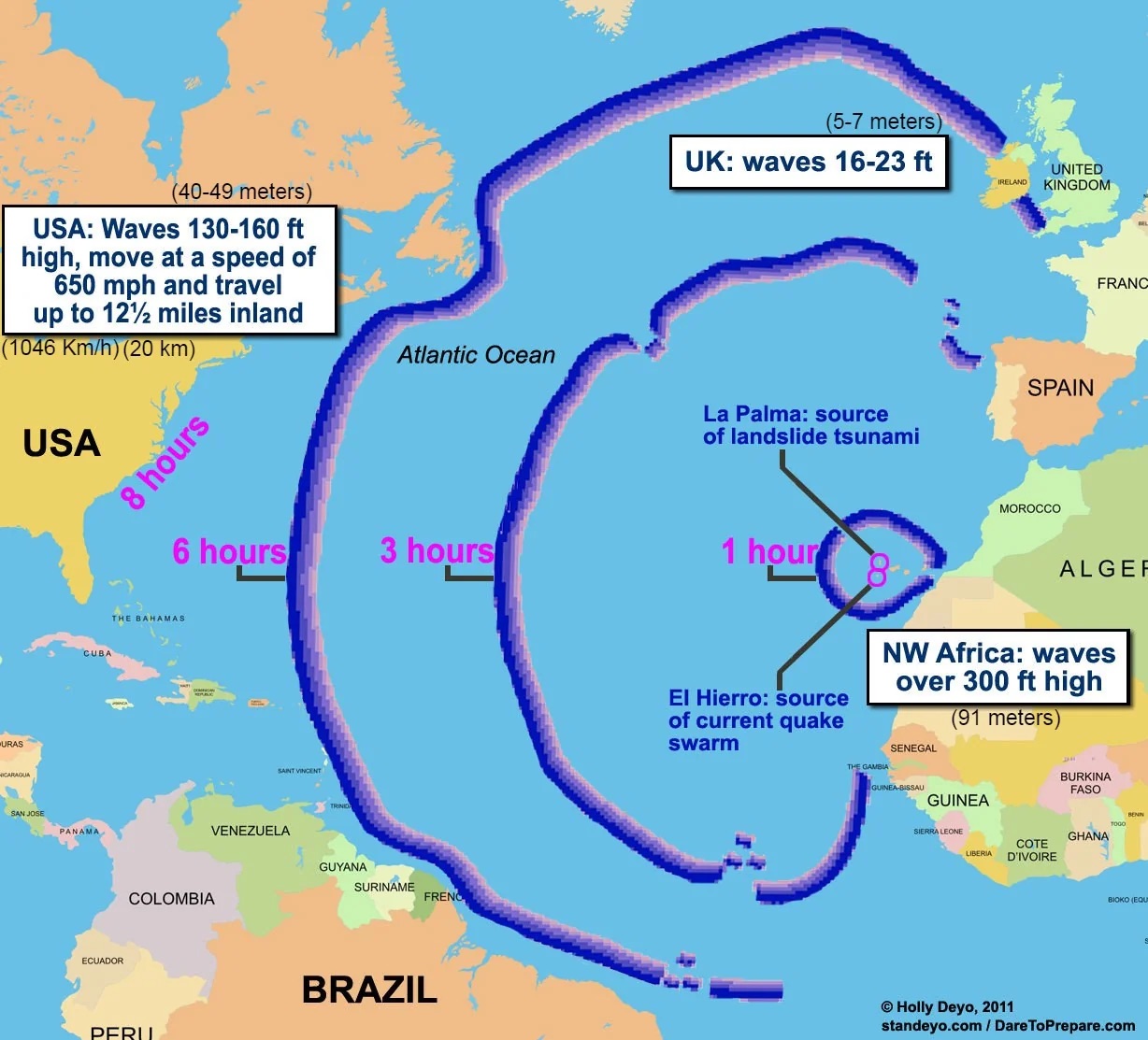
Despite caveats (“may experience…”, “reasonable estimate, “could transmit” etc. — our emphases), the scenario attracted attention on account of the wide spread of damaging tsunami fronts across the North Atlantic that they predicted. The projected oceanic disturbance was also vividly represented in various cartographic representations, such as Figure.[7] Subsequent to publication of Ward and Day’s predictions, two events occurred that reminded the global public that sudden tsunamis are very real possibilities: the December 2004 earthquake in the eastern Indonesian archipelago that set off a tsunami across the Bay of Bengal and the Tōhoku tsunami event in north-eastern Japan in March 2011, which swamped the Fukushima nuclear plant and surrounding areas. These indirectly bolstered the credibility of the Cumbre Vieja collapse scenario and raised concerns that have continued despite a series of scientific papers that have critiqued Ward and Day’s methods and the scale of event that they predicted. Writing in the journal Science of Tsunami Hazards, for instance, George Pararas-Carayannis, the journal’s editor, evaluated Ward and Day’s projections and similar claims about Hawai’i’s Kilauea volcano, and asserted that:
Recent numerical modeling studies, forecasting mega tsunami generation from postulated, massive slope failures… have been based on incorrect assumptions of volcanic island slope instability, source dimensions, speed of failure and tsunami coupling mechanisms. Incorrect input parameters and treatment of wave energy propagation and dispersion, have led to overestimates of tsunami far field effects. (Pararas-Carayannis, 2002)
Commenting on sensationalist media coverage, he continued:
Inappropriate media attention and publicity to such probabilistic results have created unnecessary anxiety that mega tsunamis may be imminent and may devastate densely populated coastlines at locations distant from the source [but] the threat of mega tsunami generation from collapses of oceanic island stratovolcanoes has been greatly overstated. No mega-tsunamis can be expected. (Pararas-Carayannis, 2002)
Subsequent studies — such as Løvholt et al., (2008) and Abadie et al. (2012) — have tended to favour Pararas-Carayannis’s far more moderate modelling.[8] Hunt, Wynn, Talling et al.’s (2013) report on their research on seafloor deposits left by local slope collapses is also significant for identifying a historical pattern of small-scale slippage that would only produce modest tsunami events. Nevertheless, as a report for the US National Tsunami Hazard Mitigation Program concluded that should a substantial collapse at the worst end of the anticipated range eventuate, the results “would still be formidable and devastate the Canary Island [i.e., La Palma], while causing major impact in the far-field at many locations along both the western European and US east coasts” (Tehranirad, Harris, Grilli et al. 2005: 2389). Despite these dissenting publications, many media representations of the issue have continued to foreground extreme catastrophic scenarios.
4. La Palma, mega-tsunamis and audiovisual media
Three media productions exemplify both the adherence to Ward and Day’s initial study and the key aspects of the Disaster Film (DF) genre in both speculative quasi-documentary and fiction form. This genre has a variety of themes, including what has become known as ‘cli-fi,’ concerning the results of meteorological phenomena, such as Twister, 1996 and its 2024 remake, and, increasingly, global warming related phenomena, such as The Day after Tomorrow, 2004 and Blind Sun, 2015. The genre often has a predictive aspect, showing potential worst-case scenarios, and producers, publicists and critics are prone to identifying the informative function of such works. Indeed, the American Academy Museum of Motion Pictures’ January 2024 event ‘Beware the elements! Natural disasters on film,’ which combined screenings and live discussions with scientists, was introduced online with in the following terms:
Naturally, we see our fears reflected in cinema, especially in the case of the so-called “disaster film”… In considering natural disaster films and the scientists who intervene within them, we can use cinema to envision a world in which humans can harness the elements, tame nature, and save the day… This screening series considers natural disasters through our planet’s primary elements—earth, wind, water, and fire—and seeks to highlight key moments in the history of the disaster film genre as a source of entertainment and portrayal of science, and as a tool to raise our collective consciousness about science-based solutions to the mounting global climate crisis. (American Academy Museum of Motion Pictures, 2024)
There have also been a number of disaster themed TV films and mini-series such as Supervolcano (2005) and Japan Sinks (2020) and, most relevantly for this article, the 2004 US mini-series 10.5 and its 2006 sequel 10.5: Apocalypse. The first depicts the impact of a catastrophic earthquake that registers 10.5 on Richter scale on the west coast of North America and causes a massive tsunami across the Pacific.[9] 10.5 Apocalypse ups the ante and ends with as a massive fault opening up across the middle of the North American continent that fills with water and divides into two halves.
While the following productions were all publicised as documentaries — rather than Disaster fictions — they share many similarities with the DF genre and collectively constitute an example of what has been termed ‘media-lore’ i.e. the creation and/or elaboration of a scenario within modern audio-visual media that can be understood as a modern folk of folklore (Russian Laboratory of Theoretical Folkloristics, 2104).
a) BBC Horizon — Mega-tsunami: Wave of Destruction (2000)
The dramatic title of the 50-minute long BBC documentary Mega-tsunami: Wave of Destruction clearly indicates its approach, which is far from the more sober balance once associated with BBC Science broadcasting (and with the Horizon series it was broadcast as an episode of). Indeed, the program’s title alone is more in line with late 1990s fictional disaster films and TV series, such as Deep Impact (1998) or Aftershock: Earthquake in New York (1999), than conventional TV science documentaries on geo-physical phenomena. With regard to the title, Goff, Terry, Chagué-Goff and Goto (2014) identify that the term mega-tsunami emerged in scientific literature in the early 1990s but remained obscure until it was taken up and disseminated by the producers of the eponymous BBC TV series. The authors also identify that early uses were somewhat vague:
Recent years have seen the term mega-tsunami being used increasingly in association with waves generated by ocean-island flank collapse and the emplacement of high elevation coastal boulder deposits… Yet much of this work has either ignored the need for any definition or offered only an arbitrary one to fit the specific discussion at hand. Clearly, the lack of an accepted definition for mega-tsunami combined with the potentially sensational nature of the term itself is undesirable. (Goff, Terry, Chagué-Goff and Goto, 2014)
Appropriately, in the light of Goff, Terry, Chagué-Goff and Goto’s comments, the BBC program’s publicity material (2000) carefully explained its use of the term as follows:
A megatsunami is a very large wave created by a large, sudden displacement of material into a body of water. Megatsunamis have quite different features from other, more usual types of tsunamis. They can have extremely high initial wave heights of hundreds and possibly thousands of metres, far beyond any ordinary tsunami. Ordinary tsunamis have shallow waves out at sea, and the water piles up to a wave height of up to about 10 metres (33 feet) as the sea floor becomes shallow near land. By contrast, megatsunamis are caused by giant landslides and other impact events. This could also refer to a meteorite hitting an ocean. Underwater earthquakes or volcanic eruptions do not normally generate such large tsunamis, but landslides next to bodies of water resulting from earthquakes can, since they cause a large amount of displacement. (BBC 2000)
This definition substantially accords with the series producers’ consultation with Ward about his research on La Palma’s Cumbre Vieja volcano following their familiarisation with the researchers’ emerging predictions about the catastrophe that might follow a substantial slope collapse.[10]
The initial part of the Horizon program includes extracts from film of the 1949 eruption and an introduction to the volcanicity and instability of La Palma provided by University of London professor Bill McGuire before it describes the threat posed by a substantial rift opening along the central to southern end of the island, leading it narrator to characterise that “ever since 1949 the peaceful island of La Palma has been a time-bomb.” Building on this, she comments that “some scientists believe that today another eruption could send five hundred cubic kilometres of it crashing into the sea; a colossal landslide with enough energy to generate the biggest wave humanity will have ever seen” and characterising the latter as “the first mega-tsunami in recorded history.” This dramatic characterisation, uttered over footage of giant waves, sums up the overall program and drives its speculative point home with further comments referring to the tsunami’s supposed ability to cross the Atlantic at “the speed of a jet aircraft”, “ready to make landfall with potentially apocalyptic results”. Following this introduction, the program provides a brief predictive sequence of the five days before a major eruption that shows holiday makers enjoying their vacations intercut with increasing signs of volcanic activity before “in one instant, a whole section of the island is dislodged, breaking it up as it falls, an entire mountainside plunges into the sea.” The video then switches to computer visualisations of peak wave height at point of impact, which McGuire comments could be “more than two Empire State buildings on top of one another” (i.e., 760 metres in height), with catastrophic effects on the other islands of the archipelago and then on the coastlines of Africa, Europe and North America. Following lengthy predictions of impacts on a range of cities, the program ends with Day’s confident assertion that the volcano will collapse, and the mega tsunami will happen, it only being a question of when.
b) Discovery Channel — Doomsday Earth: Mega Tsunami (2010)
Despite growing critiques of the Ward and Day’s research, which were acknowledged in publicity for the Discovery program — “It's a controversial theory, but [they] stand by their research” — (National Geographic, 2010), the National Geographic Channel covered to the topic in a program whose title upped the ante of the BBC’s earlier documentary by combining the term “mega-tsunami” with the apocalyptic tag “Doomsday Earth.” The program essentially rehashes themes from the earlier BBC production at the same times as introducing it as presenting a “new find” that a collapse on La Palma could produce a “catastrophic monster wave” that — as Day comments in the program — would be “an event that would change history.” The majority of the program consists of impressionistic footage of eruptions and waves, computer models and scientists talking. As Ward later made apparent, he (at least) did not treat the production as an attempt to modify their modelling and prediction but, rather, went with ‘the flow’ of the media coverage and treated it as a diversion from their more routine scientific activities:
National Geographic took Simon Day and myself to La Palma, Canary Islands to film “Disaster Earth, Mega Tsunami”. It was great fun to fly in a helicopter, be carted around by a driver, having a ‘go-fer’ at your disposal, and generally be treated like a movie star. Of course after three days, I turned back into a pumpkin. (Ward, 2014: 22)
The sequences of the scientists on the island, flying above the fault line, walking close to it and investigating underground chambers gives the program a greater sense of factual veracity than the earlier Horizon feature, and Day’s comments also explain issues such as the role of pressurised groundwater in destabilising slopes during increases in magma activity. Like its BBC predecessor, the program ends by emphasising that there is every likelihood that a collapse will take place and calls for additional monitoring of the ridge to ensure as much advance notice as possible.
c) Netflix’s La Palma (2024)
Netflix’s 2024 four-part mini-series La Palma (running for a total of c 180 minutes) was a surprise hit for the streaming service in the second half of 2024, gathering 75,100,00 views (making it second highest- ranking show after Squid Game Season II [with 86,500,000]) (Spangler, 2025). The mini-series drew heavily on the media myth of imminent catastrophic collapse developed in the abovementioned documentaries and also propagated online in videos and print media accounts that repeated their key claims.[11] Indeed, in many ways it is essentially a fictionalisation of the documentaries that focusses on the immediate impact of a collapse and tsunami on the titular island. The series was a Norwegian production shot in the Canary Islands (mainly on La Palma) with a mainly Norwegian lead cast and featured English, Norwegian and Spanish dialogue. The Norwegian focus reflects both the strong profile of the Canary Islands in the Norwegian market, with around half a million nationals visiting per year — i.e. just under 10% of Norway’s national population,[12] and the series features a Norwegian family holidaying on La Palma together with the activities of two Norwegian scientists. Prominent young actress Thea Sofie Loch Næss plays Marie Ekdal, a PhD student examining whether changes in groundwater levels are indicative of variations in the physical structure of the Cumbre Vieja volcano, and Ólafur Darri Ólafsson plays Haukur, a Norwegian scientist familiar with the island who is gradually persuaded of the veracity of her research. Understandable as such casting may be, given its production context, the net effect is to marginalise Canarios from the scenarios represented as occurring on their island. Naes’s casting, in particular, serves to present a blonde, Aryan outsider as the enlightened scientist who grasps the unfolding crisis that Álvaro, the local lead researcher at the (fictional) volcano research institute on the island that Marie and Haukur are working at, [13] is reluctant to accept.
The mini-series was directed by Kaspar Barfoed and co-written by Lars Gudmestad and Harald Rosenløw-Eeg, the latter of whom also wrote the script for the similarly themed 2015 Norwegian feature Bølgen (released as The Wave in anglophone markets). Bølgen concerns the impact of a collapse in the upper slopes of a Norwegian fjord predicted by a Norwegian geologist who notices an abrupt change in groundwater levels. The collapse generates an 85-metre-high tsunami that erases the (real life) town of Stranda, causing multiple casualties. The dramatic scenario and accomplished special effects of a domestic film production contributed to it becoming the highest grossing film in the Norwegian market in 2015 and returned a healthy US 12.9 million dollars from a production budget of c 6 million.[14] Like Bølgen, La Palma has a narrative device that was most notably deployed in Steven Spielberg’s shark-themed feature Jaws (1975), whereby a concerned individual (in Jaws’ case an oceanographer) sounds the alarm about shark aggression only for local authorities to delay action so as not to disrupt visitors and the local population during peak tourism season. In La Palma, Marie has the task of first convincing her fellow scientists of the imminent threat and then her boss, Álvaro, has to convince authorities to issue an alarm that comes too late for most of the island, with many trying to flee by sea on overcrowded boats. In a parallel narrative thread, the estranged Norwegian husband of the mother in the visiting Norwegian family becomes involved in assessing the impact of a slope collapse on La Palma when a young Norwegian scientist introduces himself as able to plot wave trajectories and, thereby, identify safe spots on the island, again, the Nordic scientific saviour.
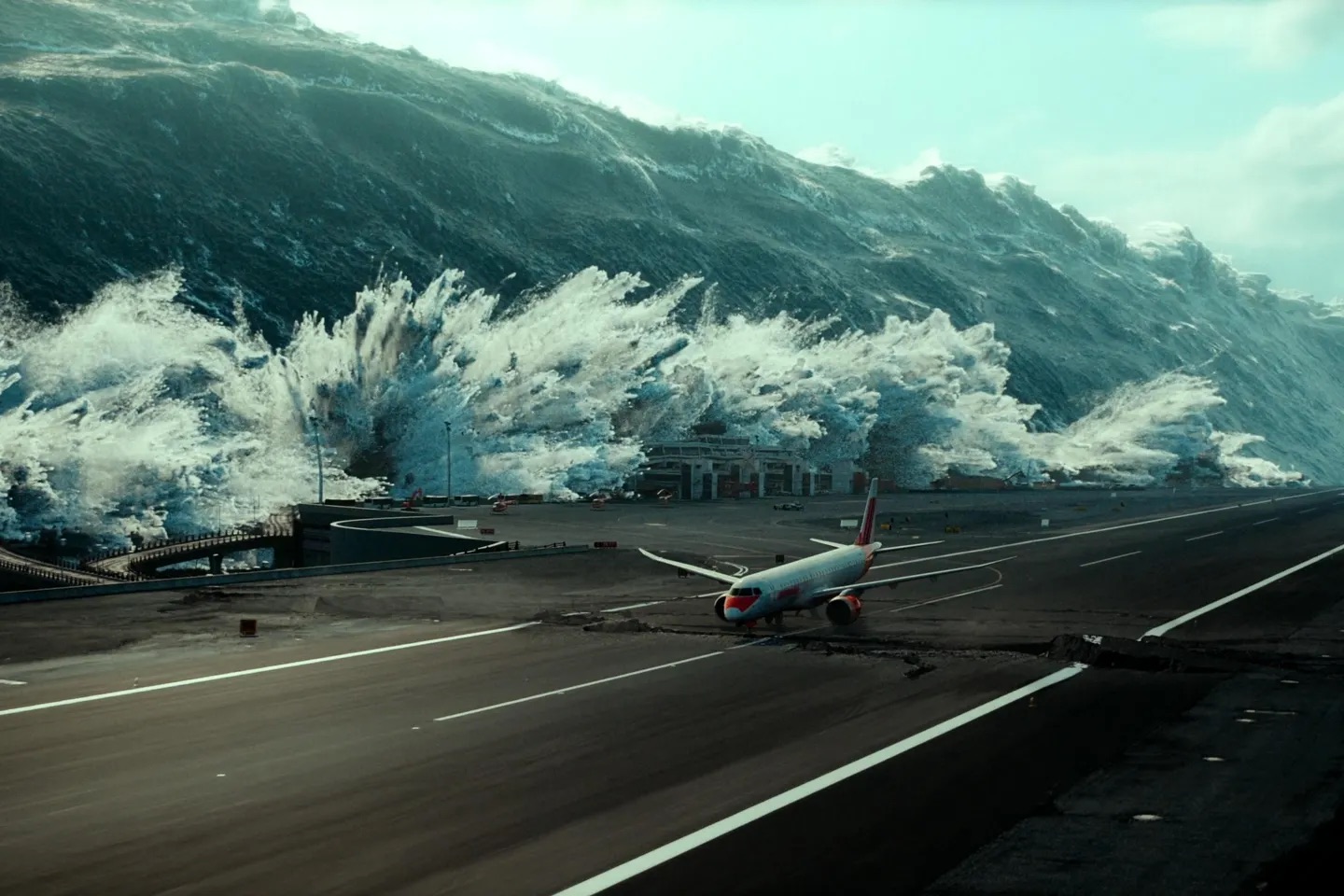
Most of the series provides a slow build-up of tension and anxiety over the likelihood of a massive collapse and the final part deploys CGI effects to visualise the catastrophic impact of a mega tsunami on the island, its capital Santa Cruz and its airport (Fig. 2). Whatever the degree of accuracy in the science behind the predictions of slope collapse, the series’ most risible element concerns the prediction of tsunami interactions as waves surge around the island in opposite directions. The Norwegian expert modeller comes up with a scenario that identifies a cove on the far side of the island where the two tsunami surges will meet and cancel each other out.[15] A group of key characters then travel to the location in an effort to survive. A special effects sequence subsequently shows the wave collision occurring, with the two waves meeting head on and rolling back from each other, leaving the small cove affected. But the most basic awareness of the physics of water makes it apparent that two waves meeting head-on will produce substantial sideways displacement of water, resulting in major surge inland that would have swamped the group of optimistic shelterers. Another, not insignificant, factor is that La Palma (along with Gran Canaria, Tenerife, La Gomera and El Hierro) all have central areas rising to over 1500 m elevation, meaning that people would not have had to leave the island to avoid the tsunami, they just needed to climb or drive up towards the island’s summit.
5. Impacting Tourism
It might be assumed that the representation of catastrophe, violence and/or dystopic situations onscreen has a problematic relationship to the promotion of those locales as tourist destinations (just as the representation of more positive scenarios might be assumed to constitute favourable promotion for other locales). But there is little evidence that this is the case, with the mere representation of appealing or dramatic landscapes and/or cultures on-screen seemingly being more important than the precise associations accruing to them. One clear example of this was identified by the producers of La Palma during the early phase of their negotiation of production in the Canary Islands. The previously mentioned film Bølgen raised the possibility of collapsing ridges and giant tsunamis in the Storfjorden in western Norway, which had experienced a similar incident in 1731 and smaller ones in 1934 and 1936. Given that only 79 years had passed since the latter, the film might have been perceived to have revived a sense of regional precarity that might have had a negative effect on tourist visitation after its release. However, the former mayor of Stranda, Jan Ove Tryggestad, has identified an increase in visitor numbers to the town following the film’s release (Folkvord, 2105). Indeed, media coverage has not indicated any sense of potential alarm over La Palma’s safety as a destination and, indeed, some writers have identified a likely increase in visitor interest. An article on the Yahoo Entertainment website, for instance, neatly summarised the paradox:
Over the years, the Canary Islands… have become a winter go-to. In Netflix’s La Palma, a four-part Norwegian series, we witness a family of four and several scientists as they navigate Mother Nature’s wrath. On-screen, a natural disaster caused by the island’s volcano causes a beautiful luxe vacation to go awry; when everyone tries to escape the island at the same time, chaos ensues. At the time of writing, La Palma is the No. 1 ranked show on Netflix in the US, so it won’t be surprising if the Canary Islands (specifically La Palma and Tenerife) are flooded with tourists eager to adventure in the area in the new year. (Baltazar, 2024)
Local perceptions of the production and subsequent streaming of the mini-series have been mixed. The initial announcement of the production was generally well received, in part because of the income it promised to bring to island businesses, with Turismo de Tenerife (TdT) subsequently reporting that:
the economic impact of the project on the islands has been close to a ten-digit figure. Around 1,000 extras and 20 Canarian and Spanish supporting actors have been hired in front of the cameras. Approximately 100 permanent workers were needed for five months for the preparation and filming, and another 200 on a temporary basis. In addition, a host of services were required in terms of rentals, accommodation, catering, suppliers, industry and transport. (Turismo de Tenerife, 2024)
TdT went on to identify that the production was a major boon for the embryonic media industry on the island whose growth promised a significant diversification of economic activity on the island:
The fact that this production was partly filmed on one of the non-capital Canary Islands also boosts international interest in these islands: it confirms that it is very feasible to shoot on them, which in turn means that the Canary Islands as a film destination broadens its offer of locations and validates its competitiveness at an international level…. For several years now, the audiovisual sector in the Canary Islands has been a lifeline for various sectors on which it depends… Each production contributes to an increasingly buoyant sector and to the fact that our region offers more local professionals to international productions. Moreover, we are talking about highly qualified and wage-intensive jobs, which has a direct impact on the wealth of our archipelago and its true economic diversification. (Turismo de Tenerife 2024)
None of the media coverage of the initial production announcement and shooting on the island identified the (mega-)tsunami aspect of the production and even locals involved in the production did not seem to have been aware that this aspect was going to comprise the show’s ‘hook’ and special effects climax (Stiefenhofer, p.c., March 21 2025). Nor, indeed, was this aspect particular apparent during production on La Palma, since all the tsunami scenes were CGI generated and edited into the location footage after completion.
Whatever their surprise about the focus of the final mini-series, locals seem to have been relatively indifferent to its apocalypticism. Indeed, the scenario represented ‘old news’ for islanders that dates back to 2000 without any subsequent research that has corroborated Ward and Day’s worst-case scenario. Despite some initial speculation as to potential negative impacts, local tourism practitioners have not observed any reduction in bookings and/or in visitor interest in La Palma. Indeed, local opposition to the Air BnBs catering for visitors and a related rise in living costs for Canarios (Pérez Morales 2024) appears a more real and pressing threat to locals and one more likely to sour tourist experiences than conjectural mega-tsunamis.
6. Conclusion
One of the clearest aspects of the cycle of media texts detailed above is the manner in which subsequent revisions of catastrophe modeling have served to diminish the scale and threat of a major volcanic collapse and a mega tsunami predicted in 2000. But — especially in an age of media sensationalism when science broadcasters routinely favour extreme scenarios and even veer off into pure science fiction[16] — the worst case scenario continues to attract attention. It is notable in this regard that the BBC held firm to the legitimacy of their 2000 program Mega-tsunami: Wave of Destruction despite substantial dissent from scientifically informed viewers before publishing an almost imperceptibly mild qualification of the program’s perspective. This appeared in an item in the Science & Nature: TV & Radio Follow-up section of the BBC website entitled ‘Mega-tsunami: Questions and Answers.’ The questions the unidentified author presented (without any indication if such questions had been raised by viewers or were the author’s rhetorical inventions) were ones that did not query the science behind the program or the nature of its representations and also failed to offer any retractions or modifications. Perhaps the most inventive aspect of the fabricated Q&A was the manner in which the author disingenuously represented the program essentially as a public service message, identifying that:
Although nothing can be done to stop a collapse, scientists point out there is a lot that can be done to prevent loss of life when a collapse does eventually happen. With suitable monitoring, warning and evacuation, people can be moved out of the areas at risk. (BBC, 2014)
Before going on to assert that:
Mega-tsunami are very rare. However, it is important for governments to understand the potential risk, so that they can decide what hazard preparations, if any, are required. (BBC, 2014)
La Palma achieved high viewing figures, being Netflix’s most streamed show in the US in mid-December 2024 and was one of the streaming service’s top 10 shows globally in the pre-Christmas period. Assuming that, at very least, a substantial portion of its audience were unfamiliar with either the scientific papers concerned or with the BBC or National Geographic programs discussed above, the series’ representation of a collapse of Cumbre Vieja triggering a major (i.e. ‘super’) tsunami helped diffuse the trope to a broader audience, repopularising it twenty-five years after the story’s first dramatic screen outing.
Produced as a drama series fictionalising a worse-case scenario with no requirement to be accurate to any facts, La Palma proved popular with international audiences but, along with a scenario that privileged Norwegian characters and the superior expertise of their scientists, the drama unfolded in an exploitative manner that reinforced well-worn narrative tropes. In somewhat of an irony, representations of imminent global catastrophe emanating from La Palma appear to principally illustrate the substantial disconnect between responses to media fictions even those based on scientific elements and public perceptions and travel intentions. The ‘media-lore’ of La Palma’s slope collapse tsunami therefore primarily exists within its own sphere of reference and only intersects with the reality of La Palma’s volcanicity in a tangential and conjectural manner. Despite the series of media programs detailed above, and the diffusion of media-lore around a likely tsunami event, there are no tsunami alert signs, let alone mechanisms, in place in La Palma and seemingly, no local interest in installing any given a lack of conviction in the likelihood of Ward and Day’s worst-case scenario eventuating.
Acknowledgements
Thanks to Fabian Stiefenhofer for his assistance with research on tourism on La Palma for this article.
Endnotes
References
- Abadie, S. M, Harris, J. C., Grilli, S. T., Fabre, R., 2012. Numerical modeling of tsunami waves generated by the flank collapse of the Cumbre Vieja Volcano (La Palma, Canary Islands): Tsunami source and near field effects. Journal of Geophysical Research: Oceans 117 (C5). https://agupubs.onlinelibrary.wiley.com/doi/10.1029/2011JC007646
- Abadie, S. M., Paris, A., Ata, R. et al., 2020. La Palma landslide tsunami: calibrated wave source and assessment of impact on French territories. Natural Hazards and Earth System Sciences 20 (11), 3019–3038.
- American Academy Museum of Motion Pictures, 2024. Beware the elements! Natural disasters on film. https://www.academymuseum.org/en/programs/series/beware-the-elements-natural-disasters-on-film
- Baltazar, A.N., 2014. ‘La Palma’ filming location: Disaster strikes the Canary Islands in new Netflix show. Y!Entertainment. https://www.yahoo.com/entertainment/la-palma-filming-location-disaster-192633479.html
- BBC TV, 2014. Horizon — Mega-tsunami: Wave of Destruction. https://www.youtube.com/watch?v=R3E8C5xZgdw
- BBC TV, 2014. Mega-tsunami: Questions and Answers. https://www.bbc.co.uk/science/horizon/2000/mega_tsunami_qanda.shtml
- Bory De St. Vincent, J.B., 1803. Essai sur les îles fortunées et l'antique Atlantide. Baudouin. https://gallica.bnf.fr/ark:/12148/bpt6k6344040s
- Canet, C., Sánchez-Aguirre, D., García-Sánchez, L. Castañeda-Bastida, E., 2024. Geological heritage in UNESCO's World Heritage List: A critical review. International Journal of Geoheritage and Parks, 12 (14), 531–543.
- Carracedo, J.C., 2008. Geología de Canarias I. (origen, evolución, edad y vulcanismo). Ed. Rueda, Madrid.
- García Conde, M., Roldán Delgado, H., 2010. The last of the Atlanteans. Child’s Nervous System 26, 1131–1134.
- Dóniz-Páez, J., Pérez, N. M., Becerra-Ramírez, R., Hernández-Ramos, W., 2024. Geotourism on an active volcanic island (La Palma, Canary Islands, Spain). Miscellanea Geographica 28(2), 47–53.
- ECOAQUA, 2024. ECOAQUA participates in the exploration of the seabed of the three youngest volcanoes in the Canary Islands. ECOAQUA News. https://www.ecoaqua.eu/en/blog/-ecoaqua-participates-in-the-exploration-of-the-seabed-of-the-three-youngest-volcanoes-in-the-canary-islands-a4879.html
- Erfurt-Cooper, P., Sigurdsson, H., Lopes, R.M.C. 1999. Volcanoes and Tourism. In H. Sigurdsson (Ed.) The Encyclopedia of Volcanoes (Second Edition). London: Academic Press: 1295–1311.
- Erfurt-Cooper, P., Cooper, M. 2011. Volcano and Geothermal Tourism: Sustainable Geo-Resources for Leisure and Recreation. London: Taylor & Francis.
- Fernández-Palacios, J. M., Fernández-Palacios, E. 2023. La actividad turística frente al paisaje canario. Impactos y oportunidades. In. Romero, M. (ed.) Turismo, Paisaje, Futuro: Hacia una transición turística en Canarias. Gobierno de Canarias, Las Palmas de Gran Canaria: 83–89.
- Folkvord, 2015. The Wave preview. NordicFantasy.info. https://nordicfantasy.wordpress.com/2015/08/22/the-wave-preview/
- Goff, J., Terry, J. P., Chagué-Goff, C., Goto, K. 2014. What is a mega-tsunami? Marine Geology 358: 12–17.
- Gutscher, M.-A., 2005. Destruction of Atlantis by a great earthquake and tsunami? A geological analysis of the Spartel Bank hypothesis. Geology, 33(8): 685–688.
- Hello Canary Islands, 2024. Arguineguín, a paradise for Norwegians in the south of Gran Canaria. https://www.hellocanaryislands.com/experiences/arguineguin-a-paradise-for-norwegians-in-the-south-of-gran-canaria/
- Hernández-Ramos, W, Dóniz-Páez, J., García-Hernández, R Pérez, N. M., 2024. Evaluation of sites of geotouristic interest on active volcanic island La Palma, Spain for potential volcanic tourism. Geoheritage 16: 102.
- Hunt, J. E., Wynn, R. B., Talling, P.G., Masson, D.G., 2013. Multistage collapse of eight western Canary Island landslides in the last 1.5 Ma: Sedimentological and geochemical evidence from subunits in submarine flow deposits. Geochemistry, Geophysics, Geosystems, 14 (7): 2159–2181.
- Lilley, H., 2007. The wave that destroyed Atlantis. BBC Timewatch. http://news.bbc.co.uk/2/hi/science/nature/6568053.stm
- Mutaqin, B.W., Lavigne, F., Hadmoko, D.S., Ngalawani, M.N., 2018. Volcanic Eruption-Induced Tsunami in Indonesia: A Review. IOP Conference Series: Earth and Environmental Science 256: 012023.
- National Geographic, 2010. Doomsday Earth. https://www.natgeotv.com/uk/shows/nationalgeographicwild/doomsday-earth#episodes-t1
- Osborne, H., 2024. 'This could be the origin of the Atlantis legend': Mountain that sank beneath the waves discovered off Canary Islands. Live Science. https://www.livescience.com/planet-earth/volcanos/this-could-be-the-origin-of-the-atlantis-legend-mountain-that-sank-beneath-the-waves-discovered-off-canary-islands
- Pararas-Carayannis, G., 2002. Evaluation of the threat of mega tsunami generation from postulated massive slope failures of island stratovolcanoes on La Palma, Canary Islands, and on the Island of Hawaii. Science of Tsunami Hazards 20(5): 251–277.
- Piercy, G., 2024. Huge Canary Islands discovery as mystery of real-life Atlantis could finally be solved. Daily Express. https://www.express.co.uk/news/world/1935828/canary-islands-africa-islands-atlantis
- Pérez Morales, V., 2024. A la sombra del turismo: turismofobia en Tenerife. Masters thesis, Universidad de Jaén. https://crea.ujaen.es/items/fcd97a39-fec8-4ee4-b93a-766903e9a3c0
- Russian Laboratory of Theoretical Folkloristics, 2104. ‘Conference “Mechanisms of Cultural Memory: From Folk-Lore to Media-Lore.” RANEPA website (now inactive) https://web.archive.org/web/20140714085541/http://www.ranepa.ru/eng/activities/item/604-cultural-memory.html
- Santana, J., del Pino, M., Morales, J., Gilson, S-P. 2024. The chronology of the human colonization of the Canary Islands. PNAS, 121: e2302924121
- Spangler, T., 2025. Netflix Viewing Up 5% in Second Half of 2024, ‘Squid Game 2’ Leads as Most-Watched TV Series. Variety. https://variety.com/2025/digital/news/netflix-viewing-reports-second-half-2024-squid-game-2-1236321284/#
- Touchard, C., 2024. We know the risks — So why is extreme tourism so popular? Worldcrunch. https://worldcrunch.com/food-travel/extreme-tourism-titanic-submarine
- Troll, V. R., Carracedo, J.C., 2016. The geology of the Canary Islands. Elsevier Science.
- USGS, 2021. The Canary Islands “mega-tsunami” hypothesis, and why it doesn’t carry water. Volcano Watch. https://www.usgs.gov/observatories/hvo/news/volcano-watch-canary-islands-mega-tsunami-hypothesis-and-why-it-doesnt-carry
- UNESCO, 1972. World Heritage. Convention Concerning the Protection of the World Cultural and Natural Heritage. https://whc.unesco.org/en/conventiontext
- UNESCO, 2025. UNESCO Global Geoparks. https://www.unesco.org/en/iggp/geoparks/about
- Walker, R. 2024. There is NO possibility of a megatsunami from La Palma — it was debunked many years ago. Many volcanologists on Twitter today reassuring scared people — viral nonsense on social media. Debunking Doomsday. https://debunkingdoomsday.quora.com/We-are-NOT-at-risk-from-a-megatsunami-from-the-Canary-Isles-La-Palma-BBC-documentary-based-on-unpublished-research-soo
- Ward, S. N., 2014. Curriculum Vitae. https://websites.pmc.ucsc.edu/~ward/vitafull.pdf
- Ward, S, N., Day, S., 2001. Cumbre Vieja Volcano—Potential collapse and tsunami at La Palma, Canary Islands. Geophysical Research Letters 28 (7), 3397–3400.