
Other Effective Area-Based Conservation Measures (OECMs) in Marine and Island Social-Ecological Systems: A PRISMA-Guided SLR 2014–2024
 10.21463/jmic.2026.15.1.22
Abstract
Understanding the interactions between human and natural systems is crucial for building sustainable futures in marine and island social-ecological systems, especially in response to ecological crises such as climate change and biodiversity loss. Other Effective Area-Based Conservation Measures (OECMs) provide a pathway to strengthen and complement existing protected areas, acknowledging that conservation can occur in areas managed by Indigenous Peoples (IPs), Local Communities (LCs), and private-sector actors. This study aims to provide a systematic synthesis of the evolution of studies on Other Effective Area-Based Conservation Measures (OECMs) in marine and island social-ecological systems between 2014 and June 2024 through a Preferred Reporting Items for Systematic Reviews and Meta-Analyses (PRISMA)-guided systematic literature review of Scopus-indexed, English-language journal articles structured by the Population, Intervention, Comparison, and Outcome (PICO) framework and complemented by bibliometric analysis. The review followed the PRISMA guidelines for study identification, screening, and inclusion and was applied to Scopus-indexed articles, identifying 162 eligible publications, of which 20 papers on OECMs were selected for qualitative synthesis. These 20 papers comprise conceptual or policy-framing articles, guidance and criteria-setting documents, and case studies situated within, or linked to, the context of the Convention on Biological Diversity (CBD), Aichi Target 11, SDG 14.5, and the Kunming–Montreal Global Biodiversity Framework (KMGBF) target 3 (30×30). Governance, rights, and social safeguards emerged as the most frequently discussed theme, alongside conceptualization and relationships to protected areas, marine, coastal, and island applications, and contributions to global conservation targets. Taken together, the evidence suggests that effective OECMs in marine and island social-ecological systems function as complementary governance configurations that integrate biodiversity outcomes, equity, and context-specific seascapes rather than serving as additional polygons for meeting coverage targets.
Keywords
OECMs, Marine and island, Biodiversity conservation, Governance and rights, PRISMA
1. Introduction
Countries increasingly recognize that achieving the Sustainable Development Goals (SDGs) requires balancing development with environmental protection. Understanding the interactions between human and natural systems is crucial for building sustainable futures, especially in response to ecological crises such as climate change and biodiversity loss (Putra et al., 2023; Hermon et al., 2025). These dynamics are pronounced in marine and island social-ecological systems, where community livelihoods and cultures depend on the surrounding seas. Other Effective Area-Based Conservation Measures (OECMs) provide a pathway to strengthen and complement existing protected areas, acknowledging that conservation can also occur in areas managed by a variety of actors, including Indigenous Peoples (IPs), Local Communities (LCs), and private-sector actors, who help sustain both biodiversity and local ways of life. Since its introduction under the Convention on Biological Diversity (CBD) in 2010, the OECMs concept has gained momentum in research, particularly as a critical approach for achieving the 30 × 30 global conservation target. OECMs are geographically defined areas that are not formally designated as protected areas but deliver effective biodiversity conservation outcomes. In recent years, scholarship on OECMs has expanded to examine their roles in community-based conservation, traditional territories, and forms of collaborative knowledge governance (Zabala et al., 2024; Podda and Porporato, 2023). Although publications on OECMs have increased rapidly, conceptualizations and applications of the concept remain highly regional and context-specific, with policies differing in how they interpret and operationalize the framework (Dawson et al., 2024; Gale and Montenegro, 2024).
Systematic evidence synthesis methods, such as Systematic Literature Reviews (SLRs) structured by the Population, Intervention, Comparison, and Outcome (PICO) framework and guided by the Preferred Reporting Items for Systematic Reviews and Meta-Analyses (PRISMA), have become essential tools in contemporary scientific research because they support transparent, reproducible, and question-driven assessments of the state of knowledge in a given field (Pati and Lorusso, 2018; Aryantie et al., 2023; McKenna, 2024). In the context of OECMs, previous studies have employed bibliometric approaches to map publication dynamics, scientific collaboration, and emerging themes related to marine spatial planning, protected area management, and ecosystem conservation (Donthu et al., 2021; Tasneem and Ahsan, 2024). However, there is still a lack of specific synthesis of how studies on OECMs have evolved in marine and island environments, where ecological processes, cultural practices, and socio-economic systems are tightly intertwined. To support future research in this field, it is therefore crucial to develop a structured understanding based on a PRISMA-guided SLR using PICO, because existing literature reviews have not yet provided a comprehensive, question-oriented synthesis of OECMs with a dedicated focus on marine and island social-ecological systems.
Furthermore, when embedded within a systematic review, bibliometric analysis that traces temporal trends and salient keywords can provide a more precise picture of how studies in a given field have evolved (Amiruddin et al., 2024). Such an approach also enables the identification of research gaps and key actors contributing to the development of OECMs scholarship. This study aims to provide a systematic synthesis of the evolution of OECMs in marine and island social-ecological systems between 2014 and June 2024 through a PRISMA-guided systematic literature review of Scopus-indexed, English-language journal articles structured by the PICO framework and complemented by bibliometric analysis. Specifically, the objectives are to: 1) analyze how scientific publications related to OECMs in marine and island environments have evolved from 2014 to 2024; 2) identify which institutional and geographical actors, especially those in coastal and island regions, contribute most to this field; 3) determine which papers and journals are most frequently cited in marine- and island-related OECMs scholarship; 4) examine dominant keyword trends and related bibliometric network visualizations that show links between conservation, culture, and social-ecological systems in islands and seas; and 5) assess how collaboration on studies of OECMs is structured across countries, particularly archipelagic states.
2. Methods
2.1 Search Methods
A systematic search was conducted in the Scopus database to identify publications related to OECMs. The search strategy applied the following query to titles, abstracts, and author keywords using Boolean operators (AND, OR): TITLE-ABS-KEY ("OECMs"). To ensure consistency and quality, the search was restricted to peer-reviewed, English-language journal articles published between 2014 and June 2024, a period during which the OECM concept began to appear more consistently in the scientific literature. The initial search results were first filtered by publication year and document type, according to the predefined eligibility criteria. Titles and abstracts were then screened to ensure that each article explicitly engaged with the OECMs concept, understood here as area-based measures that deliver effective biodiversity conservation outcomes outside formally designated protected areas. Subsequently, inclusion and exclusion criteria were applied using the PICO framework to identify studies suitable. These criteria are summarized in Table 1. Based on this process, 162 articles met the eligibility criteria for bibliometric analysis and were retained for quantitative mapping. From within this corpus, 20 highly cited and/or thematically central OECMs papers were selected for the SLR component, combining the ten most cited articles with ten additional studies identified as particularly relevant to marine, coastal, and island contexts.
| Criteria | Inclusion | Exclusion |
|---|---|---|
| Population | Studies focusing on clearly defined area-based conservation settings (e.g., marine, coastal, island, freshwater, or terrestrial areas) | Studies without a specific area-based conservation context (e.g., purely generic discussions of sustainability) or articles not linked to OECMs or other effective area-based measures. |
| Intervention | Implementation, governance, policy design, or assessment of OECMs, including comparisons with protected areas, ICCAs, or other conservation tools. | Studies dealing exclusively with conventional protected areas, general conservation strategies, or management instruments that do not refer to OECMs or equivalent concepts. |
| Comparison | Articles that include empirical or conceptual comparisons (e.g., OECMs vs. protected areas, different governance types, cross-country or cross-ecosystem contrasts). | Articles that do not offer any explicit comparison or discussion of how OECMs differ from or relate to other area-based or governance arrangements. |
| Outcome | Outcomes related to biodiversity conservation, ecological integrity, governance effectiveness, socio-cultural or livelihood impacts, policy implementation, or progress toward global targets (e.g., 30×30, SDGs). | Articles where the main outcomes are unrelated to conservation, governance, or social-ecological dimensions of OECMs (e.g., purely methodological papers on unrelated topics). |
| Publication Year | Published between 2014 and June 2024. | Published before 2014 or after the final search date. |
| Language | Full text available in English. | Articles published in languages other than English or without accessible full text. |
| Article Type | Peer-reviewed journal articles, reviews, and substantial policy or conceptual commentaries on OECMs indexed in Scopus. | Non–peer-reviewed documents, short news items, brief editorials, conference abstracts, notes, book reviews, and grey literature. |
Based on the inclusion and exclusion criteria outlined in Table 1, a final dataset of 162 articles was deemed eligible for bibliometric mapping. Within this dataset, a subset of 20 key studies that met the PICO criteria for detailed synthesis forms the basis of the systematic literature review and is summarized in Table 2 below.
| No | Authors | Paper title | Journal | Key finding |
|---|---|---|---|---|
| 1 | Jonas et al., 2014 | New steps of change: Looking beyond protected areas to consider other effective area-based conservation measures | PARKS: Switzerland | Argues that many governed and managed areas outside formal protected area systems can deliver long-term in situ conservation, but they must meet clear criteria on governance quality, durability, and biodiversity outcomes to count as OECMs. |
| 2 | MacKinnon et al., 2015 | Canada and Aichi Biodiversity Target 11: understanding ‘other effective area-based conservation measures’ in the context of the broader target | Biodiversity and Conservation: Netherlands | Shows that multiple Canadian area-based measures outside protected areas could potentially qualify as OECMs, but stresses the need for robust criteria and safeguards to avoid counting weak or purely paper-based measures. |
| 3 | Butchart et al., 2015 | Shortfalls and solutions for meeting national and global conservation area targets | Conservation Letters: United States | Finds major global shortfalls in coverage and ecological representation; argues that expanded, better-targeted protected areas plus recognition of effective OECMs are both needed to achieve Aichi Target 11. |
| 4 | Watson et al., 2014 | Bolder science needed now for protected areas | Conservation Biology: United States | Concludes that incremental approaches are insufficient; calls for rigorous, outcomes-focused science to guide expansion and management of protected areas and OECMs if they are to halt biodiversity loss. |
| 5 | Rees et al., 2018 | Defining the qualitative elements of Aichi Biodiversity Target 11 with regard to the marine and coastal environment | Marine Policy: United Kingdom | Proposes a set of qualitative criteria and indicators that can be used to assess whether marine protected areas and OECMs genuinely contribute to SDG 14 and Aichi Target 11, rather than just increasing nominal coverage. |
| 6 | Diz et al., 2017 | Mainstreaming marine biodiversity into the SDGs: The role of other effective area-based conservation measures (SDG 14.5) | Marine Policy: United Kingdom | Shows that a wide variety of marine area-based measures if effectively governed and managed can function as OECMs and significantly advance SDG 14, but warns against counting weak measures that lack conservation outcomes. |
| 7 | Jonas et al., 2017 | Editorial essay: other effective area-based conservation measures: from Aichi Target 11 to the post-2020 biodiversity framework | PARKS: Switzerland | Sets out core principles and guidance for recognizing OECMs that truly deliver biodiversity conservation and social benefits, and highlights risks of misusing the label to inflate area-based targets. |
| 8 | Donald et al., 2019 | The prevalence, characteristics and effectiveness of Aichi Target 11’s “other effective area-based conservation measures” (OECMs) in key biodiversity areas | Conservation Letters: United States | Finds that OECMs-type sites already cover substantial portions of KBAs in some countries and can deliver strong conservation outcomes, but many lack secure governance or long-term protection, so careful screening is essential. |
| 9 | Bhola et al., 2021 | Perspectives on area-based conservation and its meaning for future biodiversity policy | Conservation Biology: United States | Argues that post-2020 targets must prioritize ecological effectiveness and equitable governance (including Indigenous and local community OECMs), not just 30% numerical coverage. |
| 10 | Alves-Pinto et al., 2021 | Opportunities and challenges of other effective area-based conservation measures (OECMs) for biodiversity conservation | Perspectives in Ecology and Conservation: Brazil | Concludes that OECMs could significantly expand effective conservation coverage, but only if recognition is tied to demonstrable biodiversity outcomes, robust governance, and strong social safeguards. |
| 11 | Estradivari et al., 2022 | Marine conservation beyond MPAs: Towards the recognition of other effective area-based conservation measures (OECMs) in Indonesia | Marine Policy: United Kingdom | Shows that Indonesia hosts many area-based measures outside MPAs that likely meet OECMs criteria; argues that formally recognizing them could greatly strengthen national progress towards biodiversity targets. |
| 12 | Garcia et al., 2022 | OECMs in marine capture fisheries: Key implementation issues of governance, management, and biodiversity | Frontiers in Marine Science: Switzerland | Identifies governance and management conditions under which fisheries spatial measures can function as OECMs, and highlights risks where weak management or unclear objectives undermine biodiversity benefits. |
| 13 | Lemieux et al., 2022 | Running to stand still: The application of substandard OECMs in national and provincial policy in Canada | Biological Conservation: Netherlands | Concludes that some Canadian OECMs designations are “substandard”, counting areas with weak or uncertain conservation outcomes, and warns that this undermines both national reporting and the credibility of OECMs globally. |
| 14 | Dudley et al., 2018 | The essential role of other effective area-based conservation measures in achieving big bold conservation targets | Global Ecology and Conservation: Netherlands | Argues that OECMs are essential complements to protected areas for reaching large-scale conservation goals and that meaningful integration demands major shifts in planning, governance, and respect for indigenous and community rights. |
| 15 | Mitchell et al., 2018 | PPA or OECMs? Differentiating between privately protected areas and other effective area-based conservation measures on private land | PARKS: Switzerland | Shows that PPAs and OECMs must be clearly distinguished based on primary conservation objectives and governance; warns that conflating them can distort reporting against Aichi Target 11 and future targets, and illustrates practical classification through national case studies. |
| 16 | Maini et al., 2023 | Charting the value and limits of other effective conservation measures (OECMs) for marine conservation: A Delphi study | Marine Policy: United Kingdom | Finds strong expert consensus that OECMs can enhance equitable and effective marine conservation, especially where Indigenous and local rights are strengthened, but identifies key challenges, including unclear metrics of effectiveness, risks of shifting burdens to communities, and the need for robust social-equity and monitoring guidelines to realize OECMs’ full potential. |
| 17 | Gurney et al., 2021 | Biodiversity needs every tool in the box: use OECMs | Nature: United Kingdom | Emphasizes that OECMs can deliver strong biodiversity and social outcomes when they recognize customary tenure, are co-governed with local and Indigenous communities, and avoid becoming “paper parks”; calls for equitable alliances and robust safeguards in OECMs designation. |
| 18 | Jonas et al., 2024 | Global status and emerging contribution of other effective area-based conservation measures (OECMs) towards the ‘30×30’ biodiversity Target 3 | Frontiers in Conservation Science: Switzerland | Shows that formally recognized OECMs already make a measurable and growing contribution to global area-based conservation targets, particularly in complementing protected-area networks and recognizing Indigenous and community-governed sites, but highlights large geographic gaps, uneven reporting, and the need for clearer standards and support to ensure OECMs deliver equitable, long-term biodiversity outcomes. |
| 19 | Paterson, 2023 | Other Effective Area-Based Conservation Measures, Biodiversity Stewardship and Statutory Intervention – A South African Perspective | Potchefstroom Electronic Law Journal (PER/PELJ): South Africa | Concludes that biodiversity stewardship areas have strong potential to be recognized as OECMs but highlight weaknesses in the current legal framework; recommends targeted statutory reforms and clearer criteria so that only well-governed, effectively managed sites are counted towards Target 3. |
| 20 | Cook, 2024 | Progress developing the concept of other effective area-based conservation measures | Conservation Biology: United States | Finds that the OECMs concept has matured and is increasingly used in global policy, but remains inconsistently interpreted across countries; calls for clearer operational standards, better incorporation of social safeguards, and stronger monitoring frameworks to ensure OECMs complement rather than dilute protected area commitments. |
All selected OECMs articles were assessed for conceptual and methodological quality before being included. The assessment focused on core criteria, including 1) clarity in defining the study setting as an area-based conservation context (for example, protected areas, OECMs, Indigenous and community territories, or marine and coastal areas); 2) explicit engagement with the OECMs concept or closely related "OECM-like" measures as recognized under the CBD; 3) transparency in describing governance arrangements, management objectives, and, where applicable, ecological or social outcomes; and 4) relevance to the overarching themes of this review, particularly the contribution of OECMs to biodiversity targets, equity, and marine and island social-ecological systems. For each article retained in the SLR, information was systematically extracted and organized into a structured summary. The final set of 20 studies summarized in Table 2 thus represents the most influential and/or thematically central contributions to the development of OECMs scholarship within the period 2014–2024.
2.2 Synthesis
A narrative synthesis approach was employed to interpret and integrate the findings from the 20 key OECMs studies. Four main analytical steps were applied, namely 1) classification by article type and role in the literature; 2) examination of how different studies characterized OECMs governance types (state-managed, privately managed, Indigenous and community-governed, or shared governance), legal security, and recognition processes, with particular attention to equity, human rights, and the role of IPs and LCs; 3) comparison of ecological and social-ecological outcomes; 4) assessment of contributions to global conservation targets in terms of how they discussed OECMs’ contribution to Aichi Target 11 (Laffoley et al., 2017), SDG 14, and, more recently, the Kunming–Montreal Global Biodiversity Framework (KMGBF) target 3 "30×30" (Watson et al., 2023). This step highlighted both the potential and the risks of using OECMs within global reporting and accountability frameworks. This thematic synthesis allowed convergent insights and divergent perspectives to be identified across the 20 key articles, providing a more comprehensive understanding of how OECMs are conceptualized, implemented, and debated in the contemporary conservation policy landscape, with a particular focus on marine and island social-ecological systems.
2.3 PRISMA flow diagram
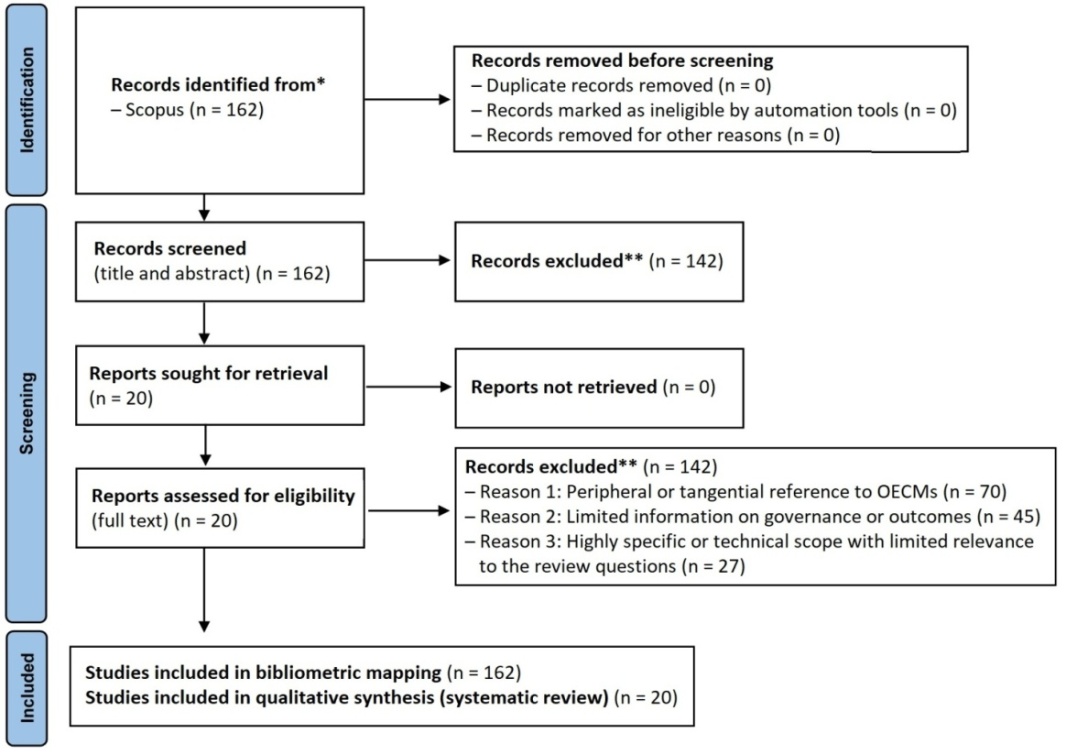
The process of article identification, screening, eligibility assessment, and final inclusion followed the PRISMA 2020 guidelines, ensuring transparency and methodological rigor. No duplicate records, automation-based exclusions, or other removals occurred before screening (Figure 1). For the SLR, all 162 records were screened by title and abstract, of which 142 were excluded because they did not meet the predefined eligibility criteria. The reasons for exclusion of these 142 records were: (1) peripheral or tangential reference to OECMs (n = 70); (2) limited information on governance arrangements or ecological or social outcomes (n = 45); and (3) a highly specific or technical scope with limited relevance to the review questions (n = 27). The remaining 20 records were sought for full-text retrieval, and all were successfully obtained (n = 20). These 20 reports were assessed for eligibility based on the PICO criteria and thematic relevance to marine and island social-ecological systems. All 20 were retained for the qualitative synthesis (SLR), while the full set of 162 records was included in the quantitative mapping of the OECMs literature. More details can be seen in Figure 1 below.
3. Results
3.1 Overview of included studies
These 20 papers were published between 2014 and 2024 and comprise a mix of conceptual or policy-framing articles, guidance and criteria-setting documents, and empirical case studies. Most of the studies are situated within, or closely linked to, the policy context of the CBD and its Aichi Target 11, SDG 14.5, and the KMGBF target 3 (30×30). Several articles focus explicitly on marine, coastal, and island social-ecological systems, particularly in relation to Marine Protected Areas (MPAs), fisheries spatial measures, and community-governed seascapes. Others address terrestrial and freshwater contexts, including biodiversity stewardship areas and privately protected lands. In terms of study design, the corpus includes conceptual reviews, legal and policy analysis, Delphi-based expert assessments, and empirical evaluations of potential or recognized OECMs (Fitzsimons et al., 2024). Across these designs, the articles consistently examine how OECMs are defined, governed, and evaluated, and how they interact with protected area systems. Several studies foreground the roles of IPs and LCs, analyzing how recognition of their territories as OECMs can contribute simultaneously to biodiversity conservation, cultural continuity, and social justice.
3.2 Thematic synthesis of key findings
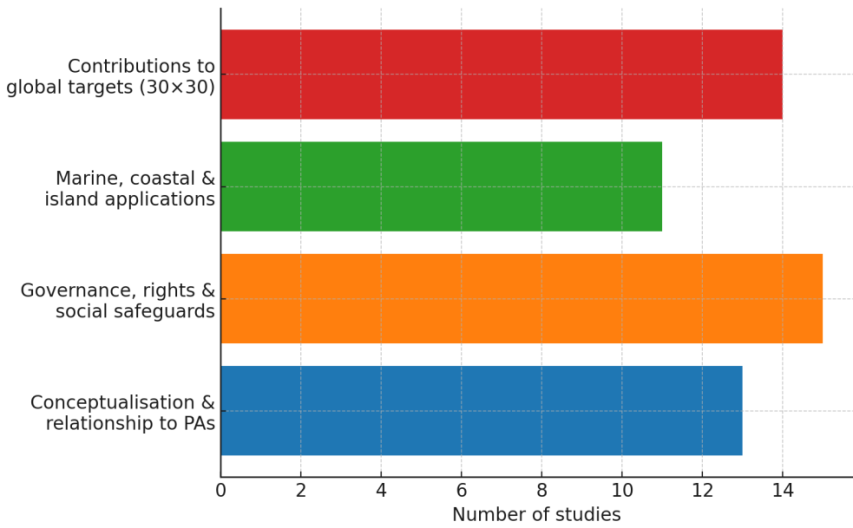
A thematic synthesis of the 20 studies included in the qualitative review yielded four overarching themes, namely 1) conceptualization of OECMs and their relationship to protected areas; 2) governance, rights, and social safeguards; 3) marine, coastal, and island applications; and 4) contributions to global conservation targets and the 30×30 agenda. As shown in Figure 2, governance, rights, and social safeguards emerged as the most frequently discussed theme (15 of 20 studies), followed by contributions to global conservation targets (14 studies), conceptualization and relationship to protected areas (13 studies), and marine, coastal, and island applications (11 studies). This pattern indicates that the OECMs literature is strongly oriented towards questions of governance and equity, while also engaging deeply with debates on the 30×30 agenda and context-specific applications in marine and island social-ecological systems. More details can be seen in Figure 2 below.
Conceptualization of OECMs and their relationship to PAs:
A primary overarching theme concerns the conceptual evolution of OECMs and their positioning in relation to PAs. Early contributions (e.g., Jonas et al., 2014; MacKinnon et al., 2015; Butchart et al., 2015) argue that many governed and managed areas outside formal PAs networks can deliver long-term in situ conservation and therefore merit recognition as OECMs, provided that they meet clear criteria relating to governance quality, durability, and biodiversity outcomes. These studies emphasize that OECMs should be understood as complements rather than substitutes for PAs, helping address ecological and social gaps in existing conservation systems. Jonas et al. (2017); Cook (2024) stress the need for clear operational definitions, consistent global guidance, and robust safeguards to prevent OECMs from becoming a vehicle for counting weakly protected or purely "paper-based" measures toward ambitious numerical targets. Studies such as Mitchell et al. (2018) further disentangle OECMs from related instruments, notably privately protected areas, arguing that distinctions should be based on primary conservation objectives, governance arrangements, and accountability mechanisms. Taken together, these contributions show a gradual shift from broad definitional proposals to more nuanced and critical debates about where OECMs sit within the wider family of area-based conservation tools.
Governance, rights, and social safeguards:
Many of the reviewed studies foreground Indigenous and community rights, tenure security, and the politics of recognition. Dudley et al. (2018); Jonas et al. (2024) argue that OECMs hold particular promise when they recognize and support existing IPs’ and LCs’ conservation practices, provided that these arrangements are grounded in free, prior, and informed consent and respect customary institutions. Lemieux et al. (2022) show how some Canadian designations risk counting sites with uncertain or weak biodiversity outcomes, limited legal security, or unclear management responsibilities. Paterson (2023) similarly identifies legal and policy gaps in South African biodiversity stewardship that could affect the robustness of terrestrial OECMs. This dual potential means that OECMs can strengthen rights-based conservation alliances, but they can also undermine local trust and global credibility if they are used to legitimize inadequate governance arrangements. Overall, the literature converges on the view that social safeguards, especially around tenure, participation, and equity, are as central to OECMs as ecological criteria.
Marine, coastal, and island applications:
Several studies focus specifically on marine contexts and small-island or archipelagic states. Rees et al. (2018); Diz et al. (2017) develop qualitative criteria for assessing whether marine area-based measures, including fisheries closures, spatial management tools, and locally managed marine areas, genuinely contribute to Aichi Target 11 and SDG 14.5. Estradivari et al. (2022) identify a wide range of potential marine OECMs in Indonesia, such as customary closure areas and fisheries management zones, and argue that formal recognition of these sites could substantially strengthen national progress toward global targets. Garcia et al. (2022) analyze how fisheries measures can function as OECMs when they are designed with explicit biodiversity objectives, enforceable rules, and long-term commitments, while Maini et al. (2023) use a Delphi process to surface expert views on the opportunities and limits of marine OECMs under the post-2020 KMGBF. Across these contributions, marine and island OECMs are portrayed as critical for conserving mobile species, migratory routes, and biocultural seascapes, but they also face distinct challenges, including overlapping jurisdictions, the risk of burden-shifting to LCs, and the need for context-appropriate monitoring systems that capture both ecological integrity and cultural values.
Contributions to global conservation targets and the 30×30 agenda:
Butchart et al. (2015); Dudley et al. (2018) show that, under current PAs coverage, global targets cannot be reached without recognizing additional effective area-based measures, especially in sites of high biodiversity value beyond formal networks. Donald et al. (2019) demonstrate that OECM-like sites already cover substantial portions of key biodiversity areas in some countries, while Bhola et al. (2021) call for future targets to emphasize ecological effectiveness and equitable governance rather than percentage coverage alone. More recent analyses (e.g., Alves-Pinto et al., 2021; Jonas et al., 2024) quantify the emerging contribution of recognized OECMs to global area-based statistics and highlight both their potential and their limitations. On the one hand, OECMs can enhance ecological representativeness and social-ecological fit, particularly when they recognize Indigenous and community-governed territories and productive seascapes. On the other hand, large geographic gaps, inconsistent national interpretations, and uneven reporting reveal that OECMs could either strengthen or dilute the 30×30 agenda, depending on how strictly standards, monitoring, and social safeguards are applied.
3.3 Distribution patterns of studies
To complement the thematic synthesis in Section 3.2 above, the 20 key OECMs studies were further examined in terms of their thematic focus, geographic origin, and publication period. These distribution patterns are summarized in three pie charts in Figure 3, where panel (A) shows the relative weight of the four main thematic and keyword clusters, panel (B) shows the primary geographic origin or case study region of each article, and panel (C) shows the distribution of studies across three publication periods.
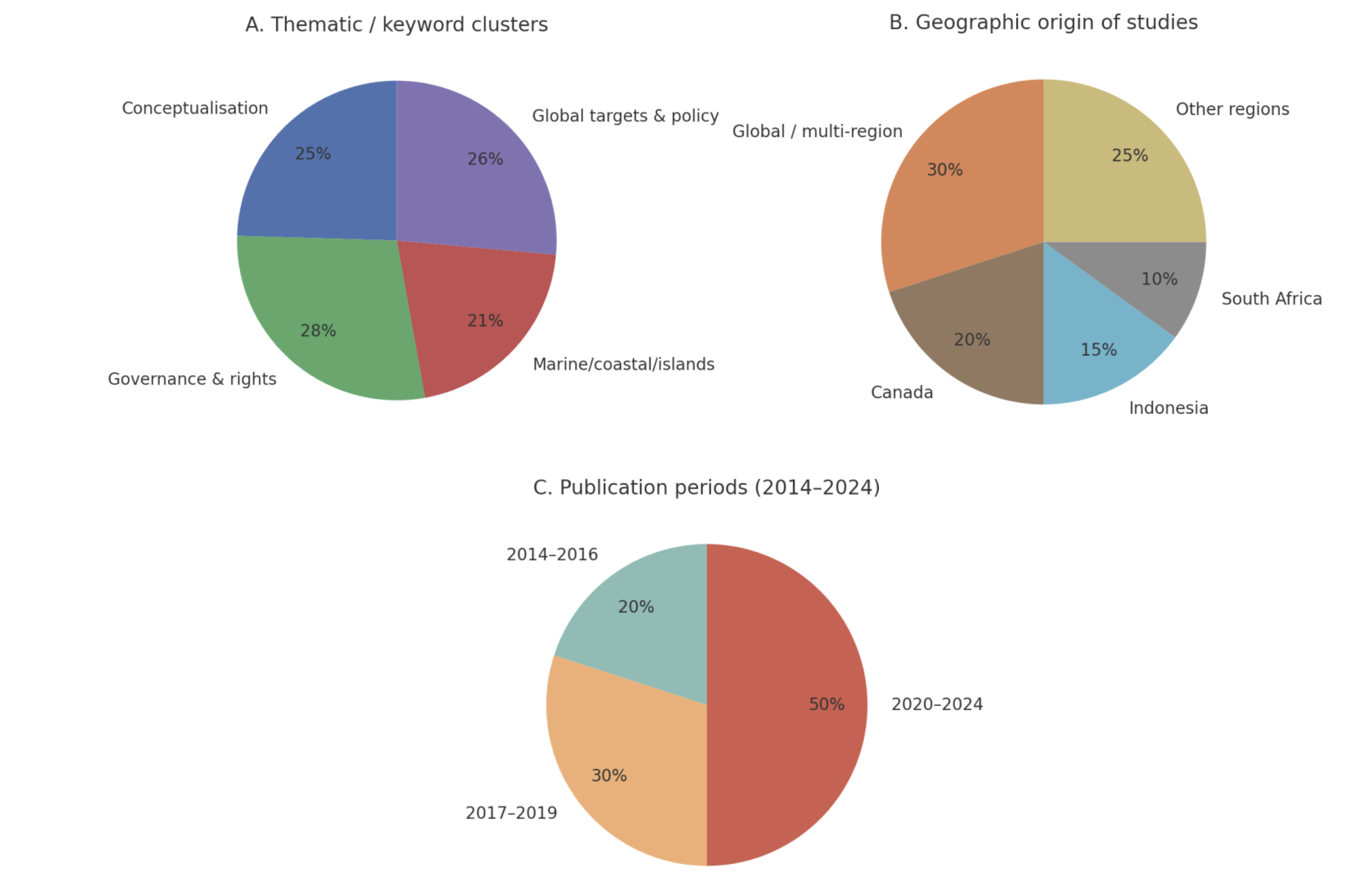
As shown in Figure 3A, governance and rights constitute the largest cluster, accounting for 28% of coded occurrences and highlighting that debates on OECMs are strongly shaped by questions of who governs, whose rights are recognized, and how safeguards are implemented. Conceptual and definitional work on OECMs and their relationship to protected areas accounts for 25% of occurrences, while references to global targets and policy instruments such as Aichi Target 11, SDG 14.5, 30×30, and the KMGBF represent 26%. Together, these clusters show that the literature focuses both on the conceptual positioning of OECMs within wider area-based conservation frameworks and on their role in global monitoring and reporting. Keywords related to marine, coastal, and island systems make up the remaining 21% and indicate a substantial and growing body of work on OECMs in archipelagic and seascape contexts, particularly in Indonesia and other coastal states. Figure 3B shows the geographic origin of the 20 reviewed studies. Global or multi-region analyses account for 30% of the sample and provide the conceptual backbone for understanding how OECMs have evolved and been incorporated into international biodiversity commitments. Among country-level studies, Canada contributes 20% of the articles, reflecting its early use of OECMs reporting and role as a testing ground for national implementation. Indonesia represents 15% of the sample, highlighting the potential recognition of marine OECMs in an archipelagic state with extensive small islands and coastal systems. South Africa contributes 10%, mainly on terrestrial biodiversity stewardship regimes. The remaining 25% fall under "other regions", including Europe and additional parts of the Global South. This pattern shows that OECMs debates are shaped both by actors in the Global North and by countries in the Global South that are experimenting with rights-based and community-centered conservation.
The temporal distribution of the 20 studies (Figure 3C) reveals three waves of publication. The earliest phase, 2014–2016, comprises 20% of the sample and coincides with efforts to interpret Aichi Target 11 and outline the initial contours of the OECMs concept. A second wave in 2017–2019 contributes 30% of the studies and is characterized by attempts to clarify criteria, distinguish OECMs from other instruments, and examine their prevalence in KBAs and national policy frameworks. The most recent period, 2020–2024, accounts for 50% of all reviewed articles and marks a clear acceleration of OECMs scholarship. This surge overlaps with negotiations on the post-2020 KMGBF, when OECMs began to be framed explicitly in relation to the 30×30 target and rights-based approaches. These temporal patterns mirror broader bibliometric trends and suggest a shift from mainly conceptual work toward more applied analyses of governance models, marine and island applications, and the practical use of OECMs in reporting progress toward 30×30.
3.4 Wordcloud synthesis and conceptual insights
To complement the preceding results, the author keywords from the 20 studies included in this systematic review were aggregated and visualized in a wordcloud, which highlights the concepts that recur most frequently across the corpus and how they cluster around the main thematic concerns of OECMs scholarship. The resulting wordcloud is presented in Figure 4, where the relative size of each word reflects its frequency of occurrence in the combined keyword list.
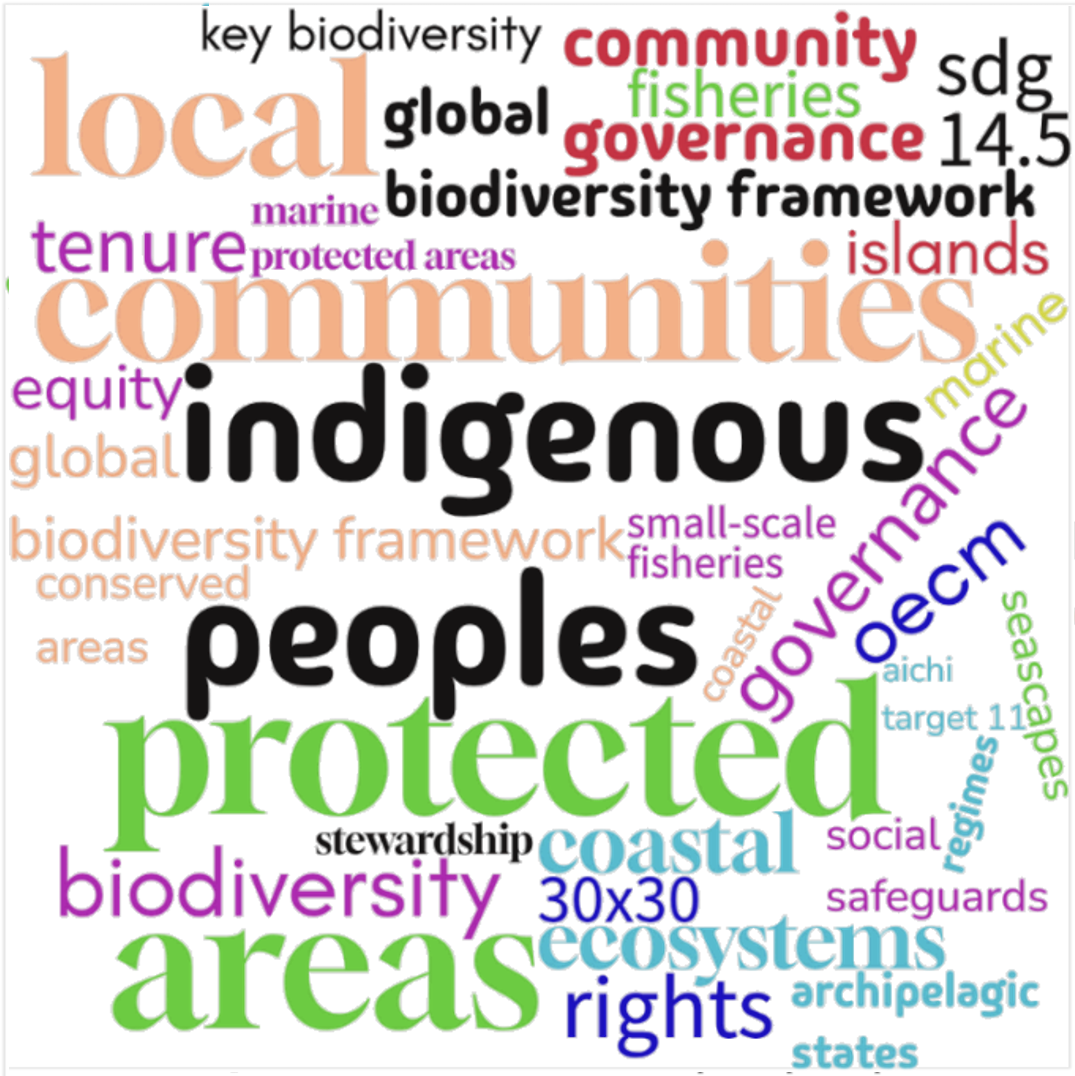
As shown in Figure 4, the most prominent terms are "protected areas or PAs", "Indigenous peoples or IPs", "Local Communities or LCs", "governance", and "biodiversity". Their dominance signals a persistent concern with how OECMs are distinguished from, yet related to, conventional protected-area systems and with who manages and benefits from conserved spaces. Keywords linked to governance and social safeguards such as "rights", "tenure", "safeguards", "stewardship", "community governance" confirm that debates around OECMs are fundamentally about justice, accountability, and power rather than purely technical conservation tools. Marine and coastal terms such as "marine protected areas or MPAs", "fisheries", "coastal ecosystems", "seascapes", and "archipelagic states" indicate that much of the literature examined here is anchored in seascapes and island settings, often in relation to customary marine tenure and small-scale fisheries. Policy-oriented keywords including "Aichi Target 11", "SDG 14.5", "biodiversity framework", and "30×30" underline the tight coupling between OECMs studies and global biodiversity governance, showing that OECMs are routinely framed through international targets and reporting obligations. Overall, the wordcloud provides a concise visual synthesis of the OECMs studies landscape, spanning conceptual debates, governance and rights, marine and island applications, and global policy.
These patterns illuminate the main insights of the review in relation to the five research questions. For RQ1, the literature shows a progression from early conceptual work (2014–2016) interpreting Aichi Target 11 and outlining OECMs as area-based measures outside formal protected-area systems, through a second wave (2017–2019) that refines definitions, criteria, and safeguards, to a recent phase (2020–2024) marked by rapid growth and stronger engagement with marine, coastal, and island social-ecological systems linked to the 30×30 agenda under the KMGBF. For RQ2, the prominence of global policy language reflects the central role of international organizations, research institutes, and universities mostly in the Global North in defining OECMs and connecting them to global targets, while case-based studies from Canada, Indonesia, South Africa, and other regions show that national agencies, civil-society organizations, and community institutions are crucial for implementation. Archipelagic and coastal states serve as important sites of empirical innovation but remain less visible as agenda-setters, highlighting asymmetries in epistemic authority and the need for stronger leadership from institutions rooted in coastal and island regions. For RQ3 and RQ4, the clustering of terms around "protected areas or PAs", "governance", and "biodiversity framework" mirrors the role of a relatively small group of high-impact journals that anchor OECMs scholarship. Widely cited articles in these outlets define OECMs, propose criteria, and assess their contribution to global targets, while empirical studies on seascapes and fisheries test these ideas. The four main keyword clusters, namely conceptual and definitional issues, governance and rights, marine and island systems, and global policy terms, show how conservation, culture, and social-ecological systems in islands and seas are tightly linked in the literature. Finally, in relation to RQ5, the underlying corpus points to an emergent but uneven international collaboration network: multi-author papers often involve cross-country teams and a mix of researchers, practitioners, and NGOs, yet high-income countries still dominate authorship, whereas archipelagic and island states appear more frequently as case-study locations than as hubs of agenda-setting.
Taken together, the evidence suggests that effective OECMs in marine and island social-ecological systems are best understood at the intersection of four interdependent domains 1) a clearly delimited conceptual status in relation to protected areas and other conserved spaces, where OECMs function as complementary rather than substitutive measures; 2) governance and rights arrangements that secure tenure, participation, and social safeguards for IPs and LCs; 3) context-specific social-ecological settings especially seascapes, fisheries, and archipelagic systems shaped by biocultural relationships and overlapping jurisdictions; and 4) embedding within national and global policy frameworks in ways that strengthen, rather than dilute, ecological integrity and social justice. From this perspective, OECMs emerge not as additional polygons for meeting coverage targets, but as governance configurations that integrate biodiversity outcomes, rights-based conservation, and the specific ecological and cultural conditions of marine and island systems.
Operationally, these four domains can be translated into an assessment pathway for identifying marine and island OECMs. First, reviewers and policy actors should verify whether the site has a clearly delimited area, a non-protected-area legal status, and demonstrable in situ biodiversity outcomes. Second, they should evaluate governance quality through tenure clarity, participation, free, prior, and informed consent where relevant, and the presence of social safeguards for Indigenous Peoples and Local Communities. Third, they should assess context-specific social-ecological fit by examining whether the measure responds to seascape connectivity, fisheries use, customary marine tenure, and overlapping island or coastal jurisdictions. Fourth, they should align site-level evidence with national reporting and global policy criteria through transparent indicators, periodic monitoring, and accountability mechanisms so that recognition strengthens rather than dilutes conservation standards.
4. Conclusions
This review used a PRISMA-guided SLR combined with bibliometric mapping to examine how OECMs scholarship in marine and island social-ecological systems has developed between 2014 and 2024. The analysis shows a clear shift from early conceptual exploration of Aichi Target 11 toward more applied work that tests OECMs criteria, safeguards, and governance models in seascapes and archipelagic settings. Publication patterns, author affiliations, and collaboration networks reveal that a small group of international organizations and research institutes, largely based in the Global North, still set much of the agenda, while coastal and island states contribute growing but uneven empirical leadership. Across journals and study designs, the most influential contributions converge on four interconnected domains, namely: 1) the conceptual positioning of OECMs in relation to protected areas and other conserved spaces; 2) governance, rights, and social safeguards for IPs and LCs; 3) context-specific marine, coastal, and island social-ecological settings; and 4) the embedding of OECMs within global policy frameworks such as Aichi Target 11, SDG 14.5, and the KMGBF 30×30 target. The keyword structures and wordcloud patterns underscore that OECMs are consistently framed not as neutral technical tools, but as governance configurations that sit at the intersection of biodiversity conservation, equity, and international target setting. For policy and practice, the findings imply that recognizing OECMs in marine and island environments should be treated as an opportunity to raise standards, not as a shortcut for expanding reported coverage. Robust attention to tenure, participation, and monitoring is especially important in archipelagic and small-island states, where overlapping jurisdictions and long histories of coastal marginalization shape the politics of recognition. This review has several limitations that should be acknowledged, namely: 1) our analysis is based solely on Scopus-indexed, English-language journal articles; and 2) the search string focused on explicit use of the term "OECMs" in titles, purposes, and findings.
Acknowledgements
We thank our colleagues and institutional partners for their support in developing the conceptual framework for Other Effective Area-Based Conservation Measures (OECMs) and in preparing this manuscript. We also acknowledge the digital library and e-resource services at Institut Pertanian Bogor (IPB), the e-Resource and Bibliometric Analysis services of the National Research and Innovation Agency (BRIN), and the digital library services at Universitas Negeri Padang (UNP) for facilitating access to Scopus and other bibliographic resources used in this review.
References
- Alves-Pinto, H., Geldmann, J., Jonas, H., Maioli, V., Balmford, A., Latawiec, A. E., Crouzeilles, R., Strassburg, B. 2021. Opportunities and challenges of other effective area-based conservation measures (OECMs) for biodiversity conservation. Perspectives in Ecology and Conservation, 19(2): 115–120. DOI: https://doi.org/10.1016/j.pecon.2021.01.004
- Amiruddin, M. Z. B., Samsudin, A., Suhandi, A., Coştu, B., Prahani, B. K. 2025. Scientific mapping and trend of conceptual change: A bibliometric analysis. Social Sciences & Humanities Open, 11: 101208. DOI: https://doi.org/10.1016/j.ssaho.2024.101208
- Aryantie, M. H., Hidayat, M. Y., Widodo, T., Putra, A., Dewata, I. 2023. Environmental perspectives to the rejection of Javanese karst mining in systematic literature reviews. International Journal of Sustainable Development and Planning, 18(12): 3757–3764. DOI: https://doi.org/10.18280/ijsdp.181207
- Bhola, N., Klimmek, H., Kingston, N., Burgess, N. D., van Soesbergen, A., Corrigan, C., Harrison, J., Kok, M. T. J. 2021. Perspectives on area-based conservation and its meaning for future biodiversity policy. Conservation Biology, 35(1): 1–11. DOI: https://doi.org/10.1111/cobi.13509
- Butchart, S. H. M., Clarke, M., Smith, R. J., Sykes, R. E., Scharlemann, J. P. W., Harfoot, M., Buchanan, G. M., Angulo, A., Balmford, A., Bertzky, B., Brooks, T. M., Carpenter, K. E., Comeros-Raynal, M. T., Cornell, J., Ficetola, G. F., Fishpool, L. D. C., Fuller, R. A., Geldmann, J., Harwell, H., Hilton-Taylor, C., Hoffmann, M., Joolia, A., Joppa, L., Kingston, N., May, I., Milam, A., Polidoro, B., Ralph, G., Richman, N., Rondinini, C., Segan, D. B., Skolnik, B., Spalding, M. D., Stuart, S. N., Symes, A., Taylor, J., Visconti, P., Watson, J. E. M., Wood, L., Burgess, N. D. 2015. Shortfalls and solutions for meeting national and global conservation area targets. Conservation Letters, 8(5): 329–337. DOI: https://doi.org/10.1111/conl.12158
- Cook, C. N. 2024. Progress developing the concept of other effective area-based conservation measures. Conservation Biology, 38(1): e14106. DOI: https://doi.org/10.1111/cobi.14106
- Dawson, N. M., Coolsaet, B., Bhardwaj, A., Booker, F., Brown, D., Lliso, B., Loos, J., Martin, A., Oliva, M., Pascual, U., Sherpa, P., Worsdell, T. 2024. Is it just conservation? A typology of Indigenous peoples’ and local communities’ roles in conserving biodiversity. One Earth, 7(6): 1007–1021. DOI: https://doi.org/10.1016/j.oneear.2024.05.001
- Diz, D., Johnson, D., Riddell, M., Rees, S., Battle, J., Gjerde, K., Hennige, S., Roberts, J. M. 2018. Mainstreaming marine biodiversity into the SDGs: The role of other effective area-based conservation measures (SDG 14.5). Marine Policy, 93: 251–261. DOI: https://doi.org/10.1016/j.marpol.2017.08.019
- Donald, P. F., Buchanan, G. M., Balmford, A., Bingham, H., Couturier, A. R., de la Rosa, G. E., Jr., Gacheru, P., Herzog, S. K., Jathar, G., Kingston, N., Marnewick, D., Maurer, G., Reaney, L., Shmygaleva, T., Sklyarenko, S., Stevens, C. M. D., Butchart, S. H. M. 2019. The prevalence, characteristics and effectiveness of Aichi Target 11’s “other effective area-based conservation measures” (OECMs) in Key Biodiversity Areas. Conservation Letters, 12(5): e12659. DOI: https://doi.org/10.1111/conl.12659
- Dudley, N., Jonas, H., Nelson, F., Parrish, J., Pyhälä, A., Stolton, S., Watson, J. E. M. 2018. The essential role of other effective area-based conservation measures in achieving big bold conservation targets. Global Ecology and Conservation, 15: e00424. DOI: https://doi.org/10.1016/j.gecco.2018.e00424
- Donthu, N., Kumar, S., Mukherjee, D., Pandey, N., Lim, W. M. 2021. How to conduct a bibliometric analysis: An overview and guidelines. Journal of Business Research, 133: 285-296. DOI: https://doi.org/10.1016/j.jbusres.2021.04.070
- Estradivari, Agung, M. F., Adhuri, D. S., Ferse, S. C. A., Sualia, I., Andradi-Brown, D. A., Campbell, S. J., Iqbal, M., Jonas, H. D., Lazuardi, M. E., Nanlohy, H., Pakiding, F., Pusparini, N. K. S., Ramadhana, H. C., Ruchimat, T., Santiadji, I. W. V., Timisela, N. R., Veverka, L., Ahmadia, G. N. 2022. Marine conservation beyond marine protected areas: The role of other effective area-based conservation measures in Indonesia. Marine Policy, 137: 104939. DOI: https://doi.org/10.1016/j.marpol.2021.104939
- Fitzsimons, J. A., Partridge, T., Keen, R. 2024. Other effective area-based conservation measures (OECMs) in Australia: Key considerations for assessment and implementation. Conservation, 4(2): 176–200. DOI: https://doi.org/10.3390/conservation4020013
- Gale, T., Báez Montenegro, A. 2024. Toward understanding research evolution on indirect drivers of ecosystem change along the interface of protected and non-protected lands. Sustainability, 16(17): 7572. DOI: https://doi.org/10.3390/su16177572
- Garcia, S. M., Rice, J., Himes-Cornell, A., Friedman, K. J., Charles, A., Diz, D., Appiott, J., Kaiser, M. J. 2022. OECMs in marine capture fisheries: Key implementation issues of governance, management and biodiversity. Frontiers in Marine Science, 9: 920051. DOI: https://doi.org/10.3389/fmars.2022.920051
- Gurney, G. G., Darling, E. S., Ahmadia, G. N., Agostini, V. N., Ban, N. C., Blythe, J., Claudet, J., Epstein, G., Estradivari, Himes-Cornell, A., Jonas, H. D., Armitage, D., Campbell, S. J., Cox, C., Friedman, W. R., Gill, D., Lestari, P., Mangubhai, S., McLeod, E., Muthiga, N. A., Naggea, J., Ranaivoson, R., Wenger, A., Yulianto, I., Jupiter, S. D. 2021. Biodiversity needs every tool in the box: Use OECMs. Nature, 595(7869): 646–649. DOI: https://doi.org/10.1038/d41586-021-02041-4
- Hermon, D., Putra, A., Tengku Hamzah, T.A.A. 2026. Flood Risk Mapping and Adaptive Sustainability Assessment for Ecological Resilience in Kampar Regency, Indonesia. Environmental Management, 76: 130. DOI: https://doi.org/10.1007/s00267-026-02428-x
- Huq, N., Pedroso, R., Bruns, A., Ribbe, L., Huq, S. 2020. Changing dynamics of livelihood dependence on ecosystem services at temporal and spatial scales: An assessment in the southern wetland areas of Bangladesh. Ecological Indicators, 110: 105855. DOI: https://doi.org/10.1016/j.ecolind.2019.105855
- Jonas, H. D., Barbuto, V., Jonas, H. C., Kothari, A., Nelson, F. 2014. New steps of change: Looking beyond protected areas to consider other effective area-based conservation measures. Parks, 20(2): 111–128. DOI: https://doi.org/10.2305/IUCN.CH.2014.PARKS-20-2.HDJ.en
- Jonas, H. D., Lee, E., Jonas, H. C., Matallana-Tobon, C., Wright, K. S., Nelson, F., Enns, E. 2017. Will “other effective area-based conservation measures” increase recognition and support for ICCAs? Parks, 23(2): 63–78. DOI: https://doi.org/10.2305/IUCN.CH.2017.PARKS-23-2HDJ.en
- Jonas, H. D., Bingham, H. C., Bennett, N. J., Woodley, S., Zlatanova, R., Howland, E., Belle, E., Upton, J., Gottlieb, B., Kamath, V., Lessmann, J., Delli, G., Dubois, G., Ahmadia, G. N., Claudet, J., Cook, C. N., Deza, J., Grorud-Colvert, K., Gurney, G. G., Lemieux, C. J., Ruiz, L. 2024. Global status and emerging contribution of other effective area-based conservation measures (OECMs) towards the ‘30×30’ biodiversity Target 3. Frontiers in Conservation Science, 5: 1447434. DOI: https://doi.org/10.3389/fcosc.2024.1447434
- Laffoley, D., Dudley, N., Jonas, H., MacKinnon, D., MacKinnon, K., Hockings, M., Woodley, S. 2017. An introduction to ‘other effective area-based conservation measures’ under Aichi Target 11 of the Convention on Biological Diversity: Origin, interpretation and emerging ocean issues. Aquatic Conservation: Marine and Freshwater Ecosystems, 27(S1): 130–137. DOI: https://doi.org/10.1002/aqc.2783
- Lemieux, C. J., Kraus, D. T., Beazley, K. F. 2022. Running to stand still: The application of substandard OECMs in national and provincial policy in Canada. Biological Conservation, 275: 109780. DOI: https://doi.org/10.1016/j.biocon.2022.109780
- MacKinnon, D., Lemieux, C. J., Beazley, K., Woodley, S., Helie, R., Perron, J., Elliott, J., Haas, C., Langlois, J., Lazaruk, H., Beechey, T., Gray, P. 2015. Canada and Aichi Biodiversity Target 11: understanding ‘other effective area-based conservation measures’ in the context of the broader target. Biodiversity and Conservation, 24(14): 3559–3581. DOI: https://doi.org/10.1007/s10531-015-1018-1
- Maini, B., Blythe, J. L., Darling, E. S., Gurney, G. G. 2023. Charting the value and limits of other effective conservation measures (OECMs) for marine conservation: A Delphi study. Marine Policy, 147: 105350. DOI: https://doi.org/10.1016/j.marpol.2022.105350
- McKenna, J. W. 2024. Systematic literature reviews. In B. L. Hott, F. J. Brigham, C. Peltier (Eds.), Research methods in special education, pp. 89–111. Routledge
- Mitchell, B. A., Fitzsimons, J. A., Stevens, C. M. D., Wright, D. R. 2018. PPA or OECMs? Differentiating between privately protected areas and other effective area-based conservation measures on private land. Parks, 24(S1): 49–60. DOI: https://doi.org/10.2305/IUCN.CH.2018.PARKS-24-SIBAM.EN
- Paterson, A. R. 2023. Other effective area-based conservation measures, biodiversity stewardship and statutory intervention – A South African perspective. Potchefstroom Electronic Law Journal, 26: 1–45. DOI: https://doi.org/10.17159/1727-3781/2023/v26i0a15441
- Pati, D., Lorusso, L. N. 2018. How to write a systematic review of the literature. HERD: Health Environments Research, Design Journal, 11(1): 15–30. DOI: https://doi.org/10.1177/1937586717747384
- Podda, C., Porporato, E. M. D. 2023. Marine spatial planning for connectivity and conservation through ecological corridors between marine protected areas and other effective area-based conservation measures. Frontiers in Marine Science, 10: 1271397. DOI: https://doi.org/10.3389/fmars.2023.1271397
- Putra, A., Dewata, I., Hermon, D., Barlian, E., Umar, G. 2023. Sustainable Development-Based Coastal Management Policy Development: A Literature Review. Journal of Sustainability Science and Management, 18(1): 237–245. DOI: https://doi.org/10.46754/jssm.2023.01.015
- Rees, S. E., Foster, N. L., Langmead, O., Pittman, S. J., Johnson, D. E. 2018. Defining the qualitative elements of Aichi Biodiversity Target 11 with regard to the marine and coastal environment in order to strengthen global efforts for marine biodiversity conservation outlined in the United Nations Sustainable Development Goal 14. Marine Policy, 93: 241–250. DOI: https://doi.org/10.1016/j.marpol.2017.05.016
- Tasneem, S., Ahsan, M. N. 2024. A bibliometric analysis on mangrove ecosystem services: Past trends and emerging interests. Ocean and Coastal Management, 256: 1-14. DOI: https://doi.org/10.1016/j.ocecoaman.2024.107276
- Watson, J. E. M., Dudley, N., Segan, D. B., Hockings, M. 2014. The performance and potential of protected areas. Nature, 515(7525): 67–73. DOI: https://doi.org/10.1038/nature13947
- Watson, J. E. M., Venegas-Li, R., Grantham, H., Dudley, N., Stolton, S., Rao, M., Woodley, S., Hockings, M., Burkart, K., Simmonds, J. S. 2023. Priorities for protected area expansion so nations can meet their Kunming–Montreal Global Biodiversity Framework commitments. Integrative Conservation, 2(3): 140–155. DOI: https://doi.org/10.1002/inc3.24
- Zabala, A., Palomo, I., Múgica, M., Montes, C. 2024. Challenges beyond reaching a 30% of area protection. npj Biodiversity, 3: 9. DOI: https://doi.org/10.1038/s44185-024-00041-x