
Bridged or Isolated? Life Satisfaction and Industrial Perceptions in Connected vs. Unconnected Islands: Regional Revitalization Implications
 10.21463/jmic.2026.15.1.21
Abstract
This study examines how fixed-link connections influence island residents’ life satisfaction and perceptions of preferred future industries in Shinan County, Jeollanam-do, South Korea. Based on a survey of 344 residents from connected and unconnected islands, the study compares overall life satisfaction, satisfaction with health-care services and cultural life, and preferred future industries. The results show statistically significant differences in overall life satisfaction and health-care service satisfaction by fixed-link status, while cultural life satisfaction shows only marginal significance at the 10 percent level. Preferred future industries also differ significantly by fixed-link status. However, both groups commonly show high preferences for accommodation and food services and tourism and leisure services. These findings suggest that fixed-link status is an important structural factor shaping island residents’ quality of life and perceptions of preferred future industries, but its effects are selective and complex rather than uniform. The study concludes that island policy should move beyond one-dimensional assumptions about fixed-link effects and adopt differentiated strategies that reflect the specific characteristics of connected and unconnected islands.
Keywords
island connectivity, fixed-link infrastructure, regional revitalization, rural development, infrastructure-led growth, infrastructure impact, resident perceptions, industrial diversification, accessibility effects
1. Introduction
Island regions are distinctive marine and island cultures where isolation and openness operate simultaneously, shaped by their geographical character as territories surrounded by the sea (Lee et al., 2012; Park, 2022). This duality influences residents' quality of life, cultural participation, and industrial aspirations, with the sea serving as both a channel enabling exchange with the outside world and a physical boundary constraining daily lives and economic activities. Against this backdrop of duality, islands have continuously experienced a complex set of challenges, including limited transport accessibility, high logistics costs, narrow market scale, population outflow, demographic aging, and insufficient public services. In this study, fixed-link status refers to whether an island is connected to the mainland by a bridge or causeway, as opposed to remaining dependent on maritime transport. In South Korea in particular, most islands have maintained livelihood structures centered on primary industries such as agriculture, fisheries, and aquaculture; yet insufficient industrial diversification and inadequate development of the living infrastructure have allowed the vulnerability of residential conditions and the local economy to accumulate over time.
The South Korean government and local authorities have implemented a series of policies—including the Island Comprehensive Development Project, fishing village and port revitalization, and rural and agricultural village development initiatives—aimed at improving infrastructure and living conditions in island regions (Shin, 1997; Kim et al., 2008). These approaches, however, have also been assessed as having a tendency to focus primarily on expanding physical infrastructure and reducing living-standard disparities, while delivering limited results in terms of industrial structural transformation and improvements in residents' perceived quality of life (Seo et al., 2009; Shin and Park, 2012). In cases where uniform support was applied without carefully distinguishing among island types, levels of accessibility, scales, and demographic structures, there were numerous instances in which the policies failed to translate into meaningful gains in life satisfaction or industrial revitalization.
Against this backdrop, fixed links—land-to-island bridges and inter-island causeways—have come to be recognized as key infrastructure for mitigating the structural limitations of islands. Fixed links are expected to reduce travel time and transportation costs by permanently connecting islands to the mainland, and to improve accessibility to logistics, tourism, and public services (Baldacchino et al., 2007; McQuaid and Greig, 2007). Beyond simply enhancing mobility, fixed links may operate as a factor of change that also influences residents' perceptions of their living conditions, future prospects, and industrial choices. The effects of fixed links are not uniform, however: while some islands experience expansion in tourism and commercial functions, others may see their existing livelihoods maintained or their dependence on external resources intensified. It is therefore necessary to empirically analyze what kinds of differences fixed-link status—that is, whether an island is connected to the mainland by a bridge or causeway, as opposed to remaining dependent on maritime transport—actually produces in residents’ life satisfaction and in the structure of their industry perceptions.
Existing research has focused primarily on tourism change, transport accessibility, land use, and spatial restructuring following bridge connections (Jeong et al., 2019; Park, 2022), yet comparative studies examining life satisfaction and perceptions of preferred future industries between connected and unconnected island residents remain relatively scarce. From the perspective of island policy development, it is particularly important to clarify what differential effects fixed-link status exerts on residents' quality of life and perceptions of preferred future industries. This study therefore conducts a resident survey of connected and unconnected islands in Shinan County (Shinan-gun), Jeollanam-do, to compare and analyze differences in life satisfaction and industry perceptions by fixed-link status. The study aims to examine the possibility of utilizing fixed-link status as a typological criterion in island policy, and to propose differentiated policy directions by island type.
2. Theoretical Background
Islands are not simply geographic units separated from the mainland but complex spaces in which isolation and openness overlap. Island residents' lives are shaped by the natural environment, maritime transport conditions, livelihood structures, and modes of external connection—all of which affect lifestyles, social relationships, and community identity. Island regions generally have small populations and limited markets, making industrial diversification difficult and the efficient provision of public services challenging (Lee et al., 2012; Shin and Park, 2012). Islands therefore need to be understood not only as physically isolated spaces but as spaces where physical isolation and socioeconomic vulnerability are combined (Sun, B., et al., 2019).
South Korean island development policy has long emphasized reducing disparities and expanding basic infrastructure. Although roads, ports, water supply systems, electricity, housing, and welfare facilities have been improved to some extent (Shin, 1997; Kim et al., 2008), this approach has had limitations in promoting the capacity for endogenous development and facilitating industrial structural transformation in island regions (Shin and Park, 2012; Park, 2022). In particular, policies that failed to account for differences in accessibility—such as fixed-link status—resulted in uniform support being applied indiscriminately to islands with very different conditions. More recently, island policy has been expanding beyond the simple remediation of underdevelopment toward more complex directions, including sustaining residential continuity, expanding the living population (non-resident regular users of island areas), fostering tourism and leisure services, and utilizing cultural and ecological resources. This points to the need for a typologically differentiated approach to island policy.
Prior research on fixed links generally divides into two streams. One line of research holds that fixed links improve mobility and accessibility, thereby contributing to transportation convenience, tourism revitalization, improved logistics efficiency, and increased economic activity (Baldacchino et al., 2007). The other holds that fixed links bring about a reorganization of community structures, cultural identity, livelihood systems, and daily lives within island societies. The former views fixed links as a catalyst for development (Kubota et al., 2021; Jeong et al., 2019), while the latter holds that fixed links may also entail negative effects, including increased external dependency, lifestyle change, and weakening of community cohesion, thereby reshaping residents’ daily lives and community relations (Park, 2022; Jeong et al., 2019). Fixed links are thus not a uniform benefit but a structural variable that induces complex changes in the patterns of living and industrial activity.
Drawing on this body of research, fixed-link status can be understood not merely as the presence or absence of transport infrastructure but as a higher-order structural variable that shapes residents' overall evaluations of their living conditions and their perceptions of preferred future industries. Fixed links can raise mobility and accessibility in ways that affect a range of domains—including healthcare, cultural life, consumption, and commercial activity—yet the effects are unlikely to manifest uniformly across all dimensions of daily living. In terms of industrial orientation as well, connected islands may more readily envision a development path centered on tourism and services, while unconnected islands may have a relatively greater policy demand for sustaining existing livelihood bases and improving distribution functions. Building on this theoretical background, the present study empirically examines what kinds of differences fixed-link status produces in life satisfaction and perceptions of preferred future industries.
3. Research Design and Methods
The study area is Shinan County (Shinan-gun), Jeollanam-do, South Korea. Shinan County includes numerous inhabited and uninhabited islands, some of which are connected to the mainland via fixed links—including land-to-island bridges and inter-island causeways—while others remain dependent on maritime transport. To compare the effects of this difference in accessibility on residents' lives and industrial perceptions, we distinguished between connected and unconnected islands. Connected islands surveyed were Aphae-do, Anjwa-do, Amtae-do, Jaeun-do, and Palgeum-do; unconnected islands were Docho-do, Bigeum-do, Sangtae-do and Hatae-do (combined due to their geographical proximity and similar accessibility patterns, listed as Sangtae-do/Hatae-do in the survey), Jangsan-do, and Haui-do.
Sample sizes were determined using proportional allocation based on the square root method, drawing on each island's 2022 population (Table 1). A structured questionnaire was administered through face-to-face and telephone surveys conducted from August 21 to September 10, 2023. A total of 400 questionnaires were collected, of which 344 were retained for final analysis after excluding insincere responses and those with excessive missing values. Insincere responses were identified by straight-lining across multiple items, substantial item nonresponse (more than 30% missing), or logically inconsistent answer patterns (e.g., contradictory responses to related items). In the life domain, we measured overall life satisfaction, satisfaction with health-care services, and satisfaction with cultural life; in the industry domain, we surveyed perceptions of preferred future industries. Responses were composed primarily of Likert-scale and categorical items.
| Type | Island | Population | Sample (n) | (%) |
|---|---|---|---|---|
| Unconnected | Docho-do | 2,475 | 49 | 22.7 |
| Bigeum-do | 3,484 | 56 | 25.9 | |
| Sangtae-do/Hatae-do | 1,517 | 38 | 17.6 | |
| Jangsan-do | 1,521 | 38 | 17.6 | |
| Haui-do | 1,669 | 35 | 16.2 | |
| Subtotal | 10,666 | 216 | 100.0 | |
| Connected | Aphae-do | 5,615 | 72 | 30.3 |
| Anjwa-do | 2,295 | 51 | 21.4 | |
| Amtae-do | 1,951 | 40 | 16.8 | |
| Jaeun-do | 2,295 | 45 | 18.9 | |
| Palgeum-do | 965 | 30 | 12.6 | |
| Subtotal | 13,121 | 238 | 100.0 |
Analysis was conducted using SPSS, centering on descriptive statistics, cross-tabulation, and chi-square tests. Fixed-link status was treated as the independent variable; overall life satisfaction, health-care service satisfaction, cultural life satisfaction, and perceptions of preferred future industries were treated as dependent variables. As the study aims to exploratorily confirm the existence and direction of differences by fixed-link status rather than to estimate causal relationships, results were interpreted primarily in terms of distributional differences and statistical significance.
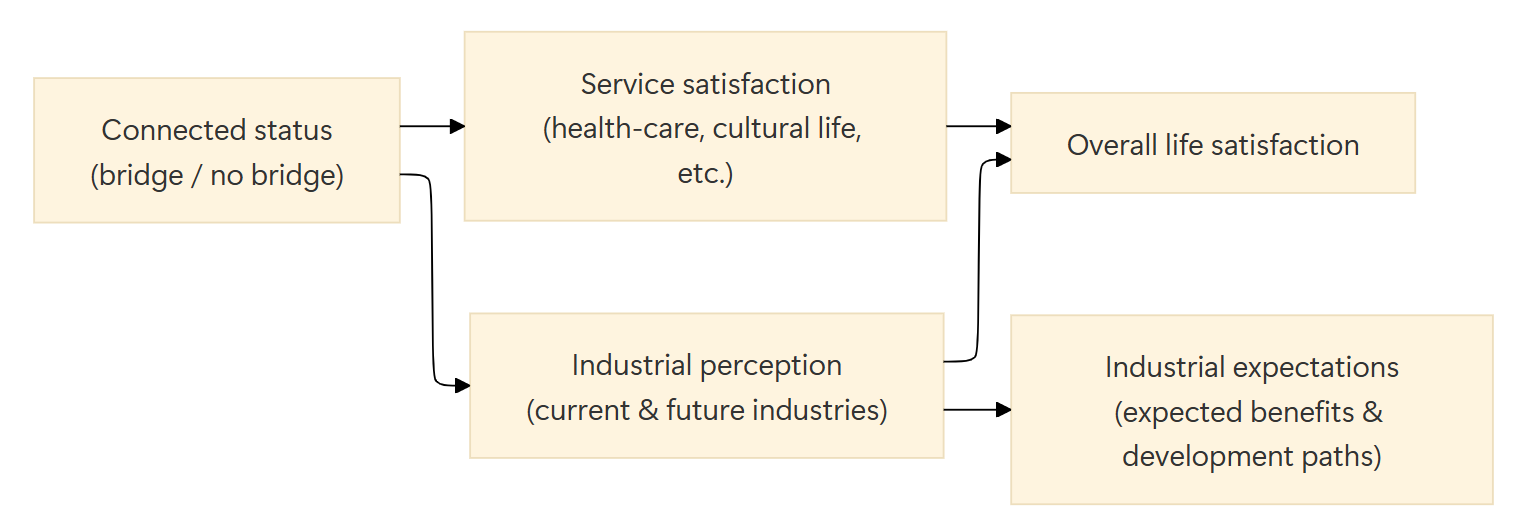
* Author-generated conceptual diagram based on the survey findings.
4. Results
4.1 Overall Life Satisfaction by Fixed-Link Status
The results showed statistically significant differences in overall life satisfaction by fixed-link status (Table 2, χ²(2) = 25.98, p < .001). Due to limited responses at scale extremes, categories 1-2 were combined as "low" and 4-5 as "high" to ensure stable cross-tabulation and clearer interpretation. Among connected island residents, 7.2% reported low satisfaction (scores of 1–2), 28.3% reported moderate satisfaction (score of 3), and 64.5% reported high satisfaction (scores of 4–5). The corresponding figures for unconnected island residents were 3.4%, 27.0%, and 69.7%, respectively.
| Variable | Category | Connected n(%) | Unconnected n(%) | χ² | p-value |
|---|---|---|---|---|---|
| Overall life satisfaction | Low (1–2) | 12(7.2) | 6(3.4) | 25.98 | <.001 |
| Medium (3) | 47(28.3) | 48(27.0) | |||
| High (4–5) | 107(64.5) | 124(69.7) | |||
| Health-care services | Low (1–2) | 10(6.0) | 1(0.6) | 8.19 | .004 |
| Medium (3) | 54(32.5) | 69(38.8) | |||
| High (4–5) | 102(61.4) | 108(60.7) | |||
| Cultural life | Low (1–2) | 18(10.9) | 6(3.4) | 5.49 | .064 |
| Medium (3) | 68(41.0) | 70(39.3) | |||
| High (4–5) | 80(48.2) | 102(57.3) |
These results indicate that the distributional pattern of overall life satisfaction differs by fixed-link status. Although the proportion of respondents reporting high satisfaction was somewhat higher among unconnected island residents, this finding should not be interpreted as simply indicating that unconnected islands have higher life satisfaction. A more appropriate interpretation is that fixed-link status constitutes a structural factor that alters the overall distributional pattern of life satisfaction, rather than consistently shifting satisfaction in a single direction. In other words, fixed-link status shapes not only the distributional pattern of life satisfaction but also the way in which residents assess their living conditions—and its effects do not manifest consistently in one direction.
4.2 Health-Care Service Satisfaction by Fixed-Link Status
Health-care service satisfaction also differed significantly by fixed-link status (χ²(2) = 8.19, p = .004). Among connected island residents, 6.0% reported low satisfaction, 32.5% moderate satisfaction, and 61.4% high satisfaction; the corresponding figures for unconnected island residents were 0.6%, 38.8%, and 60.7%, respectively. The proportion reporting high satisfaction showed little difference between the two groups, yet a statistically significant difference was confirmed in the overall response distribution.
Health-care services represent a critical domain directly linked to island residents' safety, survival, and residential continuity. These results therefore show that fixed-link status is one of the conditions that shapes residents' experiences of and satisfaction with health-care services. As with overall life satisfaction, however, a more appropriate reading is that the standards by which health care is evaluated and the experiences through which it is accessed are formed differently depending on fixed-link status, rather than interpreting these results as simply indicating that connected islands are better off than unconnected ones.
4.3 Cultural Life Satisfaction by Fixed-Link Status
Cultural life satisfaction showed only marginal significance at the p < .10 level (χ²(2) = 5.49, p = .064). Among connected island residents, 10.9% reported low satisfaction, 41.0% moderate satisfaction, and 48.2% high satisfaction; among unconnected island residents, the figures were 3.4%, 39.3%, and 57.3%, respectively. The proportion reporting high satisfaction was higher among unconnected island residents, while the proportion reporting low satisfaction was higher among connected island residents.
This result suggests that cultural life satisfaction may vary to some extent by fixed-link status, but that the difference is not as pronounced as it is for overall life satisfaction or health-care service satisfaction. Cultural life is shaped not only by physical connectivity but also by the cultural resources available within the local community, resident participation, the structure of daily living areas, and the vitality of community activities. The influence of fixed-link status on cultural life satisfaction is therefore limited, and a more complex set of variables must be considered alongside it. This aligns with island tourism perception studies showing that residents' cultural satisfaction is shaped by both connectivity and local resource utilization (Kim and Choi, 2017).
4.4 perceptions of preferred future industries by Fixed-Link Status
Analysis of perceptions of preferred future industries by fixed-link status revealed a statistically significant difference between the two groups (Table 3, χ² = 8.30, p = .004). Examining the specific responses, however, both connected and unconnected island residents showed a common orientation toward accommodation and food services and toward tourism and leisure services. Tourism and leisure services were preferred by 19.3% of connected island residents (n=32) and 14.0% of unconnected island residents (n=25).
| Preferred future industry | Connected n(%) | Unconnected n(%) | χ² | p-value |
|---|---|---|---|---|
| Accommodation & food services | 90(54.2) | 98(55.1) | 8.30 | .004 |
| Tourism & leisure services | 32(19.3) | 25(14.0) | ||
| Retail, transport & storage | 65(39.2) | 69(38.8) | ||
| Other services | 47(28.3) | 67(37.6) |
Retail, transport, and storage—distribution-based industries—were preferred by 39.2% of connected island residents and 38.8% of unconnected island residents, with connected island residents showing a somewhat higher preference. Other services were preferred by 28.3% of connected island residents and 37.6% of unconnected island residents, with unconnected island residents showing a relatively higher preference. These results suggest that while both groups regard tourism and leisure services as core future industries, meaningful differences exist in their expectations regarding specific industrial sub-categories.
These results indicate that while fixed-link status does not completely differentiate industrial perceptions across the board, it exerts meaningful effects on the details of development strategies and industrial priorities. Connected and unconnected islands share a common orientation toward the possibilities of tourism and leisure services; however, connected islands express a relatively stronger interest in expanding retail, transport, and storage, while unconnected islands reveal a relatively greater demand for other services.
4.5 Synthesis
Taken together, the results confirm that fixed-link status is an important structural variable that affects life satisfaction and industry perceptions. This complex pattern aligns with marine island studies documenting how connectivity influences residents' perceptions of tourism development and cultural life satisfaction (Yang and Kim, 2020). Its effects do not appear, however, in the simple form of connected islands being uniformly superior to unconnected islands. Overall life satisfaction and health-care service satisfaction showed significant distributional differences by fixed-link status, but the direction of those differences varied across items. Cultural life satisfaction showed differences only at a marginal level, while perceptions of preferred future industries revealed a shared high preference for tourism and leisure services in both groups.
Fixed-link status is thus an important condition shaping island residents' lives and perceptions of preferred future industries, but its effects should be understood as operating selectively and in complex ways rather than uniformly. This interpretation is consistent with prior studies on island bridge-induced social change and the differentiated development trajectories of island communities (Park, 2022) and with research showing that residents' perceptions are closely tied to tourism development processes in marine island settings (Song, 2025). Island policy should likewise reflect this complexity, utilizing fixed-link status not as a simple indicator of superiority or inferiority but as a structural criterion through which typological differences can be explained.
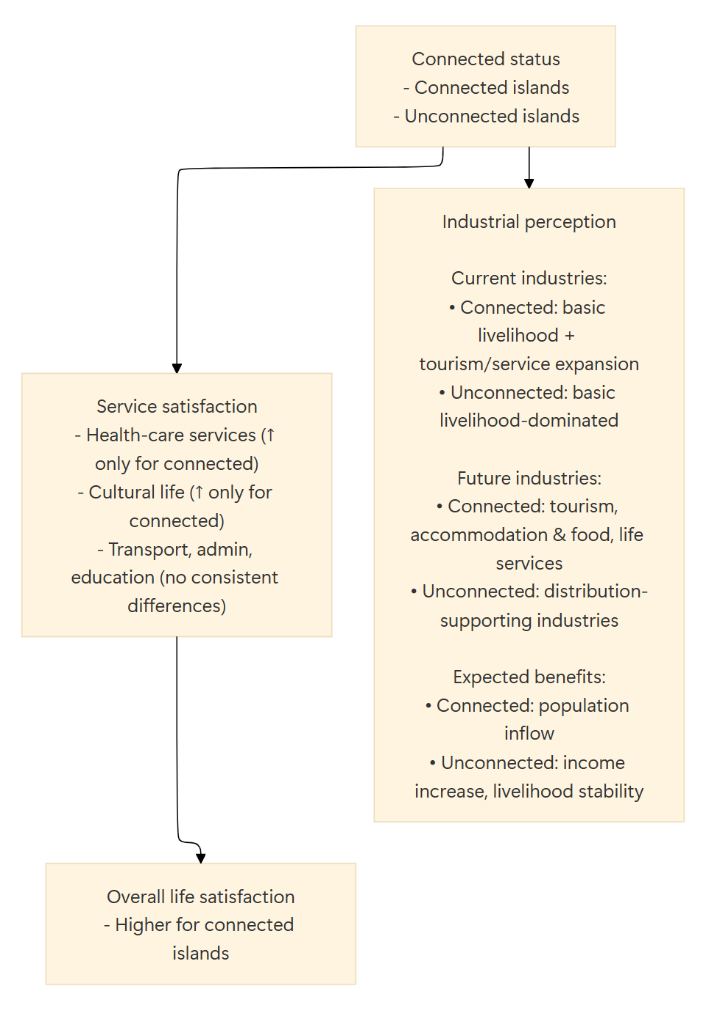
* Author-generated conceptual diagram summarizing the study's analytical pathways.
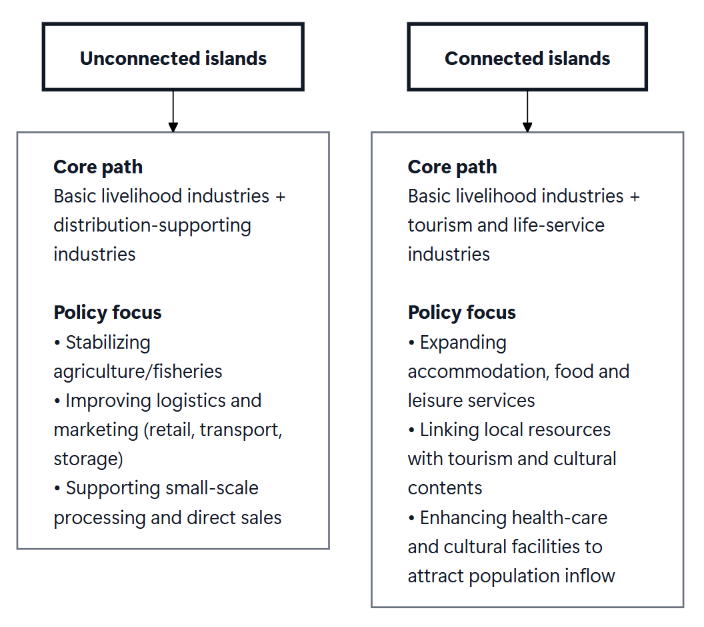
* Author-generated conceptual diagram based on empirical findings.
5. Conclusion and Policy Implications
This study analyzed residents of connected and unconnected islands in Shinan County (Shinan-gun), Jeollanam-do, and compared differences in life satisfaction and perceptions of preferred future industries by fixed-link status. The results showed that overall life satisfaction and health-care service satisfaction differed significantly by fixed-link status, while cultural life satisfaction exhibited only marginal significance at the p < .10 level. perceptions of preferred future industries also differed significantly by fixed-link status; nevertheless, both connected and unconnected island residents showed a high preference for accommodation and food services and tourism and leisure services.
These findings demonstrate that fixed-link status is an important structural variable shaping island residents' lives and perceptions of preferred future industries. At the same time, however, its effects are not unidirectional; rather, they operate selectively and in complex ways across different items. Fixed-link status should therefore not be understood as a simple indicator of development level but as a typological criterion through which differences in life satisfaction and industrial perceptions can be explained.
From a policy perspective, since both connected and unconnected island residents recognize tourism and leisure services as core future industries, island policy may treat extended-stay tourism and local service industries as important pillars, consistent with island revitalization research emphasizing tourism-led development (Kang et al., 2023; Yang and Kim, 2020). For connected islands, it would be advisable to strengthen retail, transport, and storage to leverage enhanced connectivity for tourism-service scalability and local economic circulation. For unconnected islands, support for other services appears particularly relevant to bolster community-grounded functions while maintaining cultural identity (Park, 2022).
These differentiated strategies align with findings from Shinan-gun's bridge projects, which have transformed island society while highlighting the need for type-specific approaches (Park, 2022). Similar to resident perception studies in Korean marine tourism contexts (Song, 2025), fixed-link status shapes not only economic preferences but also cultural life satisfaction, underscoring the importance of culturally sensitive revitalization policies for marine island communities.
Island policy must ultimately be designed not as a set of separate approaches to industry and living services, but as an integrated strategy that considers residents' quality of life and local industrial structure together. Fixed-link connections provide important physical foundations, but they do not automatically improve life satisfaction or transform industrial structure. Future policy must therefore shift toward a tailored approach that reflects differences by fixed-link status while also taking into account each island's internal resources, the structure of its daily living area, and the needs of its residents.
The findings illuminate marine island cultures where physical connectivity intersects with cultural life satisfaction and community-driven economic revitalization, highlighting the need for island-specific policy approaches that respect local social structures and aspirations.
This study is limited to cross-sectional survey data from a single region—Shinan County—and is thus constrained in its generalizability. It also has limitations in that it was unable to control for various factors that may influence life satisfaction and industrial perceptions, including age, income, occupation, and length of residence. Future research should incorporate longitudinal data and objective regional indicators across a wider range of island regions to more precisely verify the structure of fixed-link effects and their policy implications.
Acknowledgments
This Research was supported by Research Funds of Mokpo National University in 2023.
References
- Baldacchino, G., MacDonald, E., Spears, A., 2007. Bridging islands: the impact of fixed links. Charlottetown, PEI: Acorn Press.
- Jeong, D., Choi, Y. E., Jin, L., Chon, J., 2019. Impact of spatial change on tourism by bridge connections between islands: a case study of Ganghwa County in South Korea. Sustainability, 11(22): 6516.
- Kang, H., Kim, J., Lee, S., 2023. Revitalizing island tourism in the digital transformation era. Journal of Marine and Island Cultures, 12(2): 69.
- Kim, H., Choi, Y., 2017. Effects of income inequality on satisfaction in life perceived by island residents. Journal of Marine and Island Cultures, 9(2): 12.
- Kim, S.-M. et al., 2008. Evaluation of island comprehensive development projects [in Korean].
- Kubota, E., Shigematsu, J., Tanishita, M., 2021. Impact analysis of bridging on remote island population. Journal of Civil Engineering and Architecture, 15(2): 78-83.
- Lee, S. et al., 2012. Industrial structure and development conditions in Korean island regions [in Korean].
- McQuaid, R. W., Greig, M., 2007. The bridge to Skye, Scotland. In G. Baldacchino, E. MacDonald, A. Spears (Eds.), Bridging islands: the impact of fixed links, pp. 189-206. Charlottetown, PEI: Acorn Press.
- Park, S.-H., 2022. Changing island society following the opening of the island bridge and sustainable development of island society of Korea. Journal of Marine and Island Cultures, 11(1): 09.
- Seo, S. et al., 2009. Assessment of the performance of island development projects [in Korean].
- Shin, S., 1997. Evaluation of the first island comprehensive development project [in Korean].
- Shin, S., Park, S.-H., 2012. Industrial policy for Korean island regions: achievements and tasks [in Korean].
- Song, J., 2025. The impact of residents' knowledge and perception on tourism development in Korean marine sports tourism destinations. Journal of Marine and Island Cultures, 13(1): 45.
- Sun, B., Ma, X., de Jong, M., Bao, X., 2019. Assessment on island ecological vulnerability to urbanization: a tale of Chongming Island, China. Sustainability, 11(9): 2536.
- Yang, S., Kim, M., 2020. Island tourism revitalization strategies in Korea. Journal of Marine and Island Cultures, 12(1): 45.