
From Codification to Conservation: Community-Led Strategies for Revitalizing the Enggano Island Endangered Language and Biocultural Diversity
 10.21463/jmic.2026.15.1.16
Abstract
The Enggano language, spoken by a minority ethnic group on a remote island off the coast of Sumatra, has drawn attention from various stakeholders, including the Indonesian government and both national and international scholars. Numerous studies have been conducted in an effort to preserve the language. The government has officially categorized Enggano as an endangered language and, through its language institutions, has launched initiatives for revitalization—such as integrating the language into school curricula and developing language policies. Scholars, both domestic and foreign, have also produced linguistic learning materials, including dictionaries, as part of these preservation efforts. However, such initiatives have largely fallen short. The number of Enggano speakers continues to decline. A key reason for this failure appears to be the minimal involvement of local communities in the knowledge production processes surrounding language preservation. Local residents are often treated merely as data sources rather than active participants in revitalization. From the community’s perspective, preservation efforts have functioned more as bureaucratic exercises than as genuine attempts to safeguard the language. This article aims to foreground local voices in the conversation on Enggano language preservation. The preservation of language impacts the biocultural diversity sustainability. It also highlights the importance of their creative, micro-level initiatives as essential components of the preservation process itself. Using the vignette method, this article critically examines the linguistic expressions of informants.
Keywords
Enggano, island, preservation, endangered, language
1. Introduction
The Enggano language, spoken by a minority ethnic group on one of Indonesia’s outermost islands in Bengkulu Province, has been categorized as nearly extinct (Wibowo, 2014). In a 2014 study, Sarwo F. Wibowo estimated that around 1,424 people across the Enggano archipelago still spoke the language. A decade later, however, Enggano Subdistrict Head Susanto reported that only 20% to at most 30% of the island’s local Enggano population remained active speakers (Aribowo, 2024), a figure that translates to approximately 480 to 720 individuals.
Enggano is the primary language of the island’s indigenous tribes. The island itself lies at the southern end of a string of remote islands off Sumatra’s western coast—alongside Simeulue, Nias, and Mentawai—and is frequently described as isolated (Fachruliansyah, 2019). According to the 2020 census, Enggano Island had a population of about 4,000 (BPS Kabupaten Bengkulu Utara, 2020), a number that remained steady as of 2024 (Aribowo, 2024). Fewer than 60% of these residents are indigenous Enggano; the remainder are mostly transmigrants from Java, Sumatera and other islands. As noted above, only about 480 to 720 of the indigenous population still speak the language. This estimate aligns with a statement by Wilson Kaitora, Head of the Enggano Customary Institution (pabuki or tribal coordinator), who confirmed in a July 2024 interview: “The number of Enggano people who can still speak the Enggano language is at most only around 700 people.” Among these speakers, fluency is largely limited to the elderly. Most younger members of the community are no longer able to actively use the language.
Enggano’s geographic remoteness contributes significantly to its linguistic precarity. The island’s peripheral position has rendered its language increasingly isolated, even among local residents. Travel to the island by boat takes between 17 and 30 hours, depending on weather conditions. Periods of complete isolation are common, especially when storms, coastal shallowing, or other environmental factors disrupt transport. For instance, from March to May 2025, ferry services were suspended for three months due to shallow waters, cutting off food and fuel supplies and leaving the island in crisis (Firmansyah and Maullana, 2025). Air travel to Enggano is limited to two or three flights per week, each carrying just ten passengers. These flights typically serve officials or elite visitors from Bengkulu—such as government personnel on assignment or plantation-linked business people, as Enggano is a major banana producer.
This chronic inaccessibility has driven many young people to leave Enggano in search of better economic, social, and cultural opportunities (Aribowo, 2024). Most relocate to Bengkulu City. The outmigration of the younger generation poses a serious threat to language continuity, as it reduces the number of individuals capable of transmitting the Enggano language to future generations.
In the context of Enggano language use, marginalization is not only imposed from the outside but also unfolds within the island itself. The significant presence of transmigrants—now comprising nearly 40% of the island’s population—has made everyday use of the Enggano language increasingly rare. The language is pushed to the margins by the encroachment of more dominant languages, a trend driven by several interrelated factors.
First, as elsewhere in Indonesia, Indonesian functions as the dominant national language (Udasmoro et al., 2024). On Enggano Island, Bengkulu Malay has also emerged as a common medium of communication between local residents and transmigrants. In this multilingual environment, where mutual intelligibility is limited across ethnic groups, Indonesian or Bengkulu Malay—linguistically close to Indonesian—are often chosen as neutral lingua francas (Wijaya and Erniati, 2021). The large number of Javanese migrants, who typically continue to use Javanese or Indonesian, further contributes to the decline in Enggano language use. Younger Enggano speakers, in particular, tend to avoid speaking their own language for fear that their migrant peers will not understand them (Aribowo, 2024; Wibowo, 2014).
This dynamic stands in stark contrast to what occurs in many parts of Java, where newcomers are often expected to learn and use Javanese (Udasmoro et al., 2023). In Central and East Java, the continued dominance of Javanese creates a sociolinguistic pressure that encourages assimilation into the local language. The political, social, economic, and cultural influence of the Javanese ethnic majority helps to sustain this dominance. In Enggano, however, the inverse occurs: the indigenous population yields to incoming groups. Despite being native to the island, Enggano people often find themselves in subordinated positions—economically, socially, and technologically—compared to transmigrants who arrive with superior access to agricultural tools, trade networks, and institutional knowledge.
Second, many young Enggano residents choose to pursue high school education outside the island, driven by aspirations for a more modern lifestyle in Bengkulu Province. Most of them eventually find work outside Enggano, and this migration pattern has stalled intergenerational transmission of the language. As a result, efforts to maintain the Enggano language face increasing challenges, not only from external pressures but also from the loss of its youngest potential speakers.
Research on the Enggano language has a long history, extending back to the Dutch colonial period in the 19th century (Hemmings et al., 2023). Early documentation efforts, primarily word lists, were undertaken by Boewang in 1854 and Walland in 1864. Hemmings et al. also mention the Holle list, later compiled and published by Van der Noord in 1987. In the 20th century, more detailed linguistic studies began to emerge, particularly in the 1940s, with the appearance of grammatical sketches. A key figure in this phase was the German linguist Hans Kähler, whose sustained commitment to documenting and legitimizing the Enggano language spanned over four decades. From the 1940s through the 1980s, Kähler published extensively across scholarly journals and books, producing a body of work that includes a grammar of Enggano (Kähler, 1940), two volumes of narrated texts titled Texte von der Insel Enggano (1964, 1957), a reflection on cultural decline (Kähler, 1975), and an Enggano–German dictionary (Kähler, 1987).
Following Indonesian independence, research on Enggano continued to expand, especially after the 1970s. Much of this later work has centered on the language’s classification. Most researchers agree that Enggano falls within the Austronesian language family (Arka et al., 2022; Hemmings et al., 2023; Nothofer, 1994). Yet, as Hemmings points out, there is still no consensus on its precise placement. Some linguists, including Nothofer (1994) and Billings & McDonnell (2022), propose that Enggano belongs to the Batak subgroup of North Sumatra. Others suggest it fits within the broader Malayo-Polynesian branch. A more radical position comes from Capell (1982), who describes Enggano as a non-Austronesian isolate—perhaps a remnant of a pre-Austronesian linguistic stratum. Still, recent studies tend to reaffirm its Austronesian affiliation (Edwards, 2015).
Hemmings (2023) still reports approximately 1,500 Enggano speakers. Yet, according to the Pabuki (tribal coordinator) of Enggano, in a 2024 interview with the researchers, the number of active speakers has declined to around 700. Western linguists have shown particular interest in specific features of the language, including nasalization (Smith, 2020) and its phonological and phonetic systems (Yoder, 2014).
Indonesian scholars have also engaged in research and preservation efforts. One of the earlier initiatives was a language mapping project by the Center for Language Development and Cultivation, which included vulnerable languages in West Sumatra and Bengkulu (Kasim et al., 1987). Researchers from the same institution later explored syntactic and morphological aspects of Enggano (Nikelas et al., 1994), producing lexical documentation that contributed to a bilingual Enggano–Indonesian and Indonesian–Enggano dictionary (Riswari et al., 2021). Additional studies by the Bengkulu and Maluku Provincial Language Offices have investigated grammatical modality through the use of local terms such as kahãp and buh (both are language modalities in Enggano language). Other works, by both Indonesian and international scholars, have focused more directly on Enggano’s endangerment and the looming threat of extinction (Hemmings et al., 2023; Wibowo, 2014).
Much of the research discussed above approaches the Enggano language from external perspectives—documenting and preserving it through frameworks set by outsiders. This study, by contrast, centers the voices of the Enggano people themselves, examining how they position their identity and agency within the ongoing crisis of linguistic endangerment. While recognizing the importance of preservation efforts, the study insists that listening to the speakers of the language is just as essential.
Government initiatives and external academic projects have indeed been implemented in the name of Enggano language preservation (Alfanda et al., 2023). Yet from the standpoint of Enggano-speaking communities, these interventions are often seen as limited in impact—amounting more to administrative fulfillment than to meaningful preservation. Fundamental challenges around language loss remain insufficiently addressed. For community members, effective preservation must include their perspectives, motivations, and lived experience. Any sustainable solution requires a process in which constructive institutional efforts meet the community’s own intentions and strategies.
The Pabuki of Enggano Wilson Kaitora voiced deep concern about the future of the language. In an interview, he stated:
“So as I mentioned from the beginning, perhaps if there really is no way to address this, in the next 50 years the Enggano language will be extinct.” (Interview on July 14, 2024)
This article explores the Enggano language’s endangerment from a micro-level perspective, foregrounding the community’s own voices. It examines how local residents view government policy and outsider-led preservation projects, and how they are crafting their own micro-level strategies to reclaim agency in the fight to keep their language alive. This study also examines the relevance of endangered languages to the broader issue of vulnerable biocultural diversity, a condition that can lead not only to the extinction of language but also to the erosion of Enggano’s local culture. Such risks arise from the absence of cultural preservation in the context of outmigration, as many Enggano residents leave the island.
In this framework, the concept of biocultural diversity serves as an analytical lens to reveal the inseparable relationship between linguistic diversity and biocultural diversity. These two dimensions transform in a reciprocal manner: when language weakens, culture weakens as well, and vice versa. They are interdependent within a complex socio-ecological system. The nexus concept is therefore essential for understanding the co-evolution of language and biocultural diversity on Enggano Island. This complexity becomes visible in how systems of managing biocultural resources and cultural heritage form the foundation of the island’s biocultural landscape (Bridgewater and Rotherham, 2019).
2. Methodology
This study adopts the vignette method, which critically examines the linguistic expressions of informants. Vignettes are narrative accounts—textual or visual—that depict individuals or situations to illuminate particular representations (Christine and Renold, 1999; Goetze, 2023). Using this approach, interview data are analyzed to bring forward salient points—what Foucault (1981, 1969) terms "meaningful discourses." These discursive elements are then drawn together and interconnected to provide a deeper, more situated understanding of the issues under study.
The research is conducted at a micro level, focusing on how language preservation is experienced, interpreted, and acted upon by the Enggano-speaking community. It highlights their aspirations and the tangible steps they take to preserve the language.
Data were collected through in-depth interviews with active Enggano speakers and other local residents. Fifteen interviews were conducted in two stages—August 2024 and March 2025—with a range of informants, including the tribal coordinator (the Pabuki of Enggano), customary leaders, village and subdistrict heads, and both Enggano speakers and non-speakers. Within Enggano Subdistrict governance, public decision-making is predominantly male-dominated due to long-standing customary norms; the traditional elders interviewed are generally over 45 years of age. These interviews, recorded and rendered in narrative form, were analyzed to identify recurring themes and points of emphasis. From these narratives emerged key discourses that offer insight into how the community perceives and enacts language preservation efforts in response to both external interventions and internal concerns.
3. Results & Discussion
Enggano Island and the Enggano Language within Indonesia’s Linguistic Landscape
Enggano Island lies in the Indian Ocean off the western coast of Sumatra, forming part of a small island group that includes Satu Island, Dua Island, Merbau Island, Bangkai Island, and Karang Island. Geographically, it is located at 5°31'13" South Latitude and 102°16'0" East Longitude. As the only inhabited outermost island in Bengkulu Province, Enggano sits roughly 156 kilometers from the Port of Bai Island. It stretches approximately 40 kilometers in length and 17 kilometers in width. Administratively, the island falls under the Enggano Subdistrict, North Bengkulu Regency, and directly borders the Indian Ocean. The island is home to six villages: Kahyapu, Kaana, Malakoni, Apoho, Meok, and Banjarsari (Sari, 2017; Zamdial et al., 2019).
The name "Enggano" originates from Portuguese, meaning "disappointment"—a reflection of the Portuguese expedition in the 17th century that failed to find the spices they were seeking. Since then, the island has carried this name. During the Dutch colonial era, it was also referred to as Pulau Telanjang (“Naked Island”) due to the community’s adherence to traditional lifeways and lack of cloth usage at the time (Sari, 2017).
The indigenous population of Enggano consists of five principal tribes: Kauno, Katora, Kaarubi, Kaharuba, and Kahaoa. In addition, a group of migrant-origin residents is collectively referred to as the Kaamay tribe. These six groups coexist peacefully under a customary leadership system that includes tribal heads and a central figure known as the pabuki, whose authority is equivalent to that of a subdistrict head. The Kaamay tribe, composed primarily of migrants, is concentrated in Kahyapu, Kaana, and Banjarsari—villages that remain less densely populated compared to Malakoni, Meok, and Apoho villages. The clustering of settlements around Apoho and Malakoni relates to their administrative and logistical significance: Apoho hosts the subdistrict center, while Malakoni served as the island’s primary shipping point prior to the establishment of ferry service.
Most Enggano residents work in agriculture. Many of them are former transmigrants who have permanently settled by formally changing their residential status via identity card updates. The availability of arable, unused land has been a key factor in their decision to remain on the island (Sari, 2017). Linguistically, the Enggano language stands apart from its regional neighbors, including Bengkulu Malay, Rejang, and Pekal. It is classified within the Malayo-Polynesian subgroup of the Austronesian language family (Fachruliansyah, 2019). Currently, Enggano is considered critically endangered and faces the threat of extinction. The most recent language mapping conducted by the Language Agency in 2019 recorded 718 distinct languages across 2,560 observation areas throughout Indonesia (Badan Pengembangan Bahasa dan Perbukuan Kementrian Pendidikan dan Kebudayaan, 2019).
Within Bengkulu Province, Enggano is one of only six actively spoken languages. Estimates of the number of its speakers vary, though they are concentrated in several villages where the local population is predominantly composed of the island’s five indigenous tribes: Kauno, Kaltora, Kaarubi, Kaharuba, and Kahaoa (Fachruliansyah, 2019). Colchester et al. (2025:9) report that the number of active Enggano speakers is approximately 1,500. As illustrated in the map below (Figure 1), these speakers are concentrated on a single island, which they share with a minority population of Bengkulu Malay speakers. The Enggano language is notable for its distinctive features, which differ significantly from other languages spoken within the province.
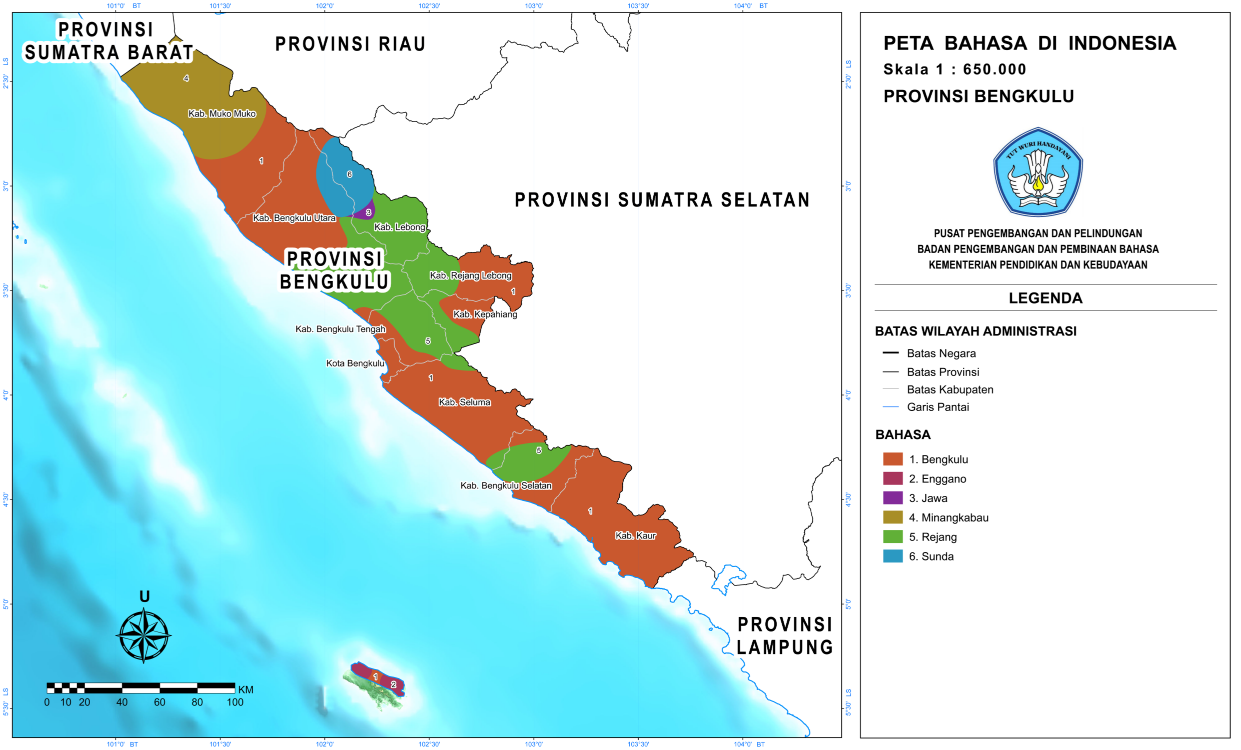
Source: https://petabahasa.kemdikbud.go.id/provinsi.php?idp=Bengkulu#36
The speaker data reported by Colchester differs from UNESCO’s 2021 record, which listed only 999 Enggano speakers and categorized the language as definitely endangered (UNESCO, 2021). According to the pabuki—the tribal coordinator on Enggano Island—the number of Enggano speakers in 2024 remained at no more than 700. In 2022, the Indonesian Language Agency launched a regional language revitalization initiative targeting 38 languages deemed vulnerable based on their Language Vitality Index. This index, developed by the Agency, classifies vitality across six levels: Safe (0.81–1.00), Vulnerable (0.61–0.80), Definitely Endangered (0.41–0.60), Severely Endangered (0.21–0.40), Critically Endangered (0.01–0.20), and Extinct. However, government policy surrounding revitalization remains largely invisible to the public and is rarely disseminated through the media (Andriani and Tama, 2024).
The Enggano language stands out for its phonetic and lexical features, which deviate significantly from typical Austronesian patterns. Linguistic debate persists: Capell (1982:6) argued that Enggano is not an Austronesian language at all, but a language that has borrowed heavily from Austronesian vocabularies. In contrast, Edwards (2015) and Nothofer (1994) identified both phonetic affinities and lexical structures shared between Enggano and other Austronesian languages in Indonesia, such as Nias, Mentawai, and several Sulawesi languages. Dialectometric research confirms that Enggano exhibits lexical and structural differences ranging from 81% to 100% compared to neighboring languages like Bengkulu Malay, Serawai, and Pasemah, supporting its classification as a distinct language rather than a dialect.
In terms of daily use, Enggano remains actively spoken in the villages of Apoho, Meok, Malakoni, and Kaana—areas still largely inhabited by the island’s indigenous population. In Apoho and Meok, some youth retain fluency, but in other villages, younger generations have shifted primarily to Bengkulu Malay and Indonesian. Many can still comprehend Enggano but no longer speak it—a form of passive bilingualism. For example, they may understand a question posed in Enggano but respond in Indonesian (Taher, 2022). Today, fluent Enggano speakers are largely elderly, and the language is sustained through a precarious system of “remember, apply, and die,” making documentation efforts both urgent and difficult.
Critique of Enggano Language Preservation Policy as Administrative Fulfillment
Traditional leaders and village heads on Enggano Island have expressed deep concern about the imminent extinction of the Enggano language. One of the primary causes, they note, is the language’s declining use within the home. Increasingly, families on Enggano—like those in many other parts of Indonesia—have replaced their regional language with Indonesian. This trend is not unique to Enggano; even major languages such as Javanese, despite their numerical strength, face similar vulnerabilities due to intergenerational language shift (Udasmoro et al., 2023). Indonesian, as a nationally dominant and widely accessible language, is perceived as more practical and beneficial for daily communication.
Local leaders acknowledge that numerous external parties have made attempts to support Enggano language preservation. These include the Bengkulu provincial government, the Bengkulu Education Office, the Bengkulu Language Center, and various academic and research institutions from within Indonesia and abroad. Among the foreign researchers who have visited Enggano are scholars from Germany and the United Kingdom—one of whom has even learned to speak the language. Yet despite this attention, these efforts have not succeeded in reviving Enggano as a language used across generations. A key challenge lies in the difficulty of developing a written system that accurately reflects the spoken language and is accessible to the community.
Karubi, a customary leader on Enggano, describes the issue this way:
“So this Enggano language is only spoken in a few villages. The thing is, for a long time now, parents at home—fathers and mothers—haven’t spoken Enggano with their children. That’s the real problem. The language has been studied several times. I mean, there were even researchers from England. But there haven’t been any useful results. Spoken Enggano is actually easy for daily use. But when we try to write it, that’s where it gets hard. Many of the sounds in Enggano can’t be written down. The codes linguists use are difficult. The codes have been written, but Enggano people can’t read them. So we really hope there will be experts who can write codes that actually match how we pronounce the words.” (Interview on August 10, 2024)
The issue of sound coding—essentially a linguistic challenge understood by trained researchers—becomes a barrier when local speakers are expected to apply these expert-devised systems in educational settings. The phonetic or orthographic codes produced by linguists are often inaccessible to the Enggano community, who find them unusable and confusing.
Another significant problem lies in the production of written materials, particularly textbooks and dictionaries, by outsiders—most notably through programs led by the Enggano Language Office. These materials often contain inaccuracies, which local leaders attribute to a disconnect between the linguistic knowledge of the authors and the lived, spoken reality of the Enggano language. The gap between theoretical understanding and actual usage results in texts that do not reflect how Enggano is truly spoken on the island.
A village tribe that still actively uses Enggano explained:
“So our hope is: research the Enggano language thoroughly. If it can indeed be made into a book, then make it a book. Please send us the results later. We need to know because we often have to correct what the Bengkulu Language Office prints—it's still about 40% wrong. So when we protest, they say, well, that's just the program. Their way of writing is adjusted to words, when in fact one word has many meanings. Maybe their education is higher, different from us here in Enggano. But we who speak [the language] don’t understand [what they’ve written].” (Interview with Head of the Kauno tribe, August 14, 2024)
The Pabuki of Enggano has also drawn attention to how inaccurate writing and coding of the Enggano language can alter its pronunciation. Mistakes appear not only in printed books but also across social media platforms, which are increasingly used in efforts to preserve the language. These errors, however well-intentioned, can unintentionally contribute to its distortion. In a meeting with a visiting research team, one participant wore a t-shirt printed with words in Enggano. Wilson Kaitora, the Pabuki, offered a correction:
“So from what I've observed, all this time on social media, they often write in Enggano. That's not how you write the Enggano language. Enggano has sounds that come from the nose and some from the throat, different from Indonesian. That's the Enggano language. And earlier, if I'm not mistaken, I saw—please show this (writing), is there anything on the back of the t-shirt? (pointing at it). Well, if you read this, it says kané. But the correct form, if I write it, should be kanë with dots above [the e] (note: the word ends with a [k] sound after the letter ë). So this is a wrong way of writing it, and that leads to incorrect pronunciation. This kind of thing may be one of the reasons the language is shifting.” (Interview on August 14, 2024)
Such errors are not confined to social media or casual clothing. They also appear in official materials, including Enggano dictionaries published and sold outside the island.
“I once went to Bali; I saw a dictionary in an airport shop. That dictionary was published by the Bengkulu Language Office. Well, I saw it was still far from perfect. Still many mistakes. I realize that's a government program. They have targets they're chasing. They just take data from Enggano children who are studying in Bengkulu. But those children, they don't really understand the Enggano language. So if this is allowed to continue, the Enggano language will change and lose its authenticity. So we continue to anticipate how to ensure that the Enggano language and culture don't become extinct. We have already started anticipating.” (Interview with Wilson Kaitora, Pabuki of Enggano, August 14, 2024)
Returning to concerns about the quality of the Enggano language as officially documented—concerns rooted in discrepancies between such representations and the actual language spoken on Enggano Island—local leaders argue that these efforts risk compromising linguistic authenticity and accelerating the language’s extinction. Government-led documentation, particularly through the language office, is criticized for relying on flawed dictionary-writing methods that fail to reflect the spoken reality. These efforts are seen not as genuine preservation work, but as perfunctory exercises aimed at fulfilling bureaucratic mandates and completing programs, with little regard for their long-term consequences.
From the perspective of Enggano leaders, language extinction follows two entwined paths. The first is the loss of intergenerational transmission, when families stop using Enggano in everyday life with their children. The second is misrepresentation: when the language is documented in ways that distort or detach it from how it is actually spoken. In this view, careless or inaccurate documentation doesn’t just risk rendering the language obsolete—it threatens to transform it. What remains may still bear the name “Enggano,” but it would no longer be the language its speakers once knew.
The Impact of Language Endangerment on Biocultural Sustainability
When a language is not preserved, the process endangers biocultural diversity as well. The strong coexistence between language survival and biocultural diversity explains why both face critical challenges in Enggano. The inability of policymakers, such as language agencies and related government offices, to assist communities in preserving their language is closely tied to their broader inability to safeguard local culture. This issue is further intertwined with economic pressures. Because younger generations are more attracted to opportunities outside Enggano, migration becomes the main gateway through which both language and culture are abandoned, thereby weakening the island’s biocultural diversity.
One example lies in Enggano’s cultural heritage, much of which consists of chants (mantra) performed in rituals and artistic expressions. These chants are recited in the Enggano language. In practice, however, ritual chants embedded in traditional dance are now performed only by the elderly. Customary leaders, too, are generally from senior generations. Parents who remain in Enggano thus serve as the backbone of cultural preservation. As expressed by Suhaidi Karubi, Head of the Karubi Tribe:
“What is disappearing is actually not only the language, but also the arts. I am deeply concerned, ma’am. During traditional ceremonies or festivals in Enggano, children are only brought along for the feasts or performances, and even then they just watch. They come for the entertainment and the festivities. But when it comes to rituals, no one wants to participate. It is left to us elders to carry out the ceremonies, the arts, the traditions. Even so, many of us no longer fully understand the chants, because only the very oldest still know their meaning. That is why we need to find ways to revive the traditions and culture of Enggano.” (Interview with Suhaidi Kaarubi, Head of Kaarubi Tribe, August 14, 2024)
Concern for revitalizing Enggano culture was also voiced by a youth leader who ultimately chose to return and settle in Enggano after living away from the island.
“As a young person of Enggano descent, I would like to share some advice with you all. I do not have much to say about how we can preserve Enggano traditions and culture. There is only one key: teaching our children the values of Enggano customs. Let me share a little story from my experience. Last year I returned from North Sumatra, from Medan. There, I tried to learn the traditions of the Batak people. Why has Batak culture continued to grow and endure? Because they are not ashamed of speaking their language every day—the Batak language. The problem on Enggano Island is that Enggano people, especially the youth, are not proud of their language and customs. I asked one of the elders there. In Batak custom, they call their fathers Amang and their mothers Inang. So I asked him, ‘Amang, please allow me to ask: how is it that Batak traditions have continued to thrive?’ He explained that Batak customs and culture are preserved across generations, passed down from great-grandparents to grandparents, then to parents and children. They are not ashamed to inherit their customary stories. After learning from them, I realized that Batak people are never embarrassed to use their language, their arts, or their adat, as they say. They even introduce all of this to outsiders.” (Interview with Hezzron, Enggano youth leader, August 14, 2024)
This testimony illustrates the youth leader’s reflection: he regards everyday use of the Batak language as the foundation for preserving Batak traditions and culture. He argues that there is no other strategic way to preserve language and culture than by practicing them and introducing them to the community itself.
“In my view, the way to protect the traditions of Enggano Island is by teaching them to our children, the next generation on Enggano. We need to educate them so that they practice Enggano culture and traditions. Because many migrants have settled here, it is important to introduce Enggano culture and language to them as well. This is Enggano, this is our art and our language. By presenting these to outsiders, the newcomers can also share them with others. Through such sharing, more people will talk about Enggano. In turn, outsiders will become curious and come to learn about Enggano Island—what it is, and what it represents. This is how we can preserve Enggano and ensure a better future for the island.” (Interview with Hezzron, Enggano youth leader, August 14, 2024)
From this account it becomes clear that, in addition to inward-facing actions, such as preserving Enggano language and culture by teaching the younger generation to actively practice them, the youth leader also proposes an outward-facing approach. Just as Batak culture has become widely recognized beyond the Batak community, he suggests that Enggano culture should also be introduced to outsiders as a way to ensure broader recognition. By promoting Enggano language and culture to people beyond the island, he believes they will continue to be practiced and transmitted.
Local Actions for Enggano Language and Cultural Preservation
The Enggano community has not remained passive in the face of their language’s endangerment. On the contrary, a variety of local initiatives have taken shape—ranging from the creation of textbooks for elementary and junior high school students to the compilation of dictionaries using indigenous orthographic conventions. These written efforts are complemented by a revival of spoken Enggano within households, where families have begun consciously reintroducing the language into daily life.
“So that’s one of the ways we try to prevent extinction. We create textbooks for elementary and junior high school students, even dictionaries. Then we implement the program—personally, with my own children at home, we continue using the Enggano language. When we’re outside or when guests visit, we use Indonesian. But in any normal situation, we use Enggano. Sometimes we just speak. Our children are still learning. Mistakes happen. We correct them.” (Interview with Head of the Kauno Tribe, August 14, 2024)
Within the family, a subtle yet purposeful form of discipline shapes the everyday use of Enggano. This home-based learning operates as a process of habituation—an organic, repetitive reinforcement of language use that, in the context of a critically endangered language, may prove more effective than formal schooling. Graham (2022) notes that linguistic familiarization in intimate, everyday settings is more likely to foster active use than classroom instruction, which often remains abstract and disconnected from lived experience. Similar dynamics have been observed with other regional languages. In the case of Javanese, for instance, research in the Special Region of Yogyakarta shows that the erosion of Javanese as a home language has significantly weakened its vitality. School programs tend to emphasize theoretical knowledge rather than encouraging the practical, daily use of the language (Udasmoro et al., 2023).
Another priority for the Enggano community is the recruitment of qualified individuals who can speak the language fluently and are capable of teaching it accurately. The community recognizes the need to identify key actors responsible for ensuring that Enggano remains actively spoken. While parents are central to language transmission at home, teachers are also seen as critical. As Murray (2021) notes, competent language educators are indispensable; without the right teachers, language learning in formal education is unlikely to succeed. This concern is echoed by the Head of Kauno Village:
“We’ve raised concerns with elementary, junior high, and high school teachers who are teaching Enggano. We ask for help in finding Enggano people who actually speak the language. So far, many of the teachers have been teaching it incorrectly. But schools are reluctant to replace them because the honorarium from the Regency is already assigned to those individuals. If they ask for help, we’re ready. For instance, if a good teacher needs gas money, we’ll cover it. What we’re asking is simple—if we don’t want the Enggano language to disappear, we need Enggano teachers who teach the language correctly. Even if local content is only taught once a week, it matters. But up to now, there’s been no response.” (Interview with Head of the Kauno Tribe, August 14, 2024)
According to the Head of Kauno Tribe, the difficulty of finding teachers who can properly teach the Enggano language has become a persistent problem. This challenge is closely tied to rigid administrative procedures and an institutional reluctance to revise the existing system. Teachers currently assigned to teach Enggano in schools are often seen by community members as contributing to the language’s decline rather than its preservation. Echoing the situation of Javanese in parts of Java, what is supposed to be “local content” in the curriculum—a government initiative intended to promote regional languages—is frequently repurposed for teaching unrelated subjects, such as traditional dance or general cultural topics. In Enggano, the inability of teachers to actually speak the language has led to a similar outcome: the language component of local content is reduced to teaching about Enggano culture in general rather than using or practicing it. According to the Head of Tribe, such material should be limited to a once-weekly session at most, rather than substituting for language instruction altogether.
In response to these shortcomings, the Enggano community has taken it upon themselves to engage in their own written language preservation efforts. Aware that outsiders struggle to write the Enggano language accurately, they have initiated a form of self-discipline by producing written materials themselves, in a range of formats.
“One thing we’ve already completed—the first major project finished—was the translation of the New Testament into Enggano. That was launched some time ago. What we’re still working on now is the creation of textbooks for elementary and junior high school students. We’re even developing an Enggano dictionary. That dictionary might not just be in book form—it could also be accessible through social media, or even as an app to make it easy to use.” (Interview with Head of the Kauno Tribe, August 14, 2024)
Beyond language preservation, cultural preservation is also actively undertaken by customary elders and tribal leaders on Enggano Island. Notably, even leaders of migrant background, such as those who married into the Enggano community, feel a strong responsibility to help safeguard local culture. This is evident in the testimony of the Kaamai tribal chief:
“Since 2015, the tribal chiefs have been striving to establish a customary regulation—a regional customary law for the Enggano community. Until now, it remains unfinished and has yet to be ratified, even though the draft has been completed. From my side, as someone of migrant background, my way of preserving Enggano culture is by always being active in customary ceremonies. This is how I contribute to sustaining the culture. I always participate whenever there is a customary event. That is all I can share. Having lived in Enggano for a long time, there is still much I do not understand. What I do have is the willingness within myself. If I have misspoken in any way, I apologize. I deeply respect the customs and traditions of Enggano.” (Interview with Anjani Simamora, Head of Kaamai Tribe, August 14, 2024)
These community-led initiatives reflect a broader strategy of reclaiming the means of language and cultural preservation from external, state-driven efforts that are often perceived as insufficient. Rather than relying on systems that reduce preservation to administrative formality, Enggano leaders advocate for a more hands-on, locally rooted approach—one that insists on both linguistic accuracy and lived usage as essential to the survival of their endangered language.
4. Conclusion
The marginalization of island territories as peripheral spaces has serious implications, particularly for the survival of local languages. In the case of Enggano, language vulnerability arises from several interrelated factors. First, the island’s underdevelopment compared to other regions compels many residents to migrate elsewhere. In doing so, they do not simply leave the island physically—they also abandon its symbolic and cultural dimensions, especially the language. The island, and the language spoken on it, thus becomes doubly marginalized: by outsiders, and by its own former residents who seek better economic, social, and cultural opportunities elsewhere.
Second, even among those who remain on the island, the language continues to erode. This occurs through a process of self-subordination, in which local residents adopt the dominant language practices of incoming migrants. These newcomers tend to wield greater economic, social, and cultural capital, resulting in asymmetrical power relations that displace local linguistic norms. The Enggano language is thus gradually set aside, even on its native ground.
Third, the vulnerability of the Enggano language is further exacerbated by the disconnect between government policy and the work of outside researchers on language preservation. A hierarchical knowledge structure persists, wherein state actors and external experts approach Enggano as an object to be preserved, rather than recognizing its speakers as subjects with agency. Local voices are sidelined in the production of linguistic knowledge, and preservation efforts often proceed without the involvement—or consent—of the community itself.
In contrast, local initiatives by the Enggano people mark a crucial form of self-assertion and identity reconstruction through language. Community-led disciplinary efforts to reintroduce Enggano into everyday life—especially within families and schools—represent a path toward revitalization. These initiatives offer a foundation for meaningful intergenerational transmission, keeping alive not just the language, but the biocultural diversity and social fabric it carries.
References
- Alfanda, W., Muktadir, A., Djuwita, P., 2023. Pergeseran Bahasa Enggano dalam Komunikasi Siswa SDN 053 Pulau Enggano Sebagai Literasi Bahasa Daerah. Kapedas 2: 15–24. https://doi.org/10.33369/kapedas.v2i1.26020.
- Andriani, M., Tama, A.P., 2024. Language policy in fake news handling within French and Indonesian digital media. Jurnal Studi Komunikasi 8: 337–345. https://doi.org/10.25139/jsk.v8i2.7806.
- Aribowo, R., 2024. Bahasa Enggano Bengkulu Masuk Dalam Kategori Terancam. rri.co.id.
- Arka, I.W., Arono, Wijaya, D., Zakaria, 2022. Critical ecological factors in ethnolinguistic vitality: evidence from Enggano. Presented at the Austronesian and Papuan Langauges and Linguistics Conference, Berlin. https://doi.org/10.25894/LDD.329.
- Badan Pengembangan Bahasa dan Perbukuan Kementrian Pendidikan dan Kebudayaan, 2019. Bahasa dan Peta Bahasa di Indonesia [WWW Document]. URL https://petabahasa.kemdikbud.go.id/index.php (accessed 10.28.25).
- Billings, B., McDonnell, B., 2022. Subgrouping Malayo-Polynesian languages of Sumatra and the Barrier Islands. Presented at the The 30th Annual Meeting of the Southeast Asian Linguistics Society, University of Hawai‘i Mānoa.
- BPS Kabupaten Bengkulu Utara, 2020. Kecamatan Enggano Dalam Angka 2020.
- Bridgewater, P., Rotherham, I.D., 2019. A critical perspective on the concept of biocultural diversity and its emerging role in nature and heritage conservation. People and Nature 1: 291–304. https://doi.org/10.1002/pan3.10040.
- Capell, A., 1982. Local languages in the PAN area, in: Carle, R., Heinschke, M., Pink, P.W., Rost, C., Stadtlander, K. (Eds.), GAVAʻ: Studies in Austronesian Languages and Cultures Dedicated to Hans Kähler. Reimer, Berlin, pp. 1–15.
- Christine, B., Renold, E., 1999. The Use of Vignettes in Qualitative Research. Social Research Update 25.
- Colchester, M., Anderson, P., Kusdinar, P.A., Basrin, E., Kudus, W., Kauno, A.K., Kauno, H., Jalil, A., Fithen, E., 2025. The Enggano an island people of Indonesia in search of recognition. Forest People Programme, Indonesia.
- Edwards, O., 2015. The Position of Enggano within Austronesian. Oceanic Linguistics 54: 54–109. https://doi.org/10.1353/ol.2015.0001.
- Fachruliansyah, I., 2019. Suku Bangsa Enggano dalam Perdebatan Rumpun Bangsa dan Bahasa Austronesia: Suatu Tinjauan Antropologis. Jurnal Antropologi Indonesia 40: 19–48. https://doi.org/10.7454/ai.v40i1.10762.
- Firmansyah, Maullana, I., 2025. Terisolasi 3 Bulan, Warga Enggano Nekat Seberangi Samudera Hindia Pakai Kapal Kecil. Kompas.com.
- Foucault, M., 1981. The Order of Discourse, in: Young, R. (Ed.), Untying the Text: A Post-Structuralist Reader. Routledge & Kegan Paul, Boston, London & Henley, pp. 48–78.
- Foucault, M., 1969. Archaeology of Knowledge and the Discourse on Language. Pantheon Books, New York.
- Goetze, J., 2023. Vignette methodology in applied linguistics. Research Methods in Applied Linguistics 2: 100078. https://doi.org/10.1016/j.rmal.2023.100078.
- Graham, S., 2022. Self-efficacy and language learning – what it is and what it isn’t. The Language Learning Journal 50: 186–207. https://doi.org/10.1080/09571736.2022.2045679.
- Hemmings, C., Arka, I.W., Sangian, E.Z., Wijaya, D., Dalrymple, M., 2023. Challenges in Enggano Orthography Development. Language Documentation and Description 23. https://doi.org/10.25894/ldd.329.
- Kähler, H., 1987. Enggano-Deutsches Wörterbuch [Enggano-German Dictionary]. Dietrich Reimer Verlag, Berlin.
- Kähler, H., 1975. Texte von der Insel Enggano (Berichte über eine untergehende Kultur) [Texts from the island of Enggano (Reports about a declining culture)]. Dietrich Reimer Verlag, Berlin.
- Kähler, H., 1964. Texte von der Insel Enggano (Westküste von Sumatra) [Texts from the island of Enggano (west coast of Sumatra)]. Afrika und Übersee 48: 46–57.
- Kähler, H., 1957. Ein Text von der Insel Enggano (Westküste von Sumatra) [A text from the island of Enggano (west coast of Sumatra)]. Afrika und Übersee 41: 153–56.
- Kähler, H., 1940. Grammatischer Abriss des Enggano [Grammatical outline of Enggano]. Zeitschrift für Eingeborenen Sprachen 30: 81–117, 182–210, 296–320.
- Kasim, Yuslina, Maksan, M., Arifin, S., Zailoet, Yamin, M., 1987. Pemetaan bahasa daerah di Sumatra Barat dan Bengkulu [Mapping of local languages in West Sumatra and Bengkulu]. Pusat Pembinaandan Pengembangan Bahasa, Departemen Pendidikan dan Kebudayaan, Jakarta.
- Murray, J., 2021. Good teachers are always learning. International Journal of Early Years Education 29: 229–235. https://doi.org/10.1080/09669760.2021.1955478.
- Nikelas, Syahwin, Rasyad, H., Semi, M.A., 1994. Morfologi dan sintaksis bahasa Enggano [Morphology and syntax of the Enggano language]. Pusat Pembinaan dan Pengembangan Bahasa, Departemen Pendidikan dan Kebudayaan, Jakarta.
- Nothofer, B., 1994. The relationship between the languages of the Barrier Islands and the Sulawesi-Philippine languages, in: Dutton, T., Tryon, D.T. (Eds.), Language Contact and Change in the Austronesian World. Mouton de Gruyter, Berlin, pp. 389–409.
- Riswari, Yanti, Fauzi, A.R., Yusuf, M., Novalia, R., Nugraha, Z.A., Novianti, O.C., 2021. Kamus Dwibahasa: Enggano-Indonesia, Indonesia-Enggano [Bilingual Dictionary: Enggano-Indonesian, Indonesian-Enggano]. Kantor Bahasa Provinsi Bengkulu, Badan Pengembangan dan Pembinaan Bahasa, Kementerian Pendidikan, Kebudayaan, Riset dan Teknologi, Bengkulu.
- Sari, I.P., 2017. Harmoni dalam Kebhinekaan (Kearifan Lokal Masyarakat Pulau Enggano Provinsi Bengkulu Dalam Mengatasi Konflik). JANTRO 19: 139–147. https://doi.org/10.25077/jaisb.v19.n2.p139-147.2017.
- Smith, A.D., 2020. Nasalization in Enggano Historical Phonology. Oceanic Linguistics 59: 347–365. https://doi.org/10.1353/ol.2020.0015.
- Taher, M.D.S., 2022. Enggano language viability: diglossia leakage phenomenon and endangered language defense strategy in Enggano. Linguistik, Terjemahan, Sastra (LINGTERSA) 3: 50–65. https://doi.org/10.32734/lingtersa.v3i1.8847.
- Udasmoro, W., Marai, L., Sulistyowati, Firmonasari, A., Astuti, W.T., 2024. The Vulnerability of The Javanese Language: An Analysis of Students’ Competence. Presented at the Critical Island Studies 2023 Conference (CISC 2023), Atlantis Press, pp. 20–32. https://doi.org/10.2991/978-2-38476-186-9_4.
- Udasmoro, W., Yuwono, J.S.E., Sulistyowati, S., Firmonasari, A., Astuti, W.T., Baskoro, B.R.S., 2023. The Preservation of the Javanese Language in the Special Region of Yogyakarta. Indonesian Journal of Geography 55: 59–68. https://doi.org/10.22146/ijg.68183.
- UNESCO, 2021. The World Atlas of Languages: Enggano [WWW Document]. URL https://ar.wal.unesco.org/languages/enggano.
- Wibowo, S.F., 2014. Vitalitas Bahasa Enggano di Pulau Enggano. Ranah: Jurnal Kajian Bahasa 3: 1–12. https://doi.org/10.26499/rnh.v3i1.6.
- Wijaya, D., Erniati, E., 2021. Penanda Modalitas Intensional Kahãp dan Buh dalam Bahasa Enggano. Indonesian Language Education and Literature 7: 179–193. https://doi.org/10.24235/ileal.v7i1.9047.
- Yoder, B.E., 2014. Phonological and phonetic aspects of Enggano vowels. SIL International, Dallas, Texas.
- Zamdial, Z., Hartono, D., Anggoro, A., Muqsit, A., 2019. Valuasi ekonomi ekosistem terumbu karang di pulau Enggano, Kabupaten Bengkulu Utara, Provinsi Bengkulu. j.enggano 4: 160–173. https://doi.org/10.31186/jenggano.4.2.160-173.