
Safeguarding Shores, Strengthening Livelihoods: An Empirically Grounded Theory of Change for Sustainable Coastal Livelihoods in Luna, La Union, Philippines
 10.21463/jmic.2026.15.1.15
Abstract
This study examines how shoreline gravel extraction in Luna, La Union, Philippines, is shaped by the interaction between household livelihood dependence and coastal erosion risks. Prolonged manual extraction has altered shoreline dynamics while providing immediate income for coastal households. Using a qualitative approach, the study draws on semi-structured interviews with coastal residents and institutional stakeholders, supported by field observations, document analysis, and triangulated estimates of shoreline change and extraction activity. Reflexive thematic analysis identifies four interrelated drivers sustaining extraction: immediate income needs; resilience constraints associated with poverty, limited education, and exposure to hazards; financial insecurity and limited market access; and weak governance combined with low ecosystem awareness. Existing interventions have not produced sustained livelihood transitions because they fail to address these constraints in combination. In response, the study develops the Sustainable Alternative Livelihoods Framework (SALF), an empirically grounded Theory-of-Change model that establishes an evidence-based linkage between coordinated institutional and economic conditions and livelihood diversification. While grounded in Luna, the framework is analytically applicable to small-island and coastal municipalities facing similar social–ecological constraints.
Keywords
coastal livelihoods, gravel extraction, social–ecological systems, Theory of Change, coastal governance, coastal sustainability
Introduction
Coastal communities worldwide face growing environmental and socio-economic challenges as climate change and human activities alter naturally dynamic shoreline systems (Crossland et al., 2005; IPCC, 2019; Nicholls, 2010). These areas concentrate populations, fisheries, and major cities, so even small losses in coastal ecosystem services can threaten livelihoods, infrastructure, and well-being (Sekovski et al., 2012). A key global indicator is sea-level rise, which has averaged about 3.3 mm per year from 1993 to 2009, a trend linked to widespread beach erosion and increased vulnerability of assets (Prandi et al., 2009; Elliott et al., 2017).
The Philippine situation mirrors and worsens these global pressures. Sea levels in the Philippines have risen about two to three times faster than the global average, at roughly 6–9 mm annually. This accelerates shoreline instability and increases exposure of low-lying communities to coastal flooding (Halpern et al., 2015). National risk assessments show that many coastal local government units in La Union Province are at risk from rising sea levels, with residents possibly displaced if current trends persist (Nguyen and Woodroffe, 2016). More generally, island and low-elevation coasts are especially vulnerable, particularly where human activities accelerate erosion and weaken natural defenses (Steffen et al., 2015).
Within this national context, Northern La Union clearly demonstrates shoreline instability caused by both natural processes and human activities. Historical maps and studies document severe, rapid erosion in areas where magnetite sands were mined and report that engineered structures can disrupt longshore transport, leading to beach loss along the coast. For example, a 120-meter pier in Bauang, La Union, blocked sediment flow and exacerbated erosion south of the structure (Depietri et al., 2013; OECD, 2013; O’Neill et al., 2018; Ostrom, 2009). In Luna, non-mechanized gravel and pebble extraction began in the 1960s. This has resulted in land losses of about 30–33 hectares and an average shoreline retreat of roughly 1.5 meters per year, with an estimated annual extraction of around 31,600 cubic meters in the early 2000s (Siringan et al., 2024). There are also indications that beach gravels are not being naturally replenished (Ostrom, 1990). Recent field observations also indicate extraction beyond authorized zones and size limits, suggesting persistent enforcement gaps and continued dependence of livelihoods on shoreline resources.
These conditions indicate a structurally unsustainable livelihood base in Luna’s coastal barangays, where dependence on declining natural resources coincides with increasing exposure to coastal hazards. Without viable alternatives, poverty and environmental degradation are likely to reinforce each other, a pattern often seen in resource-dependent coasts (Bullock and Acreman, 2003; PAGASA, 2019).
The proposed intervention, alternative sustainable livelihoods, is grounded in extensive research demonstrating that factors such as poverty, vulnerability, access to assets, and institutions shape livelihood choices and environmental outcomes. Notable studies highlight assets and capabilities, diversification, and the vulnerability context (National Integrated Climate Change Database and Information Exchange System, 2022; Oscar M. Lopez Center, 2020–2025), along with policy and market conditions that influence the feasibility of shifting activities (Campbell, 2008; Cattermoul et al., 2008; Department of Environment and Natural Resources, 1992; Office of the President of the Philippines, 1987). Guidance for coastal areas emphasizes that alternatives should not be viewed as quick fixes; they need to align with local assets, risk perceptions, skills, and demand, supported by enabling institutions and proper enforcement (Campbell, 2008; Cattermoul et al., 2010; French, 2001; Fletcher et al., 1997; Hu et al., 2020; Kurniawan et al., 2016; Msuya et al., 2022; Pomeroy et al., 2017). Within the Philippine policy framework, sustainable use of coastal and marine resources is a core goal, linking livelihood improvements with conservation objectives.
Evidence on effectiveness shows both promise and limitations. A national review of 15 livelihood programs for Philippine fishing communities over three decades found that sustained gains depend on participant engagement, inter-agency cooperation, skills development, market access, and systematic learning; without these, projects often fail to last (Pomeroy et al., 2017). International examples illustrate common pathways and challenges. Mariculture around Komodo diversified incomes but faced high entry costs and market barriers for poorer households (Msuya et al., 2022). Seaweed farming in Madagascar boosted women’s earnings and expanded production, yet required upskilling to manage biological and market risks. Small-stock and crop diversification trials in Indonesia’s Seribu Islands and Tanzania’s Tanga Region proved technically feasible but suffered from high mortality, limited inputs, or low adoption without sufficient support (French, 2001; Fletcher et al., 1997; Kurniawan et al., 2016). Regulatory bans on coral and sand mining in the Maldives reduced extraction only after tariff changes and public education addressed affordability and awareness (O’Neill et al., 2018). Collectively, these studies demonstrate that sustainable alternatives succeed when they are economically attractive, skill-matched, supported by institutions, and paired with governance measures that reduce pressure on common-pool resources (Cattermoul et al., 2008; Campbell, 2008; Cattermoul et al., 2010; French, 2001; Fletcher et al., 1997; Hu et al., 2020; Kurniawan et al., 2016; Msuya et al., 2022; Pomeroy et al., 2017).
This study develops a context-specific Sustainable Alternative Livelihoods Framework (SALF) for Luna, La Union, by identifying the structural drivers that sustain gravel extraction and examining why previous interventions have failed to produce lasting transitions. Rather than proposing a prescriptive program, the study constructs an empirically grounded Theory of Change that links observed livelihood constraints to feasible transition pathways. In doing so, it contributes to the sustainability of island and coastal regions by demonstrating how livelihood dependence on extractive practices can be reduced through coordinated changes in market access, financial inclusion, adaptive capacity, and governance. This provides an evidence-based foundation for designing livelihood transitions that simultaneously support ecological stability and community resilience.
Methodology
Theoretical Foundations. This study used a Theory of Change (ToC) to explain how inputs and activities lead to outputs, outcomes, and impacts, while explicitly stating the assumptions and contextual conditions needed for change (Weiss, 1995). Following guidance that differentiates between ex-ante design ToC and the iterative, learning-focused ToC used during implementation (Rehfuess et al., 2018), the author adopted this approach to coordinate stakeholders, identify risks, and specify evidence needs in a complex, multi-stakeholder setting (Breuer et al., 2016; Douthwaite and Hoffecker, 2017). The ToC outlines the causal pathways through which sustainable alternative livelihoods are expected to reduce pressure on coastal resources and improve well-being in Luna’s barangays, aligning with the Sustainable Development Goals’ focus on equity, poverty alleviation, and ocean stewardship (World Bank Group, 2024).
Research Design. A descriptive qualitative design was employed to examine the factors influencing gravel and pebble extraction, stakeholder responses, and livelihood transition options. This approach enables in-depth analysis of lived experiences and contextual conditions through narrative synthesis (DiCicco-Bloom and Crabtree, 2006; Gill et al., 2008; Patton, 2002). Document analysis complemented interview data through systematic review of ordinances, program reports, and technical assessments, strengthening triangulation and analytical rigor (Creswell, 2013).
Location of the Study. The research was conducted in Luna, La Union, an Ilocos coastal municipality along the West Philippine Sea. Three shoreline barangays identified as at risk based on evidence of shoreline change and local records, namely Sto. Domingo Norte, Rimos 2, and Rimos 3 were intentionally selected as key sites. According to the 2020 Census of Population and Housing, these barangays had a combined population of 2,803 people and 794 households, with an average household size of 3.5 (Philippine Statistics Authority, 2020).
Quantifying Shoreline Change and Extraction. As shown in Table 1, shoreline change and extraction were triangulated using complementary datasets and methods. First, historic NAMRIA 1:50,000 coastlines (1977) were digitized and compared with satellite-derived shorelines (2020/2022); end-point rates were calculated at 50-m transect spacing to estimate planform change along approximately 7 km of coast. This analysis indicates a cumulative land loss of about 30–33 ha and a mean shoreline retreat of roughly 1.4–1.6 m per year. Uncertainty accounts for georeferencing error (older map sheets ±5–10 m; recent imagery ±2–5 m), shoreline proxy selection (high-water line/vegetation line), and seasonal variability, resulting in an overall error of roughly ±3–4 ha and ±0.3 m per year (Halpern et al., 2015; Siringan et al., 2024; World Bank Group, 2024). Second, extraction volumes were estimated from three independent indicators: DENR-MGB/LGU permit and receipt records; counted truck egresses, multiplied by assumed truck capacity and operational days; and household sacks per day, converted at approximately 0.02 m³ per sack and scaled by the number of active harvesters. The triangulated estimate centers around 31,600 m³ per year (roughly 24,000–38,000 m³ per year), acknowledging potential underreporting or non-reporting in administrative records, sampling limitations in counts, and assumptions regarding truck capacity (approximately 3–5 m³) and work schedules (LGU/MGB records; World Bank Group, 2024).
| Metric | Period / Spatial Scope | Primary data and method | Point estimate (range) | Key assumptions and uncertainty |
|---|---|---|---|---|
| Cumulative land loss (ha) | 1977–2022; ~7 km shoreline | NAMRIA 1:50k (1977) + satellite (2020/2022); shoreline digitization; Digital Shoreline Analysis System (DSAS) area change (EPR sum) | 30–33 ha | Map RMSE (old ±5–10 m; new ±2–5 m); proxy = HWL/vegetation line; seasonal width; ±3–4 ha overall |
| Mean shoreline retreat (m yr⁻¹) | 1977–2022; transect mean | DSAS EPR (50 m spacing) | ~1.4–1.6 m yr⁻¹ | Sensitivity to proxy and georeferencing; ±0.3 m yr⁻¹ |
| Extraction volume (m³ yr⁻¹) | Early 2000s; municipal | (a) MGB/LGU permits and receipts; (b) truck-egress counts × capacity × operating days; (c) household sacks/day × 0.02 m³ × active pickers | 31,600 (24,000–38,000) | Under-/non-reporting in admin logs; temporal sampling in counts; self-report bias; capacity = 3–5 m³/truck |
Participants and Sampling. This study employed purposive sampling to recruit two complementary groups: coastal residents directly involved in or affected by shoreline gravel and pebble extraction, and institutional stakeholders engaged in coastal governance and livelihoods. A total of 36 semi-structured interviews were conducted, including 24 household respondents (14 women and 10 men). Of these, 24 were household heads or senior household representatives living in the three at-risk barangays: Sto. Domingo Norte (n = 10), Rimos 2 (n = 6), and Rimos 3 (n = 8). To qualify for the household group, participants had to reside in one of these three coastal barangays and have direct livelihood exposure to coastal extraction; those without such exposure were excluded. The remaining 12 interviews involved institutional stakeholders purposively selected based on their roles, experience, and knowledge of the phenomenon (Creswell, 2013; Patton, 2002). Their livelihood activities reflected the area’s diverse coastal economy. Categorized by primary livelihood activity, respondents engaged in full-time pebble picking (n = 8), part-time pebble picking (n = 6), small-scale fishing (n = 4), vending (n = 3), tricycle driving (n = 2), and farm labor (n = 1). Educational attainment was generally low to moderate: 29% had primary education or less, 38% had some junior high schooling, 25% completed high school, and 8% had education beyond high school. The median age was 44 years (range 21–74). The 12 institutional stakeholders included representatives from the Local Government Unit (LGU), the Department of Environment and Natural Resources (DENR), the Department of Social Welfare and Development (DSWD) / Department of Labor and Employment (DOLE) / Department of Tourism (DOT) / Technical Education and Skills Development Authority (TESDA), as well as cooperatives, a nearby state university, and coastal Non-government Organizations (NGOs). Interviews were conducted in Ilocano (58%), Filipino (25%), or English (17%). Translation and back-translation were used as needed to ensure accuracy and participant validation.
Data Collection. An interview guide was developed deductively from the literature and the preliminary ToC, then refined through expert review. Semi-structured interviews were conducted in person along the coastline during or immediately after pebble-picking activities, with multiple site visits scheduled to accommodate tidal conditions, weather variability, and participant availability. Each interview lasted approximately 45–75 minutes and was audio-recorded with written informed consent. Non-participant observations were conducted to document extraction practices, coastal conditions, and the visibility of regulatory measures. Documentary materials, including local ordinances, meeting records, program manuals, and monitoring reports, were obtained from local government units, relevant agencies, and public repositories to supplement and contextualize field data.
Framework Derivation Approach. Following reflexive thematic analysis, the SALF was developed through analytic abstraction rather than normative prescription. Initial codes generated from interview and documentary data were grouped into themes representing the main drivers of gravel extraction and the conditions necessary for livelihood diversification, which directly informed the selection of framework components within a Theory-of-Change structure. Components were retained only when they explicitly addressed empirically identified themes, ensuring a clear link from raw data to conceptual design and enhancing transparency and interpretive rigor.
Sample sufficiency and saturation were assessed through phased recruitment, with coding conducted concurrently with data collection until thematic saturation was reached, defined as the point at which additional interviews yielded no new insights and codes became repetitive across barangays (Guest et al., 2006; Hennink et al., 2017). The sampling plan followed established guidance indicating that meaningful saturation is often achieved in approximately 20–30 interviews overall (with 6–12 per relatively similar subgroup), with additional interviews conducted when participant diversity is greater (Creswell, 2013; Guest et al., 2006).
Data Management, Analysis, and Reflexivity. Audio files were transcribed verbatim and verified against recordings for accuracy. Analysis employed reflexive thematic analysis using both deductive and inductive phases (Braun and Clarke, 2006). A theory-informed codebook (e.g., drivers of extraction, institutional capacity, livelihood assets, market access, risk perceptions) guided initial coding across interviews and documents, followed by open coding to identify emergent patterns across barangays. Codes were iteratively grouped, reviewed for coherence and distinctiveness, defined, and linked to key quotes and documents; discrepant cases were used to refine interpretations and delimit claims (Creswell, 2013; Nowell et al., 2017). Theme validity was strengthened through iterative comparisons across participant groups and by assessing convergence and divergence in perspectives.
As a single-author study, the researcher conducted all coding, maintained a positionality statement and reflexive journal, and version-controlled the codebook, documenting analytic decisions in an audit trail. Credibility and trustworthiness were ensured through prolonged engagement; triangulation across interviews, shoreline observations, and documentary records; negative-case analysis; and systematic self-audits aligned with criteria for credibility, dependability, and confirmability (Lincoln and Guba, 1985; Nowell et al., 2017).
Ethical Considerations. Procedures adhered to the National Ethical Guidelines for Health and Health-Related Research (Philippine Health Research Ethics Board, 2022) and followed the principles of the Belmont Report and the Declaration of Helsinki (National Commission for the Protection of Human Subjects, 1979; World Medical Association, 2013). Approvals were obtained from the appropriate local government office and the University Research Ethics Committee before data collection. Participants received study information in their preferred language, signed written informed consent forms, and were informed of their right to withdraw at any time without penalty. Pseudonyms were used in transcripts and reports, and audio files, transcripts, and consent forms were stored on encrypted drives accessible only to the author.
Results and Discussion
Factors Why the Residents Continue to Extract Gravel Near the Coastal Areas
Four interrelated themes emerged from interviews and field observations explaining why residents continue to extract gravel in Luna’s coastal barangays: (1) Immediate Benefits for Basic Needs, where gravel picking reliably turns labor into cash for food, water, shelter, and routine health costs; (2) Resilience Constraints, such as low education, poverty, hazard exposure, limited formal schooling, chronic poverty, and recurrent typhoon-flood events, which reduce adaptive capacity and drive households back to gravel extraction; (3) Financial Insecurity and Livelihood Dependence, with unpredictable fish catches, limited local markets, scarce start-up capital, and pandemic disruptions making alternative livelihoods more uncertain than gravel; and (4) Limited Access to Coastal Ecosystem Education, Services, and Management, where misconceptions that pebbles “naturally replenish,” weak enforcement, unclear land tenure and open-access dynamics, and migration of transient pickers support ongoing extraction. Together, these themes explain the persistence of shoreline gravel extraction in Luna’s coastal barangays, reflecting common-pool resource dynamics shaped by open-access conditions and weak governance.
The following sections elaborate on each theme as derived from the data.
Theme 1: Immediate Benefits for Basic Needs
Participants emphasized that gravel picking is a reliable way to earn a daily income for food and basic needs. They described it as simple, accessible, and quick to turn into cash. One resident shared, “It is easy to pick stones if you’re fast; we can sell right away; we could earn 2,000 pesos in a day”1. Another explained, “Many still come to buy, especially flat stones and those with unique colors”2. Several also noted that the practice is inherited: “I grew up doing this because it has been my parents’ occupation; I’m used to it now”3.
These accounts indicate the intergenerational nature of gravel picking and its function as a livelihood safety net requiring minimal skills or capital. Such accounts align with research showing that local ecosystem services directly meet subsistence needs and are readily monetized when poverty restricts access to formal employment (Halpern et al., 2015; OECD, 2013). In similar coastal areas, accessible natural resources serve as backup income sources when job diversification is limited (Pomeroy et al., 2017; Campbell, 2008).
Theme 2: Resilience Constraints—Low Schooling, Poverty, and Hazard Exposure
Many participants described enduring poverty, incomplete education, and limited access to scholarships or skills training, all of which restrict their livelihood options. One said, “I did not go to school because my family was poor”4. Another mentioned, “The scholarship grant did not reach us here”5, while others lamented, “They don’t give us free training to learn other skills”6. For older residents, switching livelihoods feels impossible: “This is what I grew up doing, stone picking. I don’t wish to learn anything else as I’m already old”7. Typhoons and flooding increase dependence on gravel extraction. A resident said, “There’s nothing to fish; we pick stones, so we have cash to buy food”8. Another added, “During typhoons, we have nothing unless we pick stones”9.
These testimonies demonstrate that repeated exposure to hazards and low levels of human capital weaken resilience, reinforcing reliance on accessible extraction-based livelihoods. This aligns with broader research highlighting limited education and recurring disasters as barriers to adaptive capacity among the coastal poor (O’Neill et al., 2018; PAGASA, 2019; World Bank Group, 2024). Communities with weak safety nets and low levels of education often rely on resource-based survival after climate shocks, thereby increasing ecological stress (Halpern et al., 2015; Nicholls, 2010).
Theme 3: Financial Insecurity and Livelihood Dependence
Residents observed that gravel picking remains more dependable than other income sources. One college graduate said, “I finished college but can’t find a job; I help my mother pick stones.”10 Another added, “Sometimes I sell vegetables, but if there’s none, I extract gravel.”11 Several mentioned financial difficulties: “We have no money to start even a small business.”12 and one noted, “It’s hard to sell because we all sell the same products here.”13 A participant summarized their situation: “If I had a choice, I would not have gone pebble picking. I needed to make a living, and with pebble picking, I didn’t need anything but physical strength.”14
These patterns are consistent with findings from small-scale fisheries research, where income volatility, limited capital, and constrained markets sustain dependence on environmentally degrading livelihoods (Campbell, 2008; Cattermoul et al., 2010; Pomeroy et al., 2017). Diversification generally requires training, startup funds, and stable market connections, conditions that are often missing in marginalized coastal areas (Hu et al., 2020; Msuya et al., 2022).
Theme 4: Limited Access to Coastal Ecosystem Education, Services, and Management
Residents often believe that “the stones always return from the sea”15, reflecting a limited understanding of shoreline sediment dynamics. Others expressed frustration over inconsistent enforcement: “We see others extracting in large volumes, but only small pickers are reprimanded”16. The influx of transient extractors has also increased local competition.
These observations are consistent with evidence showing that compliance improves when enforcement is perceived as consistent and fair (Hatcher et al., 2000; Pomeroy and Rivera-Guieb, 2006). The belief in natural replenishment reveals a knowledge gap in coastal geomorphology, which indicates that gravel and sand resources are non-renewable on human timescales (Masselink et al., 2014; Rosati, 2005). Weak institutional enforcement, overlapping jurisdictions, and limited environmental education further encourage open-access behavior (Ostrom, 1990). However, DENR Administrative Order No. 28 (1992) established utilization guidelines but lacks monitoring, and minimal community participation has hampered compliance.
Prevention and Mitigation Strategies Implemented by the LGU, DENR, DSWD, and Coastal NGOs
Based on interviews with local government officials, regional agencies, other relevant offices, coastal NGOs, and residents, five themes emerged related to prevention and mitigation strategies in Luna’s coastal zone: (1) regulatory controls and enforcement credibility; (2) monitoring, compliance, and perceived capture; (3) social protection and emergency employment; (4) extension, training, and alternative livelihoods without support elements; and (5) evidence-informed, inter-agency action still emerging. These themes reflect institutional responses shaping coastal governance in Luna, where coordination and enforcement capacity remain uneven. They highlight a broader social–ecological governance challenge: regulatory limits alone are insufficient without credible monitoring and enforcement, allowing extraction to persist (Ostrom, 1990; Ostrom, 2009). Evidence further shows that compliance improves with legitimacy and co-management and that livelihood transitions require not only training but also access to capital, assets, and markets (Hatcher et al., 2000; Pomeroy and Rivera-Guieb, 2006; Ratner et al., 2012; Campbell, 2008; Cattermoul et al., 2010; Hu et al., 2020; Msuya et al., 2022; Pomeroy et al., 2017).
The following sections review each theme sequentially.
Theme 1: Regulatory Controls and Enforcement Credibility
Local government officials described a series of regulatory efforts to control extraction, starting with a 1991 verbal order banning the use of shovels. This was followed by Executive Order No. 1 (August 12, 1992), which temporarily stopped digging and hauling. Later, DENR Administrative Order No. 28 (1992) was issued, permitting pebble gathering under specific conditions. These measures aimed to reduce storm-driven overtopping and promote shoreline recovery, but they also caused unintended social effects. One official explained, “Residents may not survive without a source of livelihood; that is why special permits were given as long as they do not use mechanized equipment.” Another added, “There was an executive order released before, but they found it not appropriate at that time because many residents were affected by the suspension order.”
These reflections highlight a common tension between environmental protection and livelihood security. Sudden bans, without co-designed compensation or participatory processes, risk undermining legitimacy and causing non-compliance. This pattern echoes findings that top-down controls in common-pool resource systems often fail when they exclude local participation and socioeconomic realities (Hatcher et al., 2000; Ostrom, 1990; Pomeroy and Rivera-Guieb, 2006). In contrast, rights-based and co-management frameworks, where communities have a say in decision-making and enforcement, promote fairness and practicality, thereby encouraging compliance (Ratner et al., 2012).
Theme 2: Monitoring, Compliance, and Perceived Capture
Officials from various agencies observed rising flood levels and erosion, emphasizing the need for better surveillance. One said, “The residents can already feel the coastal erosion in Luna because of frequent floods during typhoons. We had to conduct research to provide scientific evidence to the authorities. The moratorium was implemented last year. However, there were issues with the monitoring that we needed to address.” Another added, “The Facebook posts we see every day are alarming because even if there is a suspension order from the government, some illegal residents and migrant pickers are still extracting gravel.”
These statements reveal weak enforcement and ongoing illegal extraction, even during moratoria. Perceptions of inconsistency and corruption, especially when larger operators seem exempt while smaller pickers are penalized, undermine trust and cooperation. Research shows that compliance is highest when enforcement is credible, predictable, and seen as fair (Hatcher et al., 2000; Ostrom, 2009; Pomeroy and Rivera-Guieb, 2006). Transparent monitoring, community oversight, and public accountability are essential for restoring institutional legitimacy.
Theme 3: Social Protection and Emergency Employment
Respondents described the Department of Social Welfare and Development’s Sustainable Livelihood Program (SLP) and the Department of Labor and Employment’s TUPAD (Tulong Panghanapbuhay sa Ating Disadvantaged/Displaced Workers) as visible efforts. However, they were limited in scope and lacked continuity. One participant explained, “They made us join the training; they transferred the technology, but afterward we had no capital to start a business.”
Others raised concerns about leakage and limited help. One said, “We signed up for ₱3,400 under TUPAD, but ₱2,400 was taken ‘for the barangay hall,’ and we residents only received ₱1,000”6. Another commented, “TUPAD was given only once; it’s not enough for food and medicine”7.
These accounts suggest that temporary assistance, in the absence of sustained financial and institutional support, is insufficient to enable durable livelihood shifts, consistent with findings that social protection alone rarely drives long-term transitions without complementary economic inputs (Cattermoul et al., 2010; Pomeroy et al., 2017; Ratner et al., 2012).
Theme 4: Extension, Training, and Alternative Livelihoods Without Complements
Residents and officials recalled many skills-training and technology-transfer programs; however, these initiatives often lacked sustained support. One participant said, “After the training, we had no capital to start a business”5. Without access to credit, inputs, or buyers, many trainees couldn’t apply their new skills and ended up returning to gravel extraction.
This pattern reinforces evidence that capacity-building must be integrated with financial resources, value-chain linkages, and market access to be effective, as training alone does not generate sustainable livelihood change (Campbell, 2008; Hu et al., 2020; Msuya et al., 2022; Pomeroy et al., 2017).
Theme 5: Evidence-Informed, Inter-Agency Action Still Emerging
Provincial agencies announced new initiatives to improve surveillance and conduct geological research. One official said, “We had to conduct research to present scientific evidence to the authorities… There were issues in the monitoring that we had to address.”3 This move toward evidence-based management shows progress toward adaptive governance, where data guides more accurate and fair rules.
However, evidence alone is not sufficient. For scientific studies to influence policy, they need to be part of collaborative frameworks that link technical results with community engagement. Research indicates that shared diagnostics, such as sediment budgets and erosion mapping, improve legitimacy and increase stakeholder support (Masselink et al., 2014; Rosati, 2005; Pomeroy and Rivera-Guieb, 2006). Coordinated agency-wide efforts are crucial to turning evidence into clear, co-managed strategies.
Analytical synthesis: from empirical themes to the Sustainable Alternative Livelihoods Framework (SALF)
The empirical findings identify four interconnected drivers that sustain gravel extraction, collectively forming a coupled social–ecological constraint system. The Sustainable Alternative Livelihoods Framework (SALF) is derived from these empirical themes and structured as an integrated system of market linkages, financial access, capacity building, governance, and knowledge systems, with social protection incorporated as a cross-cutting support.
The interaction of these drivers forms a reinforcing constraint system that sustains dependence on gravel extraction unless addressed through coordinated interventions. These relationships are synthesized in Figure 1.
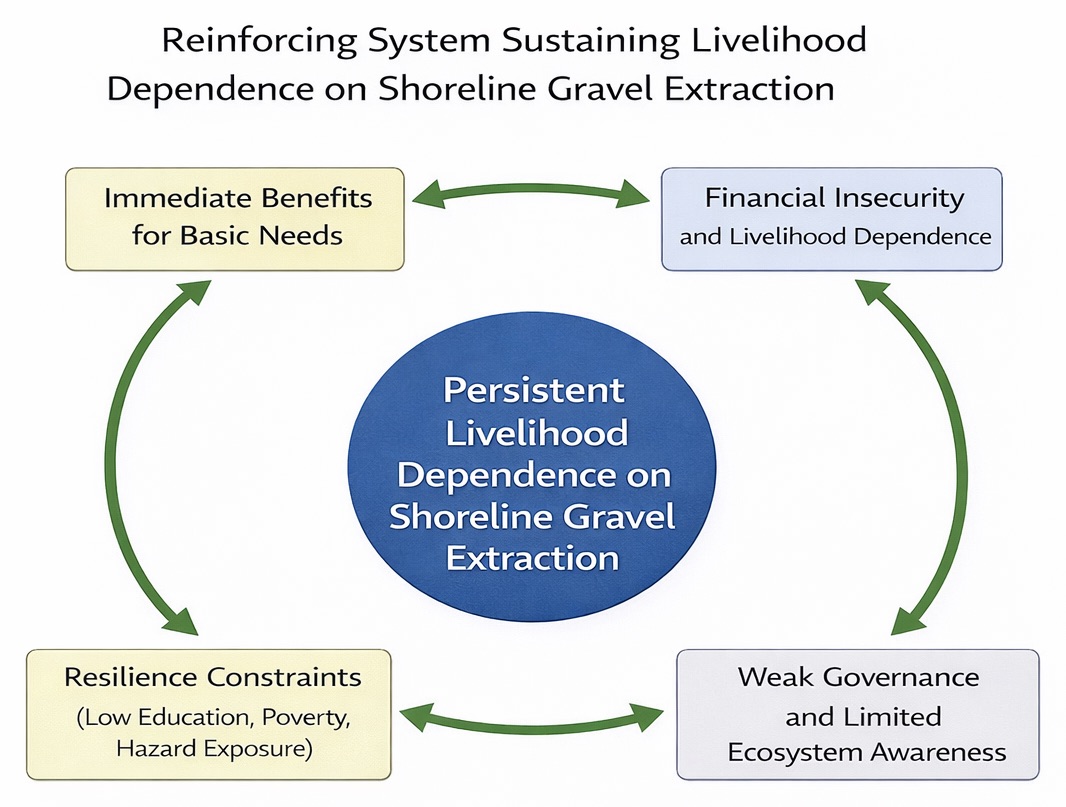
Figure 1 conceptualizes these drivers as a reinforcing feedback system in which immediate livelihood gains, financial insecurity, limited adaptive capacity, and weak governance interact to sustain continued dependence on gravel extraction.
To clarify how these empirically identified constraints inform the structure of the SALF, Table 2 maps each driver to its corresponding intervention domain and intended mechanism for change.
| Empirical driver identified in the study | Key participant signals | SALF Intervention Domain | Intended mechanism for change |
|---|---|---|---|
| Immediate Benefits for Basic Needs | Gravel extraction provides immediate income for food, health needs, and household expenses | Market Linkages | Establish demand-driven alternative livelihoods capable of replacing extraction-based income |
| Resilience Constraints (low education, poverty, hazard exposure) | Limited access to education, training, and livelihood mobility | Capacity Building | Strengthen adaptive capacity through skills development, training, and institutional support |
| Financial Insecurity and Livelihood Dependence | Lack of start-up capital and unstable markets discourage livelihood diversification | Financial Access | Reduce financial barriers and enable investment in sustainable livelihood enterprises |
| Weak Governance and Limited Ecosystem Awareness | Misconceptions about natural replenishment and weak enforcement credibility | Governance and Knowledge Systems | Improve ecosystem awareness, strengthen regulatory legitimacy, and support participatory coastal governance |
The mapping shows that framework components are analytically derived from qualitative evidence rather than introduced as normative design elements. The transformation from empirical themes to SALF components followed a rule-based analytical procedure in which intervention domains were retained only when multiple coded segments across participants indicated that the corresponding constraint could not be addressed by existing institutional responses. For example, repeated accounts of failed livelihood transitions due to lack of start-up capital supported the inclusion of financial access as a distinct domain, while consistent references to unstable demand justified the inclusion of market linkages. Detailed implementation elements are provided in Supplementary Material A to maintain analytical focus in the main text.
While Table 2 establishes the empirical-to-conceptual linkage, Figure 2 integrates these domains into a Theory-of-Change model, illustrating how coordinated changes across the four intervention domains can shift livelihood trajectories away from extraction-based dependence.
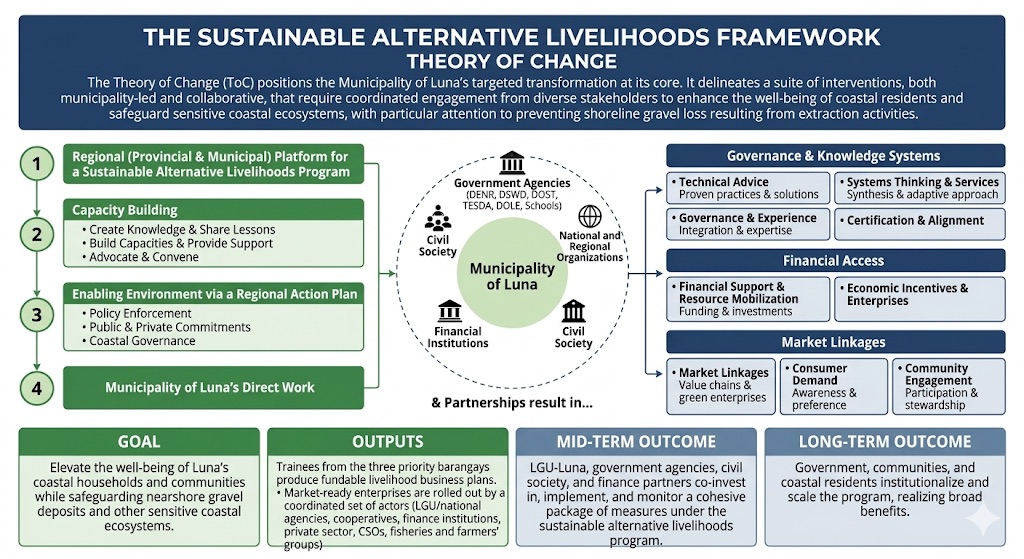
Figure 2 operationalizes the analytical relationships identified in Figure 1 and Table 2 into a causal pathway model. The Theory of Change analytically maps the causal relationships linking coordinated improvements across the intervention domains, enabling livelihood diversification and reducing dependence on gravel extraction. If coastal households gain access to viable market opportunities supported by financing and capacity development, and if these are reinforced by credible governance and ecosystem awareness, then a transition toward sustainable livelihoods becomes feasible and self-reinforcing.
The results are consistent with established work on common-pool resource governance, which emphasizes that resource dependence persists when immediate livelihood needs outweigh long-term sustainability incentives (Ostrom, 1990). The results align with sustainable livelihoods frameworks, which highlight the role of asset constraints, institutional access, and vulnerability contexts in shaping livelihood strategies (Ellis, 2000; FAO, 2010).
However, unlike conventional applications of the Sustainable Livelihoods Framework, which often treat constraints as separable dimensions, the present findings demonstrate that livelihood barriers in coastal systems operate as mutually reinforcing feedbacks. Immediate income dependence, financial insecurity, limited adaptive capacity, and weak governance interact dynamically, creating a self-reinforcing system that sustains reliance on environmentally degrading practices. These results indicate a systems-based pattern of livelihood persistence, where isolated interventions are unlikely to succeed without coordinated changes across institutional, financial, and market domains.
Building on these findings, the study advances the literature by developing the Sustainable Alternative Livelihoods Framework (SALF), an empirically grounded Theory of Change model derived from qualitative evidence. Instead of suggesting a normative intervention, the framework is analytically built from observed livelihood constraints, illustrating how immediate income dependence, financial insecurity, limited adaptive capacity, and weak governance form a reinforcing social–ecological system. This evidence-based connection explains why isolated livelihood, training, or regulatory interventions often have limited success in similar coastal settings.
The framework’s contribution is mainly analytical, offering a transferable structure for studying livelihood transitions in small-island and coastal municipalities facing similar challenges. It shows how immediate income reliance, financial insecurity, limited adaptive capacity, and weak governance interact as a reinforcing system, explaining why isolated interventions often fail. The framework also has practical relevance, detailed in the next section.
Building on the causal pathways presented in Figure 2, Figure 3 identifies the enabling conditions necessary for these pathways to function effectively in practice.
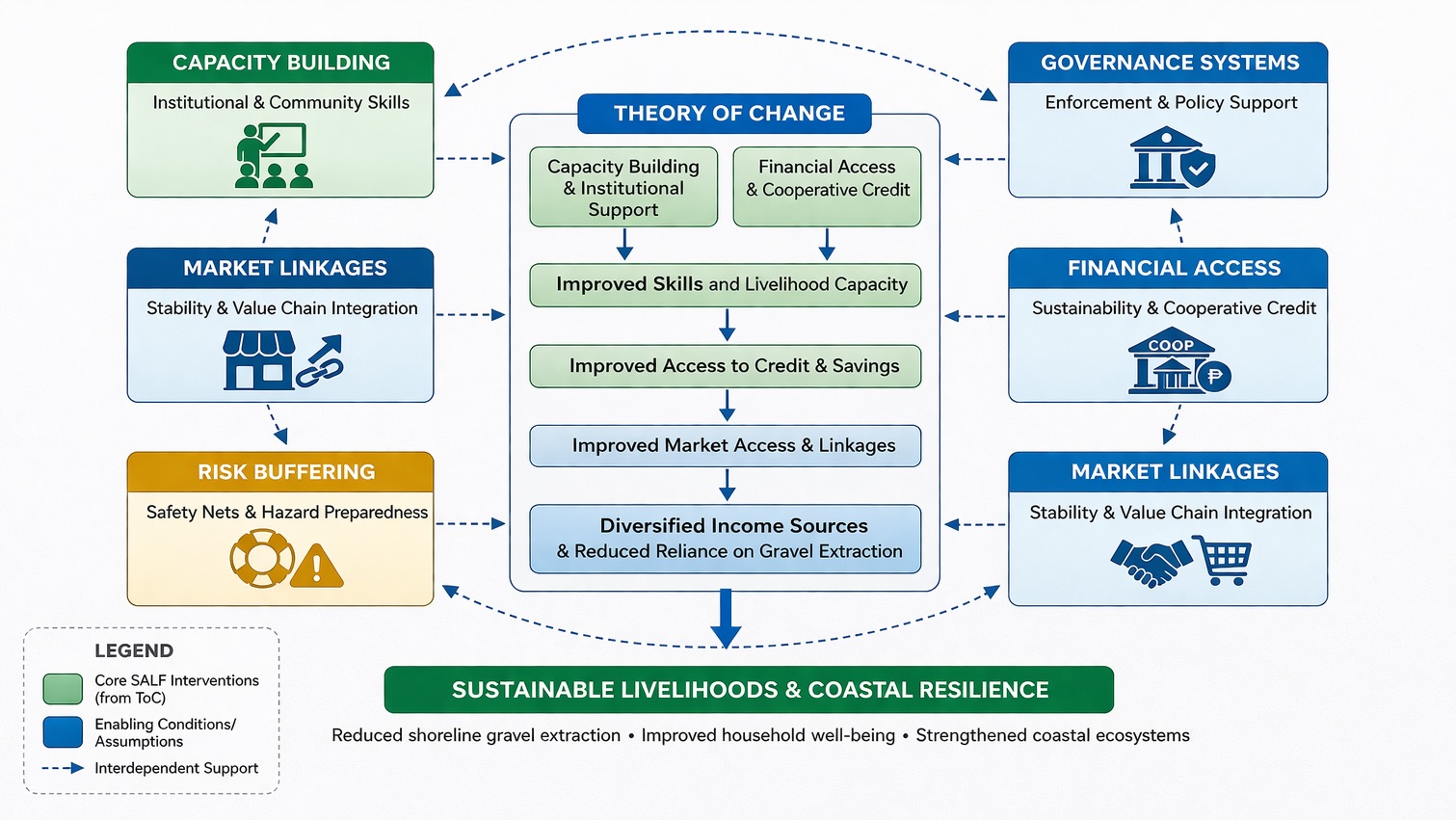
Figure 3 highlights six interdependent factors crucial for shifting livelihoods away from shoreline gravel extraction. These include capacity building, governance systems, market linkages, financial access, household risk buffering, and adaptive learning. Governance legitimacy, achieved through co-management and fair enforcement, encourages compliance and collective behavior change, while market alignment ensures that trained households can access reliable buyers and stable price signals (FAO, 2010; FAO, 2015; Pomeroy et al., 2017; Ostrom, 1990; Pomeroy and Rivera-Guieb, 2006; Ratner et al., 2012; Hatcher et al., 2000; Campbell, 2008). These enabling conditions reinforce the Theory of Change by ensuring that the causal pathways identified in Figure 2 can operate effectively within the local context.
Furthermore, livelihood transitions rely on patient and inclusive financing methods such as revolving funds or cooperative credit, supported by temporary safety nets like cash-for-work programs and wage subsidies that reduce the risk of households reverting to extraction-based activities during the transition (Cattermoul et al., 2008; Hu et al., 2020; FAO, 2010; Msuya et al., 2022; Pomeroy et al., 2017). Continuous monitoring and adaptive learning processes help stakeholders evaluate whether livelihood efforts, financial tools, and governance structures are meeting their intended social and environmental outcomes (Le Blanc, 2015; Thornton et al., 2017; United Nations General Assembly, 2015).
This adaptive governance approach, embedded within the Sustainable Alternative Livelihoods Framework, offers an empirically grounded pathway to reduce shoreline gravel extraction while promoting resilient coastal livelihoods. The findings extend the literature on coastal social–ecological systems by showing how livelihood dependence, governance legitimacy, and market access interact to shape resource-use decisions in small coastal communities. The study also offers an analytically grounded model to guide coastal governance strategies in other resource-dependent shoreline communities, illustrating how qualitative evidence from household decision-making can be turned into a structured Theory of Change for livelihood transition. Similar patterns are observed in small-scale fisheries and coastal commons, where weak institutional credibility and limited livelihood options increase reliance on extractive practices (Ostrom, 2009; Pomeroy et al., 2017). The Sustainable Alternative Livelihoods Framework demonstrates how governance reforms, financial access, and value-chain integration can work together to promote behavioral change in coastal resource systems by transforming empirically identified livelihood challenges into a Theory of Change.
Practical Application of the Sustainable Alternative Livelihoods Framework (SALF) in Island and Coastal Contexts
Although the SALF is empirically grounded in Luna, La Union, the structural conditions it addresses are common across island and small coastal municipalities, including limited economic diversification, restricted market access, high vulnerability to coastal hazards, and reliance on common-pool resources. In island systems, where geographic isolation and resource limitations heighten vulnerability, livelihood transitions need not only alternative income sources but also coordinated institutional and market support. In this context, the SALF functions as a practical decision-support framework, operationalized through a structured implementation pathway that links empirical constraints to coordinated interventions, as illustrated in Figure 4 (Ostrom, 2009; Pomeroy et al., 2017).
The practical value of SALF lies in its focus on connection and timing. Luna’s experiences: intermittent livelihood programs, limited market access, and ongoing shoreline extraction, show that capacity building alone is not enough. As shown in Figure 4, sustainable livelihood changes occur when market access, financial support, capacity building, and governance systems are used together as interconnected, interdependent areas rather than as separate efforts. Livelihood training works better when combined with steady market access and available financing; governance measures gain credibility when real livelihood options exist; and social protection serves as a safety net during the transition, reducing households' need to return to damaging practices.
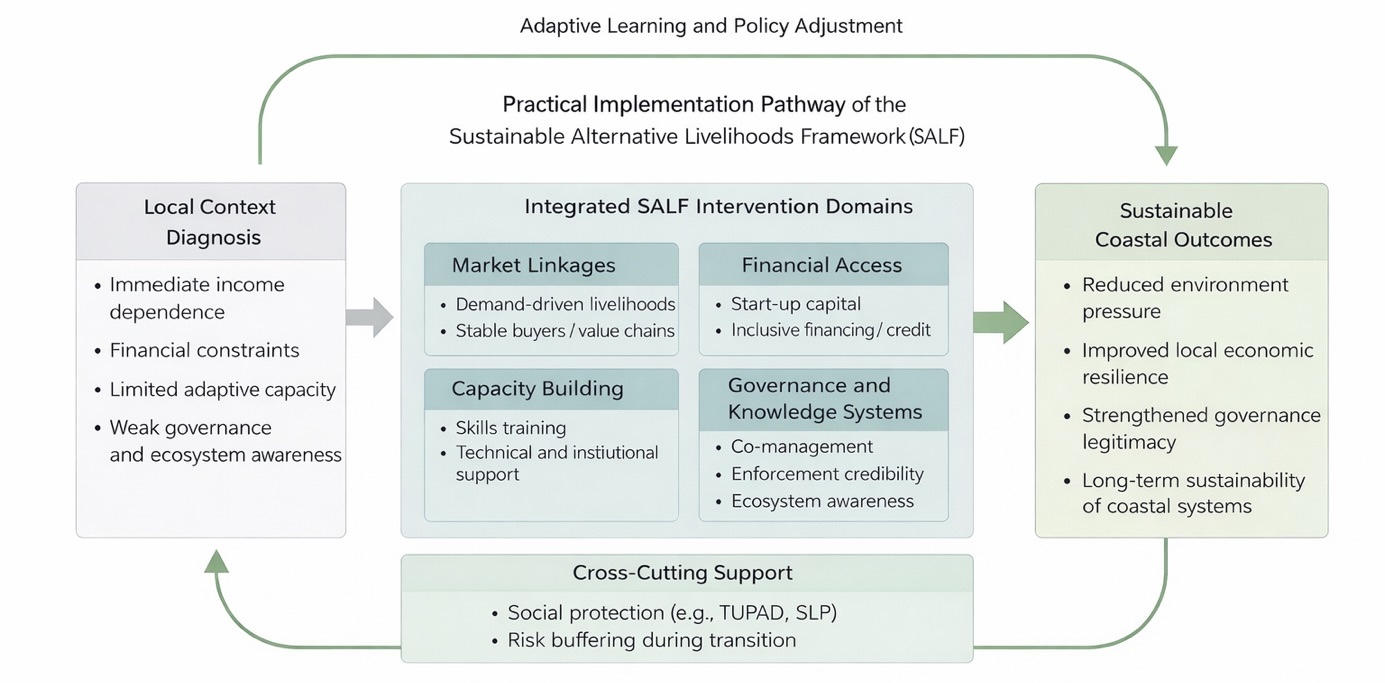
The framework also operationalizes island revitalization in measurable and practice-oriented terms. As shown in Figure 4, the shift from extraction-based dependence to sustainable livelihoods is iterative rather than linear, supported by adaptive learning and policy adjustment mechanisms that continuously align interventions with local conditions. In this study, revitalization is defined not only as income improvement but as a structural transition toward diversified, resilient, and ecologically sustainable livelihood systems. This transition is evident when households consistently engage in non-extractive income sources, when institutional support mechanisms persist beyond short-term program cycles, and when governance systems gain legitimacy through participatory engagement and accountability.
Applied to island and coastal governance, SALF helps local governments and partner agencies prioritize coordination within existing institutional frameworks. As shown in Figure 4, the framework does not require creating new structures but focuses on aligning market linkage, financing, skills development, and governance mechanisms. This integrated approach ensures that shoreline pressure is reduced sustainably while strengthening both economic resilience and institutional credibility.
The results show that the Sustainable Alternative Livelihoods Framework (SALF) is both scientifically grounded and practically useful in island and coastal governance settings. By integrating market development, access to finance, capacity building, and governance systems through a coordinated implementation plan, the framework offers a clear approach to supporting livelihood changes in resource-dependent communities, turning empirical insights into actionable, sustainable solutions.
Conclusions and Recommendations
This study examined the socio-ecological factors maintaining shoreline gravel extraction in Luna, La Union, illustrating how livelihood reliance, governance gaps, and economic challenges interact within a coastal resource system. Extraction continues not only because of enforcement weaknesses but also because it offers a practical livelihood option amid poverty, limited access to training, climate-related threats, unstable markets, and weak institutional support. The findings highlight the need to address structural factors that influence livelihood choices in resource-dependent coastal communities.
The analysis shows how empirically identified constraints inform a Theory-of-Change approach to livelihood transitions and coastal resource management. The Sustainable Alternative Livelihoods Framework (SALF) offers an analytically grounded model that links qualitative insights from household decision-making with institutional, financial, and market mechanisms. This integration connects livelihood behavior with governance structures, showing how coordinated interventions can reduce pressure on coastal resources while strengthening household resilience.
The evidence indicates that efforts to reduce environmentally damaging extraction are more effective when they extend beyond regulatory bans or isolated training programs. Livelihood transitions become more sustainable when skills development is supported by accessible financing, credible market linkages, and participatory governance structures that enhance legitimacy and compliance. In Luna, coordinated multi-stakeholder arrangements provide a practical pathway for integrating knowledge sharing, capacity building, technical support, and economic mechanisms to support livelihood diversification while reducing extraction pressures. The effectiveness of these efforts depends on consistent enforcement, reliable market demand, and sustained collaboration among government agencies, civil society, and local communities.
This study has several limitations. The qualitative, cross-sectional design, which focused on three coastal barangays, restricts how widely the findings can be applied. Field observations were limited by environmental factors such as weather and tidal cycles, and reliance on self-reported experiences may introduce recall bias and social desirability bias. Additionally, the study does not measure the causal effects of proposed interventions on household income or shoreline dynamics.
Future research might expand this work through mixed-methods and long-term studies that explore livelihood transition pathways, governance legitimacy, and coastal ecosystem outcomes over time. Pilot applications of SALF, including experimental or quasi-experimental designs, can offer empirical evidence on how effective coordinated livelihood interventions are in reducing reliance on extraction and enhancing household resilience. Additional research is necessary to understand the gender and intergenerational aspects of livelihood change, market sustainability, and value-chain development for alternative enterprises, along with how well co-management strategies improve compliance within coastal commons.
The practical applicability of the Sustainable Alternative Livelihoods Framework (SALF) lies in its capacity to guide coordinated municipal-level interventions in island and coastal contexts. In settings such as Luna, implementation requires alignment among local government units, national agencies, cooperatives, and community organizations to ensure that livelihood programs are directly linked to market demand and environmental management objectives. Skills development initiatives become effective when paired with accessible financing and stable market channels, while enforcement mechanisms gain legitimacy when supported by participatory governance structures. Through this integration, SALF enables a transition from fragmented, project-based interventions toward a coordinated system that simultaneously reduces pressure on coastal resources, stabilizes household income, and strengthens institutional capacity. This establishes the framework as an operational strategy for advancing sustainable livelihoods and community revitalization in island environments.
Although grounded in Luna, La Union, the SALF serves as a transferable and SDG-aligned framework for island and small coastal municipalities facing similar livelihood dependence and shoreline risks. The Sustainable Alternative Livelihoods Framework thus provides an empirically grounded and operationally applicable model for advancing sustainable livelihoods, strengthening governance systems, and supporting the long-term revitalization of small island and coastal communities under coupled socio-ecological pressures.
This study improves the sustainability and renewal of island and coastal areas by showing how empirically based livelihood changes can be implemented through coordinated institutional, financial, and market systems. The Sustainable Alternative Livelihoods Framework (SALF) tackles structural factors common to small-island systems, such as limited economic diversity, high vulnerability to climate risks, and dependence on extractive coastal resources. By linking household-level livelihood behaviors with governance, financial access, and market integration, the framework provides a practical way to reduce environmental stress while increasing economic resilience. In island settings where isolated or fragmented efforts often fail, SALF offers a systems-based approach that aligns local development with ecological sustainability. This makes the framework not just a specific solution for Luna, La Union, but a adaptable model for promoting sustainable livelihoods, strengthening governance legitimacy, and supporting long-term resilience in island communities.
Acknowledgments
I extend my deepest gratitude to my family for their unwavering support in my pursuit of learning. I am thankful to my family and friends for their thoughtful involvement during the development of this work. I appreciate Dr. Fernando Siringan, professor of University of the Philippines – Marine Science Institute (UP- MSI) and the research and development team of the Coastal Engineering and Management Research and Development Project 1, funded by the Department of Science and Technology – Philippine Council for Industry, Energy and Emerging Technology Research and Development (DOST–PCIEERD), for their guidance and data support, which were crucial to this study. I am especially grateful to my adviser at the Ateneo de Manila University School of Government, Dr. Cristina Liamzon, for her mentorship and insightful feedback. I also thank Don Mariano Marcos Memorial State University for the scholarship and institutional assistance, and the study participants for generously sharing their time and experiences. All remaining errors are my own.
Conflict of Interest
The author declares no conflict of interest.
Fieldwork Notes
References
- Braun, V., Clarke, V., 2006. Using thematic analysis in psychology. Qual. Res. Psychol. 3: 77–101. https://doi.org/10.1191/1478088706qp063oa
- Breuer, E., Lee, L., De Silva, M., Lund, C., 2016. Using theory of change to design and evaluate public health interventions: a systematic review. Implement. Sci. 11: 63. https://doi.org/10.1186/s13012-016-0422-6
- Bullock, A., Acreman, M., 2003. The role of wetlands in the hydrological cycle. Hydrol. Earth Syst. Sci. 7: 358–389. https://doi.org/10.5194/hess-7-358-2003
- Campbell, J., 2008. Sustainable coastal livelihoods guidance. FAO, Rome. Available at https://www.fao.org
- Cattermoul, B., Pilling, D., Crawford, M., 2008. Sustainable livelihoods guidance sheets. FAO, Rome. Available at https://www4.unfccc.int/sites/NAPC/Documents%20NAP/Supplements/FAO_Addressing%20Agriculture%2C%20Forestry%20and%20Fisheries%20in%20NAPs.pdf
- Cattermoul, B., Townsley, P., Campbell, 2008. Sustainable livelihoods enhancement and diversification (SLED): a manual for practitioners. IUCN, CORDIO, ICRAN, Gland, Colombo, Cambridge. https://portals.iucn.org/library/sites/library/files/documents/2008-066.pdf
- Cattermoul, B., Townsley, P., Lemon, M., 2010. Sustainable livelihoods approaches and fisheries. FAO, Rome.
- Creswell, J.W., 2013. Qualitative inquiry and research design: choosing among five approaches. Sage, Thousand Oaks, CA.
- Crossland, C.J., Kremer, H.H., Lindeboom, H.J., Marshall Crossland, J.I., Le Tissier, M.D.A., 2005. The coastal zone—a domain of global interactions, in: Crossland, C.J., Kremer, H.H., Lindeboom, H.J., Marshall Crossland, J.I., Le Tissier, M.D.A. (Eds.), Coastal fluxes in the Anthropocene. Springer, Berlin, pp. 1–37. https://doi.org/10.1007/3-540-27851-6_1
- Department of Environment and Natural Resources (DENR), 1992. Administrative Order No. 28, s. 1992. DENR, Quezon City.
- Depietri, Y., Welle, T., Renaud, F.G., 2013. Social vulnerability assessment of the Cologne urban area to heat waves. Int. J. Disaster Risk Reduct. 6: 28–38. https://doi.org/10.1016/j.ijdrr.2013.10.001
- DiCicco-Bloom, B., Crabtree, B.F., 2006. The qualitative research interview. Med. Educ. 40: 314–321. https://doi.org/10.1111/j.1365-2929.2006.02418.x
- Douthwaite, B., Hoffecker, E., 2017. Towards a complexity-aware theory of change. Agric. Syst. 155: 117–128. https://doi.org/10.1016/j.agsy.2017.04.002
- Elliott, M., Burdon, D., Atkins, J.P., Borja, Á., Cormier, R., de Jonge, V.N., 2017. DPSIR framework developments. Mar. Pollut. Bull. 125: 155–165. https://doi.org/10.1016/j.marpolbul.2017.03.049
- FAO, 2010. Guidelines for the economic analysis of rural livelihoods. FAO, Rome. Available at https://openknowledge.fao.org/server/api/core/bitstreams/5fc6bb8d-32a7-4c5e-ac71-81c1f19d13e4/content
- FAO, 2015. Voluntary guidelines for securing sustainable small-scale fisheries. FAO, Rome. https://www.fao.org/3/i4356en/i4356en.pdf
- Fletcher, C.H., Mullane, R.A., Richmond, B.M., 1997. Beach loss along armored shorelines. J. Coast. Res. 13: 209–215. https://journals.flvc.org/jcr/article/view/80120
- French, P.W., 2001. Coastal defences: processes, problems and solutions. Routledge, London.
- Gill, P., Stewart, K., Treasure, E., Chadwick, B., 2008. Methods of data collection in qualitative research. Br. Dent. J. 204: 291–295. https://doi.org/10.1038/bdj.2008.192
- Guest, G., Bunce, A., Johnson, L., 2006. How many interviews are enough? Field Methods 18: 59–82. https://doi.org/10.1177/1525822X05279903
- Halpern, B.S., Longo, C., Hardy, D., et al., 2012. An index to assess the health of the global ocean. Nature 488: 615–620. https://doi.org/10.1038/nature11397
- Halpern, B.S., Frazier, M., Potapenko, J., et al., 2015. Spatial and temporal changes in cumulative human impacts on the world’s ocean. Nat. Commun. 6: 7615. https://doi.org/10.1038/ncomms8615
- Hatcher, A., Jaffry, S., Thébaud, O., Bennett, E., 2000. Normative influences on compliance with fisheries regulations. Land Econ. 76: 448–461.
- Hennink, M.M., Kaiser, B.N., Marconi, V.C., 2017. Code saturation versus meaning saturation: how many interviews are enough? Qual. Health Res. 27: 591–608. https://doi.org/10.1177/1049732316665344
- Hu, W., Liu, J., Ma, Z., et al., 2020. China’s marine protected area system: evolution, challenges, and prospects. Mar. Policy 115: 103780. https://doi.org/10.1016/j.marpol.2019.103780
- IPCC, 2019. Special Report on the Ocean and Cryosphere in a Changing Climate. Cambridge University Press, Cambridge. https://doi.org/10.1017/9781009157964
- Kurniawan, F., Adrianto, L., Bengen, D.G., Prasetyo, L.B., 2016. Vulnerability of small islands to tourism development: the case of the Karimunjawa Islands, Indonesia. Tour. Mar. Environ. 12: 9–23. https://doi.org/10.1016/j.gecco.2016.04.001
- Le Blanc, D., 2015. Towards integration at last? The sustainable development goals as a network of targets. Sustain. Dev. 23: 176–187. https://doi.org/10.1002/sd.1582
- Lincoln, Y.S., Guba, E.G., 1985. Naturalistic inquiry. Sage, Newbury Park, CA.
- Masselink, G., Hughes, M.G., Knight, J., 2014. Introduction to coastal processes and geomorphology. Routledge, London. https://doi.org/10.4324/9780203785461
- Msuya, F.E., Bolton, J., Pascal, F., et al., 2022. Seaweed farming in Africa: current status and future potential. J. Appl. Phycol. 34: 985–1005. https://doi.org/10.1007/s10811-021-02676-w
- National Commission for the Protection of Human Subjects, 1979. The Belmont Report. U.S. Government Printing Office, Washington, DC.
- Nguyen, T.T.X., Woodroffe, C.D., 2016. Assessing relative vulnerability to sea-level rise in the western part of the Mekong River Delta in Vietnam. Sustain. Sci. 11: 645–659. https://doi.org/10.1007/s11625-015-0336-2
- Nicholls, R.J., 2010. Impacts of and responses to sea-level rise, in: Church, J.A., Woodworth, P.L., Aarup, T., Wilson, W.S. (Eds.), Sea-Level Rise and Variability. Wiley-Blackwell, Chichester, pp. 17–51. https://doi.org/10.1002/9781444323276.ch2
- Nowell, L.S., Norris, J.M., White, D.E., Moules, N.J., 2017. Thematic analysis: striving to meet the trustworthiness criteria. Int. J. Qual. Methods 16: 1–13. https://doi.org/10.1177/1609406917733847
- Office of the President, 1987. Executive Order No. 192. Official Gazette, Manila. Available at https://lawphil.net/executive/execord/eo1987/eo_192_1987.html
- OECD, 2013. Coastal zone management report. OECD, Paris.
- O’Neill, D.W., Fanning, A.L., Lamb, W.F., Steinberger, J.K., 2018. A good life for all within planetary boundaries. Nat. Sustain. 1: 88–95. https://doi.org/10.1038/s41893-018-0021-4
- Oscar M. Lopez Center, 2020–2025. Sea level rise in the Philippines. Pasig. https://www.omlopezcenter.org/tag/sea-level-rise/page/3/
- Ostrom, E., 1990. Governing the commons: the evolution of institutions for collective action. Cambridge University Press, Cambridge.
- Ostrom, E., 2009. A general framework for analyzing sustainability of social–ecological systems. Science 325: 419–422. https://doi.org/10.1126/science.1172133
- PAGASA, 2019. State of the Philippine climate reports. PAGASA, Quezon City.
- Patton, M.Q., 2002. Qualitative research and evaluation methods. Sage, Thousand Oaks, CA.
- Philippine Health Research Ethics Board, 2022. National ethical guidelines for health and health-related research. Manila.
- Philippine Statistics Authority, 2020. Census of population and housing. PSA, Manila.
- Pomeroy, R.S., Rivera-Guieb, R., 2006. Fishery co-management: a practical handbook. CABI, Wallingford. https://doi.org/10.1079/9780851990880.0000
- Pomeroy, R.S., Parks, J.E., Mrakovcich, K.L., LaMonica, C., 2016. Drivers and impacts of fisheries scarcity, competition, and conflict on maritime security. Mar. Policy 67: 94–104. https://doi.org/10.1016/j.marpol.2016.01.005
- Prandi, P., Cazenave, A., Becker, M., 2009. Coastal sea-level rise: observations and causes. Geophys. Res. Lett. 36: L05602. https://doi.org/10.1029/2008GL036564
- Ratner, B.D., Oh, E.J., Pomeroy, R.S., 2012. Navigating change: second-generation challenges of small-scale fisheries co-management. Mar. Policy 36: 643–650. https://doi.org/10.1016/j.marpol.2012.04.014
- Rehfuess, E.A., Booth, A., Brereton, L., et al., 2018. Towards a taxonomy of logic models in systematic reviews and health technology assessments. Res. Synth. Methods 9: 13–24. https://doi.org/10.1002/jrsm.1254
- Rosati, J.D., 2005. Concepts in sediment budgets. J. Coast. Res. 21: 307–322.
- Sekovski, I., Newton, A., Dennison, W.C., 2012. Megacities in the coastal zone: using a driver–pressure–state–impact–response framework. Estuar. Coast. Shelf Sci. 96: 48–59. https://doi.org/10.1016/j.ecss.2011.07.011
- Siringan, F.P., Sta. Maria, M.Y.Y., 2024. Sea level rise and coastal erosion in the Philippines, in: Berse, K.B., et al. (Eds.), Climate Emergency in the Philippines. Springer, Singapore, pp. 45–68. https://doi.org/10.1007/978-981-99-7804-5_3
- Steffen, W., Richardson, K., Rockström, J., et al., 2015. Planetary boundaries: guiding human development on a changing planet. Science 347: 1259855. https://doi.org/10.1126/science.1259855
- Thornton, P.K., Schuetz, T., Förch, W., et al., 2017. Responding to global change: a theory of change approach to making agricultural research for development outcome-based. Agric. Syst. 152: 145–153. https://doi.org/10.1016/j.agsy.2017.01.005
- United Nations General Assembly, 2015. Transforming our world: the 2030 agenda for sustainable development. United Nations, New York.
- Weiss, C.H., 1995. Nothing as practical as good theory: exploring theory-based evaluation for comprehensive community initiatives. Aspen Institute, Washington, DC. Available at https://www.scirp.org/reference/referencespapers?referenceid=3202497
- World Bank Group, 2024. Climate change knowledge portal: Philippines. World Bank, Washington, DC. https://climateknowledgeportal.worldbank.org/country/philippines
- World Medical Association, 2013. Declaration of Helsinki: ethical principles for medical research involving human subjects. JAMA 310: 2191–2194. https://doi.org/10.1001/jama.2013.281053
Supplementary Materials
Supplementary Material A. Operational Matrix of the Sustainable Alternative Livelihoods Framework (SALF)
Table 3. Operational Matrix of the Sustainable Alternative Livelihoods Framework (SALF): translating the four core domains: market linkages, financial access, capacity building, and governance and knowledge systems, into coordinated institutional functions, outputs, and outcomes, with social protection embedded as a cross-cutting mechanism.
| SALF ToC Level | Intervention Domain | Institutional Functions / Components | Expected Outputs | Expected Outcomes |
|---|---|---|---|---|
| GOAL | Integrated SALF Implementation | Coordinated delivery across governance, finance, market, and capacity systems | Improved livelihood systems and reduced dependence on gravel extraction | Long-Term: Sustainable livelihoods institutionalized; reduced shoreline degradation; improved household well-being |
| GOAL | Integrated SALF Implementation | Coordinated delivery across governance, finance, market, and capacity systems | — | Mid-Term: LGU, government agencies, civil society, and finance partners co-invest, implement, and monitor coordinated interventions |
| ENABLING FOUNDATION | Governance and Knowledge Systems | Technical advice and proven practices; systems thinking and integrated planning; multi-agency coordination (LGU, DENR, DSWD, DOLE, TESDA, etc.); certification and standards alignment | Knowledge products disseminated; governance platforms operational; certified participants | Strengthened institutional coherence, improved decision-making, increased legitimacy and compliance |
| ENABLING MECHANISM | Financial Access | Financial support and resource mobilization (grants, revolving funds, cooperative credit); economic incentives (subsidies, tax incentives, enterprise support) | Capital deployed to households; livelihood enterprises supported | Reduced financial barriers; increased enterprise viability and sustainability |
| DRIVER OF CHANGE | Market Linkages | Value chain integration; buyer partnerships; offtake agreements; consumer demand development; community participation in markets | Established buyer networks; signed MOUs; market-ready enterprises | Stable demand for alternative livelihoods; improved income security; diversified livelihoods |
| IMPLEMENTATION CORE | Capacity Building | Knowledge creation and sharing; training and certification; technical assistance and mentoring; stakeholder engagement and participatory planning | Trained and certified participants; supported enterprise development; collaboration platforms | Improved skills, adaptive capacity, and livelihood success rates |
| CROSS-CUTTING DELIVERY SYSTEM | Integrated Platform and Enabling Environment | Regional and municipal coordination platform; action plan development and enforcement; public–private commitments; community-level implementation | Operational SALF platform; adopted action plan; fundable business plans deployed | Coordinated implementation; strengthened governance support; transition away from extraction-based livelihoods |
| OUTPUTS | — | — | Trainees produce fundable livelihood business plans; market-ready enterprises rolled out; financial resources mobilized; governance platforms activated | — |
| OUTCOMES | — | — | — | Mid-Term: Coordinated implementation and compliance across stakeholders; Long-Term: Institutionalized sustainable livelihoods and coastal ecosystem protection |
Supplementary Material B. Assumption-to-Action Matrix (Implementation Risks and Mitigation Measures)
The assumption-to-action matrix operationalizes key risks across SALF domains, linking market, finance, capacity, governance, and cross-cutting social protection to adaptive triggers and mitigation responses.
| SALF Domain Alignment | SALF Assumption | Risk Triggers (Monitored) | Mitigation Actions (If Triggered) |
|---|---|---|---|
| Market Linkages (Driver of Change) | A1. Market demand must precede or accompany livelihood supply | Offtake agreements cover <80% of projected volume prior to cohort start; rejection rates >10% of production; average prices fall >15% below agreed floor for 3 consecutive months | Secure additional buyers and anchor firms; diversify market channels; recalibrate product mix; strengthen quality assurance and certification processes; phase production based on demand signals |
| Financial Access (Enabling Mechanism) | A2. Livelihood transition requires timely, adequate, and risk-sharing finance | <70% of trainees receive working capital within 30 days; disbursement delays >30 days; portfolio at risk (>30 days) >10%; enterprise survival <60% at 12 months | Increase grant and credit envelopes; extend repayment grace periods; introduce blended finance (grants + credit); provide enterprise coaching; shift portions of financing to performance-based grants |
| Capacity Building (Implementation Core) | A3. Skills development must translate into viable, market-linked enterprises | <70% certification completion rate; <60% of trained participants engaged in enterprises within 6 months; low business plan approval rates | Strengthen training design and mentoring; align curricula with market demand; provide post-training incubation and coaching; integrate certification with enterprise deployment pathways |
| Governance and Knowledge Systems (Enabling Foundation) | A4. Legitimacy, co-management, and enforcement drive compliance and sustainability | Illegal extraction incidents do not decrease by ≥20% by Month 12; >10% of grievances unresolved after 30 days; low participation in governance platforms | Reconvene participatory rule-making; revise enforcement protocols and sanctions; expand community monitoring; publish transparency dashboards; strengthen grievance redress mechanisms |
| Integrated Delivery System (Cross-Cutting Platform) | A5. Multi-stakeholder coordination and co-investment are required for program coherence | Co-financing commitments fall below targets; <70% stakeholder participation in coordination platforms; delays in action plan implementation | Strengthen LGU-led coordination; formalize partnership agreements; increase stakeholder incentives; enforce accountability mechanisms; align timelines and responsibilities across actors |
| Social Protection (Cross-Cutting Risk Buffer) | A6. Household risk buffering is necessary during livelihood transition | Median household income declines >20% during rollout; >10% of participants report food insecurity spikes; dropout rates increase | Activate cash-for-work or wage subsidies; stagger training and enterprise rollout; provide emergency transfers; link households to DSWD/DOLE programs |
| Monitoring, Evaluation, and Learning (MEL) | A7. Continuous learning and adaptive management must be institutionalized | No MEL review conducted for two consecutive quarters; indicators not updated; corrective actions not implemented within review cycles | Convene MEL 'stop-go-adapt' reviews; conduct rapid external validation; adjust program design, incentives, and delivery mechanisms based on evidence |
Supplementary Material C. Monitoring and Evaluation Indicators for the SALF
The monitoring framework aligns directly with the SALF domains and sequencing logic, tracking how market formation and financial access enable capacity deployment, reinforced by governance systems, to produce livelihood and ecosystem outcomes, with social protection functioning as a cross-cutting safeguard.
| ToC Level | SALF Domain Alignment | Indicator (Operational Definition) | Baseline (Y0) | Target and Timeline | Frequency / Data Source |
|---|---|---|---|---|---|
| OUTPUTS | Capacity Building | Trainees enrolled/completed; TESDA certification pass rate (%) — sex-disaggregated; with vulnerability flags | 0; 0% | ≥150 trained; ≥70% certified by Month 12 | Quarterly; LGU/TESDA registers |
| OUTPUTS | Capacity Building | Bank/coop-vetted business plans (# approved) | 0 | ≥60 approved by Month 12 | Quarterly; coop/bank approvals |
| OUTPUTS | Market Linkages | Offtake/anchor-buyer MOUs signed (#) | 0 | ≥10 MOUs by Month 12 | Quarterly; LGU-private MOUs |
| OUTPUTS | Financial Access | Concessional finance disbursed (PHP) and number of beneficiaries — sex-disaggregated; with vulnerability flags | 0 | ≥PHP 7.5M; ≥120 households by Month 18 | Quarterly; LGU/coop ledgers |
| OUTPUTS | Governance and Knowledge Systems | Governance convenings held (#) and attendance (unique participants) | 0 | ≥6 sessions; ≥120 participants by Month 12 | Quarterly; minutes |
| OUTPUTS | Governance and Knowledge Systems | Awareness sessions on coastal rules/tenure rights (# sessions; # attendees) | 0 | ≥12 sessions; ≥300 residents by Month 12 | Quarterly; DENR/LGU logs |
| MID-TERM OUTCOME | Integrated Delivery | Co-financing mobilized (PHP from LGU, national agencies, private sector, and CSOs) | 0 | ≥PHP 25M by Month 24 | Semi-annual; funding MOUs |
| MID-TERM OUTCOME | Market + Capacity Linkage | Placement: % of certified trainees engaged in offtake-linked enterprises ≥6 months — sex-disaggregated; with vulnerability flags | 0% | ≥60% by Month 24 | Semi-annual; enterprise rosters |
| MID-TERM OUTCOME | Financial Access | Enterprise survival rate at 12 months (%) | TBD (baseline from Cohort 1) | ≥70% by Month 30 | Annual; coop/LGU registers |
| MID-TERM OUTCOME | Governance (Compliance) | Compliance index: illegal extraction incidents per patrol day | TBD (Month 0 baseline) | ≥40% reduction by Month 24 | Monthly; LGU/DENR patrol logs |
| MID-TERM OUTCOME | Governance (Legitimacy) | Perceived legitimacy of rules (mean Likert score, 1–5) | TBD (Month 0 baseline) | +0.7 increase by Month 24 | Semi-annual; household survey |
| LONG-TERM OUTCOME | Livelihood Transition | Households primarily reliant on gravel extraction (%) — sex-disaggregated; with vulnerability flags | 50.7% | ≤30% by Month 36 | Annual; household survey |
| LONG-TERM OUTCOME | Livelihood Diversification | Income diversification index (Herfindahl) among target households | TBD (baseline survey) | 20% improvement by Month 36 | Annual; household survey |
| LONG-TERM OUTCOME | Ecosystem Pressure Reduction | Estimated extraction effort (truck egress/day; sacks/day) and volume (m³ per year) | ≈31,600 m³ per year | ≥40% reduction by Month 36 | Quarterly; MGB/LGU records |
| LONG-TERM OUTCOME | Coastal Condition | Shoreline trend (End-Point Rate, meters per year) on critical reaches | ~1.4–1.6 m per year retreat | Statistically significant slowing by Year 3 | Annual; DSAS/NAMRIA satellite data |
| LONG-TERM OUTCOME | Household Well-being | Food security proxy (FIES or MAHFP) — sex-disaggregated; with vulnerability flags | TBD (baseline survey) | 25% improvement by Month 36 | Annual; household survey |
| LONG-TERM OUTCOME | Social Protection | Social-protection coverage among transitioning households (%) — sex-disaggregated; with vulnerability flags | TBD (baseline) | ≥70% by Month 18 | Quarterly; DSWD/DOLE records |
Note: All livelihood, training, placement, and social-protection indicators are sex-disaggregated and tagged with vulnerability markers (e.g., female-headed households and households with members reporting disability). Results should be presented for total and disaggregated groups. (HH = household; FIES = Family Income and Expenditure Survey proxy; MAHFP = Months of Adequate Household Food Provisioning; EPR = End-Point Rate.)
Operationalizing Assumptions—Sequence, Triggers, and Mitigations. Table 5 operationalizes the core assumptions of the Sustainable Alternative Livelihoods Framework (SALF) through measurable indicators, thresholds, and adaptive triggers. Consistent with Tables 3 and 4, the framework prioritizes: (1) market demand secured through off-take agreements (Indicators 3, 8); (2) timely, risk-sharing finance (Indicator 4); (3) capacity deployment enabled by prior market formation and financial access (Indicators 1, 2, 8); (4) governance and co-management mechanisms (Indicators 5, 10, 11); and (5) integrated monitoring of livelihood and ecosystem outcomes (Indicators 12–16).
Implementation follows a sequenced logic where market and finance enable capacity, reinforced by governance. Indicators are sex-disaggregated and vulnerability-tagged. Threshold-based reviews trigger adaptive adjustments to maintain alignment between outputs and long-term livelihood and coastal outcomes.