
Journal of Marine and Island Cultures
Special Issue: The Present and Future of Island Cultural Diversity
Islands at the Crossroads: Biocultural Diversity, Heritage, and Sustainable Futures
 10.21463/jmic.2026.15.1.01
1. Anchoring the Conversation: The Yeosu Forum and Its Legacy
This special issue of the Journal of Marine and Island Cultures grows out of a sustained and generative intellectual encounter: the 2025 International Island Forum held in Yeosu, Republic of Korea. Convened under the theme “The Present and Future of Island Cultural Diversity,” the Forum brought together scholars, community advocates, policymakers, and practitioners whose work spans archipelagos from the East China Sea to the Mediterranean, from the Pacific Northwest to the Seto Inland Sea. What united them was not a single methodology or disciplinary allegiance, but a shared conviction that islands matter, and that the way we think about islands must change.
The Forum took place at a moment of heightened urgency. Island communities worldwide face converging crises: accelerating biodiversity loss, the cultural homogenization driven by globalization, demographic collapse in peripheral archipelagos, and the mounting impacts of climate change on coastal and low-lying environments. Yet Yeosu was not a gathering defined by crisis alone. The conversations and the scholarship gathered in this issue consistently demonstrated that island cultures are not simply victims of global forces. They are, in many instances, among humanity’s most sophisticated living systems where we can observe co-production of ecological and cultural knowledge. The challenge is not to freeze islands in time, but to create the conditions that allow island communities to navigate contemporary change on their own terms.
Yeosu also carries particular significance as the host city of the upcoming 2026 World Island Exhibition, whose theme, “Islands and the Sea: Sustainable Future,” offers an opportunity to shift global narratives about islands from vulnerability and marginality toward agency, innovation, and knowledge production. Several contributions in this issue speak directly to that ambition, and we return to it in our closing remarks.
2. Islands Recentred: From Margin to Nexus
A defining intellectual commitment runs through this special issue: the refusal to frame islands as peripheral, isolated, or simply “small.” This move, now well-established in island studies, has a distinguished genealogy. Epeli Hauʻofā’s (1994) foundational reframing of Oceania as a “Sea of Islands” rather than “islands in a far sea” redirected attention from bounded territory to relational networks, the sea as connector, not barrier. This archipelagic imaginary has since been extended through postcolonial scholarship in the Caribbean, Mediterranean, and East Asian contexts (Baldacchino, 2004; Grydehøj, 2017; Hayward, 2014; Stratford et al., 2011), and it infuses the six contributions assembled here.
The opening paper by Sun-Kee Hong, Jae-Eun Kim, and Gyeong-Ah Lee provides the conceptual scaffolding for the entire issue. Drawing on multidisciplinary scholarship and comparative cases from East Asia, Southeast Asia, and the Pacific, their synthesis proposes six interrelated analytical lenses through which island cultures can be understood: biocultural diversity, islandness, social-ecological systems, commons and community resilience, archipelagic thinking, and place-based knowledge. Hong and colleagues resist any single lens in isolation. Their argument is that explanatory power emerges only when these frameworks are read together, as a composite optic adequate to the complexity of island life. Their paper also highlights gaps in existing literature regarding regional imbalance, disciplinary fragmentation, insufficient engagement with power and inequality, and limited dialogue with broader theoretical currents such as the Anthropocene and the Blue Humanities. This contribution points toward the kind of epistemological pluralism, relationally oriented, comparative, and glocal scholarship that a maturing field requires.
The concept of “biocultural diversity”, the co-evolution of biological and cultural systems as a single, intertwined phenomenon, serves as a unifying thread across this issue. First articulated in the 1988 Declaration of Belém and developed through Luisa Maffi’s foundational synthesis (Maffi, 2001, 2005; Sterling et al., 2017), biocultural diversity insists that the erosion of cultural systems and the decline of biological systems are not parallel crises but a single one. Several papers in this issue both draw on and deepen this framework, each adding texture from a distinct geographic and disciplinary vantage point.
3. The Papers in Dialogue
3.1 Oceans of Knowledge: Biocultural Connections in the Marine World
Annette Breckwoldt and Ron Vave’s contribution, “Cultural Diversity and Marine Biodiversity: Bridging What Is Already Connected,” offers the most direct theoretical engagement with the marine dimensions of biocultural diversity. Writing from the Leibniz Centre for Tropical Marine Research in Bremen and the Department of Pacific Islands Studies, University of Hawai’i, Breckwoldt and Vave argue that the relationship between cultural diversity and marine biodiversity on islands is not one of co-location but of “co-constitution”, each sustaining, shaping, and reinforcing the other through biocultural feedback loops. Their paper makes a striking observation. To their knowledge, no systematic literature review has yet examined the connections between cultural diversity and marine biodiversity explicitly from an island studies perspective. This gap is both a scholarly failing and an opportunity, and this paper begins to address it.
Drawing on the concept of Two-Eyed Seeing (Etuaptmumk), as articulated by Elder Dr. Albert Marshall of the Mi’kmaw Nation (Bartlett et al., 2012), Breckwoldt and Vave propose a methodology for knowledge coexistence that goes beyond the familiar call to “integrate” Indigenous knowledge into Western science. Two-Eyed Seeing asks practitioners to see from one eye with the strengths of Indigenous ways of knowing and from the other with the strengths of Western science, using both together “for the benefit of all.” Applied to marine stewardship, this framework grounds the case study of reef passages in New Caledonia, where these ecological features function simultaneously as biocultural keystones: spaces of fish passage, ceremonial significance, social memory, and customary governance. These passages are not merely features of marine geography; they are inscribed with generations of relational knowledge and practice. Breckwoldt and Vave’s analysis is complemented by their engagement with the clam garden traditions of the Pacific Northwest, where Coast Salish peoples have cultivated intertidal ecosystems for millennia in ways now being recognized by conservation science as models of adaptive management.
Breckwoldt and Vave’s paper situates itself explicitly within the editorial vision of island epistemology, ways of knowing that emerge from and are shaped by island-human-ocean relations. Their conclusion is characteristically forward looking. Rather than lamenting the marginalization of Indigenous knowledge, they call for governance frameworks and research partnerships that treat it as “a co-equal epistemological foundation.”
3.2 Islandscapes: Landscape, Seascape, and Biocultural Participation
Gloria Pungetti’s article, “Islandscape Biocultural Diversity and Community Participation,” brings a European-Mediterranean dimension to the issue while extending the biocultural diversity framework into landscape studies. Pungetti introduces the concept of the “islandscape”, the full landscape of an island, understood as the meeting point of landform, seascape, and cultural heritage, and argues for its analytical and policy value in island governance.
Drawing on decades of European research, including the ESLAND (European Culture Expressed in Landscapes) and Seascapes projects, as well as her own work in Sardinia, Pungetti demonstrates how natural and cultural forces have co-shaped island environments across the Mediterranean over millennia. Her Sardinian case study is organized around three methodological pillars: an interdisciplinary and biocultural dimension; active community participation; and shared results with structured follow-up. The finding that community members’ perceptions of their own islandscape differ systematically from expert assessments, and that mapping these perceptions is itself a form of governance, has direct implications for conservation planning and cultural heritage management in island contexts worldwide.
Pungetti’s paper also makes a normative argument that “biocultural, transdisciplinary and collaborative approaches for resilient island cultures” are not merely desirable but necessary if islandscape biocultural diversity is to be preserved against the twin pressures of standardization and demographic decline. Her articulation of green-blue infrastructures as governance instruments for islandscapes connects to broader European policy frameworks while remaining firmly grounded in the lived realities of island communities.
3.3 Voices from the Edge of Memory: Oral History and Endangered Heritage
Perhaps the most poignant contribution in this issue is Yuji Ankei and Takako Ankei’s account of the Fuganutu Epic, an oral history preserved on Yonaguni Island, Japan’s westernmost point in the paper “The Fuganutu Epic Connecting Remote Islands: An Oral History of 15th-Century Drifters from Jeju to Yonaguni.”
Yonaguni is a place of extraordinary cultural precariousness. It sits at the edge of Japan geographically and linguistically. Its indigenous language, Dunan munui, has been designated endangered by UNESCO, and as of 2025, the island’s population of 1,660 includes a substantial proportion of Self-Defense Forces personnel. Against this backdrop, Ankei and Ankei describe a 36-year collaborative relationship with a Yonaguni-born artist and storyteller known as Wakaranko (1954–2025), who over the course of those years transmitted to him an oral epic of approximately 80,000 characters in Dunan munui, a narrative that no previous researcher had recorded.
The Fuganutu Epic recounts the arrival of three men from Jeju Island in 1477 and their six-month stay on Yonaguni. The authors’ remarkable discovery is that this oral tradition correlates closely with entries in the Veritable Records of the Joseon Dynasty (1479), a documentary source that the Yonaguni storytellers had no access to. This convergence is powerful evidence that the Fuganutu tradition was transmitted independently on Yonaguni, not derived from written historical sources. The Epic is richer and more detailed than the written record, containing life-wisdom teachings about food, fiber, weather forecasting, and tidal patterns that reflect sustained cultural exchange across the Ryukyu archipelago in an era before Japanese or Ryukyuan sovereignty consolidated these islands.
Yuji and Takako Ankei’s methodological approach, what they call “narrator-led oral history through remote collaboration”, raises important questions about ethics, authorship, and the politics of cultural heritage. Wakaranko chose to “throw” her knowledge at the researchers; they positioned themselves as editors, not extractors. The authors’ discussion of plagiarism, privacy, and the ethical hazards of making indigenous artists visible to a curious public reads as an unusually frank account of the real dilemmas of collaborative ethnography. The article reaches its most affecting moment in noting that Wakaranko’s picture book, the culmination of her lifetime’s work, was published four months before her death in 2025. The timing is a reminder of how much irreplaceable knowledge departs with individual lives, and of how narrow the window can be for collaborative preservation.
3.4 Heritage Under Pressure: UNESCO, Tourism, and the “Amami Model”
Evangelia Papoutsaki’s ethnographic research on Amami Ōshima, “Narratives of Heritage, Tourism, and Community in Amami Ōshima: Reflections on an Animate Island and the Implications of the UNESCO World Natural Heritage Inscription”, addresses the double-edged consequences of global heritage recognition. When Amami Ōshima and three associated islands in the Ryukyu archipelago were inscribed as Japan’s fifth UNESCO World Natural Heritage site in July 2021, the designation was welcomed as international validation of the islands’ extraordinary endemic biodiversity. But as Papoutsaki’s fieldwork demonstrates, inscription is not arrival but threshold: the beginning of a complex negotiation among competing interests, scales of governance, and visions of the island’s future.
Papoutsaki’s research combines stakeholder interviews with conservation advocates, media practitioners, local government officials, tour guides, and community members, alongside a survey of professional tour guides and participant observation. The resulting portrait is of a community at once proud and anxious, aware that UNESCO status is an asset but alert to the risks of overtourism, cultural commodification, and governance failures. A consensus is emerging around what Papoutsaki calls the “Amami Model”: a “high-value, low-impact” approach to tourism that foregrounds ecological integrity and cultural authenticity. But the model remains aspirational rather than operational, frustrated by infrastructure deficits, limited community participation in planning, and unresolved tensions between municipal, prefectural, and national authorities.
Drawing on David Abram’s (1996) phenomenological distinction between islands as “relational/animate places” and as “visual/consumable destinations,” Papoutsaki articulates what is at stake in these negotiations: not only economic outcomes but the very character of human–island relationships. Tour guides emerge in her account as underappreciated custodians of this relationship, interpreters who mediate between global visitors and local worlds, yet they remain economically precarious and institutionally marginal. This finding resonates with the broader pattern across the issue: those who do the daily work of cultural and ecological stewardship are often the least protected by governance systems.
A further resonance concerns cultural heritage. The UNESCO designation, which pertains to the natural environment, does not directly protect cultural heritage, and the pressure to commodify the island experience may have an adverse effect on it. Papoutsaki’s contribution thus speaks implicitly to a tension that runs through many UNESCO World Heritage sites: the designation of “outstanding universal value” can paradoxically undermine the locally-embedded values that made a place worth designating.
3.5 Revitalization at What Price? Art Festivals and Peripheral Archipelagos
Meng Qu’s article, “Revitalization at a Price? Intermittent Art Festivals on Peripheral Archipelagos,” shifts the focus from heritage governance to the political economy of cultural revitalization, using Japan’s Setouchi Triennale, a large-scale contemporary art festival spread across twelve islands in the Seto Inland Sea, as its primary case. Drawing on a decade of mixed-methods fieldwork (2015–2025), including business surveys and in-depth interviews, Qu’s analysis offers a valuable longitudinal and empirically granular account in this collection.
The Setouchi Triennale runs for several months once every three years, attracting millions of visitors to islands facing severe depopulation and aging. In the official narrative, it is a model of art-based rural revitalization. Qu’s findings complicate this story without dismissing it. The Triennale does generate social exchange, cultural energy, and economic activity, particularly for the small tourism businesses whose labour makes festival hospitality possible. But it also creates what Qu terms “Intermittent Festivalness”, a precarious commercial rhythm in which businesses and communities must absorb the strain of mass visitation during festival periods and then sustain themselves through two-year intervals with diminished revenue and reduced visitor interest. The islands bear a “socio-economic price” that official narratives routinely overlook.
Qu’s most striking conceptual contribution is the concept of “social over-interaction”, a condition in which the psychological and relational demands placed on elderly residents by large numbers of visitors, while initially welcomed as stimulating, can erode local autonomy and generate a subtler form of exhaustion. This concept extends the established literature on overtourism in ways specific to the island context, where small communities, limited infrastructure, and strong but fragile social fabrics make the impacts of mass visitation qualitatively different from those in mainland rural settings.
Qu’s prescription is neither to abandon art-based revitalization nor to scale it back to boutique status. Instead, he argues for what he calls an “archipelagic perspective” that transcends temporary tourism spikes, and for social entrepreneurship as a structural buffer that enables communities to internalize the side effects of creative destruction and build endogenous resilience.
Alongside the Ankei and Papoutsaki articles, this contribution underscores a theme that emerges with particular force from this special issue: the importance of ensuring that revitalization strategies are co-designed with, not merely delivered to, the communities they seek to serve.
4. Connecting Threads
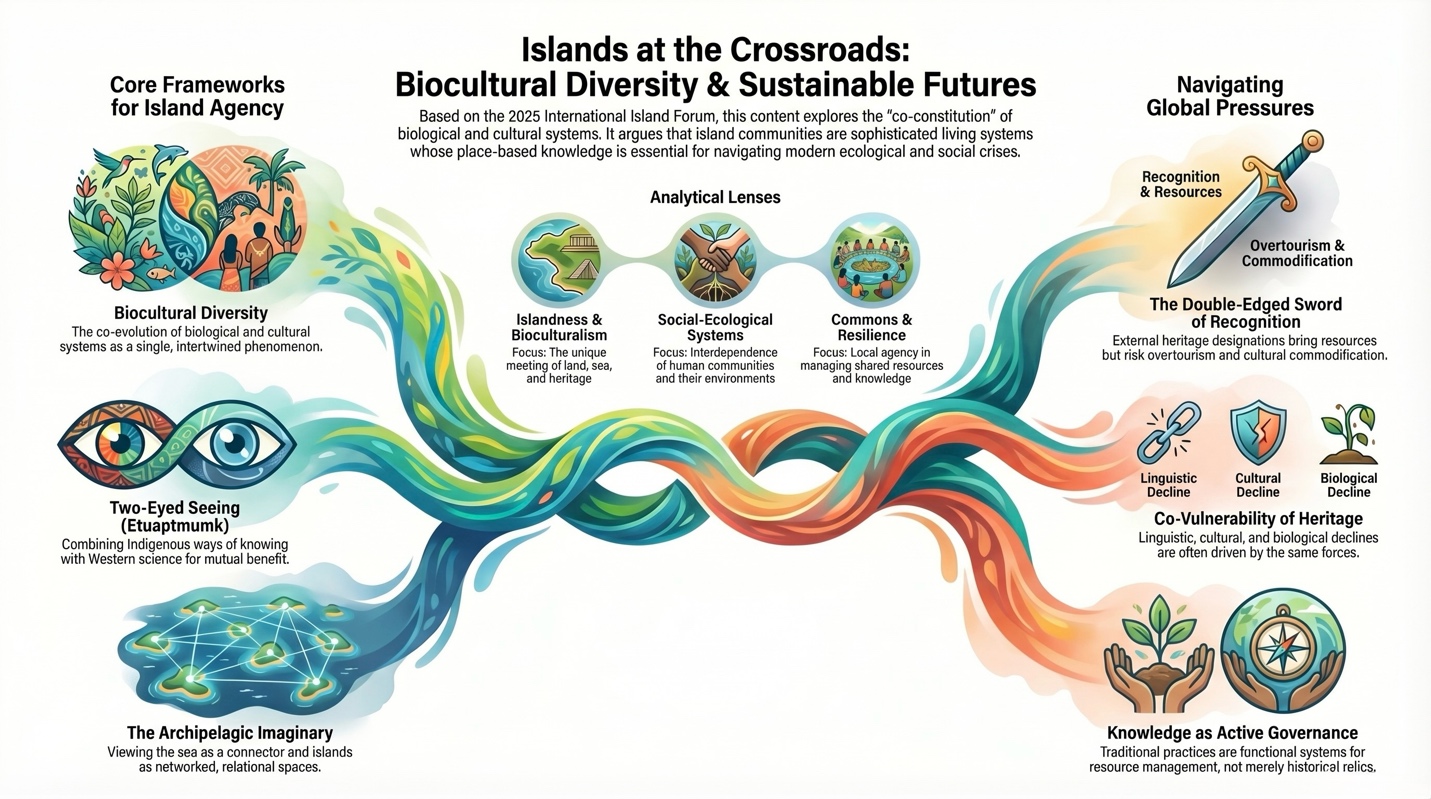
Reading these six papers together, several themes emerge with particular clarity: islands as relational, networked spaces; the co-vulnerability of biological and cultural heritage; the ambivalence of external recognition; knowledge as practice, practice as governance; and the ethics of collaborative research.
The rejection of insularity as isolation is the common ground on which all six contributions stand. Whether the argument is framed in terms of archipelagic thinking (Hong et al., Breckwoldt and Vave), biocultural co-constitution (Breckwoldt and Vave; Pungetti), the long-distance cultural exchange recorded in the Fuganutu Epic (Ankei and Ankei), or the global circuits of art and tourism that connect peripheral Japanese islands to cosmopolitan audiences (Qu), the islands in this issue are emphatically not closed worlds. They are nodes in ecological, cultural, economic, and epistemological networks.
Several papers document the simultaneous endangerment of linguistic, cultural, and biological diversity, often driven by the same structural forces: demographic decline, economic marginalization, and governance that prioritizes growth over community wellbeing. The Fuganutu Epic, transmitted by a single individual in an endangered language, is the most dramatic case, but Pungetti’s Mediterranean islandscapes and Papoutsaki’s Amami Ōshima narrate variants of the same story. Breckwoldt and Vave’s paper provides the systematic analytical framework for understanding this co-vulnerability. When customary systems of marine tenure are replaced by state ownership, when commercialization erodes traditional sharing networks, or when conservation interventions are imposed without cultural integration, both biological and cultural systems suffer.
Whether the external agent is UNESCO heritage designation (Papoutsaki), a large-scale art festival promoted by national government and private art foundations (Qu), or even the scholarly apparatus of oral history research (Ankei and Ankei), this issue identifies a consistent pattern: external recognition can be simultaneously enabling and corrosive. It brings visibility, resources, and legitimacy; it can also commodify, over-simplify, and disempower. The “double-edged sword” metaphor that Papoutsaki applies to UNESCO designation could, with appropriate modification, be applied to almost every form of external engagement with island cultures discussed in these pages. The challenge, and the aspiration expressed across multiple contributions, is to design forms of engagement that genuinely foreground local agency.
A salient aspect of this collection is how consistently it connects knowledge systems to governance outcomes. Traditional ecological knowledge is not ornamental; it is functional (Berkes, 2008). The reef passage practices documented by Breckwoldt and Vave, the tidal flat management traditions discussed by Hong et al., the food preservation and weather-forecasting wisdom encoded in the Fuganutu Epic, the participatory islandscape mapping developed by Pungetti’s Sardinian communities—these are not survivals from the past but active systems for managing shared resources and sustaining community life. Recognizing them as such is a prerequisite for the kind of co-management and co-governance that multiple papers call for (Ostrom, 1990).
Yuji and Takako Ankei’s paper is unusual in its extended ethical reflection on the problems that arise when researchers make indigenous artists and oral historians visible to a wider public. But the ethical dimension it foregrounds, the question of who benefits from cultural research and who bears its costs, is relevant across the entire collection. As island communities are asked to share their knowledge, their landscapes, and their lifeways with researchers, festival audiences, and heritage tourists, the asymmetries of power and benefit that structure these encounters demand ongoing critical attention.
5. Looking Forward: Island Epistemology and the 2026 World Island Exhibition
Breckwoldt and Vave’s paper proposes the concept of “island epistemology” as an analytical lens for the contributions in this issue, ways of knowing that emerge from, and are shaped by, island-human-ocean relations. This concept complements and extends the archipelagic thinking articulated by Hong and colleagues, and it has important implications for how we think about the future of both island scholarship and island governance. Island epistemology does not mean romanticizing local knowledge or treating it as static. It means recognizing that island communities have developed, over centuries and millennia, sophisticated ways of reading ecological and social systems, and that these ways of knowing have something to teach the rest of the world.
The 2026 World Island Exhibition in Yeosu presents a significant opportunity to make this argument on a global stage. As Breckwoldt and Vave observe, events of this scale can “amplify island voices and reshape global narratives about islands from sites of marginalization and vulnerability to sources of innovation for sustainable marine futures.” The scholarship gathered in this issue provides exactly the kind of empirical and conceptual grounding that such a reframing requires. From the biocultural case studies of the Pacific to the islandscapes of Sardinia, from the oral histories of Yonaguni to the governance struggles of Amami Ōshima and the impact of the global circuits of art in the Seto islands, these papers demonstrate that islands are not problems to be solved but archives of knowledge, relationship, and resilience from which humanity has much to learn.
What would it mean to take island epistemology seriously in policy and governance? At minimum, it would mean involving island communities as co-producers of the knowledge frameworks that govern their resources and heritage; designing recognition regimes, whether UNESCO designations, art festivals, or tourism promotion strategies, that genuinely centre community wellbeing and cultural continuity rather than instrumentalizing them for external audiences; supporting the documentation and transmission of endangered knowledge systems, including linguistic heritage, with the same urgency we bring to endangered species conservation (UNESCO, 2003); and developing comparative research frameworks that are genuinely attentive to the diversity of island contexts, from the archipelagos of East Asia to the Mediterranean, from the Pacific to the North Atlantic, rather than assuming that findings from one region generalize seamlessly to another.
The goal, as multiple authors in this issue articulate it, is neither to fossilize island cultures as museum exhibits nor to reduce them to laboratories for experimentation, but to support them as living, evolving systems capable of navigating our times with agency and dignity. The research collected here is offered in that spirit.
6. Acknowledgements
We extend our sincere gratitude to the organizers of the 2025 International Island Forum in Yeosu, and to the host community of Yeosu whose hospitality made the Forum possible. We thank the authors whose contributions form the heart of this special issue. We are grateful to the peer reviewers and to the editorial team of the Journal of Marine and Island Cultures. Finally, we wish to acknowledge the many island communities whose lives, knowledge, and futures are the ultimate subject of this work.
Evangelia Papoutsaki is a communication studies scholar and islands ethnographer whose research focuses on island communicative ecologies, island identities, everyday life and cultural heritage. A 2025 Japan Foundation Research Fellow and a former UNESCO Chair, Evangelia is affiliated with MIT-UNITEC, Auckland, New Zealand, and serves as co-convenor of the Small Island Cultures Research Initiative (SICRI). Email: papoutsaki@yahoo.co.uk
Sun-Kee Hong is Editor-in-Chief of the Journal of Marine and Island Cultures and a professor at Mokpo National University, Republic of Korea. His research centres on biocultural diversity, island ecology, and human–environment relations in East Asian contexts. Chair of the Local Organizing Committee of the 2026 ISISA Island of the World Conference, Shinan, Korea. Email: landskhong@gmail.com
References
- Abram, D., 1996. The spell of the sensuous: Perception and language in a more-than-human world. Pantheon Books, New York.
- Baldacchino, G., 2004. The coming of age of island studies. Journal of Economic and Human Geography. 95(3): 272–283. https://doi.org/10.1111/j.1467-9663.2004.00307.x
- Bartlett, C., Marshall, M., Marshall, A., 2012. Two-eyed seeing and other lessons learned within a co-learning journey of bringing together Indigenous and mainstream knowledges and ways of knowing. Journal of Environmental Studies and Science. 2(4): 331–340. https://doi.org/10.1007/s13412-012-0086-8
- Berkes, F., 2008. Sacred ecology: Traditional ecological knowledge and resource management, 2nd ed. Routledge, New York.
- Grydehøj, A., 2017. A future of island studies. Island Studies Journal. 12(1): 3–16. https://doi.org/10.24043/isj.1
- Hayward, P., 2024. Aquapelagos and Aquapelagic assemblages: an integrated study of island societies and marine environments. Shima: The International Journal of Research into Island Cultures. 6(1): 1-11. 10.21463/shima.aq.anth.int
- Hau‘ofā, E., 1994. Our sea of islands. Contemporary Pacific. 6(1): 147–161.
- Maffi, L. (Ed.), 2001. On biocultural diversity: Linking language, knowledge, and the environment. Smithsonian Institution Press, Washington, DC.
- Maffi, L., 2005. Linguistic, cultural, and biological diversity. Annual Review of Anthropology. 34: 599–617. https://doi.org/10.1146/annurev.anthro.34.081804.120437
- Ostrom, E., 1990. Governing the commons: The evolution of institutions for collective action. Cambridge University Press, Cambridge.
- Sterling, E.J., Filardi, C., Toomey, A., Sigouin, A., Betley, E., Gazit, N., Claudet, J., et al., 2017. Biocultural approaches to well-being and sustainability indicators across scales. Nature, Ecology and Evolution. 1(12): 1798–1806. https://doi.org/10.1038/s41559-017-0349-6
- Stratford, E., Baldacchino, G., McMahon, E., Farbotko, C., Harwood, A., 2011. Envisioning the archipelago. Island Studies Journal. 6(2): 113–130. https://doi.org/10.24043/isj.253
- UNESCO, 2003. Convention for the safeguarding of the intangible cultural heritage. United Nations Educational, Scientific and Cultural Organization, Paris.