
Remembering the Pearl of Java among the Trading Ports: A Linguistic Landscape Study in Bandar Grissee, Indonesia
 10.21463/jmic.2025.14.2.16
Abstract
Languages used in memory places do not only serve as a communication tool and convey information, but languages might be formed to recall the memories of a certain place. This study scrutinizes how the memories of Gresik as the pearl of Java displayed in the linguistic landscape of an ancient city transformed into a heritage tourism place named Bandar Grissee. Gresik is located in the north coast of Java and was known as the pearl of Java regarding the strategic location of the port to support the maritime trade in Nusantara and Southeast Asia between the 14th and 17th century. Field research was conducted to collect the data of this study through observation and documentation methods. The findings indicate that the memories draw on the multilingual and multi-ethnic nature of Gresik in the linguistic landscape of Bandar Grissee, which is represented through the texts on the information signs, place names, and inscriptions. The signages recall the memories and become a part of the memories. They are presented in Indonesian, Javanese, and particularly languages related to memories, such as Arabic, Dutch, and Chinese. The linguistic landscape can be a contemplation medium to remember the memories of Gresik as the pearl of Java and offer inspiration and innovation in the preservation of heritage places.
Keywords
Linguistic Landscape, Ancient City, Port City, Multilingual Memories, Bandar Grissee
Introduction
In the development of linguistic landscape studies, researchers have considered another very specific contribution of these studies at the interface of memorialization and multilingualism. Blackwood and Macalister (2020) state that memorials in public spaces, to varying extents, engage with the multilingual realities of the communities that commission, construct, and challenge them. Each memorial place, i.e. museums, monuments, etc, was a result of decisions made at either a macro-, meso-, or micro-level of society to commemorate memories of the past. This includes the transformation of ancient cities into heritage tourism destinations. For instance, a study by Macalister and Ong (2020) explored the memories of the past presented through the linguistic landscape of twenty-first-century Georgetown, Penang, Malaysia. The study revealed the iron sculptures in Georgetown representing the past daily life as well as entertaining the audiences. In contrast, a study by Jimaima and Banda (2020) investigated how linguistic labels and the extended taxonomy of artefactual materialities in and around the Livingstone Museum and the precincts of Victoria Falls are used together to provide narratives about the histories and memories of both the local and the global. They discovered that the artifacts in the Livingstone Museum and the Victoria Falls reflected a foreign culture and history, thereby indicating that any expectation of accurate representation of local multilingual memory and history in these two study areas would be misguided.
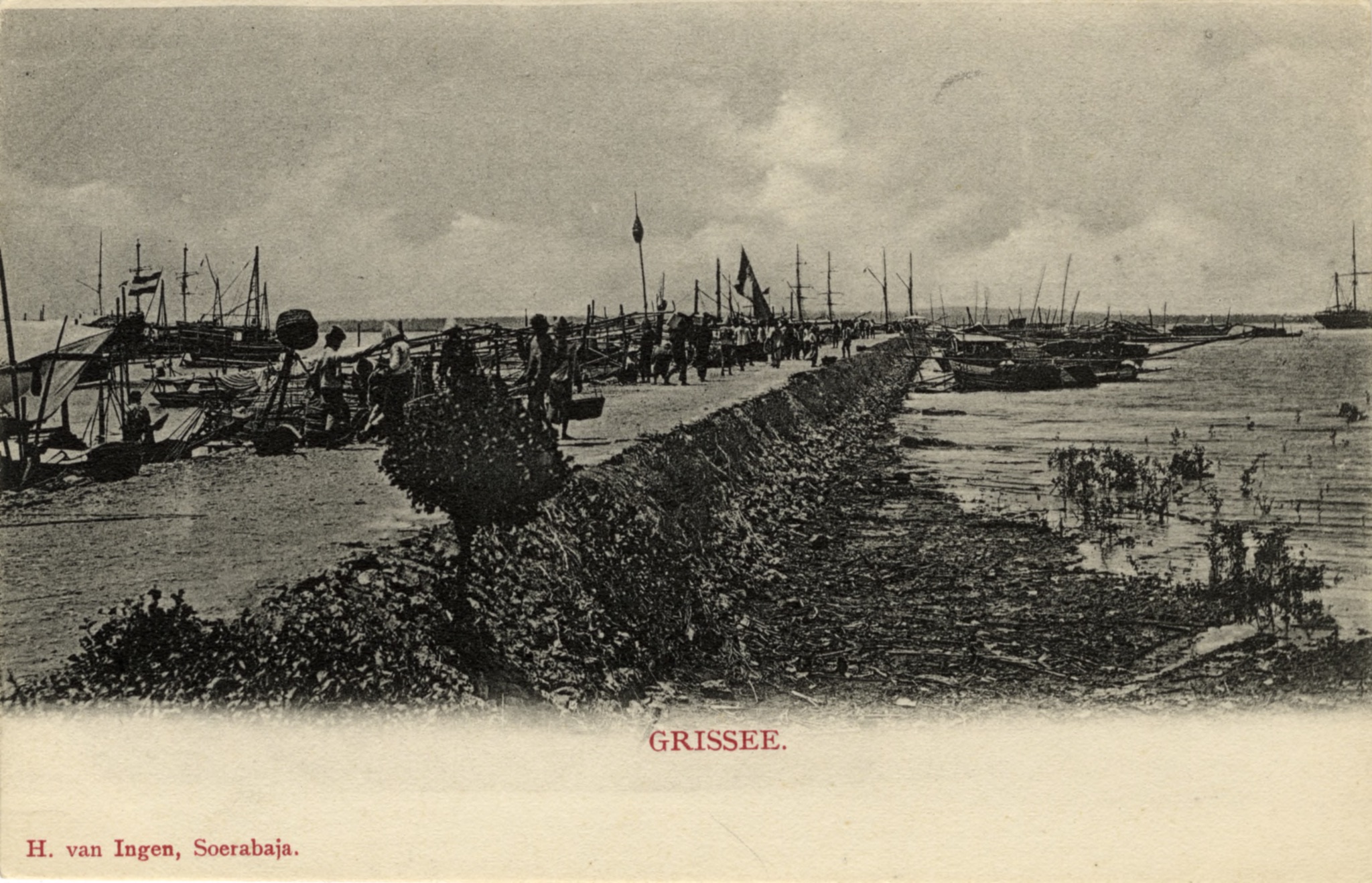
As a maritime and archipelagic country, Indonesia has played a major role in the trading histories, particularly about the spice route. Indonesian ports served as both stopping and sailing points for numerous foreign traders, who subsequently established port cities. One such example is Grissee, now known as Gresik, which has retained its significance in the region. It became an important port on the north coast of Java from the 14th to the early 17th century. It is noteworthy that Grissee exercised a significant influence over the importation of spices from Banda and Maluku to the port of Malacca until the colonization era, even as late as the 18th century. The strategic importance of Grissee is further highlighted by Tom Pires, who refers to it as the ‘Pearl of Java’ in his book, The Suma Oriental.
“We have reached Grissee (Agracij), the great trading port, the best in all Java, whither the Gujaratees, and [people of] Calicut, Bengalees, Siamese, Chinese, and [people of] Liu-Kiu (Lequeos), used to sail of old. This is the pearl of Java in trading ports. This is the royal port where the ships at anchor are safe from winds, with their bowsprits touching the houses. It is called the merchants’ port; among the Javanese it is called the rich people’s port” (Tom Pires, 1944:192–93)
According to Jarwanto (2019), the development of the port of Gresik was encouraged by several factors, both internally and externally. Tom Pires thus described it as the pearl of Java for the following reasons: the geographical conditions of the port of Gresik were more favorable; there was an increased supply and demand for goods from residents or traders based in Gresik; there was a good port management system in place; and the shahbandars, who were capable of diplomacy, supported the development, especially the foreign shahbandars, such as Chinese and Arabs. Externally, the increase in activity at the port of Gresik was a result of the policies of its competitor, the port of Tuban, which began to reduce its port facilities, or to the failure to generate expected profits from trade. Additionally, it is also noteworthy that the port manager in Tuban was known to employ violent measures to compel merchant ships to enter his port.
Grissee was the greatest port of East Java at that time, and naturally, it attracted many foreign traders to stop and settle down around the port. In 2022, the regional government of Gresik initiated investing in the renovation of the ancient city near the port of Gresik into a heritage tourism place, namely Bandar Grissee. Bandar means a port in Indonesian, and Grissee refers to the way the Dutch called the area in the past (Disparekrafbudpora, 2023). This redevelopment of a historic site is intended to revitalize the historical values of Gresik as the Pearl of Java and make people, especially youths and the next generation, remember the greatest era of Gresik.
The present study is prompted by a question of how the memories of Gresik as the pearl of Java are presented and remembered in the heritage tourism place, Bandar Grissee, Indonesia. The area was a residential area for foreign traders from many countries. It was therefore a multi-ethnic, multiracial, multilingual, and multi-religious area. In the redevelopment of the area, the regional government selected to focus on revitalizing some ancient villages, including Kampung Kemasan (Kemasan Village), Kampung Bedilan (Bedilan Village), Kampung Arab (Arab Village), and Kampung Pecinan (Chinatown/Chinese Village). The linguistic landscape study is employed to analyze whether the memories of Gresik as the Pearl of Java are presented and remembered through the linguistic landscape of these revitalized villages in Bandar Grissee.
Literature Review
Linguistic landscape refers to languages in the written form in public spaces (Gorter, 2006; Hu, 2022). The notion of linguistic landscape is initiated by Landry and Bourhis (1997) as the visibility and salience of languages on commercial and public signs in a given territory. In a broader definition of linguistic landscape, they stated that linguistic landscape is the language of public road signs, street names, place names, advertising billboards, commercial shop signs, and public signs on government buildings combining to form the linguistic landscape of a given territory, region, or urban agglomeration. It can serve two basic functions: an informational function and a symbolic function (Landry and Bourhis: 1997, 23–25).
The informational function conveys an intended message by the makers, and the symbolic function involves the presence or the identity of the social groups living in a certain territory. For example, Sudarmanto et al. (2023) found that the Indonesian language dominates on the border between Indonesia and Timor Leste that is not only to inform the language used in the area but also to symbolize the kinship and the historical factors of Indonesia and Timor Leste. This is in line with research by Purnanto et al. (2022) who found that English on the signboards in the culinary business in Surakarta, Indonesia, symbolizes the market strategy to show international perceptions, modernity, exclusivity, success, and leisure of the products.
As a subfield of sociolinguistics, the linguistic landscape study has evolved significantly in language research. It has developed and involved many different disciplines and has also attracted the attention of scholars from different fields, such as geography, education, sociology, political science, society, semiotics, architecture, literature, applied linguistics, economics, etc. Recently, this study has contributed to the interface of memorialization and multilingualism. According to Blackwood and Macalister (2020), memory places were created by accident. They might be viewed as identity statements, formed not only by determining the memories to be remembered and how they will be remembered, but also by the language used to recall them.
In recent years, there has been a great deal of research on the linguistic landscape in historical domains. Zhang (2024) explored the linguistic landscape of Wuzhen, an ancient city in the eastern coastal region of China. His study argued that the linguistic landscape should be regarded as a crucial semiotic resource anchored in sociocultural and historical space either in the context of globalization or urbanization. Alomoush (2023) discussed multilingualism in the linguistic landscape of the ancient city of Jerash, Jordan. There were three languages highly remarkable in the landscape, namely English, Arabic, and French. English is more dominant in both official and private signs even though Arabic is the official language in Jordan. The result of the study indicated that the use of English in the tourist signs, including in the ancient city of Jerash is to give information rather than to be used for aesthetic purposes. Dong et al. (2020) mapped the linguistic landscape of the cultural heritage sites and tourist spots in Bangladesh. They found that multidimensionality influenced the language choices in the sites. Bangla was used for the sociopolitical dimension, Chinese appeared in the economic dimension, and Arabic symbolized the religious dimension as Islam is the main religion in Bangladesh.
A newly ancient city, Yizhou, in China, was also explored by Guo et al. (2023). They examined the language construction in shaping ancient town tourist attractions. The result showed that Chinese and English were displayed in the ancient tourist site, but the linguistic landscape had not been constructed well enough to build the economic value of the ancient town tourist. It is not in line with the study of the linguistic landscape in Seongsu-dong in Seoul by Kim and Ahn (2023). They found that the industrial heritage in Seongsu-dong was mixed with commercial renewal as a process of economic consequence. This is evident not only in the area’s reputation as the ‘Brooklyn of Seoul’ but also in the linguistic choices and the compositions of the semiotics illustrated in the area.
The linguistic landscape has also been studied widely in Indonesia, including exploring social, cultural, and historical domains. Utomo and Yannuar (2023) explored the linguistic landscape in the Majapahit Kingdom site, Mojokerto, and found that the language used in the area brings to life the confrontation between language and the character of the royal heritage. Meanwhile, Mulyawan et al. (2022) discussed the language contestation in the linguistic landscape of Batukau temple, Bali. Their findings highlighted Balinese scripts, which are the identity of the Balinese language that contributes to maintaining Balinese culture, were in limited use in the Batukau temple area. Most of the signs in the area were written in Roman characters, including the Balinese language to provide information. The Balinese script was only used for symbolic purposes. Additionally, a linguistic landscape study was also examined by Wulandari and Rokhmawan (2022) discussing the language used in the tomb of KH. Abdul Hamid Pasuruan area in Pasuruan. Their findings indicated that cultural and religious values significantly shape the languages used in the religious tourism area.
Gresik, as one of the cities in Indonesia with a great history, is also studied in the linguistic landscape context. Ramadhani (2018) discussed the lingua franca in the linguistic landscape of a business center in Gresik, namely Gresik Kota Baru (henceforth, GKB). The finding showed that Indonesian is the most-used language in the area, although globalization impacts all aspects of business, including languages for economic business. It indicates that the lingua franca in Gresik depicted the linguistic landscape of the GKB business center. Mulyono and Yulianto (2023) also investigated the linguistic landscape of Gresik in the context of its Islamic identity. Gresik has several labels, such as Santri City (Kota Santri), Saints City (Kota Wali), and also Industry City (Kota Industri) (Istiwianah et al., 2020; Faridatin, 2016). In the study, Mulyono and Yulianto examined the linguistic landscape surrounding the tombs of Sunan Giri (Raden Paku/Raden Ainul Yaqin) and Sunan Gresik (Maulana Malik Ibrahim). They found that the functions of the linguistic landscape in Gresik are performed by Islamic identity in these areas, which convey a sense of blessing and sanctity.
Linguistic landscape studies in all historical places not only shape symbolizations and information but also recall memories through the symbols and the information inside. However, linguistic landscape studies in Indonesia are mostly discussing language variations (Aisyah, 2023; Sari et al., 2022) and language contestation (Prasetyo et al., 2024; Purnawati et al., 2022) in historical and heritage places. It is limited to discussing the scope of culture and history in depth, especially in the multilingual memories of the linguistic landscape. Thus, this study seeks evidence to understand more about how memories are remembered through the linguistic landscape. Furthermore, this study is trying to fill the gap in addressing the underexplored area of the linguistic landscape in Gresik, such as Bandar Grissee as a heritage tourism place.
Methods
This study applied qualitative research methodologies to investigate how the history of Gresik as ‘the Pearl of Java’ is remembered through the linguistic landscape of Bandar Grissee. The data of this study were obtained directly from the primary source, which was the signs. In counting the signs, this study adhered to the definition set forth by Backhaus (2007). He posits that a sign is considered to be any piece of written text within a spatially definable frame, including anything from a small handwritten sticker attached to a lamp-post to a huge commercial billboard. A total of 125 signs were collected from the revitalized areas, namely Kampung Kemasan, Kampung Bedilan, Kampung Arab, and Kampung Pecinan. The selection of the villages as the data source was based on their characteristics and historical background, which serve as memories of the past represented in the areas. Additionally, these villages received attention from the regional government of Gresik since the initiation of the revitalization program for this ancient city into a heritage tourism place.
We walked along the villages to collect the data in January 2024. The data were collected by using observation and photograph methods. In the photographic technique, a camera phone was used to take images of the signs with the naked eye, as Hult (2009) suggested. After collecting the data, we initially analyzed the data based on the informational and symbolic functions of the linguistic landscape by Landry and Bourhis (1997). Subsequently, we identified how the memories of Gresik as the Pearl of Java are presented and remembered through the linguistic landscape. Historical books and other references are the secondary sources of the data to understand the context of the memories in depth.
Results and Discussion
After analyzing 125 signs from the revitalized villages, we found the memories of Gresik as the pearl of Java represented in the linguistic landscape of Bandar Grissee. The memories were displayed through the languages in the written forms on information signs, place names, and inscriptions. The languages used and the information conveyed on those signs are to recall the memories of the past.
Information Signs
Information signs are displayed in several signages in Bandar Grissee. The majority of the signs are intended to provide information about the heritage buildings, the heritage sites, and historical figures relating to the memories of Gresik as the pearl of Java. The following examples of the information signs in Bandar Grissee are as follows:
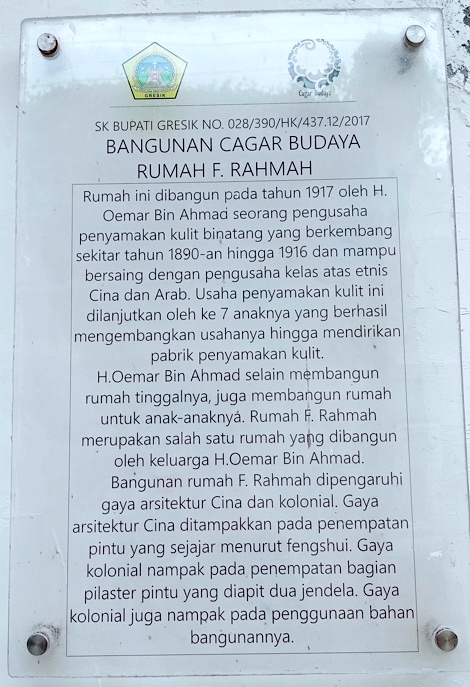
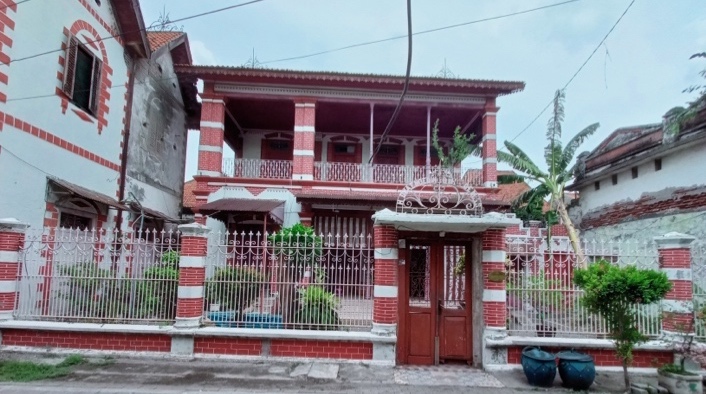
Figure 2 above depicts an information sign about a heritage building in Kampung Kemasan. This building, F. Rahmah’s house, was constructed in 1917 by H. Oemar bin Ahmad, a prosperous tannery entrepreneur who was capable of exporting his products to China, Japan, and Southeast Asia during that period. Kampung Kemasan has existed since 1853. It derives its name from a Malay phrase meaning ‘emas’ (gold in English) and has a reputation as a center for home industries, with leather tanning, gold jewelry, and a swallow’s nest industry being particularly prominent (Mariami et al., 2021). The heritage buildings in Kampung Kemasan are notable for their historical and cultural significance. During the Dutch colonial period, these residences underwent a gradual transformation into settlements for prosperous merchants from various countries, such as Arabs, Chinese, Europeans, and many others (Lail and Budiarto, 2022). Consequently, the architectural style of these buildings is a result of the influence of various cultural traditions, including Chinese, European, and local elements. This contributes to the distinctive character that makes the area a significant heritage tourism destination.
In the linguistic element, the information sign is delivered in Indonesian only, without any other languages. The uppercase letters are employed as the title of the information and placed at the top of the information text. Meanwhile, the information text is presented in lowercase letters. In addition, the information sign also displays the official logos of the Gresik government and the Indonesian Directorate of Cultural Heritage and Museum Preservation. The use of Indonesian as the only language on the information sign is appropriate for the intended targets, those are visitors to the Bandar Grissee heritage tourism area. This heritage city is still being targeted for the local people, specifically the Gresik people. Furthermore, the official logos indicate Bandar Grissee is already regarded as a cultural heritage site.
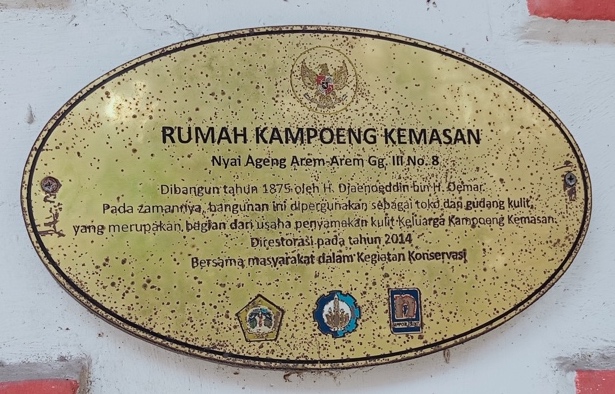
Another example of information signs in Kampung Kemasan is in Figure 3. This sign indicates that the building was built in 1900 by the son of H. Oemar, and it also provides information regarding the industries in Gresik at that time. The information signs in Kampung Kemasan offer valuable insight into the development and growth of business in Gresik during that period. The port of Gresik played an important role in facilitating international trade, thereby fostering cooperation between local businesses and foreign countries.
An additional example of an information sign can be found in Kampung Arab (see Figure 4). It is displayed in the tomb of Sunan Gresik site on Jl. Malik Ibrahim No. 52–62, Gapuro Sukolilo, Gresik, East Java. The information sign details one of the historical figures in Gresik, namely Maulana Malik Ibrahim, also known as Sunan Gresik. He is one of the nine saints (Wali-Songo), nine figures who spread Islam on Java Island (Uyuni et al., 2024). G. W. J. Drewes, in New Light on the Coming of Islam to Indonesia, mentions that Maulana Malik Ibrahim is considered one of the first figures to disseminate Islam in Java and is regarded as the senior wali among the other saints. According to Babad in Gresik, the first to arrive in Gresik were two brothers of Arab descent, Maulana Mahpur and Maulana Ibrahim, accompanied by their elder brother Sayid Yusuf Mahrebi and 40 companions. Their initial purpose in sailing to Java was twofold: to spread their religion, Islam, and to engage in trade. They arrived in Gresik in 1293 AH/1371 AD. They proceeded to present the tenets of Islam to King Brawijaya of Majapahit. The king welcomed their arrival but was not yet willing to embrace Islam. Consequently, Maulana Ibrahim was appointed by the king as a shahbandar (a harbor master) in Gresik, a position that enabled him to propagate Islam among the willing Javanese people (Sunyoto 2017).
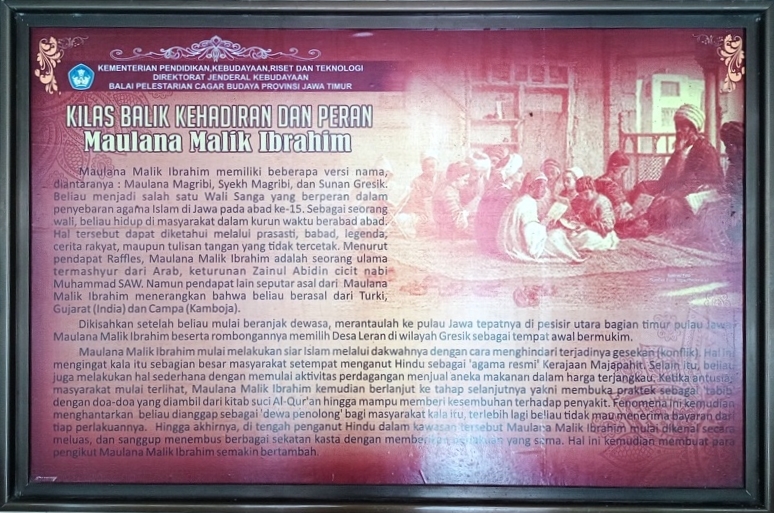
The tomb of Sunan Gresik has been recognized as a significant cultural heritage, legally protected under the legislation of the Republic of Indonesia Number 5 of 1992 concerning cultural heritage objects with the Regulation of the Minister of Culture and Tourism Number: PM.56/PW.007/MKP/2010 on 22 June 2010 (JDIH Kemenparekraf, 2010). It is a popular religious destination for Muslims, with numerous visitors arriving daily from various regions of Indonesia. Therefore, it is understandable that the information sign at the location of the tomb of Sunan Gresik is delivered in the national language, which is Indonesian.
Place Names
The linguistic landscape of Bandar Grissee, including its place names, also reflects the memories of Gresik as the pearl of Java, with the names of figures and memories connected to Gresik’s history as a port city that developed into the hub of shipping and trade in Nusantara being used in the toponymy of places in Bandar Grissee.
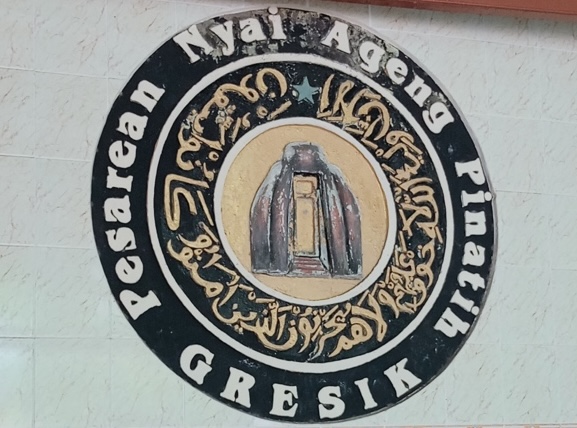
Figure 5 is an example and exemplifies the place name in Bandar Grissee with the name of a historical figure, namely Nyai Ageng Pinatih. She was a notable female figure from the Majapahit era who held the position of shahbandar, or harbor master, and successfully pursued a business career. She is recognized as the first woman in Nusantara to be entrusted with the collection of customs duties and the supervision of foreign traders, a testament to her significant role in the development of shipping and trade in Gresik during the period. Her name was inscribed on the name sign of her cemetery place located on Jl. Kh. Kholil 25 Kemuteran, Kebungson, Gresik. The place name is delivered in one language, Indonesian, and underneath it, the Quranic verse is added, which is Surah Yunus verse 62, as follows اَلَآ اِنَّ اَوْلِيَاۤءَ اللّٰهِ لَا خَوْفٌ عَلَيْهِمْ وَلَا هُمْ يَحْزَنُوْنَۚ (Verily, the patrons (or: the pious worshippers of Allah) of Allah surely will have no fear on them, nor will they grieve.). Nyai Ageng Pinatih was the foster mother of Sunan Giri (who was also one of the Wali-Songo). Hence, the Qur’anic verse is inscribed on the signboard, signifying her high esteem and regard as the pious worshipper of Allah.
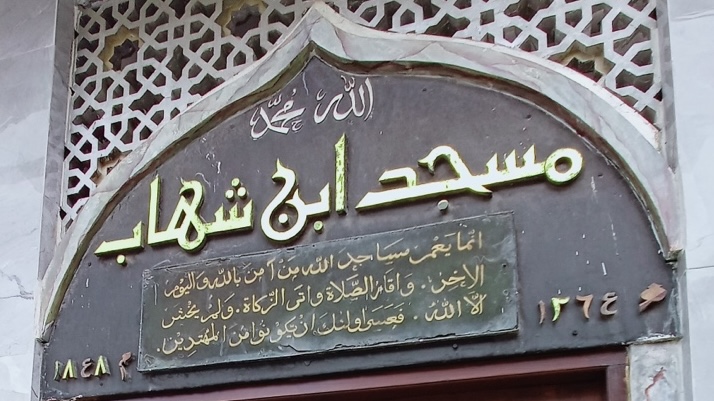
Another historical figure is also remembered through the name of a mosque in Kampung Arab. It is Masjid Bin Syahab on Jl. Malik Ibrahim; see Figure 6. According to Jarwanto (2019), the name ‘Syahab’ in Gresik became one of the icons and was one of the most prominent figures in the past. Since 1832, the Arab community in Gresik has had a leader of their group, such as Abdullah bin Muhammad Ghanehem (1894) and Hussein bin Umar Syahab (1913). In The History of Java, Thomas Stamford Raffles (2024, 88) noted that within the Arab community, a significant proportion of the population engaged in commercial activities, particularly as traders. However, the predominant majority were priests. The primary location of residence for this population was Gresik, a region that is considered significant due to its role in the spread of Islam throughout Java.
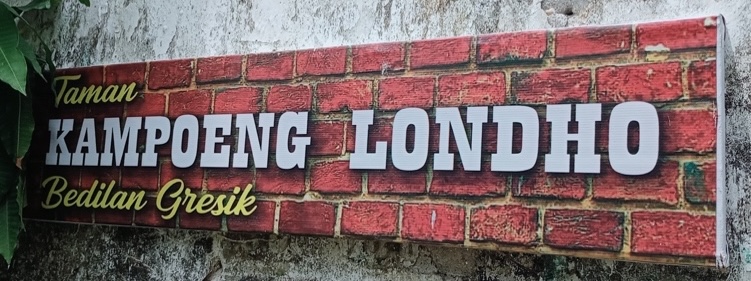
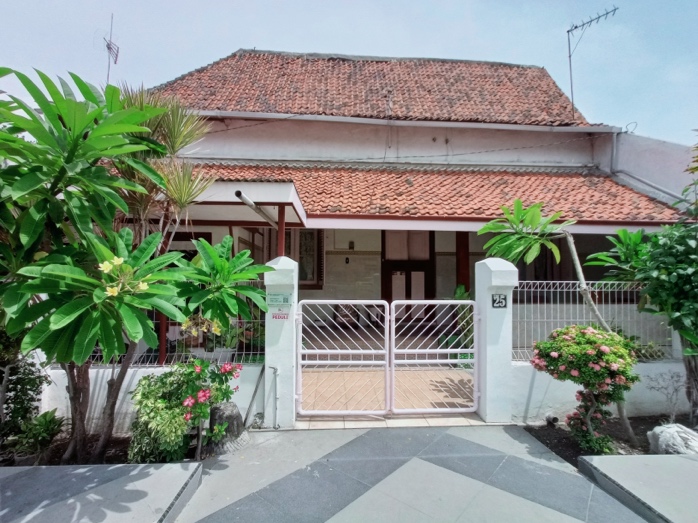
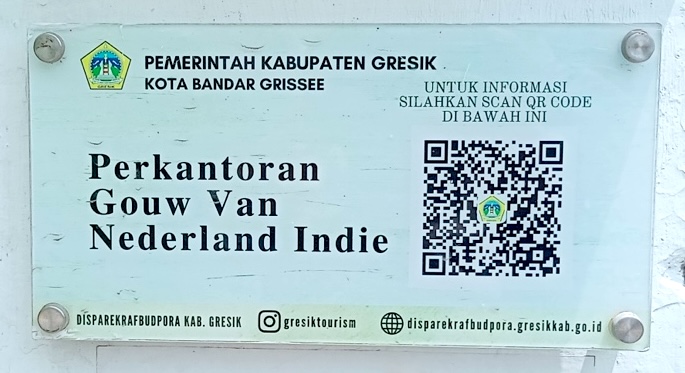
An intriguing signboard is observed in Kampung Bedilan. It is a signboard for the park “Taman Kampoeng Londho,” see Figure 7. The term ‘londho’ is of Javanese word and is used to denote the Dutch, which in Indonesian is ‘belanda.’ The memory of Dutch in the place is intricately intertwined with the nomenclature of the village itself, Kampung Bedilan (Bedilan Village). The term ‘Bedilan’ is derived from the Javanese word ‘bedil,’ which signifies a firearm. The Dutch established their commercial policy in the region, alongside the well-known reputation of the port of Gresik. The establishment of the first Dutch VOC trading office in East Java, located in Gresik, was initiated by Admiral Jacob van Heemskerck on 27 April 1602. This was followed by the establishment of another VOC trading office in Gresik by Admiral Wijbrand van Warwijk in 1608. The establishment of these trading offices resulted in a notable increase in the presence of company troops in the port of Gresik, leading to the Dutch establishing a warehouse and a firearms factory (Prasetyo, 2017; Pranata, 2022). The Dutch government also established the office of Gouw Van Nederland Indie on Jl. Basuki Rahmat 25 Bedilan; see Figure 8. This building was designated a district-ranked cultural heritage building on 24 August 2020 (Disparekrafbudpora, 2023b).
Inscriptions
Inscriptions displayed throughout the linguistic landscape of Bandar Grissee also recall the memories of Gresik as the Pearl of Java, especially in Kampung Pecinan and Kampung Bedilan. Several scripts, including Chinese, and Dutch, are used to write the inscriptions. They were on exhibit in a variety of objects, including a gate, pillar, and stone.
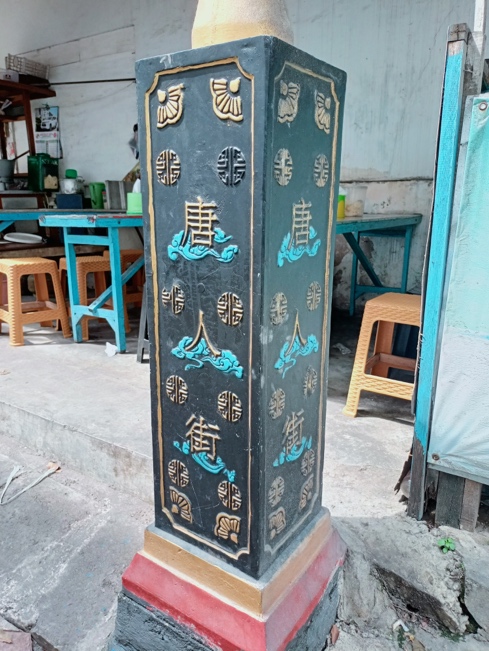
Along the streets in Kampung Pecinan, lamp-posts are designed with Chinese symbols and characters, including Chinese scripts; see Figure 9. The script 唐人街 (Tángrénjiē), which means Chinatown, is inscribed on the pillars of the lamp-posts. The script refers to the social identity of the ethnolinguistic group that has historically inhabited the area. Tángrénjiē (唐人街) was first used for Chinatowns in the United States to allow Chinese people to be found outside of China (Tu Huynh, 2015).
The note from 14th-century traveler Ma-Huan elucidates that Gresik was already inhabited by approximately 1,000 families led by a Chinese captain from Canton. The development of the port of Gresik as the Pearl of Java also led many Chinese traders to choose to reside around the port of Gresik, with many of these Chinese traders living in the east and south of the city. The Chinese community was not merely a conduit for trade but also provided capital to indigenous farmers and traders. In The History of Java, Raffles reported that the Chinese population in 1815 reached 364 individuals. According to the decree dated 9 October 1871, no. 9 of the ‘Besluit van Gouverneur Generaal,’ with the increasing density of the Chinese population in Gresik, the Dutch East Indies colonial then issued a decision to legalize Kampung Pecinan (Jarwanto, 2019).
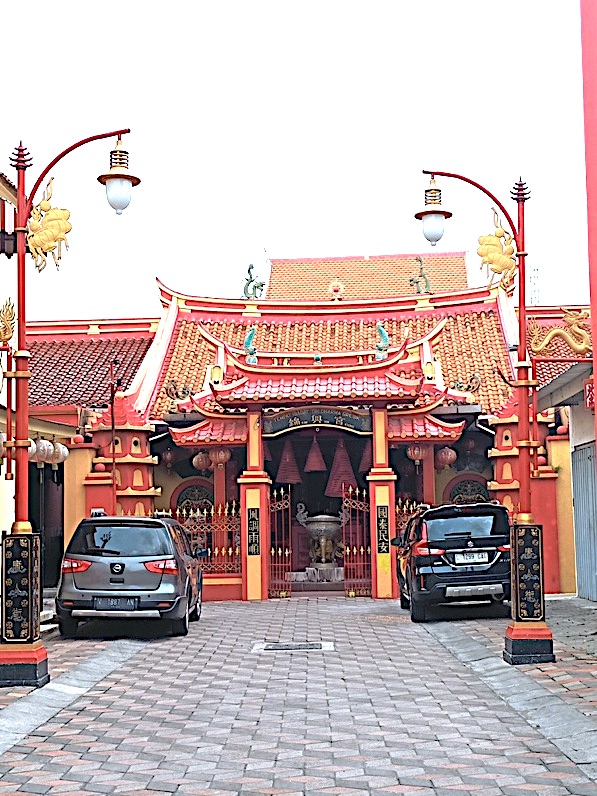
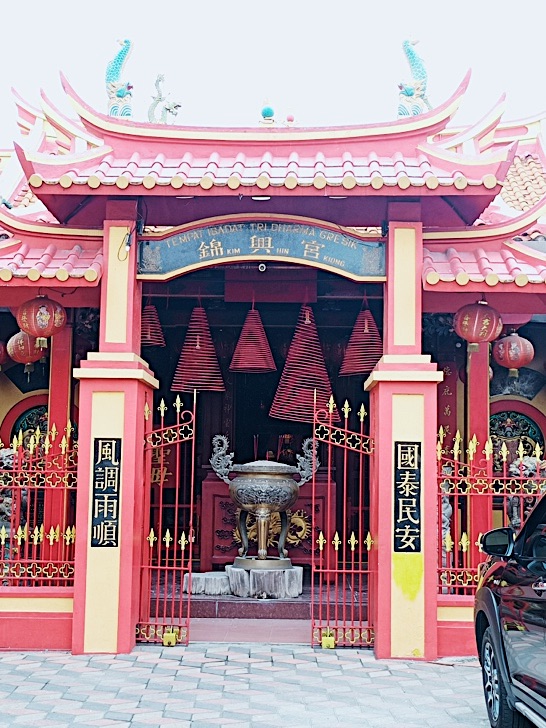
There is also an ancient temple in Kampung Pecinan, the Kim Hin Kiong temple. This temple is one of the oldest temples in East Java, estimated to be more than 400 years old. The location of this temple is close to the port of Gresik, to worship Dewi Ma Co Thian Siang Seng Boo (the Goddess of ocean/the Goddess of Sail). The Kim Hin Kiong temple has a very distinctive architecture with the dominance of red and yellow colors. At the front, there is a small gate (see Figure 10) with a right pillar inscribed with 國泰民安 (Guótàimín'ān) which means peace and prosperity, and a left pillar inscribed with 風調雨順 (Fēngtiáoyǔshùn) which means good weather. The scripts are related to the Goddess of the ocean, Ma Co Thian Siang Seng Boo, who is helpful. In the folklore of the temple, people say that fishermen always came to ask for her blessings whenever they wanted to sail (Nurfitriani, 2022).
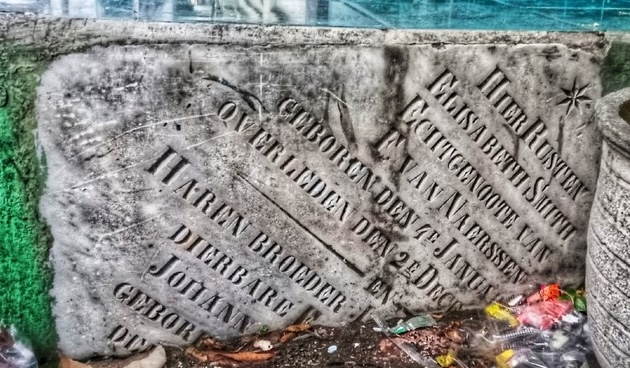
A Dutch inscription has been discovered on a tombstone in Kampung Bedilan. This stone is the sole remaining evidence of a Dutch cemetery (kerkhof) in Gresik. However, the stone is in a state of disrepair due to the conversion of the cemetery complex into a school building (SMA NU 1 Gresik). The tombstone is placed at the post in front of the school building (Wijoyo, 2024). The inscription on the stone reads as follows:
HIER RUSTEN
ELISABETH SMITH
ECHTGENOOTE VAN
F. VAN NAERSSEN GEBOREN
DEN 4E JANUA…
……….EN…….
HAREN BROEDER
DIERBARE JOHANA
GEBOREN… DEN…
The inscription reveals that the tombstone belonged to Elisabeth Smith, the wife of Frederick Van Naerssen, a high-ranking official in Gresik who was a contemporary of Frederick Jacob Rohtenbuler, a Gezaghebber op Java’s Van Den Oosthoek or eastern region official during the reign of Governor-General Daendels (1808–1811). The tombstone is in Figure 11 below.
The linguistic landscape of Bandar Grissee, especially in all revitalized villages, namely Kampung Kemasan, Kampung Bedilan, Kampung Arab, and Kampung Pecinan, presents different memories related to the greatest era of Gresik as the Pearl of Java. First, the memories of the strategic situation of the port of Gresik, which attracted many foreign traders to come and settle around the port, including traders from China and Arabia. Second, the memories of the role of the port of Gresik in the spread of Islam in the territory, especially through the two Wali-Songo, namely Sunan Giri and Sunan Gresik (Maulana Malik Ibrahim). Last, the memories of the arrival of the VOC (Vereenigde Oostindische Compagnie) in Gresik and their monopolistic activities. The memories are remembered through the texts in the linguistic landscape of Bandar Grissee, on the information signs, place names, and inscriptions. They were displayed in the national language, Indonesian; the regional language, Javanese; and languages related to the memories, i.e, Chinese, Arabic, and Dutch. The linguistic landscape in the areas is determined to remember and recall the memories of Gresik as the pearl of Java.
Conclusion
Through the linguistic landscape displayed in Bandar Grissee, we conclude that in recalling the history of Gresik as “The Pearl of Java,” the memories draw on the multilingual and multi-ethnic nature of Gresik, which is represented through the texts on the information signs, place names, and inscriptions in all four revitalized villages: Kampung Kemasan, Kampung Bedilan, Kampung Arab, and Kampung Pecinan. Multilingualism is spotted in the linguistic landscape of the revitalized villages in Bandar Grissee, including the national language, the local language, and the foreign languages related to the memories of Gresik as the Pearl of Java. Whatever the purposes of the languages used on signs, place names, and inscriptions. They are part of the memories of Gresik, particularly as the pearl of Java. The implication of this study is that the multilingual memories in the linguistic landscape can support the regional government in asking people, especially youths and the next generation, to remember the histories. In the development of the ancient city transformed into a heritage tourism place, the linguistic landscape should be regarded as a significant medium to introduce the histories and the memories of a certain place. Therefore, it can inspire heritage tourism places to employ the linguistic landscape strategies to attract visitors and contemplate the underlying memories of the places.
Acknowledgments
This research was fully funded by the Lembaga Pengelola Dana Pendidikan (LPDP), or the Indonesian Endowment Fund for Education, under the Indonesian Ministry of Finance. Part of this paper was also orally presented at the 4th International Conference of Critical Island Studies on October 4th, 2024, at De La Salle University Manila, College of Liberal Arts, The Department of Literature.
References
- Aisyah, S. 2023. “Analisis Variasi Lanskap Linguistik Di Museum Negeri Provinsi Sumatera Utara Sebagai Daya Tarik Wisata Budaya.” TOBA: Journal of Tourism, Hospitality and Destination 2 (4): 96–99.
- Alomoush, O. I. S. 2023. “Multilingualism in the Linguistic Landscape of the Anciety City of Jerash.” Asian Englishes 25 (1): 95–110. https://doi.org/10.1080/13488678.2022.2069421.
- Backhaus, P. 2007. Linguistic Landscape: Comparative Study of Urban Multilingualism in Tokyo. UK: Multilingual Matters Ltd.
- Blackwood, R., & Macalister, J. 2020. Multilingual Memories: Monuments, Museums, and the Linguistic Landscape. London: Bloomsbury Academic.
- Disparekrafbudpora, Gresik. 2023a. “Bandar Grissee.” November 30, 2023. https://disparekrafbudpora.gresikkab.go.id/detailpost/bandar-grissee.
- Disparekrafbudpora, Gresik. 2023b. “Perkantoran Gouw van Nederland Indie - Disparekrafbudpora.” 2023. https://disparekrafbudpora.gresikkab.go.id/detailpost/perkantoran-gouw-van-nederland-indie.
- Dong, J., Peng, M., & Uddin, Md. G. 2020. “Mapping the Linguistic Landscape of the Cultural Heritage Sites and Tourist Spots in Bangladesh.” Open Journal of Social Sciences 8: 228–44. https://doi.org/10.4236/jss.2020.810015.
- Faridatin, N. 2016. “Kota Gresik Sebagai Kota Santri ‘Implikasi Sebagai City Branding.’” Thaqafiyyat: Jurnal Bahasa, Peradaban, Dan Informasi Islam 17 (1).
- Gorter, D. 2006. “Introduction: The Study of the Linguistic Landscape as a New Approach to Multilingualism.” International Journal of Multilingualism 3 (1): 1–6. https://doi.org/10.1080/14790710608668382.
- Guo, Y., He, T., Nie, P., & Zhang, Ru. 2023. “Construction of Language Landscape in Newly Built Ancient Cities: A Case of Yizhou Ancient City, China.” Journal of Contemporary Language Research 2 (4): 199–206.
- Hu, J. 2022. “A Review of the Perspectives of Linguistic Landscape Research.” Open Access Library Journal 9 (e9057). https://doi.org/10.4236/oalib.1109057.
- Hult, F. M. 2009. “Language Ecology and Linguistic Landscape Analysis.” In Linguistic Landscape: Expanding the Scenery. New York: Routledge.
- Istiwianah, W., Suprapto, H., & Juwariyah, A. 2020. “Identitas ‘Kota Santri’ Kabupaten Gresik Melalui Gerak Tari Si’ar.” SALAM: Jurnal Sosial & Budaya Syar-i 7 (2). https://doi.org/10.15408/sjsbs.v7i2.14866.
- Jarwanto, E. 2019. Gresik Punya Sejarah. Gresik: Yayasan Mataseger.
- JDIH Kemenparekraf. 2010. “Peraturan Menteri Kebudayaan Dan Pariwisata Nomor: PM. 56/PW.007/MKP/2010.” Kemenparekraf. https://drive.google.com/file/d/19JUAuhi6xKvG4sC7xSdNZ7VM-FylyPnJ/view.
- Jimaima, H., & Banda, F. 2020. “Multilingual Memories: Artefactual Materiality of Erasure and Downscaling in Linguistic and Semiotic Landscapes of Livingstone Town, Zambia.” In Multilingual Memories: Monuments, Museums, and the Linguistic Landscape. London: Bloomsbury Academic.
- Kim, T. S., & Ahn, J. S. 2023. “Celebrating Local Heritage While Marginalizing Local Language: The Multilingual Linguistic Landscapes of Seongsu-Dong in Seoul.” International Journal of Multilingualism. https://doi.org/10.1080/14790718.2023.2260423.
- Lail, R. M., & Budiarto, M. T. 2022. “Eksplorasi Etnomatematika Budaya Kampung Kemasan Gresik.” Mathedunesa: Jurnal Ilmiah Pendidikan Matematika 11 (3).
- Landry, R., & Bourhis, R. Y. 1997. “Linguistic Landscape and Ethnolinguistic Vitality: An Empirical Study.” Journal of Language and Social Psychology 16 (1). https://doi.org/10.1177/0261927X970161002.
- Macalister, J., & Ong, T. 2020. “Cast in Iron: Remembering the Past in Penang.” In Multilingual Memories: Monuments, Museums, and the Linguistic Landscape. London: Bloomsbury Academic.
- Mariami, I., Parlindungan, J., & Sari, K. E. 2021. “Faktor-Faktor Pembentuk Place Identity Di Kampung Kemasan Gresik Sebagai Warisan Sejarah.” Planning for Urban Region and Environment 10 (1): 33–40.
- Mulyawan, I. W., Paramarta, I. M. S., & Suparwa, I. N. 2022. “Language Contestation at Batukau Temple, Bali (a Linguistic Landscape Study).” Cogent Arts & Humanities 9 (1). https://doi.org/10.1080/23311983.2022.2090651.
- Mulyono, & Yulianto, B. 2023. “Language and Power Relations on Islamic Identity in the Linguistic Llndscape of Gresik City, East Java.” European Journal of Language and Culture Studies 2 (2). https://doi.org/0.24018/ejlang.2023.2.2.83.
- Nurfitriani. 2022. “Kim Hin Kiong: Klenteng Tertua Di Jawa Timur Dengan Racikan Obat Dewanya Yang Populer.” Report. 2022. https://mojok.co/liputan/kim-hin-kiong-klenteng-tertua-di-jawa-timur-dengan-racikan-obat-dewanya-yang-populer/.
- Pires, T. 1944. The Suma Oriental of Tom Pireas and the Book of Francisco Rodrigues. Vol. 1. London: The Hakluyt Society.
- Pranata, G. 2022. “Pemberitaan Kantor Dagang Voc Di Pedalaman Gresik Abad Ke-17.” National Geographic, 2022. https://nationalgeographic.grid.id/read/133338462/pemberitaan-kantor-dagang-voc-di-pedalaman-gresik-abad-ke-17?page=all.
- Prasetyo, L., Artawa, K., Purnawati, K. W., & Suardiana, I. W. 2024. “Language Contestation at Borobudur Temple, the World’s Largest Buddhist Temple.” Issues in Language Studies 13 (2).
- Prasetyo, S. E. 2017. “Bedilan, Pabrik Senjata Tentara Belanda.” Jawapos, June 11, 2017. https://www.jawapos.com/hijrah-ramadan/01152895/bedilan-pabrik-senjata-tentara-belanda.
- Purnanto, D., Yustanti, H., Ginanjar, B., & Ardhian, D. 2022. “English Operation in Public Space: Linguistic Landscape in Culinary Business of Surakarta, Indonesia.” Journal of Language and Linguistic Studies 18 (1): 345–60.
- Purnawati, K. W., Artawa, K., & Satyawati, M. S. 2022. “Linguistic Landscape of Jalan Gajah Mada Heritage Area in Denpasar City.” Jurnal Arbitrer 9 (1): 27–38. https://doi.org/10.25077/ar.9.1.27-38.2022.
- Raffles, T. S. 2024. Sejarah Jawa (Terjemahan). 1st ed. Yogyakarta: Anak Hebat Indonesia.
- Ramadhani, A. R. 2018. “Lingua Franca in the Linguistic Landscape of Gresik Kota Baru.” Etnolingual 2 (2): 125–34.
- Sari, M. A., Ekawati, M., & Wijayanti, A. 2022. “Variasi Lanskap Linguistik Museum Di Magelang.” Repetisi: Riset Pendidikan Bahasa Dan Sastra Indonesia 5 (2).
- Sudarmanto, B. A., Wahyuni, T., Aji, E. N. W., Murdowo, D. A., Hendrastuti, R., Artawa, K., & Benu, N. N. 2023. “The Languages on the Border of Indonesia and Timor Leste: A Linguistic Landscape Study.” Cogent Arts & Humanities 10 (2). https://doi.org/10.1080/23311983.2023.2273145.
- Sunyoto. 2017. Atlas Wali Songo: Buku Pertama Yang Mengungkap Wali Songo Sebagai Fakta Sejarah. Depok: Kerjasama Pustaka IIMaN, Trans Pustaka, dan LTN PBNU.
- Tu Huynh, T. 2015. “‘It’s Not Copyrighted.’ Looking West for Authenticity: Historical Chinatowns and China Town Malls in South Africa.” China Media Research 11 (1).
- Utomo, K. F., & Yannuar, N. 2023. “Lanskap Linguistik Di Mojokerto: Penggunaan Bahasa Di Situs Kerajaan Majapahit.” Suar Bétang 18 (2): 277–90.
- Uyuni, B., Arief, K. M., Adnan, M., Hamid, A., & Sutiono. 2024. “Exploration of Wali-Songo (Nine Saints) Ziyarat in Indonesia from Religious Tourism (Pilgrimage) Perspective.” Cogent Arts & Humanities 11 (1). https://doi.org/10.1080/23311983.2024.2395110.
- Wijoyo, T. P. 2024. “Kerkhof Jejak Belanda Di Kampung Bedilan.” In Lagi-Lagi Sang Gresik Bercerita. Gresik: Yayasan Mataseger.
- Wulandari, B, and Rokhmawan, T. 2022. “Linguistic Landscape in the Tomb of KH Abdul Hamid Pasuruan City: Language Studies in Public Spaces with a Multimodal – Qualitative.” Jurnal SInestesia 12 (2).
- Zhang, T. 2024. “Linguistic Landscape as a Way to Construct Multiple Identitiesin the Context of Globalization: The Case of an Ancient Town in China.” Social Semiotics, 1–21. https://doi.org/10.1080/10350330.2024.2405511.