
Islands of Song: The Dynamics of Tradition and Modernity in Shima-uta (Island Songs) and Shin min’yō (New Folk Songs)
 10.21463/jmic.2025.14.2.14
Abstract
This article explores the role of song in shaping and expressing island identity in the Amami Islands 奄美群島 of southwest Japan, with a focus on the genres of shima-uta 島唄 (island songs) and shin min’yō 新民謡 (new folk songs). These two musical styles serve as distinct cultural emblems, each reflecting different historical roots, stylistic influences and social functions. The former is anchored in traditional culture and the latter is a more recent tradition connected with twentieth-century commercial recordings. By examining similarities and differences between these genres, this study demonstrates that Amami identity as conveyed through song is not static, but a dynamic process of cultural negotiation. Through shima-uta and shin min’yō, performers and communities continuously navigate the tensions between tradition and modernity, articulating a fluid sense of belonging, representation and imagination.
Keywords
Amami, island identity, island songs, modernity, new folk songs, shima-uta, shin min’yō, tradition
Introduction
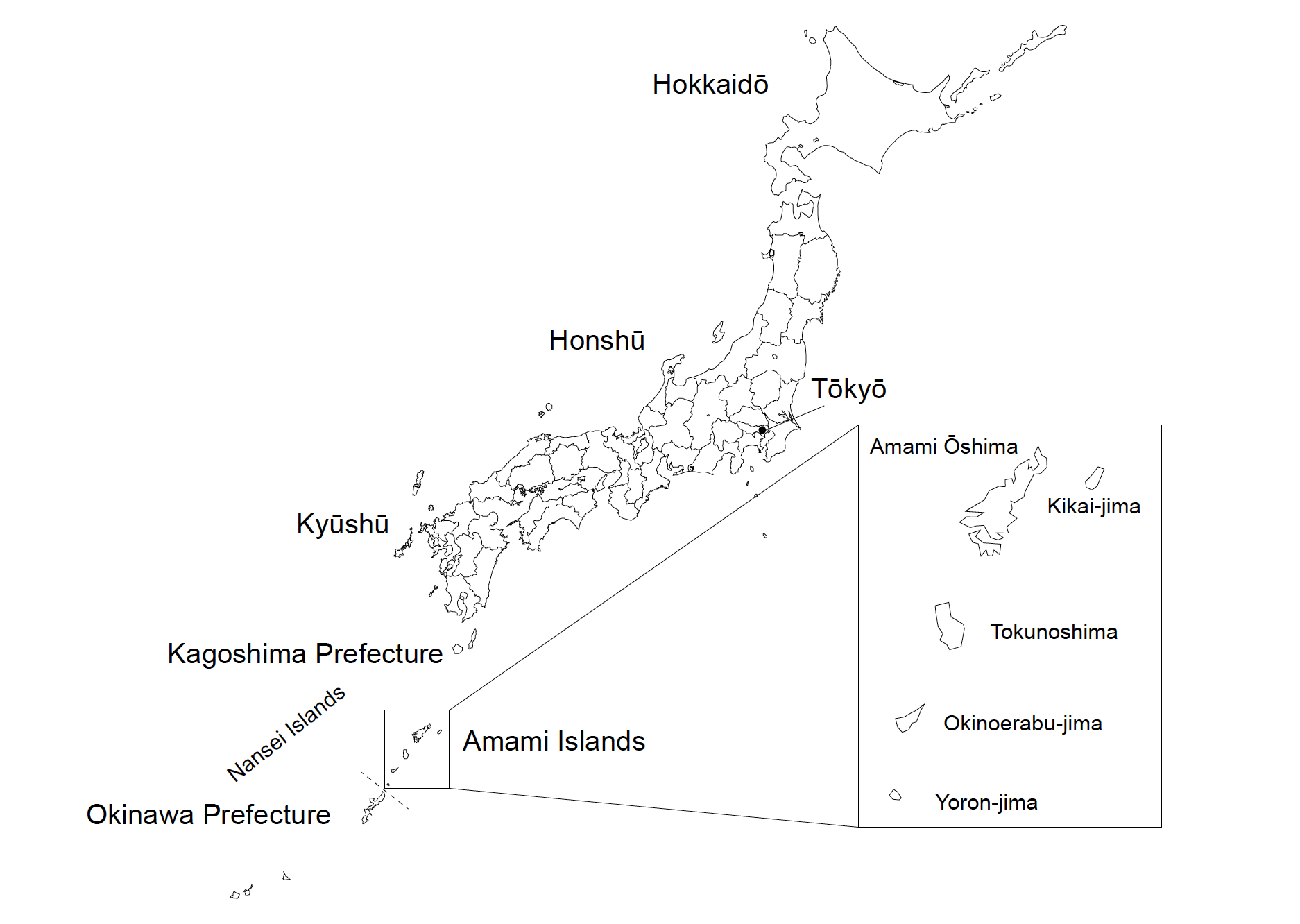
The Amami Islands[1] 奄美群島 (Fig. 1) in southwest Japan are culturally diverse in terms of their musical traditions, not only in the Japanese setting, but also between and within the islands that make up the archipelago (Johnson, 2016). As an administrative island group within the Nansei Islands, Amami forms part of Kagoshima Prefecture (mostly located in the south of the island of Kyūshū) and has eight populated and five unpopulated islands over 0.3 square kilometres (Table 1). Amami’s total population is about 105,000 (Kagoshima-ken, 2025). Amami Ōshima is the largest of these islands, also being the most populated and having a prefectural branch office.
| Island | km2 | Population |
|---|---|---|
| Amami Ōshima 奄美大島 | 712.41 | 57,986 |
| Tokunoshima 徳之島 | 247.85 | 22,248 |
| Okinoerabu-jima 沖永良部島 | 93.65 | 11,930 |
| Kakeroma-jima 加計呂麻島 | 77.25 | 1,062 |
| Kikai-jima 喜界島 | 56.76 | 6,565 |
| Yoron-jima 与論島 | 20.56 | 5,708 |
| Uke-jima 請島 | 13.34 | 89 |
| Yoro-jima 与路島 | 9.35 | 59 |
| Edateku-jima 枝手久島 | 5.81 | 0 |
| Sukomobanare 須子茂離 | 0.94 | 0 |
| Eniyabanare-jima 江仁屋離島 | 0.31 | 0 |
| Yūbanare 夕離 | 0.15 | 0 |
| Kiyama-jima 木山島 | 0.3 | 0 |
From the late fifteenth century, Amami was part of the Ryūkyū Kingdom, but in 1609, the Satsuma Domain—a historical jurisdiction mostly covering present-day Kagoshima Prefecture on Kyūshū—invaded Ryūkyū, leading to Satsuma maintaining control of Amami until the islands became part of Kagoshima Prefecture in 1871 with the abolition of the domain (han 藩) system. The southern part of the Nansei Islands became Okinawa Prefecture. At the end of the Second World War, Amami was occupied by Allied Forces from 1945 to 1953, bringing further cultural influences to the islands. Okinawa remained occupied until 1972.
As an archipelago determined by prefectural, administrative and island boundaries, Amami exhibits an island identity that distinguishes itself from its southern and northern neighbours. In this context, there are points of cultural difference and similarity across the Nansei Islands that add to the complexity of Amami’s identity. Such correlation is particularly evident within Amami’s musical culture, and discerned, for example, within two distinct, although comparable, vocal genres: shima-uta 島唄 (island songs) and shin min’yō 新民謡 (new folk songs).[2] Recognising that a number of other vocal styles exist on the islands, traditional and modern—the archipelago is colloquially referred to as ‘the islands of song’ (utau shima 唄う島) (Katō, 2017)—, a study of these two particular genres, which have been popularised within the contemporary music industry, helps reveal the dynamics of expressing Amami’s identity through music in the modern era. That is, the study demonstrates that Amami island identity includes a process of cultural differentiation and synthesis, where both musical styles contribute to the ongoing cultural negotiation of what it means to represent or imagine Amami.
Scholarly research on traditional Amami song has especially focused on shima-uta as a distinct musical element of local culture (Hayward and Kuwahara, 2016; Ibusuki, Ibusuki and Ogawa, 2011; Nakahara, 1997; Ogawa, 1979, 1999; Sakai, 1996), with shin min’yō and folk music more broadly also being the subject of other scholarly research (Kusuda, 2013; Ogawa, 1984a, 2007, 2010; Patterson, 2019). As such, this article foregrounds both shima-uta and shin min’yō in terms of how they represent Amami through song, particularly the dynamics between tradition and modernity. While both styles share many musical and performance elements, which are not always easy to differentiate to younger generations (Central Gakki, 2024a), as discussed in this article, each contains distinct elements that shape its unique musical character and Amami identity, making them recognisable to both practitioners and discerning listeners.
While studying the cultural setting of these vocal genres, the research has drawn on literature in the field of island studies to make comparisons with and help comprehend the notions of tradition and modernity in the Amami song context. Central to this theme is that island studies is defined as the study of islands “on their own terms” (McCall, 1994: 104). With this notion, shima-uta and shin min’yō are not simply musical styles on Amami, but are distinct expressions of Amami identity that can be defined in a broader Amami setting that has island identity at its core.
On a surface level, the notions of tradition and modernity are key to distinguishing differences between shima-uta and shin min’yō respectively. The former style is anchored in traditional culture and the latter is a more recent tradition connected with twentieth-century commercial recordings. The reason for such differentiation is signified in the names of the genres themselves: shima-uta stands for Amami’s ‘island songs’, while shin min’yō are Amami’s ‘new folk songs’, a new traditional style that has its beginnings in the 1920s in the sphere of commercial music branding (Hosokawa, 2022: 10; Hughes, 1990; Patterson, 2019). Both styles have inherent characteristics within their production, distribution and consumption that simultaneously stand for both tradition and modernity, inferring “misplaced polarities” (Gusfield, 1967) with such contrasting notions. Within this framework, even though shin min’yō by its very conception of being a new type of folk song implies a contradistinction to an established local counterpart such as shima-uta, both styles should be comprehended through a lens that explores their characteristics of being comparatively different, yet both representing Amami and both simultaneously traditional and modern. For example, applying Derrida’s (1976) concept of différance to these styles, while each is presented as standing for Amami, the two styles imply that one is inherently more traditional than the other, although both can be viewed as invented traditions (Hobsbawm and Ranger, 1983) in terms of their inherent modernity.
The article has been informed by studying Japanese and non-Japanese secondary literature on shima-uta and shin min’yō, as well as engaging with Amami culture and the musical styles under discussion through ethnographic research. One author (Kuwahara) is from Amami, has undertaken much anthropological study on the islands, and has published key literature on shima-uta. The other author (Johnson) has researched Amami for over a decade, studying its music and culture across the main islands, including collaborative ethnographic study with Kuwahara. In this article, therefore, we draw on this prior knowledge and research to offer a study of shima-uta and shin min’yō from a critical cultural perspective, locating the study distinctly within the field of island studies as a way of helping to comprehend how islands can inform song, and how song can represent islandness. To do this, we divide the article into two parts, one for each of the song styles, discussing representative features that help show how the styles showcase the dynamics of being simultaneously traditional and modern.
Shima-uta
Traditional songs of Amami are generally classified into two main categories: divine songs (kami-uta 神唄) and folk songs (min’yō 民謡). Kami-uta are often lengthy narrative songs that recount the origins of deities, while min’yō are typically shorter pieces that express individual sentiments or community experiences. Min’yō can be further subdivided into thematic categories, such as recreational songs (asobi-uta), event songs (gyōji-uta), work songs (shigoto-uta), and children's songs (warabe-uta) (Ogawa, 1984b: 26–29). In contemporary usage, the term shima-uta embraces not only these traditional folk song styles, but also neo-traditional Amami songs that have been adapted into popular music contexts (Hayward and Kuwahara, 2008).[3]
Shima-uta is a genre of Amami music with a singer (man or woman) who would typically accompany themselves on the sanshin (three-string lute).[4] Performances might also include another instrumentalist playing the chijin (a type of Amami drum) (Johnson, 2019). The songs that make up the style are perceived as traditional (without a known songwriter) and typically learned orally (i.e., without music notation) and sung in a local dialect, which locates the style distinctly in Amami. Shima-uta often include microtonal pitch inflections and an occasional falsetto vocal style, the latter of which can gain adulation from audiences (Central Gakki, 2024b).
The topography of Amami Ōshima is characterized by mountainous terrain in the southern region and more expansive flatlands in the north. Reflecting this geographic division on this island, for example, shima-uta are broadly categorised into two regional styles: the southern higya-uta 東唄 and the northern kansan-uta 笠利唄. The former is marked by a faster tempo and extensive use of falsetto. In contrast, the northern style is typically performed at a relatively slow tempo with a narrow melodic contour and minimal use of falsetto (Kamiya 1997: 109; Toyoyama, 2013: 66).
Shima-uta are closely associated with the islands’ small villages in which they have much cultural significance in everyday life. Further, due to their relative remoteness and reliance on the sea to navigate between coastal settlements, these villages, or shūraku 集落 (communities), are traditionally “imagined as if they are separate islands” and, as such, also called shima or islands (Suwa, 2007: 8; Takara, 1989: 135). Thus, for Amami islanders, shima-uta represent a song style closely related to a sense of place—community and island—thereby nurturing a sense of furusato 故郷 (home town/place) that helps reinforce local identity (Kamiya, 1997: 107; Nakahara, 1997: 3; Robertson, 1988). However, with such traditional elements firmly rooted in Amami and local dialects, the songs are sometimes unintelligible to a younger generation as well as visitors from elsewhere in Japan (Hayward and Kuwahara, 2008).
Such is the cultural importance of shima-uta to Amami, that Amami Park (a local exhibition and events venue dedicated to Amami’s culture and environment) has created a prominent section of the style’s presence as representing the islands (Johnson, 2016). In the exhibition, viewers can choose several shima-uta to play as pre-recorded background music, which helps emphasise the importance of the style amongst distinct island communities. One such exhibit offers the following songs:
- “Asahana Bushi” 朝花節 (“Morning Flowers”). From northern Amami Ōshima, Kikaijima and Tokunoshima and varying considerably between the islands.
- “Yoisura Bushi” ヨイスラ節 (“On the Side of the Boat’s Stern”). From Amami Ōshima and Tokunoshima.
- “Kadoku Nabe Kana Bushi” 嘉徳なべ加那節 (“Miss Kadoku Nabe Kana”). A story about Nabe Kana, a priestess (noro ノロ) from Setouchi Town in Amami Ōshima.
- “Watasha” 渡しゃ (“When I Look at Kikai Island”). From Kikaijima and Amami Ōshima. About a ferry boat between the islands.
As well as its transmission through oral tradition, shima-uta are nowadays disseminated in several other ways. These include commercial recordings, song contests, live performance venues,[5] radio, television, karaoke, and the internet,[6] all of which have contributed to the making of a repertoire of songs representative of Amami. For example, the production of commercial recordings and the emergence of artists in song contests have been particularly influential in the dissemination of shima-uta and are given particular attention below.
As well as notable more recent exponents of shima-uta such as Maeyama Shingo 前山真吾 (male, b. 1983), Kusuda Riko 楠田莉子 (female, b. 1998) and Hirata Marina 平田まりな (female, b. 1996), who all help maintain the tradition in the modern era, over the past few decades the genre has received national coverage with the popularisation of the style by several notable pop music singers, including Hajime Chitose 元ちとせ (female, b. 1979) and Atari Kōsuke 中孝介 (male, b. 1980). A winner of the junior divisions of the Amami Min’yō Taishō 奄美民謡大賞 (Amami Folk Song Award) in 2002, Hajime, who is from Amami Ōshima, was the first Amamian to become a major pop music singer in mainland Japan, and her shima-uta skills gained national attention and inspired a new generation of shima-uta singers from Amami. As a result, shima-uta CDs were released from major labels such as Sony, Tōshiba, King, and Teichiku, and the number of participants in shima-uta contests in Amami increased rapidly (Ibusuki, Y., 2004: 167).
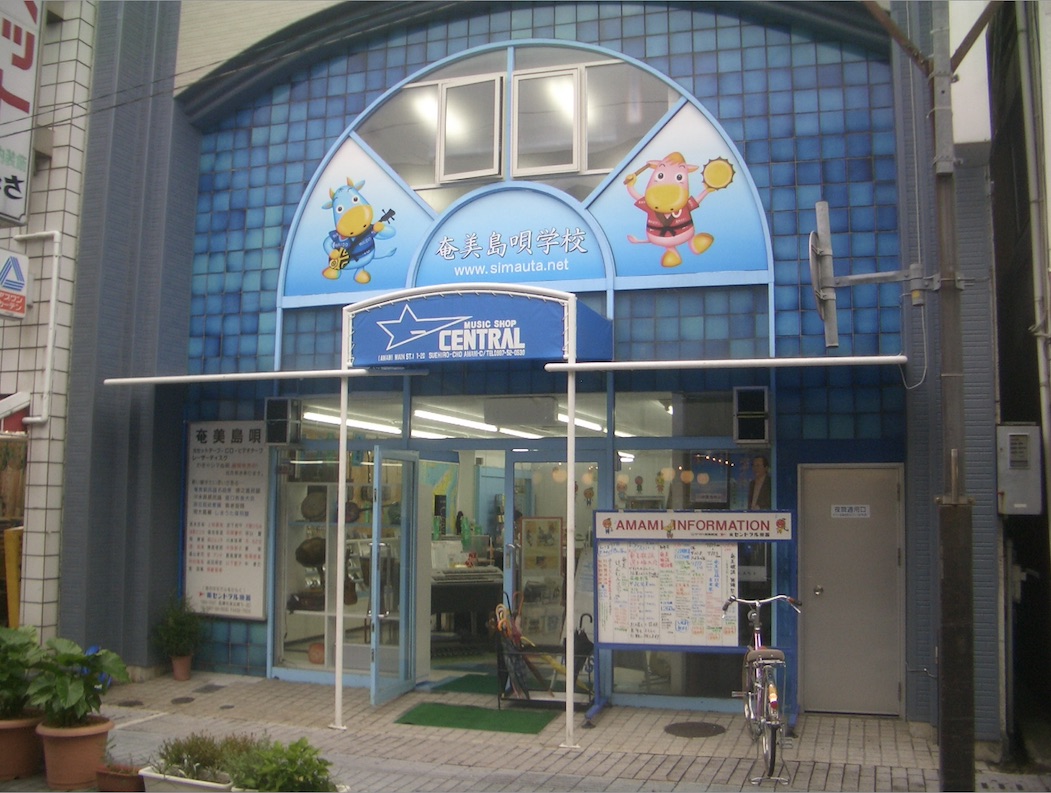
Amami’s main music store, Central Gakki セントラル楽器 (Fig. 2), has been pivotal in releasing commercial recordings of distinguished shima-uta performers (Katō, 2023; Ogawa, 2019).[7] However, before Central Gakki commenced trading, the first known recording of a shima-uta was of Nakayama Otojo 中山音女 (female, 1891–1970) from Uken Village 宇検 in Amami Ōshima in 1928 (Katō, 2021: 37). During the Allied occupation of Amami (1945–53), the recording of shima-uta was actively pursued by Yamada Yonezō 山田米三, also from Uken Village, who ran a souvenir shop called New Grand ニューグランド located near Naze port (the main urban area). Yamada recorded reputable singers, producing significant recordings of the time and commercialising shima-uta to a wider consumer audience through the use of modern means of production and distribution (Ibusuki, Y., 2004: 27; Katō and Teraoka, 2017: 252). Yamada’s endeavours helped islanders consume with greater availability their distinct musical style in the years after Japan’s defeat in World War Two and the ongoing presence of an occupying foreign military.
The first commercial recording of shima-uta produced after the war was in 1951 by Tokuyama Takeo 徳山武雄, a shop owner in Naze, and released through Mercury Records in Kobe, thereby showing a mainland interest in the production of Amami music. The singer was Kanmura Fujie 上村藤枝 (female, b. 1929), with sanshin and vocal accompaniment provided by Minami Masagorō 南政五郎 (male, 1889–1985). Kanmura and Minami established local renown by touring throughout Amami during the occupation, with Minami also performing in Okinawa, and, later, being invited to the Zenkoku Minzoku Geinō Taikai 全国民俗芸能大会 (National Folk Performing Arts Festival) in Tōkyō in 1961, organised by the Ministry of Education. He then made recordings for Central Gakki in 1964.
The founder of Central Gakki, Ibusuki Yoshihiko 指宿良彦 (1925–2014), started a recording business in 1956, initially to help preserve and promote shima-uta. His first recordings were of Fukushima Kōgi 福島幸義 (male, 1905–74), from Kakeroma Island, and Asazaki Ikue 朝崎郁恵 (female, b. 1935), also from Kakeroma (Ibusuki, Y., 2004: 61–62). Asazaki received much attention as a result of her performances, especially in Tōkyō from the 1980s. She learned shima-uta from her father and showed much talent as a teenager. She moved to Yokohama and only made her debut album, Utaba Utayun うたばうたゆん, in 2002. Since then, she has released several albums, often revealing a modern, hybrid musical approach when performing shima-uta. For example, her albums, Shima-Yumuta シマユムタ (2006), which was made in collaboration with Japanese New Age pianist Wong Wing Tsan 黄永燦 (male, b. 1949), and Hamasaki はまさき (2007) in collaboration with Japanese sitar (an Indian long-neck lute) player Yoshida Daikichi 吉田大吉, expressed a mix of island nostalgia within a modern, eclectic approach to musical expression. Amongst many other collaborations, she has also performed with Sakamoto Ryūichi 坂本龍一 (1952–2023) and New Age group Himekami 姫神. Such cross-genre collaborations help show how Amami’s traditional song form, shima-uta, is able to maintain a traditional paradigm yet also represent Amami in new ways in the modern era.
The performance activities of another shima-uta artist, Takeshita Kazuhira 武下和平 (male, 1933–2021), help show the cultural flows of the song style beyond its Amami home. Takeshita learned shima-uta from Fukushima Kōgi, his father’s cousin, and participated in events such as the Geijutsu-sai Minzoku Geinō Taikai 芸術祭民俗芸能大会 (Folk Performing Arts Festival) in 1961 and the Nihon Min’yō Taikai 日本民謡大会 (National Folksong Contest) in 1964. Central Gakki produced his recordings and he became well known with many live performances and TV appearances. Helping to disseminate shima-uta beyond Amami, he moved to mainland Japan and established the Takeshita performance tradition (Amami Min’yō Takeshita-ryū 奄美民謡武下流) in Kansai and Amami. This type of educational and performance framework is modelled on performance traditions found in other Japanese traditional music, with a school head and students adhering to their school’s performance practices (Hsu, 1975). Takeshita’s shima-uta singing style had much impact on the genre in southern Amami Ōshima, and he is regarded as one of the greatest exponents in the twentieth century (Ibusuki, Y., 2004: 91–93).
As well as the distribution of shima-uta through commercial recordings being a contributing factor to their popularity beyond Amami, performance contests have also been influential in disseminating shima-uta in the modern era. Under a broader label of folk song (min’yō), the first Amami contest, Jikkyō Rokuon Amami Min’yō Taikai 実況録音奄美民謡大会 (Live Recording of Amami Folk Song Contest), was held in 1972, organised by Central Gakki and a local newspaper, Nankai Nichinichi Shinbun 南海日日新聞. At the age of 42, Tsuboyama Yutaka 坪山豊 (male, 1930–2020), a shipwright from Uken Village, was discovered at the contest (Ibusuki, Y., 2004: 134). In 1973, Central Gakki released a recording of Tsuboyama, which helped establish his professional musical career as a leading singer. Tsuboyama grew up with his father singing shima-uta at home, which influenced his belief that the style should be learned by ear and defined uniquely by each performer, demonstrating this process by often changing a song’s lyrics between different performances, even in his recordings (Ibusuki, Y., 2004: 190–191).
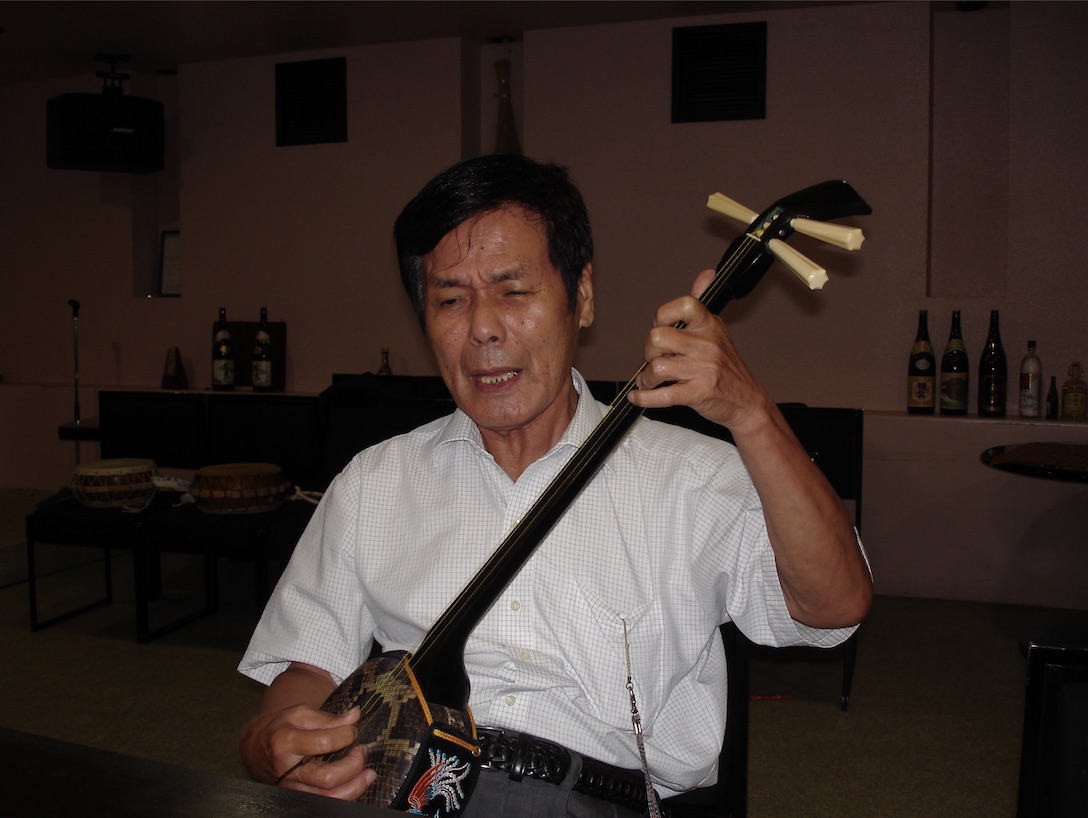
Continuing to promote shima-uta, in 1975, Nankai Nichinichi Shinbun and Central Gakki founded the Amami Shinjin Min’yō Taikai 奄美新人民謡大会 (Amami Folk Song Newcomer Contest). This was a shima-uta contest and from 1980 continued under the title Amami Min’yō Taishō 奄美民謡大賞 (Amami Folk Song Grand Prize). The success of this event is reflected in the growth of the number of contestants, from 31 in 1975 to 216 in 2019 (Nankai Nichinichi Shinbun, 2019). The first winner was Tsukiji Shunzō 築地俊造 (male, 1934–2017) (Fig. 3). Born in Kasari Village in northern Amami Ōshima, Tsukiji grew up hearing shima-uta from his father, although he didn’t start learning formally until his 30s, taking lessons from Fukushima Kōgi in a class run by Central Gakki, and after that from Tsuboyama Yutaka. When Tsukiji won the first contest, it was his first time singing shima-uta on stage to an audience (Ibusuki, Y., 2004: 149; Tsukiji, interview, 14 March 2011).
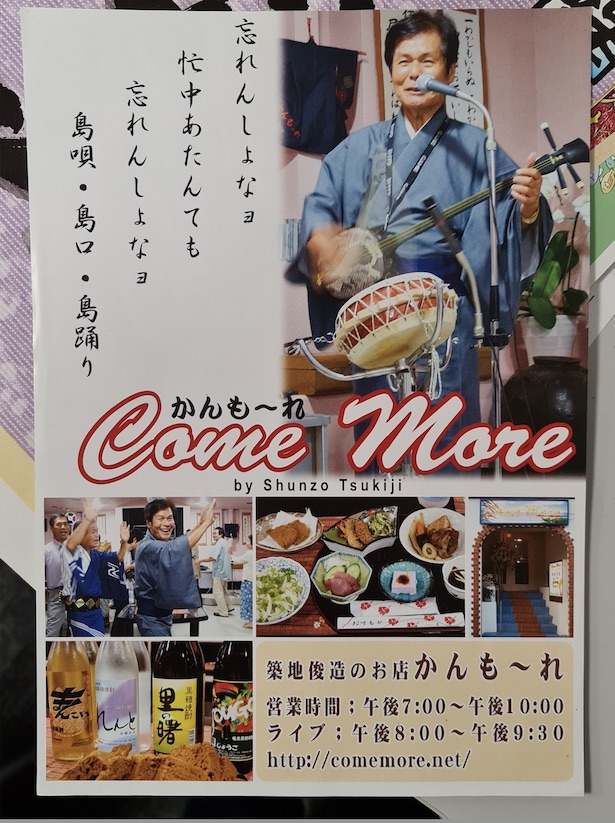
In 1979, Tsukiji entered a larger folk-song contest on the mainland, Nihon Min’yō Taishō Zenkoku Taikai 日本民謡大賞全国大会 (National Folk Song Grand Championship), organised by Nippon TV. With entrants from around Japan, Tsukiji won the contest singing the shima-uta “Mankoi Bushi” まんこい節 (“Inviting In”) in front of a live audience of 37,000.[8] Such a media event helped disseminate knowledge about Amami shima-uta to viewers throughout Japan (Takashima, 2002: 134). Thereafter, Tsukiji worked for his brother’s construction company before starting his shima-uta live house in Naze (Fig. 4) (Tsukiji, interview, 14 March 2011). Other Amami performers followed Tsukiji’s success in the contest, including Tōhara Mitsuyo 当原ミツヨ (female, b. 1943) in 1989 and Nakano Rikki[9] 中野律紀 (female, b. 1975) in 1990, further helping to disseminate shima-uta to a national audience and showing a distinct female presence (Katō and Teraoka, 2017: 241–242).
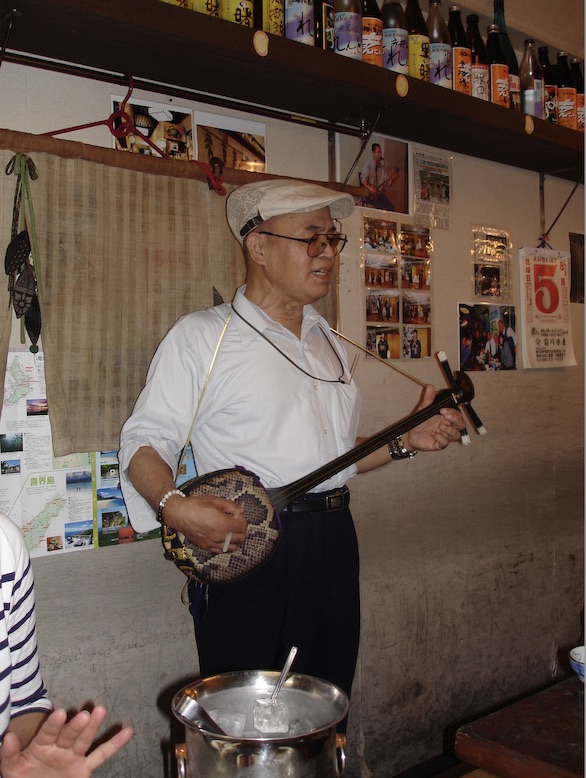
In the modern era, much change has occurred with shima-uta dissemination (Ogawa, 2010; Sakai, 2002: 142–143). While the songs of villages were once handed down within communities, individuals can now perform and consume shima-uta beyond the roots of the songs’ shima (community). The present discussion has emphasised key performers, their recordings and song contests as key to influencing shima-uta dissemination, but other media spheres should also be mentioned, although beyond the current discussion, including radio, new media and live houses/restaurants (i.e., performance/entertainment venues) (Fumoto, 2019; Mochida, 2021; Ogawa, 1984a: 12), the latter being ever-present in the Amami tourist industry (Fig. 5). However, in the media context, while some singers who won shima-uta contests have turned to the music industry beyond Amami, there are also performers who have remained in Amami, with both acting as icons of Amami musical culture and existing musically between the spheres of tradition and modernity.
Shin min’yō
The term shin min’yō is defined with the prefix ‘new’ (shin), which signifies the style’s modernity in the context of folk song (min’yō), itself a term coined in the late nineteenth century (Hughes, 1990: 1; 2008).[10] However, the term shin min’yō is often problematic to define, denoting the genre is new and thereby existing in contradistinction to a style that is ‘old’, and at the same time embracing the diversity of folk song. However nebulous the term might be, one helpful definition notes its four key features: “1) celebratory lyrics; 2) country-flavored melody; 3) rhythmical onomatopoeia; and 4) simple choreography” (Hosokawa, 2022: 10).
Shin min’yō has distinct roots from the 1920s when it became a well-known label for a style of commercial music within a rapidly developing recording music industry (Kojima, 1970; Mitsui, 2004). While nowadays having its own repertoire of popular songs, which is typically defined according to a Japanese region to which particular songs have a local connection (e.g., lyrics, performers, songwriters), shin min’yō has continued to the present day—albeit without mass popularity—with the creation and production of new songs that consolidate a sense of locality through song for performers and consumers alike (Hughes, 1990: 1–2).
The song that helped with the rise of shin min’yō was “Suzaka Kouta” 須坂小唄 (“Suzaka Small Song”), which, with “unprecedented success” (Hughes, 2008: 125) was composed at the request of a silk factory in Suzaka City in Nagano Prefecture. The song was released in 1923 with lyrics by Noguchi Ujō 野口雨情 (male, 1882–1945; real name: Noguchi Hideyoshi 野口英吉) and music by Nakayama Shinpei 中山晋平 (male, 1887–1952). “Suzaka Kouta” became well known around Japan and inspired further songs in a similar style, which were initially known as gotōchi songu ご当地ソング (local songs) that often had a purpose of promoting local culture such as tourist areas and regional specialties (Ibusuki, K., 2021a: 4; Watanabe, 2010: 238). In this song, the lyrics depict Suzaka Town, the factory and a nighttime setting. The instrumentation of shin min’yō typically includes a small ensemble of Western instruments alongside traditional Japanese instruments (e.g., shamisen), which, as with “Suzaka Kouta”, comprised piano and double bass (Hughes, 2008, p.133). The song style as formulated in “Suzaka Kouta” includes some harmonic movement as a borrowed feature typical of Western music, alongside heterophony as typically found in traditional Japanese music (Hughes, 2008: 134).
Another early shin min’yō that also helped to popularise the style, was “Tōkyō Ondo” 東京音頭 (“Tōkyō Beat”, 1933),[11] which is nowadays performed also as a popular Buddhist Bon festival dance (Hughes, 2008: 315). The song’s music was composed by shin min’yō songwriter, Nakayama Shinpei, with lyrics by Saijō Yaso ⻄條⼋⼗ (male, 1892–1970). As the song’s title suggests, the lyrics celebrate Tōkyō and they are laced with picturesque references to the nation’s capital and most populous city (Hughes, 2008: 315).
While having distinct musical and lyrical elements, Amami shima-uta and shin min’yō are sometimes performed in the same settings and even by the same performers. It is for these reasons that some listeners are unable to differentiate the two styles, making it important to note here key similarities and differences between the genres. In contrast to most folk music, shin min’yō have a credited songwriter and, to give the style broader appeal across the nation, they are typically sung in standard Japanese (hyōjungo 標準語) (Kamiya, 1997: 121; Yanagita, 1929: 251). However, as Fumoto (2019) asserts, while there are some differences between shima-uta and shin min’yō in Amami, there is some crossover in that some shin min’yō may incorporate the Amami dialect as found in shima-uta.
Shin min’yō blend vocal techniques and cultural sentiments from folk music, but often use compositional methods influenced by Western music, including instrumentation scored in a light orchestral style (Katō and Teraoka, 2017: 245; Morita, 2011: 5–6). While not continuing in popularity in some parts of Japan, shin min’yō have continued in Amami as an important musical expression of local culture (Kusuda, 2013: 46; Katō and Teraoka, 2017: 249–250). In their Amami setting, the songs might also be performed to the accompaniment of the sanshin, thereby adding a distinct local instrumental style that shows similarities to shima-uta. To stress the local significance of shin min’yō to Amamians, songs such as “Tsuki no Shirahama” 月の白浜 (“White Sandy Beach by Moonlight”), which was released in 1934 with lyrics by Nobori Shomu 昇曙夢 (male, 1878–1958; real name: Nobori Naotaka 昇直隆) and music by Mikai Minoru 三界稔 (male, 1901–61; real name: Mikai Sanetomo 三界実友), are still popular amongst consumers in karaoke (Kusuda, 2013: 15–16).[12] The song denotes Shirahama Beach on the south coast of Amami Ōshima, with lyrics laced with references to the coastal environment, the shamisen and dancing.
The first acknowledged Amami song in the shin min’yō style was “Ōshima Kouta” 大島小唄 (“Ōshima Small Song”), which dates from 1928, with lyrics by Arikawa Kunihiko 有川邦彦 (male) and music by Mikai Minoru (Kusuda, 2013: 11; Takashima, 2001: 101–102). Referring to Amami’s largest island in its title, Amami Ōshima, the lyrics depict an image of island life that would have much significance for islanders and offer an idealised image of the island to mainlanders, a type of “internal exotic” (Yano, 2002: 172) laced with “fantasy images” (Patterson, 2019: 131) through commercial song. Mikai had much success composing in this style and his second song with Arikawa, “Shima Sodachi” 島育ち (“Island Raised ”, 1939), was initially popular in Amami. However, it was only when Tabata Yoshio 田端義夫 (male, 1919–2013) covered the song in 1962 that it became a national success. Further, in 1963, Tabata performed the song in NHK’s annual New Year’s Eve music show, Kōhaku Uta Gassen 紅白歌合戦 (Red/White Song Contest), which helped generate much interest in Amami on a national level (Katō and Teraoka, 2017: 246; Takashima 2001: 104–105). Other Amami shin min’yō were also performed at this Kōhaku, namely “Erabu Yuri no Hana” 永良部百合の花 (“Erabu Lily Flower”), “Shima no Burūsu” 島のブルース (“Island Blues”), and “Amami Koishiya” 奄美恋しや (“Missing Amami”), sung by Asaoka Yukiji 朝丘雪路 (female, 1935–2018), Misawa Akemi 三沢あけみ (female, b. 1945) and Nakasone Miki 仲宗根美樹 (female, 1944–2024) respectively. At the time, the show recorded an audience rating of 81.4%, indicating that four out of five Japanese people watched the programme (Ibusuki, K., 2021c).
Just as shima-uta reference local culture and Amami sentiments, shin min’yō too emphasise a sense of island nostalgia by having “local colour” (Hosokawa, 2022: 29). Such toponymous songs became especially popular from 1927 when international record companies made a major impact on the Japanese commercial music industry (Hosokawa, 2022: 21). Further, cultural sentiments were brought to a new political milieu during the occupation of Amami when local shin min’yō were popular amongst islanders as a way of expressing island life and thereby offering a sense of nationalism through island culture (Central Gakki, 2024a).
Sentiment in Amami shin min’yō is especially expressed through the cultural geography of the style’s lyrical content, which is often evocative of the Amami context and engenders an idealised sense of local (island) culture.[13] As such, shin min’yō might also be considered a way of experiencing through music a sense of furusato, the notion of which is particularly significant in comprehending the sense of place and identity in Japanese folk music more broadly (Hughes, 2008; Patterson, 2019; Yano, 1998: 263). For example, some songwriters from Amami worked within the national music industry, but sometimes expressed a sense of Amami island life in their songs as a way of celebrating local culture and place. Such composers include Mikai Minoru and Tokuchi Masanobu 渡久地政信 (male, 1916–98; performance name: Kijima Shōichi 貴島正一), who was born in Okinawa but spent his childhood in Amami Ōshima and later worked as a composer for Victor Records and King Records (Katō and Teraoka, 2017: 245). Pointing out such musicians helps show not only the importance of shin min’yō as a style of Japanese popular music, but also how songwriters with Amami links or roots reflected on local culture within the national recording industry, thereby bringing island knowledge to a broader consumer market.
Amongst a variety of songs expressing local sentiments, some of the ones that mention Amami refer to one of the archipelago’s islands by name, or to islands more broadly within their song titles and lyrics, such as Mikai’s “Shima Sodachi”, “Tokunoshima Kouta” 徳之島小唄 (“Tokunoshima Small Song”, 1943), and “Amami Kouta” 奄美小唄 (“Amami Small Song”, 1958), and Tokuchi’s “Shima no Funa Uta” 島の船唄 (“Island Boat Song”, 1939) and “Shima no Burūsu” (Kamiya, 1997: 122). Such songs make much of island life, its culture and the natural environment, thereby emphasising local elements that strengthen or evoke a sense of furusato, and in this case islandness.
One particularly well-known Amami shin min’yō that refers to a smaller island in the Amami archipelago, Okinoerabu, is “Erabu Yuri no Hana”,[14] which was released in 1931 and represents Okinoerabu Island musically as a distinct island within Amami (Johnson and Kuwahara, 2017). Not only does the song have Amami roots, but it has also been transformed with a different set of lyrics for visitors and consumers not versed in the Amami dialect (Futatsu no Erabu Yuri no Hana, 2025). That is, the deputy mayor of Wadomari Village on Okinoerabu, Yamaguchi Teizen 山口禎善, wrote the lyrics of the first two verses, with verses 3–6 written by Takeda Ekimitsu 武田恵喜光 (1904–96), and added them to the melody of a local folk song of neighbouring Tokunoshima Island, “Tete no Makura Bushi” 手々の枕節 (“Song of Tete Village”) (Ibusuki, K., 2021b). Even though “Erabu Yuri no Hana” is classified as a shin min’yō, these two versions create a sense of one being a local, authentic version, and the other used as a version for tourists visiting or imagining the island.
Tokuchi Masanobu’s song, “Shima no Burūsu”, offers a further modernist aspect of shin min’yō. With lyrics by Hokkaidō-born Yoshikawa Shizuo 吉川静夫 (male, 1907–99), Amami is the subject. The song was released as a single in 1963 by singer Misawa Akemi and fellow musicians Wada Hiroshi 和田弘 (male, 1931–2004) and the Mahina Stars マヒナスターズ (Fig. 6). The link to Amami is significant because Tokuchi spent his early years in Amami and even performed the whistling in the song’s opening section, a musical characteristic of much folk music in the Nansei Islands. In the Amami setting, the song is known locally for its nostalgic sentiment (Ibusuki, K., 2022; Kamiya, 1997: 127). That is, its lyrics have clear references to Amami, whether naming its largest town or mentioning distinct aspects of island culture such as the summer dance or cycads (sotetsu). Reference in the lyrics to the word shima (island) is also prominent, particularly with the love theme of ‘island girl’ appearing at the end of the first and fourth verses (the idea of ‘island’ implying either a geographical island or a local community on an island). A distinct musical feature of the song is the beating of drums and plucking of lutes, which are sounds that imply the chijin and sanshin respectively, each being traditional Amami instruments. In contradistinction to these local sounds, in line with the commercial focus of shin min’yō, the backing music comprises a smaller ensemble of Western instruments provided by the Victor Orchestra (Ojisan, 2022). Musically, the song uses a major pentatonic scale, C-D-E-G-A (yonanuki ヨナ抜き scale), which became popular from the Meiji era (1868–1912) and is used much in Japanese popular music.[15]
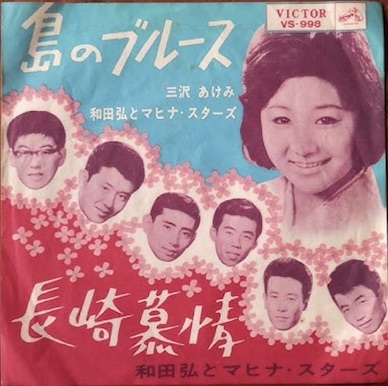
This song’s lyrics vividly evoke themes central to Amami and island life, intertwining nature, love, longing, traditional culture, and maritime imagery. The natural landscape is depicted through references to sotetsu and sanenbana (pink porcelain lily, Alpinia speciosa), which create a strong sense of place, while the southern wind and plovers symbolise the passage of time and emotions of solitude. The song also references summer dances and the local silk textile that embodies both cultural heritage and personal sentiment. Maritime life is another key theme, with Naze Port and departing ships alluding to the transient nature of island existence, where travel and separation are integral experiences. The recurring mention of the shima musume (island girl) reinforces local identity by depicting a perceived emotional depth of an Amami woman.[16] Lastly, love and longing are central motifs.
As well as the commercial release of shin min’yō, further forms of dissemination in the modern era have influenced the popularity of the genre in Amami, including karaoke and song contests. In connection with karaoke, Central Gakki’s president, Ibusuki Masaki 指宿正樹, negotiated with karaoke companies to utilise online karaoke as another way of expanding the reach of Amami kayō 奄美歌謡, a term referring to shin min’yō and more recent vocal styles with similar sentiments. Ibusuki worked initially with BMB (Best Music Boomer) and later with Daiichi Kōshō 第一興商 and, by creating a niche space in karaoke consumption, Amami kayō spread quickly to the Japanese market with 300 songs available nationwide in 2019 (Ibusuki, M., 2019: 43).
In the commercial popular music setting, a more recent Amami Ōshima-born performer, Kizuki Minami 城南海 (female, b. 1989), made an impact in the Japanese media after appearing on a national television karaoke contest show. Kizuki started performing shima-uta when she was a high school student and busked shima-uta on the streets in Kagoshima City where she was scouted by the publishing company Pony Canyon ポニーキャニオン, which led to her moving to Tōkyō to grow her performance career. Her debut release was in 2009 with the song “Aitsumugi” 愛紡ぎ (“Weaving the Thread of Love”). Kizuki participated in the TV Tokyo programme The Karaoke Battle (THEカラオケ★バトル) in 2014 and won. Reflecting her diverse singing interests, including shima-uta, shin min’yō and J-pop, Kizuki is currently one of the most exposed singers from Amami in the popular music industry.
In addition to its other forms of cultural intervention, Central Gakki sponsors the annual Amami Kayō Senshuken Taikai 奄美歌謡選手権大会 (Amami Popular Song Contest) and Amami Kōhaku Uta Gassen 奄美紅白歌合戦 (Amami Red/White Song Contest) (Kusuda, 2013: 35). For the annual Amami Kayō Contest, which was first staged in 2005, Central Gakki produces and sells a CD of the winner each year. In the contest, twenty contestants who have passed the qualifying round can participate in the main event. Amami Kōhaku Uta Gassen, which emulates the national NHK event mentioned earlier, was first held in December 2010 at the Amami Culture Center 奄美文化センター in Naze with 24 entrants (Kusuda, 2013: 71). Contests such as these help promote Amami shin min’yō and show the genre as living, celebrated and representative of local culture, both for islanders and mainlanders alike.
As well as their interests in shima-uta, Central Gakki and New Grand have contributed much to the development of shin min’yō (Kusuda, 2013: 32). Central Gakki started to record shin min’yō in 1960 with Mikai Minoru and Murata Jitsuo 村田実夫 (male, 1919–73), and played a key role in establishing shin min’yō as a recognised music genre. They also publish songbooks, which help promote Amami songs more broadly (Katō and Teraoka, 2017: 245–246).
Conclusion
Shima-uta and shin min’yō are two vocal emblems of Amami musical identity. They reveal distinct musical and linguistic characteristics that stand for local island culture, collectively across the archipelago, on islands and within island communities. Yet they have also been mediatised and celebrated nationally in the consumption of Amami culture on a wider commercial level.
In the modern era, shima-uta are being recontextualised from village (shima シマ) songs that show distinct differences between local Amami communities (within and between the islands), to island (shima 島) songs that represent Amami more broadly as a distinct cultural entity. However, shin min’yō are not traditionally tied to a particular village in terms of their roots, although they sometimes refer to locations, and, as new folk songs, they generally arouse an image of Amami as a whole, especially in connection with nature, place names and products. Though local shin min’yō are written and composed by Amamians, those who have mostly contributed to disseminating the songs on a national level have been mainland-based singers and songwriters, such as with “Shima Sodachi” and “Shima no Burūsu”, which were featured on NHK’s Kōhaku Uta Gassen. Within this construct, some Amamian shima-uta singers have become national pop singers, including Hajime Chitose and Atari Kōsuke, while Amami shin min’yō singers are yet to venture into this national sphere of the music industry.
Musically, shima-uta often require performance techniques such as a falsetto vocal style, along with knowledge of a local Amami dialect, which combine to make the genre challenging to sing and not one that can be easily leaned or understood. Shin min’yō, however, with their use of standard Japanese, have become established in commercial settings such as karaoke as a style that can reach beyond local borders.
Both shima-uta and shin min’yō are highly mediatised and negotiate the dynamics of tradition and modernity. Shima-uta, which were once sung in everyday life in Amami villages, nowadays also have a stage setting, and shin min’yō are a product of the commercial music industry. Nevertheless, the opportunity to be exposed to both song styles has increased through mediatisation, such as with community classes, recordings, karaoke, performances, and contests. As such, each of these modern-day settings helps show how the study of two key vocal styles can offer a window into the intricacies of cultural expression and Amami island identity.
Endnotes
References
- Central Gakki (Sentoraru Gakki) セントラル楽器. 2024a. Amami shin min’yō to wa? 奄美新民謡とは? https://www.simauta.net/simauta-column_048/ (accessed 24 April 2025).
- Central Gakki (Sentoraru Gakki). セントラル楽器. 2024b. Shima-uta wa yōderu 島唄はヨーデル. https://www.simauta.net/simauta-column_001/ (accessed 24 April 2025).
- Derrida, J. 1976. Of grammatology. Trans. G.C. Spivak. Johns Hopkins University Press.
- Finchum-Sung, H. 2006. New folksongs: Shin minyo of the 1930s. In K. Howard (Ed.), Korean pop music: Riding the wave. Global Oriental, pp. 10–20.
- Fumoto, K. 麓憲吾. 2014. Amami FM. Kaikyoku made no michi nori to sono yakuwari: Shima no aidentiti o keiseisuru komyuniti media あまみエフエム:開局までの道のりとその役割:島のアイデンティティを形成するコミュニティ・メディア. Kagoshima Daigaku Shōgai Gakushū Kyōiku Sentā Nenpō 鹿児島大学生涯学習教育センター年報 11: 56–62. https://ir.kagoshima-u.ac.jp/records/9019 (accessed 24 April 2025).
- Fumoto, H. 麓卑弥呼. 2016. Shima no kokoro o utau “mōhitotsu no shima-uta” ‘Amami shin min’yō’: Sakkyokka no Hisanaga Michiko-san ni kiku 島の心を歌う“もう一つの島唄”「奄美新民謡」~作曲家の久永美智子さんに聞く. Ippan Shadan Hōjin Amami Ōshima Kankō Bussan Renmei 一般社団法人あまみ大島観光物産連盟. https://www.amami-tourism.org/magazine/1560/ (accessed 24 April 2025).
- Fumoto, K. 麓憲吾. 2019. Amami no uta bunka to rajio. 奄美のうた文化とラジオ. Minami Taiheiyō Kaiiki Chōsa Kenkyū Hōkoku 南太平洋海域調査研究報告 60: 47–57. https://ir.kagoshima-u.ac.jp/records/16745 (accessed 24 April 2025).
- Futatsu no Erabu Yuri no Hana 二つの永良部百合の花. 2025. https://www.simauta.net/column06/col4.cgi?mode=main&no=4 (accessed 24 April 2025).
- Gillan, M. 2012. Songs from the edge of Japan: Music-making in Yaeyama and Okinawa. Ashgate.
- Groemer, G. 2016. Goze: Women, musical performance, and visual disability in traditional Japan. Oxford University Press.
- Gusfield, J.R. 1967. Tradition and modernity: Misplaced polarities in the study of social change. The American Journal of Sociology 72(4): 351–362. DOI: https://doi.org/10.1086/224334
- Hayward, P., Kuwahara, S. 2008. Transcience and durability: Music industry initiatives, shima uta and the maintenance of Amami culture. Perfect Beat 8(4): 44–63. DOI: https://doi.org/10.1558/prbt.v8i4.28690
- Hayward, P., Kuwahara, S. 2016. Amami shima uta: Sustaining a vernacular popular island music in the shadow of mainstream Japanese culture. In Schippers, H., Grant, C. (Eds.), Sustainable futures for music cultures: An ecological perspective. Oxford University Press, pp. 209–238. DOI: https://doi.org/10.1093/acprof:oso/9780190259075.003.0008
- Hobsbawm, E., Ranger, T. (Eds.). 1983. The invention of tradition. Cambridge University Press.
- Hosokawa, S. 2022. Tōkyō ondo in historical perspective: Nakayama Shimpei, geisha singers, and new folk song. In Gillan, M., Day, K., Huang, P. (Eds.), Folk and songs in Japan and beyond: Ethnomusicological essays in honour of David W. Hughes. Cambridge Scholars Publishing, pp. 10–34.
- Hsu, F. 1975. Iemoto: The heart of Japan. John Wiley & Sons.
- Hughes, D.W. 1990–1991. Japanese ‘new folk songs’, old and new. Asian Music 22(1): 1–49. DOI: https://doi.org/10.2307/834289
- Hughes, D.W. 2008. Traditional folk song in modern Japan. Global Oriental.
- Ibusuki, K. 指宿邦彦. 2021a, September 3. Amami shin min’yō no tabi (1) 奄美新民謡の旅(1). Nankai Nichinichi Shinbun 南海日日新聞, 4.
- Ibusuki, K. 指宿邦彦. 2021b, October 8. Uta wa kataribe: Amami shin min’yō no tabi (3) 歌は語り部:奄美新民謡の旅(3). Nankai Nichinichi Shinbun 南海日日新聞, 4.
- Ibusuki, K. 指宿邦彦. 2021c, December 16. Amami shin min’yō no tabi (8) 奄美新民謡の旅(8). Nankai Nichinichi Shinbun 南海日日新聞, 4.
- Ibusuki, K. 指宿邦彦. 2022, March 4. Amami shin min’yō no tabi (13) 奄美新民謡の旅(13). Nankai Nichinichi Shinbun 南海日日新聞, 4.
- Ibusuki, M. 指宿正樹. 2019. Amami Kōhaku Uta Gassen yomoyama banashi 奄美紅白歌合戦よもやま話. Kagoshima Daigaku Minami Taiheiyō Kaiiki Chōsa Kenkyū Hōkoku 鹿児島大学南太平洋海域調査研究報告 60: 41–46. https://ir.kagoshima-u.ac.jp/records/16744 (accessed 24 April 2025).
- Ibusuki, M., Ibusuki, K., Ogawa, H. (Eds.). 指宿正樹・指宿邦彦・小川学夫編. 2011. Amami min’yō sōran: Amami shima-uta zen-kashi, kyōtsūgo-yaku, zenkyoku-moku kaisetsu 奄美民謡総覧:奄美島唄全歌詞共通語訳, 全曲目解説. Nanpō Shinsha 南方新社.
- Ibusuki, Y. 指宿良彦. 2004. Otona seinen 大人青年. Sentoraru Gakki セントラル楽器.
- Johnson, H. 2010. The shamisen: Tradition and diversity. Brill.
- Johnson, H. 2016. Amami Park and island tourism: Sea, land and islandness at a site of simulation. Tourism and Hospitality Research 16(1): 88–99. DOI: https://doi.org/10.1177/14673584155814
- Johnson, H. 2019. ‘Island drum’: Heritage and transformation in Amami, Japan. The Galpin Society Journal 72: 158–159; 193–203. https://www.jstor.org/stable/45200868 (accessed 24 April 2025).
- Johnson, H., Kuwahara, S. 2017. North meets south: Eisā and the wrapping of identity on Okinoerabu island, Japan. Shima 11(2): 38–55. https://shimajournal.org/issues/v11n2/f.-Johnson-Kuwahara-Shima-v11n2.pdf (accessed 24 April 2025).
- Kagoshima-ken 鹿児島県. 2024. Reiwa 5-nendo Amami guntō no gaikyō 令和5年度奄美群島の概況. http://www.pref.kagoshima.jp/aq01/chiiki/oshima/chiiki/zeniki/gaikyou/r5amamigaikyou.html (accessed 24 April 2025).
- Kagoshima-ken 鹿児島県. 2025. Amami guntō no gaikyō 奄美群島の概況. https://www.pref.kagoshima.jp/aa02/chiiki/oshima/chiiki/zeniki/gaikyou/index.html (accessed 24 April 2025).
- Kamiya, Y. 神谷裕司. 1997. Amami, motto shiritai 奄美、もっと知りたい. Nanpō Shinsha 南方新社.
- Katō, H. 2017. ‘Utau shima.’ Amami to ongaku media jigyō: Shima-uta, shin min’yō, popyurā ongaku no rēberu o jiku ni 「唄う島」奄美と音楽メディア事業 --島唄・新民謡・ポピュラー音楽のレーベルを軸に. Chūkyō Daigaku Gendai Shakai Gakubu Kiyō中京大学現代社会学部紀要 10(2): 71–121. https://www.chukyo-u.ac.jp/educate/gendaisyakai/results/2017/2017_1002_02kato.pdf (accessed 24 April 2025).
- Katō, H. 加藤晴明. 2021. Amami shima-uta to iu bunka seisan: Taikai-ka o meguru shiron ①―Tsuboyama Yutaka no shima-uta to ‘jojō-ka’ 奄美島唄という文化生産:大会化をめぐる試論①―坪山豊の島唄と<叙情化> Chūkyō Daigaku Gendai Shakai Gakubu Kiyō 中京大学現代社会学部紀要 15(1): 1–68. https://chukyo-u.repo.nii.ac.jp/records/18468 (accessed 24 April 2025).
- Katō, H. 2023. Amami shima-uta to iu bunka seisan: Rokuon media-hen, Sentoraru Gakki o jiku ni 奄美島唄という文化生産:録音メディア編・セントラル楽器を軸に. Chūkyō Daigaku Gendai Shakai Gaku-bu Kiyō 中京大学現代社会学部紀要 17(1): 1–47. https://chukyo-u.repo.nii.ac.jp/record/2000015/files/105010170101katou-chukyo-u.pdf (accessed 24 April 2025).
- Katō, H., Teraoka, S. 加藤晴明・寺岡伸悟. 2017. Amami bunka no kingendai-shi 奄美文化の近現代史. Nanpō Shinsha 南方新社.
- Kojima, T. 小島美子. 1970. Shin min’yō undō no ongaku-shi-teki igi 新民謡運動の音楽史的意義. Engeki-gaku 演劇学 11: 1–29.
- Kusuda, T. 楠田哲久. 2013. Amami no shin min’yō ni kansuru ichi kōsatsu 奄美の新民謡に関する一考察. Master’s thesis, Kagoshima University.
- McCall, G. 1994. Nissology: A proposal for consideration. Journal of the Pacific Society 17(2–3): 1–14. https://dl.ndl.go.jp/pid/10495013/1/1 (accessed 24 April 2025).
- Mitsui, T. 2004. “Sing Me a Song of Araby” and “My Blue Heaven”: “New folksong”, hybridization and the expansion of the Japanese recording industry in the late 1920s. Popular Music History 1(1): 65–82. DOI: https://doi.org/10.1558/pomh.v1i1.65
- Mochida, I. 2021. Role of social media in contemporary shimauta culture in the Amami islands. Horizons 6: 78–86. https://scholarspace.manoa.hawaii.edu/server/api/core/bitstreams/99f988b6-fec8-4a4a-a98b-e79460e961be/content (accessed 24 April 2025).
- Morita, N. 森田哲至. 2011. Shin min’yō undō to uguisu geisha ni yoru ‘Shōwa kayō’ no seiritsu to hatten 新民謡運動と鶯芸者による「昭和歌謡」の成立と発展. Nihonbashigaku Kenkyū 日本橋学研究 4(1): 5–32. https://researchmap.jp/dr.morichan/misc/27053286/attachment_file.pdf (accessed 24 April 2025).
- Nakahara, Y. 中原ゆかり. 1997. Amami no ‘shima no uta’ 奄美の「シマの歌」. Kōbundō 弘文堂.
- Nankai Nichinichi Shinbun 南海日日新聞. 2019, April 10. Honsen shutsujō 105-nin kimaru 本選出場105人決まる, 8.
- Ogawa, H. 小川学夫. 1979. Amami min’yō-shi 奄美民謡誌. Hōsei Daigaku Shuppankyoku 法政大学出版局.
- Ogawa, H. 小川学夫. 1984a, January 3. Amami min’yō no yukue 奄美民謡の行方. Nankai Nichinichi Shinbun 南海日日新聞, 12.
- Ogawa, H. 小川学夫. 1984b. ‘Min’yō no shima’ no seikatsu-shi 「民謡の島」の生活誌. PHP Kenkyūjo PHP研究所.
- Ogawa, H. 小川学夫. 1999. Amami shima-uta e no shōtai 奄美シマウタへの招待. Shun’endō Shuppan 春苑堂出版.
- Ogawa, H. 小川学夫. 2007, January 1. Shin min’yō, shin kayō kara Amami kayō e 新民謡、新歌謡から奄美歌謡へ. Nankai Nichinich Shinbun 南海日日新聞, 37.
- Ogawa, H. 小川学夫. 2010. Watashi no Amami min’yō kenkyū 私の奄美民謡研究. Sōrin 想林 1: 68–81. https://k-junshin.repo.nii.ac.jp/record/671/files/sorin_01_ogawa.pdf (accessed 24 April 2025).
- Ogawa, H. 小川学夫. 2019. Watashi no kakawatta Amami shima-uta rekōdo 私の関わった奄美島唄レコード. Minami Taiheiyō Kaiiki Chōsa Kenkyū Hōkoku 南太平洋海域調査研究報告 60: 19–40. http://cpi.kagoshima-u.ac.jp/publications/occasionalpapers/occasional/vol-60/OccasionalPapersNo60-pp19-40.pdf (accessed 24 April 2025).
- Ogawa, H. 小川学夫. 2020. Tokubetsu kōen. Amami shima-uta ni miru josei no chikara: Jendā-ron no shiten kara. 特別講演 奄美島唄に見る女性の力:ジェンダー論の視点から. Sōrin 想林 11: 5–18. https://k-junshin.repo.nii.ac.jp/record/765/files/sorin_11_01.pdf (accessed 24 April 2025).
- Ojisan おじさん. 2022, October 31. Shima no Burūsu: Misawa Akemi, Mahina Sutāzu 島のブルース: 三沢あけみ・マヒナスターズ. https://www.youtube.com/watch?v=Uo7ncMfxvhg (accessed 24 April 2025).
- Patterson, P.M. 2019. Music and words: Producing popular songs in modern Japan, 1887–1952. Lexington Books.
- Robertson, J. 1988. Furusato Japan: The culture and politics of nostalgia. International Journal of Politics, Culture and Society 1(4): 494–518. https://www.jstor.org/stable/pdf/20006871.pdf (accessed 24 April 2025).
- Sakai, M. 酒井正子. 1996. Amami utagake no diarōgu 奄美歌掛けのディアローグ. Daiichi Shobō 第一書房.
- Sakai, M. 2002. Amami shima-uta no genzai 奄美島唄の現在. Yurīka ユリイカ 34(10): 140–143.
- Shima no Sanpo 島の散歩. 2025, March 12. Kagoshima ken no shimajima 鹿児島県の島々. http://shimanosanpo.com/46/ichiran_06.htm (accessed 24 April 2025).
- Suwa, J. 2007. The space of shima. Shima 1(1): 6–14. https://www.shimajournal.org/issues/v1n1/c.-Space-of-Shima.pdf (accessed 24 April 2025).
- Takara, K. 高良倉吉. 1989. Ryūkyū Ōkoku no kōzō 琉球王国の構造. Yoshikawa Kōbunkan 吉川弘文館.
- Takashima, M. 高嶋正晴. 2001. Amami min’yō, shin min’yō no media-ka: Sono rekishiteki keii ni kansuru ichi oboegaki to shite 奄美民謡・新民謡のメディア化: その歴史的経緯に関する一覚書として. Kyora キョラ 6: 99–110.
- Takashima, M. 高嶋正晴. 2002. Tabi suru Amami shima-uta: Arui wa Amami shima-uta no J-poppu-ka タビする奄美シマウタ─あるいは奄美シマウタの Jポップ化? Yurīka ユリイカ 34(10): 130–139.
- Toyoyama M. 豊山宗洋. 2013. Amami shima-uta no keishō katudō ni okeru utasha to min’yō taikai no yakuwari 奄美島唄の継承活動における唄者と民謡大会の役割. Ōsaka Shōgyō Daigaku Amyūzumento Sangyō Kenkyūsho Kiyō 大阪商業大学アミューズメント産業研究所紀要 15: 57–82. https://ouc.daishodai.ac.jp/files/ams_labo/publication/bulletin/%5BPD%EF%BC%A6%EF%BC%9A490KB%5D.pdf (accessed 24 April 2025).
- Tsukiji, S. 築地俊造. 2011. Unpublished interview with Kuwahara Sueo.
- Watanabe, H. 渡辺裕. 2010. Utau kokumin 歌う国民. Chūō Kōronsha 中央公論社.
- Yanagita, K. 柳田国男. 1929. Min’yō no ima to mukashi 民謡の今と昔. Chiheisha Shobō 地平社書房.
- Yano, C.R. 1998. Defining the modern nation in Japanese popular song, 1914–1932. In S.A. Minichiello (Ed.), Japan’s competing modernities: Issues in culture and democracy, 1900–1930. University of Hawai'i Press, pp. 247–264.
- Yano, C.R. 2002. Tears of longing: Nostalgia and the nation in Japanese popular song. Harvard University Asia Center.