
Sustainable tourism development for small islands from social exchange theory perspective: The case of Vietnam Islands
 10.21463/jmic.2025.14.2.19
Abstract
This study investigates the direct influence of residents’ perceptions about sustainable tourism development on their satisfaction. Besides, the author tests life satisfaction (LS) as a mediator in the effect of residents’ perceptions on their support for sustainable tourism development (SU). The author uses Structural Equation Modeling to examine the hypotheses and employ bootstrapping method to test the mediating role of LS. The research concludes that residents’ positive perceptions of sustainable tourism development (PP) positively affect LS, and PP, residents’ negative perceptions of sustainable tourism development (NP) and LS also significantly influence their SU. Moreover, the author confirms that LS partially mediates the relationship between their PP and SU.
Keywords
Sustainable tourism, Social Exchange Theory, residents’ perceptions, life satisfaction, small island
1 Introduction
Nowadays, in developing countries, compared to other sectors, tourism has emerged as one of the most productive and outstanding elements in economic development (Brida et al., 2020) and a cornerstone of sustainable economic growth (Higgins-Desbiolles, 2020). When a community views tourism as a possible tool to boost its economic development, sustainable tourism development is essential to align with the interests and requirements of the community’s residents (Stone et al., 2021). Moreover, it is crucial for residents to engage in and encourage to enhance sustainable tourism (Bichler, 2021). Analyzing the local community’s perceptions regarding tourism impacts becomes a major concern, as that is firmly connected to tourism development’s accomplishment and sustainability (Purnomo et al., 2020). As it develops, tourism has both beneficial and harmful effects. Therefore, local communities’ awareness towards these impacts assists in sustainable development of tourism. Besides, many theories have been applied to interpret the perceptions from inhabitants along with their assistance towards sustainable tourism growth. Of these theories, Fredline and Faulkner (2000) believed the social exchange theory (SET) gives the most critical contribution in theory to the branch of residents’ perceptions of tourism development. According to Fan (2023), in tourism, the exchanges take place in the relationship between tourists and local communities.
During recent years, the researchers in the field of tourism have been drawn to residents’ perceptions towards sustainable tourism growth. Nevertheless, not so much research has been carried out about residents’ perception towards environmentally-friendly tourism growth in developing nations, specifically, in Vietnam. Most of research has been performed about residents’ perceptions about the growth of sustainable tourism in developed nations (Lee and Jan, 2019) and Gulf Cooperation Council countries (Alhowaish, 2016).
Over and above, tourism has been largely explained to strengthen people’s happiness (Pan et al., 2021) and the success for a long time and sustainable tourism development are according to the acceptance of not only travelers but also inhabitants (Kim et al., 2021). Nevertheless, the link between life satisfaction and tourism development in accordance with residents’ perceptions has been rarely explored (Woo et al., 2015). Besides, very little research has tested the direct association between perceived effects of sustainable tourism and local communities’ overall life satisfaction. They described the effects of residents’ perceptions of tourism development effects on life satisfaction through certain life domains (Woo et al., 2015).
Research Gap
This study addresses a notable gap in the existing literature concerning sustainable tourism development, particularly within the developing island regions of Vietnam. Previous research has predominantly focused on developed regions, neglecting the unique dynamics in developing island communities. Specifically, little research has been done on the direct relationships between residents' perceptions of tourism impacts and their overall life satisfaction. Additionally, the role of life satisfaction as a mediator in the impact of these perceptions on support for sustainable tourism development remains underexplored. This research aims to fill these gaps by investigating the intricate relationships between perceptions of local residents, their satisfaction with quality of life, and their subsequent support for sustainable tourism initiatives in three small islands in Central Vietnam. This exploration is anticipated to contribute significantly to the literature on local communities' perceptions and support for environmentally friendly tourism growth.
Research Questions
Building on the identified research gaps, this study poses the following structured research questions to guide the investigation:
- RQ1: How do residents' perceptions of sustainable tourism development directly influence their overall life satisfaction in the small island communities of Vietnam?
- RQ2: What is the effect of residents' life satisfaction on their support for sustainable tourism development in these communities?
- RQ3: Does life satisfaction mediate the relationship between residents' perceptions of sustainable tourism development and their support for sustainable tourism initiatives?
The formulation of these questions is based on a critical observation that, to the extent of the researchers' knowledge, no prior research has thoroughly tested life satisfaction with the role of a mediator in these relationships. By addressing these questions, this study not only aims to fill the identified theoretical gaps but also to provide practical implications for local authorities in developing sustainable tourism strategies that are informed by resident attitudes and satisfaction levels. The use of social exchange theory as the guiding framework further emphasizes the reciprocal benefits anticipated through sustainable tourism development, enhancing the theoretical and practical contributions of this research.
2 Literature Review and Research Hypothesis
2.1 Social Exchange Theory (SET)
SET is a sociological and psychological theory that has its root from the study of Homans (1958) and it is regarded to be one of the most outdated theories of social behavior and considered exchange as the basic of human behavior. SET is “a general sociological theory concerned with understanding the exchange of resources between individuals and groups in an interaction situation” (Ap, 1992). As reported by Yamao (2024), SET focuses on a bilateral measure which engages two or more social groups, individuals, and organizations. A party is ready to join in an exchange with another party if they recognize that they will have some gains without acquiring unsatisfactory losses from that exchange (Nunkoo and Ramkissoon, 2012).
SET has been put in the tourist industry to point out local communities’ perceptions toward tourism growth and regarded to have theoretically contributed the most essential to residents’ perceptions toward tourism (Fredline and Faulkner, 2000). Charag et al. (2021) stated that SET may clarify local communities’ perceptions of tourism development effects in economy, environment, and socio-culture. SET demonstrated that local community has tendency to support tourism development when the economy, environment, and socio-culture have the positive effects (Paraskevaidis and Andriotis, 2017). For the economic perspective, SET proposes that the residents who can gain economically are tendency to support of tourism development more (Madrigal, 1995). Nonetheless, in some cases, the residents care about the benefits related to environment more than ones related to economy (Liu and Var, 1986). On the contrary, when considering the factors to support for tourism development, residents also notice that tourism is a way to help them know more about their local culture and preserve the traditional values of their communities (Besculides et al., 2002). In general, depending on residents’ priorities in their perceptions about economic, environmental or socio-cultural elements of exchange procedure, they will have the reactions to tourism development. Human interrelationships will be explained by SET to conclude the complication of social structure (Charag et al., 2021). Residents will refer to benefits or gains and costs or losses of tourism development when they want to assess tourism development (Nugroho and Numata, 2022). From the standpoint of tourism, SET explores that local communities will support sustainable development on the condition that they suppose the positive impacts exceed the negative impacts (Meimand et al., 2017). In other words, when the residents recognize that they receive more benefits than costs in their correlations with tourists, they will assist sustainable tourism growth (Garau‐Vadell et al., 2014).
2.2 Residents’ Perceptions towards Tourism Development Impacts
Many researchers have investigated residents’ perception towards tourism growth impacts (Costa et al., 2020; Tichaawa and Moyo, 2019). According to Algassim et al. (2022), tourism development directly affects inhabitants in perspectives of economy, society, and environment. Consequently, local communities perceived both beneficial and disadvantageous effects of tourism development (Gogitidze et al., 2022). They identify that tourism growth can boost residential earnings, generate more business possibilities and improve living standards for residents. In contrast, the disadvantageous economic effects of tourism growth involve the growth of the living cost and capital taxes (Costa et al., 2020)
Besides, from the social perspective, the beneficial impacts of tourism growth are the improvement of roads and public infrastructures; the presence and standard of leisure and pleasure possibilities; the enhancement the image of local culture (Costa et al., 2020). Conversely, tourism development causes negative social effects on local communities including overcrowding, the increasing availability of drugs, roadblocks, high rate of crimes and the change in traditional culture (Costa et al., 2020) .
Moreover, local community’ positive perceptions about environment towards tourism development impacts are the conservation of natural possessions, the advancement of environment-related perception (Liasidou et al., 2021). Nevertheless, many negative environmental impacts are listed as the harm to the natural surroundings, the increase of different types of pollutants such as water, air, and environment (Liasidou et al., 2021).
2.3 Support for Tourism Development (SU)
Some studies have stated the local communities’ perceptions towards beneficial and disadvantageous effects on their support for sustainable tourism growth (González-García et al., 2022; Obradović et al., 2021). Some studies stated that tourism development brings employment and investment opportunities, development in local economy (Látková and Vogt, 2012). Residents’ perceived economic benefits positively influence on support for tourism growth (Nugroho and Numata, 2022). Besides, some previous research concluded that tourism development leads to increase the opportunities both on cultural interchange between residents and travelers and on entertainment for local communities. Therefore, residents’ cultural benefits significantly affect support for tourism development (Muresan et al., 2021; Frleta and Badurina, 2019). In contrast, some prior studies also reported that tourism development brings some costs like the increasing of living expenses, environment pollution, overcrowding, heavy traffic, criminal activity and drug usage, the destroying of natural environment (Gogitidze et al., 2022; Charag et al., 2021). Therefore, residents’ perceived losses negatively affects support for tourism development (Gogitidze et al., 2022).
2.4 Life satisfaction (LS)
Life satisfaction is defined by Yamada et al. (2011) as “one of the common terms used to indicate how well people live”. According to Diener (1984), life satisfaction is the testing of cognition in one’s life and a central element of human welfare. Occupation situation, state of health, marital status, leisure satisfaction, leisure participation, safety, income, humor, community activities, etc. are the components of life satisfaction (Yamada et al., 2011). Besides, some research proved that tourism development influenced local communities’ living standards (Hassan et al., 2022; Abd Aziz et al., 2020). In this study, the author wants to explore how residents’ perceptions of tourism development have influenced their satisfaction with quality of life. Examining local communities’ life satisfaction is critical to the accomplishment of sustainable tourism development because it helps to assess the local communities’ perceptions toward sustainable tourism development impacts and support for sustainable tourism development (Abd Aziz et al., 2020; Eslami et al., 2019).
2.5 Hypothesized relationship between residents’ perception towards sustainable tourism development and their life satisfaction
LS is defined by Yamada et al. (2011) as “one of the common terms used to indicate how well people live”. Some research proposed that the gains of tourism development raise LS while losses decline satisfaction with quality of life (Pai et al., 2023). However, most of research about LS has focused on tourists rather than on local communities (Yu et al., 2023; Pan et al., 2020). These studies have also used SET to illustrate the link between residents’ perception towards tourism development and their LS. If the inhabitants recognize the tourism development effects upgrade their standard of living, they will be inclined to participate in the swapping process with the tourists (Nunkoo and So, 2016). On the other hand, a greater number of research found out that tourism impacts have effect on residents’ life satisfaction (Pai et al., 2023; Hassan et al., 2022). Hence, we hypothesize:
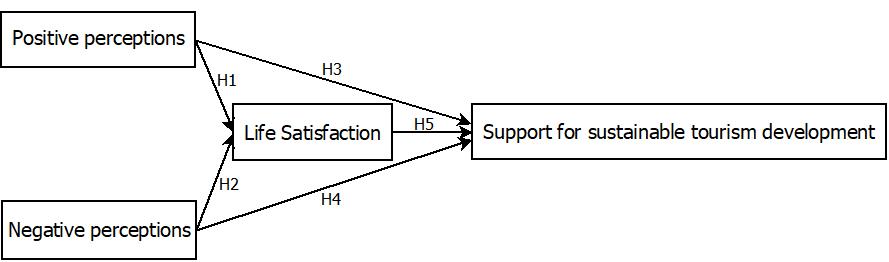
H1. Residents’ positive perceptions of sustainable tourism development significantly affect life satisfaction.
H2. Residents’ negative perceptions of sustainable tourism development significantly affect life satisfaction.
2.6 Hypothesized relationship between residents’ perceptions towards sustainable tourism development and their support for sustainable tourism development
In tourism, SU depends on whether the residents perceive tourism development effects positively or negatively (Uslu et al., 2023). According to Meimand et al. (2017), SET explores when residents suppose that the gains they get from tourism development overcome the losses, they are ready to join in the interchange.
According to Rasoolimanesh and Jaafar (2016), residents’ perceptions of tourism development effects is an essential predictor of their SU. Many researchers concluded that when the tourism development impacts are regarded as positive, the residents will support for tourism development. On the contrary, perceiving negative effects, they will disapprove tourism development (Magadán-Díaz and Rivas-García, 2022). These authors have also applied SET to analyze these effects. Consequently, if residents recognize that gains of tourism development overcome the losses of that, they will SU, and vice versa (Rasoolimanesh and Jaafar, 2016).
Therefore, in the current research, author hypothesized the hypotheses as follow:
H3. Residents’ positive perceptions of sustainable tourism development significantly affect support for sustainable tourism development
H4. Residents’ negative perceptions of sustainable tourism development significantly affect support for sustainable tourism development
2.7 Hypothesized relationship between residents’ life satisfaction and their support for sustainable tourism development
LS has been recognized as a predictor of their SU (Abd Aziz et al., 2020). In other words, LS positively affects SU. When local communities’ living standards through tourism development increases, they will SU. More specifically, according to Woo et al. (2015), having derived from SET, if residents’ living standards is enhanced from tourism development impacts, they will be more probably to get into an interchange with the industry and SU and vice versa, local communities will contradict tourism development if they recognize that tourism interrupt their quality of life. Consequently, residents’ living conditions improved owing to tourism development can be considered as positive value for residents. Hence, we hypothesize:
H5. Residents’ life satisfaction significantly affects support for sustainable tourism development.
2.8 Residents’ life satisfaction mediates the effect of their perception towards sustainable tourism development and their support for sustainable tourism development.
The direct relationships among variables were discussed in the earlier sections. The author expects that residents’ perceptions towards tourism development effects affect their LS which successively afford to support for continuous tourism development. Are there any indirect pathways existing among residents’ perceptions towards sustainable tourism development, LS, and SU? As a result, we put out the following hypotheses to look into how PP/NP and SU are related through LS:
H6. Residents’ life satisfaction mediates the effect of their positive perceptions on support for sustainable tourism development.
H7. Residents’ life satisfaction mediates the effect of their negative perceptions on support for sustainable tourism development.
Figure 1 depicts the research model with reference to the aforementioned literature review and the current study's purposes.
3 Methodology
3.1 Research Design, Instrumentation, Data Collection
In current research, a quantitative approach was employed, utilizing a survey with a five-point Likert scale ranging from 'strongly disagree' to 'strongly agree' to assess the relationships among the variables. The measurements for all variables were derived from existing literature. Specifically, the Positive Perceptions (PP) and Negative Perceptions (NP) items were adapted from Ribeiro et al. (2017) and Rasoolimanesh et al. (2017) respectively. The Life Satisfaction (LS) items were based on works by Woo et al. (2015) and Nunkoo and So (2016), while the Support for Sustainable Tourism (SU) items were taken from Rasoolimanesh et al. (2017).
The study focused on the inhabitants of three small islands in Middle Vietnam: Ly Son, Cu Lao Cham, and Ky Co Island. Data collection was conducted through a structured questionnaire using a probability sampling method, specifically simple random sampling as outlined by Hansen et al. (1953). A total of 400 questionnaires were distributed, with 300 respondents from Ly Son Island, and 50 each from Cu Lao Cham and Ky Co Islands, reflecting the proportional population distribution of these locations.
To prevent the respondents from misunderstanding scale items and decreasing incidental replies, we asked precise, succinct, and understandable questions. Besides, we ensured survey participants' confidentiality. We made it clear to the respondents that there are no right or wrong answers. As a result, respondents will be less reluctant to pass judgment on others and are less inclined to provide replies that are compatible with social norms when answering questions (Steenkamp et al., 2010). One more thing, we inform participants that the information collected will be safely stored and combined, with individual replies only accessible by researchers. Furthermore, since the information was only utilized for study, potential respondents are encouraged to take part and give truthful answers (Steenkamp et al., 2010).
3.2 Data Analysis
In the current research, to investigate the hypotheses, Structural Equation Modeling (SEM) is applied. In SEM, a model refers a theory to determine a meaningful interrelation between constructs (Hair et al., 2010). Statistical procedure for the sample’s demographic data and exploratory factor analysis (EFA) is conducted in SPSS 22. AMOS 22 is used for testing multiple group confirmatory factor analysis and path analysis of the structural model which has been hypothesized among constructs and examining life satisfaction as a mediator as well.
3.3 Testing for mediation effect in SEM
In this research, to test a variable as a mediator, the researchers employ the 1990 Bollen and Stine-introduced bootstrapping approach. This approach yields estimates with 95% confidence intervals and at least 1,000 resampling. The types of mediation should be confirmed in regard to the direct and indirect effects reported. Besides, for the interval test of indirect effect, the lower and upper confidence limits are estimated. If the upper and lower bounds' confidence intervals deviate from zero, the estimated indirect effect is considered significant (Hoyle, 2012).
4 Research findings
4.1 Demographic Characteristics
In this research, 400 questionnaires were sent out, but 332 questionnaires are useable (83%). The respondents were arranged by gender, age, marital status, education, job related to tourism or not, monthly income, and how long have they been living in this island. The findings show that the main part of participants are males (51.5%), from 31 to 40 years old (90 respondents = 27.1%), married with 219 respondents (66.0%), bachelor degree (165 respondents = 49.7%), job not related to tourism (192 respondents = 57.8%), monthly income higher than 6 to 10 million VND with 125 respondents (occupied 37.7%), and living in this island more than 10 years with 231 respondents (69.6%).
4.2 Factor analysis
Factor analysis was developed by Spearman in 1904 (Smelser and Baltes, 2001). Factor analysis is a procedure employed to check variability patterns among correlated variables including two types: exploratory factor analysis (EFA) and confirmatory factor analysis (CFA) (Decoster, 1998).
An exploratory factor analysis (EFA) is performed to assess the validity and identify the items of all variables in the current study, these are PP, NP, LS, and SU. In the current research, the author uses Principal Components Analysis for extraction method. This method helps to extract maximum variance from the data set with each component and then reduce a vast amount of variables into smaller quantity of components (Tabachnick and Fidell, 2007). Besides, the author uses Varimax as rotation method that keeps to a minimum amount of variables having high loadings on a factor (Jena et al., 2020). As a result, the items with the factor loadings lower than .5 are taken out of the data set to reach a better overall data set value. Besides, to examine the adequacy of the sample, Olkin Measure (KMO) and Bartlett’s test of Sphericity are two essential measures need to be checked. In the current study, KMO shows a good result with .88 and p-value = .000 less than .05 (Hair et al., 2006). Moreover, the cumulative is 64.48 %. This means that five variables of this research account for 64.48 % of the variability, greater than 50% (Coakes et al., 2009). These findings demonstrate that the research's sample size is adequate.
The reliability test is carried out to investigate the internal consistency of both measurement and design. Cronbach’s Alpha is the most regular measurement parameter which helps measure reliability (Tavakol and Dennick, 2011). When the Cronbach’s Alpha value is bigger than .8, the instrument is highly reliable while the Cronbach’s Alpha value is ranging from .6 to .8, the instrument is regarded reliable (Sekaran and Bougie, 2016). As a result, the Cronbach’s Alpha coefficient for all questionnaire items and each variable ranging from .75 to .86 (higher than .6). It means that the instrument of this research is reliable.
CFA is employed to regulate in case there is a powerful empirical assistance for the suggested theoretical structure (Moslehpour et al., 2018). To get measurement model validity, two approaches are accomplished: testing the goodness of fit indices and assessing the construct validity. By using AMOS 22, the measurement model fit indices demonstrate a good level of fit: CMIN/ DF = 1.947, GFI = .932, AGFI = .905, CFI = .957, IFI = .958, TLI = .947, and RMSEA = .053. These results of CMIN/DF, GFI, AGFI, IFI, TLI, CFI and RMSEA indicate the model in this study is good (Al-Mamary and Shamsuddin, 2015).
To estimate the validity of the research construct, two tests are carried out. These are convergent validity and discriminant validity (Moslehpour et al., 2018). Convergent validity indicates the extent to which two measures are intended to estimate the same construct and reveals that they are interconnected (Carlson and Herdman, 2012). It was explored by Anderson and Gerbing (1988), to investigate convergent validity, some parameters are used, these are factor loadings, Composite Reliability (CR) and Average Variance Extracted (AVE). Factor loadings of this study are Standardized Regression Weights, which should be .5 or greater (Hair et al., 2006). By running AMOS 22, all Standardized Regression Weight values in this study are from .575 to .893, higher than .5, proving that this is a reliable study. Next, all CR of variables in this study are from .76 to .86 (higher than .7), implying strong internal consistency (Moslehpour et al., 2018). Besides, the values of AVE went from .51 to .56, greater than .50, suggesting adequate convergent validity (Fornell and Larcker, 1981). That means the convergent validity of this research is satisfactory.
According to Moslehpour et al. (2018), discriminant validity refers to whether a construct are unrelated to other ones. Fornell and Larcker (1981) stated the square root of each construct’s AVE which is in comparison with the correlation coefficients of each construct with the other latent constructs can investigate discriminant validity. should be higher than .8 (Moslehpour et al., 2018). As a result, all of values are ranging from 1.13 to 1.86, indicating an adequate discriminant validity.
In short, the results show a good reliability and validity for the measurement model. It means that all the instruments used in current research are reliable and valid. Thus, the proposed model was applicable to test the structural model.
4.3 Structural Equation Modelling (SEM)
After CFA results prove that the measurement model results are satisfactory, the SEM is carried out. By using AMOS 22, the framework model of this research is analyzed. Similar to examine the goodness of fit of the measurement model, the author also uses some measures to examine the goodness of fit of the structural model. By running AMOS 22, the overall model of this research indicates a good fit: CMIN/DF = 2.375, GFI = .920, AGFI = .889, CFI = .937, TLI = .923, IFI = .938, and RMSEA = .064 (Al-Mamary and Shamsuddin, 2015).
As reported by the analysis, the results of each hypothesis are shown as follows: PP significantly influence LS (β = .52, p < .001) (H1 is supported); NP does not significantly influence LS (β = .09; p = .193, > .05 (H2 is rejected); PP significantly influence SU (β = .51, p < .001) (H3 is supported); NP significantly influence on SU (β = .15, p < .01). (H4 is supported); LS significantly influences on SU (β = .21, p < .01) (H5 is supported). Overall, of these five hypotheses, one is rejected and four are supported.
4.4 Testing of mediating variable
Firstly, the author tests the indirect effect of PP on SU. Using 2000 resampling bootstrapping results that the lower bounds of the 95 percent confidence interval is .026, and the upper bounds of that is .224. Besides, the p-values of direct, indirect and total effects are smaller than .01. Those results prove that the indirect effect of PP on SU is significant from zero (Bauer et al. 2006). This means that the hypothesis 6 is supported. It means that LS partially mediates the effect of PP on SU.
Secondly, the author tests the indirect effect of NP on SU. Similarly, using 2000 resampling bootstrapping results that the lower bounds of the 95 percent confidence interval is -.005, and the upper bounds of that is .070. Moreover, the p-values of direct and total effects are smaller than .01, but the p-value of indirect effect is bigger than .05. That means that the hypothesis 7 is rejected. In other words, LS does not mediate the effect of NP on SU.
5 Discussion and Conclusion
This study tests relationships among four constructs: PP, NP, LS, SU with five hypotheses and the role of LS as mediator in relationship between independent variables (PP, NP) and dependent variable (SU) with two hypotheses. In regard to research framework, SEM is conducted to analyze the data using SPSS and AMOS 22. Although some of the outcomes of this research are compatible with findings from the prior literature, some findings do not support the previous literature. The results of hypothesis testing will be discussed in more detail. Based on these findings, this research makes significant contributions to the literature from residents’ perceptions and SU. Furthermore, the results of this study have practical implications for the development of sustainable tourism among the local authorities of three islands in Central Vietnam.
H1. Residents’ positive perceptions of sustainable tourism development significantly affect life satisfaction. Because the path between positive perceptions about sustainable tourism development and life satisfaction has a coefficient with .52 and the associated p-value < .001, this hypothesis is supported. It means that PP significantly influence LS. These results are compatible with the findings of prior literature (Pai et al., 2023; Uslu et al., 2023). These researchers reported that PP were regarded as antecedent of their LS. Tourism is believed as an industry that powerfully enhance quality of life of local communities (Pai et al., 2023).
H2. Residents’ negative perceptions of sustainable tourism development significantly affect life satisfaction. Arguing that the path coefficient is very small (.09) and the p-value is .193 (bigger than .05), this hypothesis is rejected. The results show that NP do not have an influence on their LS. This outcome is in agreement with prior literature (Vidal Rua, 2020; Nunkoo and So, 2016). It was indicated by Vidal Rua (2020) that for residents’ quality of life, they pay attention to the benefits of tourism development and ignore the costs.
H3. Residents’ positive perceptions of sustainable tourism development significantly affect support for sustainable tourism development. The statistical analysis gets results that the path coefficient is .51 and p < .001, so this hypothesis is supported. This means that PP positively affects their SU. This finding supported the research of Uslu et al. (2023); Nunkoo and So (2016). In these studies, PP were a positive antecedent of SU.
H4. Residents’ negative perceptions of sustainable tourism development significantly affect support for sustainable tourism development. This hypothesis is supported because β = .15 and p < .01. This indicates that NP significantly affects SU. The results are both consistent and inconsistent with the prior research. Some research such as Lee (2013), Nunkoo and Smith (2013) and confirmed this finding to indicate that there was a relationship between NP and SU. However, this relationship in these studies had negative effect, contradicting to that relationship in this study with positive effect. In their studies, these researchers reported that PP were discovered to have a greater impact on SU than negative ones, supporting SET. Besides, these researchers pointed out that greater perceptions of the negative effects of tourism development bring on inferior SU. In contrast, some research disapproved the results of this research (Nunkoo and So, 2016; Gursoy et al., 2002). They found insignificant relationship between NP and SU. This may be explained that form or stage of developing which is occurring influences residents’ support (Gursoy et al., 2002). For instance, in their study, Gursoy and Kendall (2006) recognized that local residents who provide accommodations for mega events often neglect the losses before providing. While Gursoy et al. (2002) considered that the level of community’s development in their study was fundamental and local community viewed tourism as a means to improve their economic status. Therefore, residents may underrate the detrimental effects and enlarge the beneficial ones of tourism development. It means that whether there were NP or not, they were still supportive of tourism development. In current research, these three islands depended on fishing and agricultural production and did not only depend on tourism development. The level of development in these three islands is developing. Lindberg et al. (2001) found that PP and NP increased when tourism development grew. Besides, inhabitants who perceived tourism to be in the developing stage are more tendency to support the tourism development (Liu and Li, 2018). Hence. in the developing period of tourism development as in these three islands of the current study, residents who perceive tourism development both positively and negatively PP support tourism development, and who have negative perceptions of tourism development impacts support tourism development smaller than.
H5. Residents’ life satisfaction significantly affects support for sustainable tourism development. Because the fact that the associated p-value is less than .01 and β = .21. These results report in this study show that LS positively affects SU. Based on the literature review, several research conducted by Uslu et al. (2023); Abd Aziz et al. (2020) demonstrated that LS is an antecedent of their SU.
H6. Residents’ life satisfaction mediates the effect of their positive perceptions on support for sustainable tourism development. Hypothesis 6, which is confirmed by the findings that residents' life satisfaction (LS) acts as a partial mediator in the effect of their positive perceptions (PP) on sustainable tourism and their support (SU) for such initiatives, offers crucial insights for both academic understanding and practical applications in sustainable tourism development:
H7. Residents’ life satisfaction mediates the effect of their negative perceptions on support for sustainable tourism development. As reported in Findings part, LS is not a mediator in the relationship between their NP and SU. Therefore, the hypothesis 7 is not supported. It can be assumed that LS does not mediate the effect of NP on SU.
6 Implications of the Study
6.1 Theoretical implications
The present research wants to provide the current literature with local communities’ perceptions about sustainable tourism development impacts, their satisfaction about quality of life and their SU in developing countries, specifically, in some small islands. A theoretical foundation for the research of sustainable tourism development impacts, residents’ perceptions about sustainable tourism development, their LS and their SU is provided from the conceptual framework in this study.
Furthermore, the helpfulness of the social exchange theory in clarifying residents’ perceptions about sustainable tourism development impacts in developing nations, especially, in Vietnam is also reinforced in this research. These findings acknowledge that the residents have tendency to engage in the interchange with the tourists when they recognize that the gains of sustainable tourism development overcome the losses and then they satisfy with their quality of life and successively, support for sustainable tourism development. These results are in accordance with SET and consistent with previous literature (Nunkoo and So, 2016). Moreover, the validation of Hypothesis 6 enriches the Social Exchange Theory framework by illustrating how non-economic benefits (like enhanced life satisfaction derived from positive perceptions of tourism) contribute to the social exchange process. It confirms that when residents perceive beneficial outcomes from tourism, their increased life satisfaction may result in more people supporting the development of tourism industry. This supports the idea that benefits in the social exchange are not strictly tangible or financial but can also be psychological and emotional, assisting in a more comprehensive and sophisticated comprehension of SET in the context of sustainable tourism.
Additionally, some researchers stated that tourism can increase people’s happiness and sustainable tourism development is subject to the agreement not only of the tourists but also of the residents (Liu, 2013; Nawijn, 2011). Nonetheless, very few research have conducted the link between LS and sustainable tourism development on perception of residents (Kim et al., 2015; Kim et al., 2013). Furthermore, prior literature investigated the link between residents’ perceptions about sustainable tourism development effects and the satisfaction with some certain life domains (Woo et al., 2015; Kim et al., 2013). Accordingly, this research also provides the current literature when investigating the direct influence of local communities’ perceptions about sustainable tourism development effects on their overall life satisfaction without through their satisfaction with some specific life domains. The outcomes of the present study proved that PP impacts significantly affect their LS and NP impacts are not a predictor of their LS. These results are compatible with previous literature (Nunkoo and So, 2016; Kim et al., 2013).
Besides, the mediating effects tested in this research are also essential for further theoretical developments in this study scope. The results of current research also demonstrate LS as a mediator in the effect of PP on SU, which has not been found out in previous literature. In particular, in Vietnam, specifically, in some small islands, LS partially mediates the effect of their PP on their SU. Therefore, this result of the study is essentially provided to the existing literature.
6.2 Practical Implications
The current study offers a contribution to tourism organizers, managers and decision makers when they organize and conduct sustainable tourism development in three small islands in Middle Vietnam. The findings of current research proposed that inhabitants in these three small islands in Middle Vietnam have PP, they satisfy with the quality of their life and they want to SU, and then to take part in tourism activities. In addition, the findings also pointed out that residents are anxious about the costs sustainable tourism development can bring in. However, when they recognize that the gains from sustainable tourism development overcome the losses from that, they will participate in the exchange with the tourists and SU. These findings are compatible with previous literature (Meimand et al., 2017; Nunkoo and So, 2016; Garau‐Vadell et al., 2014). Therefore, local governments should give precedence to decrease the costs of sustainable tourism development in three small islands and make local communities recognize that they are operating to diminish the costs of tourism development. This lowers NP and makes them SU.
The statistical analysis of this study indicates that residents’ LS partially mediate the relationship between their PP and SU. Therefore, local authorities educate local communities about their economic role and invest in tourism strategies to provide local communities good future about economy. Besides, local government support incentives for local residents in establishing and formulating their own trading related to tourism. Furthermore, local authorities should ensure that the residents will receive benefits when tourism develops in their communities. Residents can get benefits such as employment and investment opportunities, the availability and quality of entertainment facilities, cultural exchange or local environmental improvement. Moreover, the local communities should be trained, instructed and coached to work in the jobs related to tourism. Because most of people in these three islands are fishermen or farmers, they do not have much knowledge about tourism. Therefore, if they are well educated or trained how to do business from tourism, they can perceive more benefits from employment related to tourism. From then, they will satisfy with their quality of life and successively support for tourism development. For example, local residents should be trained to take advantages of houses with ancient architecture to introduce to tourists or be used as a homestay.
The mediation effect of life satisfaction underscores the importance of involving residents in the planning and management of tourism activities that affect their community. Programs designed to increase local participation and give residents a stake in tourism can enhance their perceptions of tourism, thereby improving life satisfaction and support for ongoing and future projects. Moreover, tourism developers and marketers can use these insights to better communicate the potential benefits of sustainable tourism projects to local communities. Highlighting past successes where tourism has improved the quality of life can help in shaping positive perceptions and gaining community backing.
7 Limitations and Recommendations for future research
Although the current study has some important implications, it is not without limitations. Firstly, the study participation is the residents in three small islands in Central Vietnam, which limits the findings’ general applicability. A larger sample in different zones should be reviewed to generalize the results for future studies.
Secondly, current research tested residents’ perceptions towards sustainable tourism development in some small islands in Vietnam based on demographics in general. Future studies can investigate this field of study by comparing the differences among different groups based on socioeconomic and demographics groups (age, gender, education, personal status, monthly income, job related to tourism, the period of time living in island). Facts on how different groups of residents react differently to sustainable tourism development can help local authorities, tourism planners and managers give and develop suitable strategies in sustainable tourism development.
References
- Abd Aziz, N., Muslichah, I., Ngah, A.H., 2020. Understanding factors influencing community life satisfaction towards sustainable heritage tourism destination: The case of Yogyakarta, Indonesia. Journal of Sustainability Science and Management. 15(1): 37-51.
- Al-Mamary, Y.H., Shamsuddin, A., 2015. The impact of top management support, training, and perceived usefulness on technology acceptance. Mediterranean Journal of Social Sciences. 6(6): 11-17.
- Algassim, A.A., Saufi, A., Diswandi, D., Scott, N., 2022. Residents’ attitudes toward tourism development at Al-Juhfa, Saudi Arabia. International Journal of Culture, Tourism and Hospitality Research. 16(1): 55-74.
- Alhowaish, A.K., 2016. Is tourism development a sustainable economic growth strategy in the long run? Evidence from GCC countries. Sustainability. 8(7): 605.
- Anderson, J.C., Gerbing, D.W., 1988. Structural equation modeling in practice: A review and recommended two-step approach. Psychological bulletin. 103(3): 411.
- Ap, J., 1992. Residents' perceptions on tourism impacts. Annals of tourism Research. 19(4): 665-690.
- Besculides, A., Lee, M.E., Mccormick, P.J., 2002. Residents' perceptions of the cultural benefits of tourism. Annals of tourism research. 29(2): 303-319.
- Bichler, B.F., 2021. Designing tourism governance: The role of local residents. Journal of Destination Marketing & Management. 19: 100389.
- Brida, J.G., Gómez, D.M., Segarra, V., 2020. On the empirical relationship between tourism and economic growth. Tourism Management. 81: 104131.
- Carlson, K.D., Herdman, A.O., 2012. Understanding the impact of convergent validity on research results. Organizational Research Methods. 15(1): 17-32.
- Charag, A.H., Fazili, A.I., Bashir, I., 2021. Residents’ perception towards tourism impacts in Kashmir. International Journal of Tourism Cities. 7(3): 741-766.
- Coakes, S., Steed, L., Ong, C., 2009. SPSS: Analysis Without Anguish Using SPSS Version 17.0 for windows. John Wiley & Sons, Australia.
- Costa, T., Umbelino, J., De Lurdes Calisto, M., Nunes, S., Afonso, V.A., 2020. Impacts of tourism and residents’ perceptions: A study in the regional tourism area of Lisbon. European Journal of Tourism, Hospitality and Recreation. 10(1): 28-40.
- Decoster, J., 1998. Overview of factor analysis. Available at: https://www.stat-help.com/factor.pdf (Accessed 25/12/2024)
- Diener, E., 1984. Subjective well-being. Psychological bulletin. 95(3): 542.
- Eslami, S., Khalifah, Z., Mardani, A., Streimikiene, D., Han, H., 2019. Community attachment, tourism impacts, quality of life and residents’ support for sustainable tourism development. Journal of Travel & Tourism Marketing. 36(9): 1061-1079.
- Fan, D.X., 2023. Understanding the tourist-resident relationship through social contact: Progressing the development of social contact in tourism. Theoretical Advancement in Social Impacts Assessment of Tourism Research. Routledge, London, UK.
- Fornell, C., Larcker, D.F., 1981. Structural equation models with unobservable variables and measurement error: Algebra and statistics. Journal of Marketing Research. 18(3): 382-388.
- Fredline, E., Faulkner, B., 2000. Community perceptions of the impacts of events. In Events Beyond 2000: Setting the Agenda, pp. 60-74.
- Frleta, D.S., Badurina, J.Ð., 2019. Factors affecting residents' support for cultural tourism development. Tourism in Southern and Eastern Europe... 5: 641-653.
- Garau‐Vadell, J.B., Díaz‐Armas, R., Gutierrez‐Taño, D., 2014. Residents' perceptions of tourism impacts on island destinations: A comparative analysis. International Journal of Tourism Research. 16(6): 578-585.
- Gogitidze, G., Nadareishvili, N., Harun, R., Arion, I.D., Muresan, I.C., 2022. Exploring residents’ perceptions towards tourism development—A case study of the Adjara mountain area. Sustainability. 15(1): 492.
- González-García, R.J., Mártínez-Rico, G., Bañuls-Lapuerta, F., Calabuig, F., 2022. Residents’ perception of the impact of sports tourism on sustainable social development. Sustainability. 14(3): 1232.
- Gursoy, D., Jurowski, C., Uysal, M., 2002. Resident attitudes: A structural modeling approach. Annals of tourism research. 29(1): 79-105.
- Gursoy, D., Kendall, K., 2006. Hosting mega events: Modeling locals’ support. Annals of tourism research. 33(3): 603-623.
- Hair, J.F., Black, W.C., Babin, B.J., Anderson, R.E., Tatham, R.L., 2006. Multivariate data analysis, sixth ed. Pearson Prentice Hall, Upper Saddle River, NJ, USA.
- Hassan, T.H., Salem, A.E., Abdelmoaty, M.A., 2022. Impact of rural tourism development on residents’ satisfaction with the local environment, socio-economy and quality of life in Al-Ahsa Region, Saudi Arabia. International journal of environmental research and public health. 19(7): 4410.
- Higgins-Desbiolles, F., 2020. The “war over tourism”: Challenges to sustainable tourism in the tourism academy after COVID-19. Journal of sustainable tourism. 29(4): 551-569.
- Homans, G.C., 1958. Social behavior as exchange. American journal of sociology. 63(6): 597-606.
- Hoyle, R.H., 2012. Handbook of structural equation modeling. The Guilford Press, New York, USA.
- Jena, S., Dholawala, H., Panda, M., Bhuyan, P., 2020. Assessment of Induced Fuzziness in Passenger’s Perspective of Transit Service Quality: A Sustainable Approach for Indian Transit Scenario. In: Transportation Research: Proceedings of CTRG 2017. Springer Singapore, Singapore.
- Kim, H., Kim, Y.G., Woo, E., 2021. Examining the impacts of touristification on quality of life (QOL): The application of the bottom-up spillover theory. The Service Industries Journal. 41(11-12): 787-802.
- Kim, H., Woo, E., Uysal, M., 2015. Tourism experience and quality of life among elderly tourists. Tourism Management. 46: 465-476.
- Kim, K., Uysal, M., Sirgy, M.J., 2013. How does tourism in a community impact the quality of life of community residents? Tourism Management. 36: 527-540.
- Látková, P., Vogt, C.A., 2012. Residents’ attitudes toward existing and future tourism development in rural communities. Journal of Travel Research. 51(1): 50-67.
- Lee, T.H., 2013. Influence analysis of community resident support for sustainable tourism development. Tourism Management. 34: 37-46.
- Lee, T.H., Jan, F.H., 2019. Can community-based tourism contribute to sustainable development? Evidence from residents’ perceptions of the sustainability. Tourism Management. 70: 368-380.
- Liasidou, S., Stylianou, C., Berjozkina, G., Garanti, Z., 2021. Residents' perceptions of the environmental and social impact of tourism in rural areas. Worldwide Hospitality and Tourism Themes. 13(6): 731-743.
- Lindberg, K., Andersson, T.D., Dellaert, B.G., 2001. Tourism development: Assessing social gains and losses. Annals of tourism research. 28(4): 1010-1030.
- Liu, J.C., Var, T., 1986. Resident attitudes toward tourism impacts in Hawaii. Annals of tourism research. 13(2): 193-214.
- Liu, K., 2013. Happiness and tourism. International Journal of Business and Social Science. 4(15).
- Liu, X.R., Li, J.J., 2018. Host perceptions of tourism impact and stage of destination development in a developing country. Sustainability. 10(7): 2300.
- Madrigal, R., 1995. Residents' perceptions and the role of government. Annals of tourism research. 22(1): 86-102.
- Magadán-Díaz, M., Rivas-García, J.I., 2022. Residents’ perception of sustainable tourism in protected mountain areas: The case of Asturias. Journal of mountain science. 19(12): 3597-3614.
- Meimand, S., Khalifah, Z., Zavadskas, E., Mardani, A., Najafipour, A., Ahmad, U., 2017. Residents’ attitude toward tourism development: A sociocultural perspective. Sustainability. 9(7): 1170.
- Moslehpour, M., Wong, W.-K., Lin, Y.H., Nguyen, T.L.H., 2018. Top purchase intention priorities of Vietnamese low cost carrier passengers: expectations and satisfaction. Eurasian Business Review. 8(4): 371-389.
- Muresan, I.C., Harun, R., Arion, F.H., Fatah, A.O., Dumitras, D.E., 2021. Exploring residents’ perceptions of the socio-cultural benefits of tourism development in the mountain area. Societies. 11(3): 83.
- Nawijn, J., 2011. Determinants of daily happiness on vacation. Journal of Travel Research. 50(5): 559-566.
- Nugroho, P., Numata, S., 2022. Resident support of community-based tourism development: Evidence from Gunung Ciremai National Park, Indonesia. Journal of sustainable tourism. 30(11): 2510-2525.
- Nunkoo, R., Ramkissoon, H., 2012. Power, trust, social exchange and community support. Annals of Tourism Research. 39(2): 997-1023.
- Nunkoo, R., Smith, S.L., 2013. Political economy of tourism: Trust in government actors, political support, and their determinants. Tourism Management. 36: 120-132.
- Nunkoo, R., So, K.K.F., 2016. Residents’ support for tourism: Testing alternative structural models. Journal of Travel Research. 55(7): 847-861.
- Obradović, S., Stojanović, V., Kovačić, S., Jovanovic, T., Pantelić, M., Vujičić, M., 2021. Assessment of residents’ attitudes toward sustainable tourism development-A case study of Bačko Podunavlje Biosphere Reserve, Serbia. Journal of Outdoor Recreation and Tourism. 35: 100384.
- Pai, C.K., Chen, H., Lee, T.J., Hyun, S.S., Liu, Y., Zheng, Y., 2023. The impacts of under-tourism and place attachment on residents’ life satisfaction. Journal of Vacation Marketing. 30(4): 694-712.
- Pan, L., Xu, X.A., Lu, L., Gursoy, D., 2021. How cultural confidence affects local residents’ wellbeing. The Service Industries Journal. 41(9-10): 581-605.
- Pan, Y., Fu, X., Wang, Y., 2020. How does travel link to life satisfaction for senior tourists? Journal of Hospitality and Tourism Management. 45: 234-244.
- Paraskevaidis, P., Andriotis, K., 2017. Altruism in tourism: Social exchange theory vs altruistic surplus phenomenon in host volunteering. Annals of Tourism Research. 62: 26-37.
- Purnomo, A., Idris, I., Kurniawan, B., 2020. Understanding local community in managing sustainable tourism at Baluran National Park–Indonesia. Geo Journal of Tourism and Geosites. 29(2): 508-520.
- Rasoolimanesh, S.M., Jaafar, M., 2016. Residents’ perception toward tourism development: A pre-development perspective. Journal of Place Management and Development. 9(1): 91-104.
- Rasoolimanesh, S.M., Jaafar, M., Ahmad, A.G., Barghi, R., 2017. Community participation in World Heritage Site conservation and tourism development. Tourism Management. 58: 142-153.
- Ribeiro, M.A., Pinto, P., Silva, J.A., Woosnam, K.M., 2017. Residents’ attitudes and the adoption of pro-tourism behaviours: The case of developing island countries. Tourism Management. 61: 523-537.
- Sekaran, U., Bougie, R., 2016. Research methods for business: A skill building approach, seventh ed. Wiley & Sons, West Sussex, UK.
- Smelser, N.J., Baltes, P.B., 2001. International encyclopedia of the social & behavioral sciences. Elsevier, Amsterdam, Netherlands.
- Steenkamp, J.B.E., De Jong, M.G., Baumgartner, H., 2010. Socially desirable response tendencies in survey research. Journal of Marketing Research. 47(2): 199-214.
- Stone, L.S., Stone, M.T., Nyaupane, G., 2021. The state of tourism and community development research and future directions. Tourism Review International. 25(2-3): 79-88.
- Tabachnick, B.G., Fidell, L.S., 2007. Using multivariate statistics, fifth ed. Pearson, Boston, UK.
- Tavakol, M., Dennick, R., 2011. Making sense of Cronbach's alpha. International journal of medical education. 2: 53.
- Tichaawa, T.M., Moyo, S., 2019. Urban resident perceptions of the impacts of tourism development in Zimbabwe. Bulletin of Geography. Socio-economic Series. (43): 25-44.
- Uslu, A., Erul, E., Santos, J.A.C., Obradović, S., Custódio Santos, M., 2023. Determinants of residents’ support for sustainable tourism development: An empirical study in Midyat, Turkey. Sustainability. 15(13): 10013.
- Vidal Rua, S., 2020. Perceptions of tourism: a study of residents' attitudes towards tourism in the city of Girona. Journal of Tourism Analysis: Revista de Análisis Turístico. 27(2): 165-184.
- Woo, E., Kim, H., Uysal, M., 2015. Life satisfaction and support for tourism development. Annals of tourism research. 50: 84-97.
- Yamada, N., Heo, J., King, C., Fu, Y.Y., 2011. Urban residents' life satisfaction and cultural tourism development: the role of health perception, wealth, safety, community contentment, and cultural tourism development. Journal of Quality Assurance in Hospitality & Tourism. 12(3): 220-235.
- Yamao, S., 2024. Social exchange theory. A guide to key theories for human resource management research. Edward Elgar Publishing, Cheltenham, UK.
- Yu, Y., Lang, M., Zhao, Y., Liu, W., Hu, B., 2023. Tourist perceived value, tourist satisfaction, and life satisfaction: Evidence from Chinese Buddhist temple tours. Journal of Hospitality and Tourism Research. 47(1): 133-152.